Hacking Apple Security Report System
The Apple security report follow-up system used short numeric report identifiers, and an attacker could reply to another person's report ID from their own email to add credit comments or retrieve report details. The author tested this only against their own reports using two test email addresses.
 Published on hackrzvijay.medium.com
The original lives on hackrzvijay.medium.com
We do not hold its text, so we link to it rather than copy it. The other two tabs are our own rewrites, checked against it.
Context
Apple Product Security runs a report handling system that gives every submitted security report a nine digit identifier, in the form of a number such as 123654987. Researchers use that identifier to follow up on their reports: they reply to it, add information, and ask for status updates. The researcher found that the nine digit report number could be used to update reports and to obtain information from them.
This article describes a logic flaw in that follow-up mechanism. By sending mail to the report address with a report identifier that did not belong to them, the researcher was able to add comments to another report and to retrieve information about it. The researcher tested only against their own reports, using two test email addresses.
Setup
The researcher needed two email addresses: one acting as the legitimate report owner (the victim) and one acting as the attacker. The attacker address used in the write-up is [redacted]; the victim address is not shown. Two of the researcher's own reports were used as the victim reports, identified in the write-up as XXXXXX552 and XXXXXX885, and the original report about the flaw itself is referred to as XXXXXX315. The identifiers are redacted in the published text, but the format is the nine digit number described above.
No special tooling is involved: the interaction happens entirely over email, by replying to the report address with a chosen report identifier.
Finding it
The researcher tested whether a reply sent from another email address, quoting a report identifier, would be accepted as a follow-up to that report. The researcher then verified this against their own reports rather than against a third party's.
Exploitation
Step 1: adding a comment to a victim report
From the attacker email address, the researcher replied to the victim report XXXXXX552, asking to credit the information in the report. The message was accepted as a follow-up to that report.
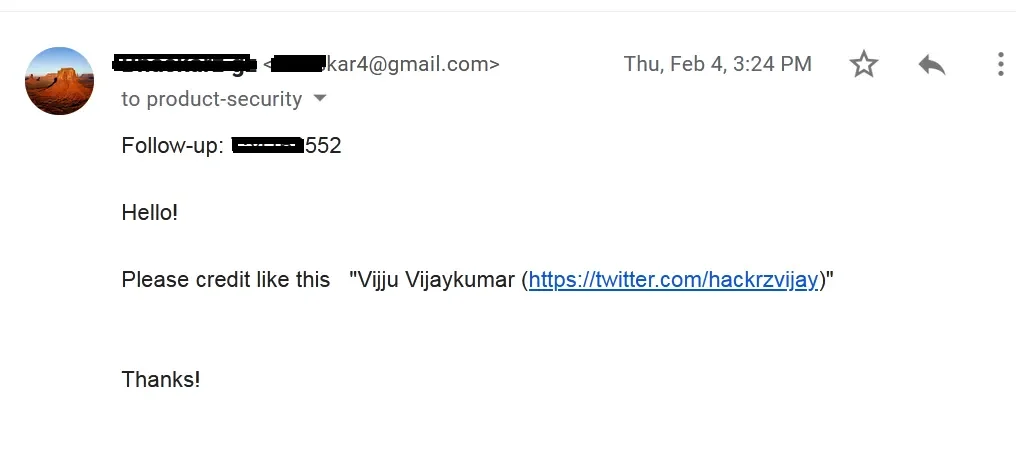
The image shows the attacker address [redacted] replying to the victim report identifier XXXXXX552 in order to credit the information.
Step 2: the system confirms the update to the attacker
One day later, the reply came back to the attacker's address, [redacted], stating that the credit had been updated in the records. The important detail is the recipient: the confirmation went to the attacker's email, not to the victim's email.
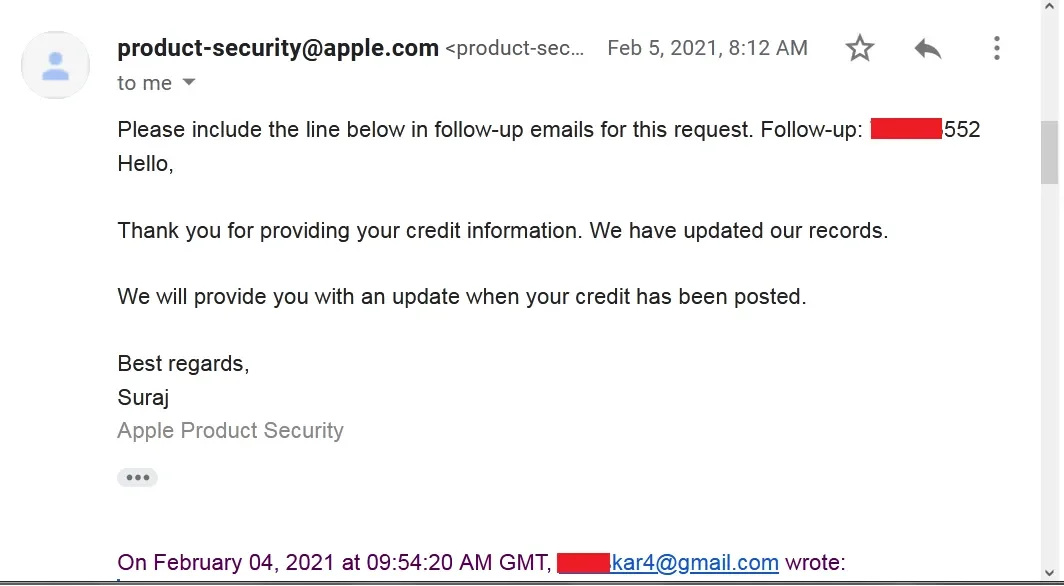
The image shows the reply to the attacker's address confirming that the credit was updated in the records and that the reply was sent to the attacker rather than the victim.
Step 3: retrieving information about a victim report
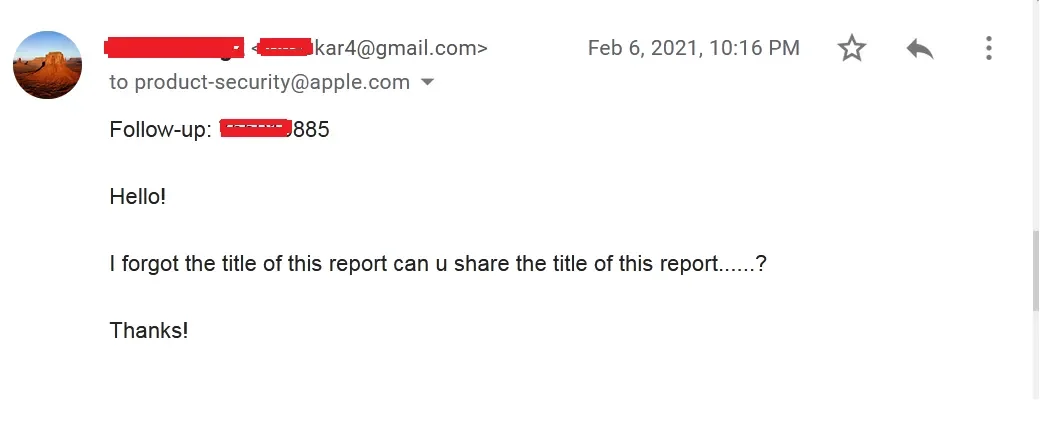
Next, the researcher tried to retrieve information from another report, XXXXXX885, again from the attacker address [redacted]. The request was for the title of the report.
Step 4: the title is disclosed to the attacker
After three days, the reply containing the title of the report arrived at the attacker's address, [redacted].
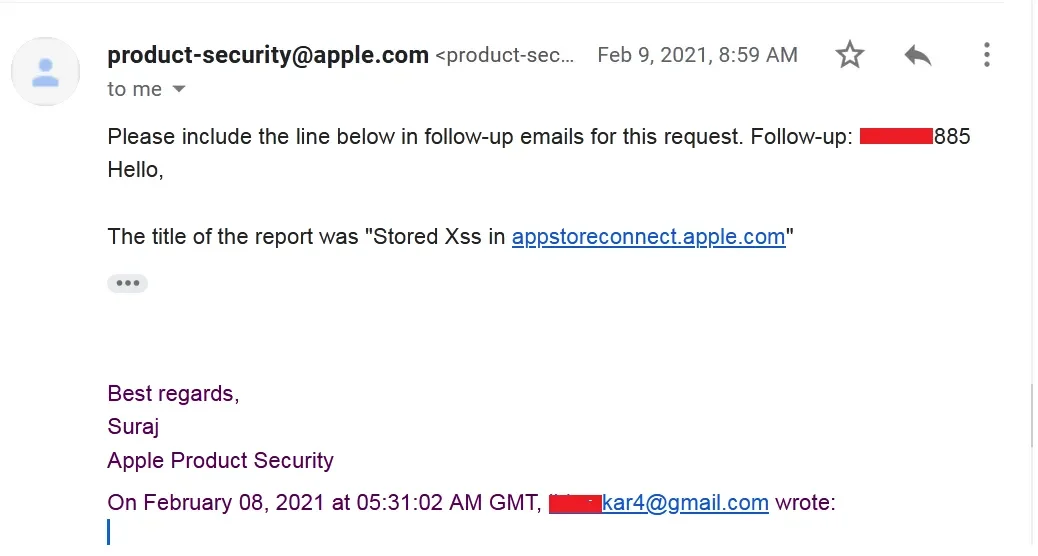
At this point both primitives are demonstrated: writing to a report the sender does not own, and reading metadata from a report the sender does not own.
Timeline of the disclosure
- On 6 February 2021 the researcher reported the bug to the Apple security team.
- The next day Apple responded that they were investigating the issue.
- On 14 May 2021, after a delay of about three months, Apple replied that they were planning to address the issue in a future security update.
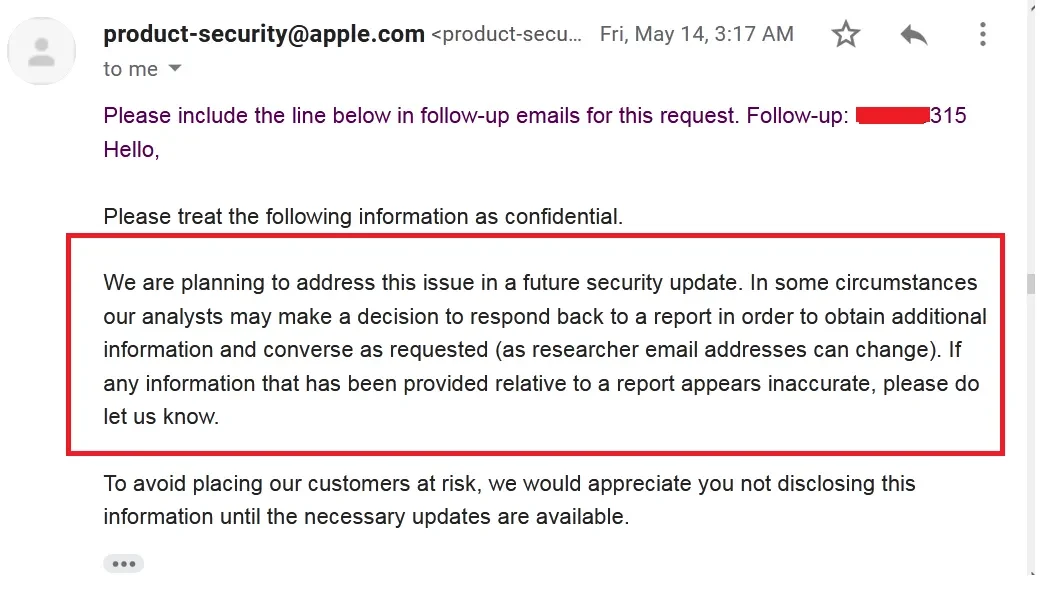
- On 18 June 2021 Apple security replied that they would address the issue with a long term solution.
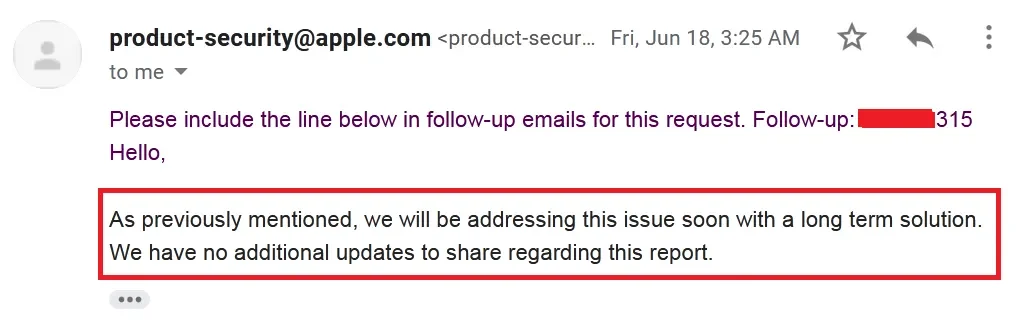
- The researcher asked for updates over the following months.
- On 17 September 2021 Apple security said they were unable to locate the report with
XXXXXX315, and asked for the email address and for verification of the report identifier that had been submitted.
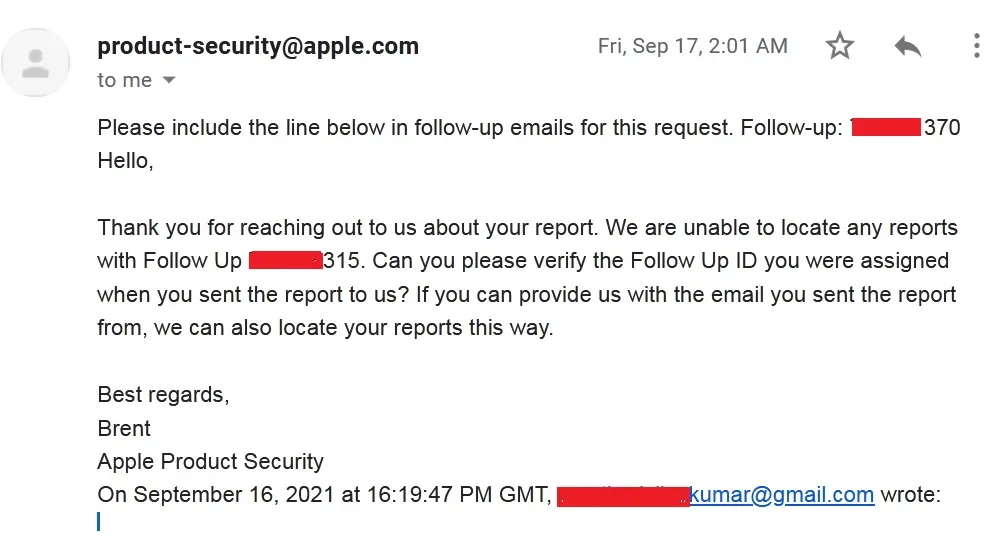
- On 12 October 2021 Apple replied to the original report,
XXXXXX315, saying that it was not treated as a security issue.
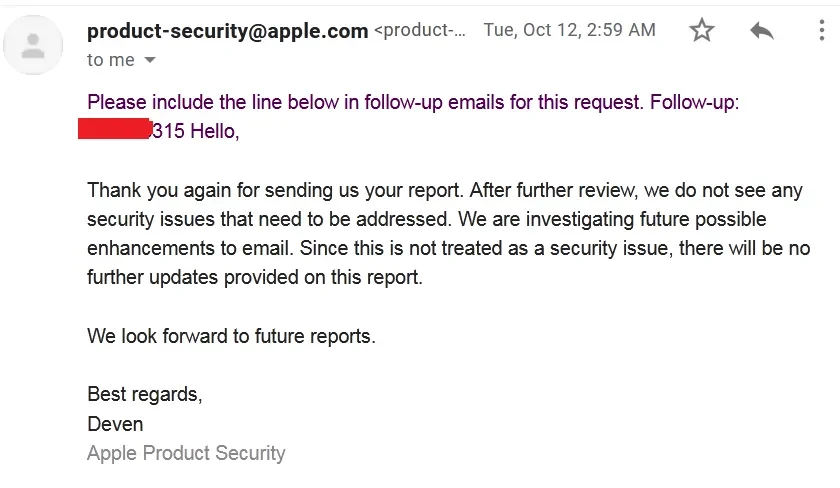
- Also on 12 October 2021 the researcher produced a write-up and sent it to Apple for approval for a blog post.
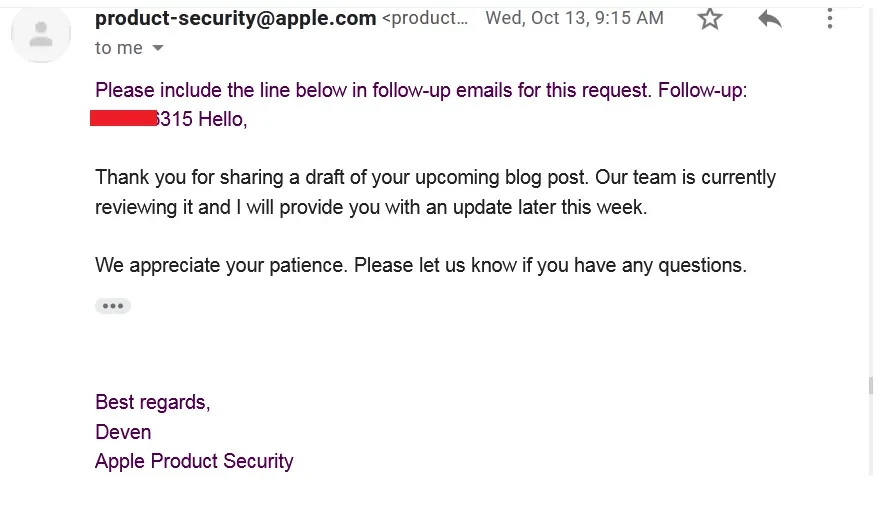
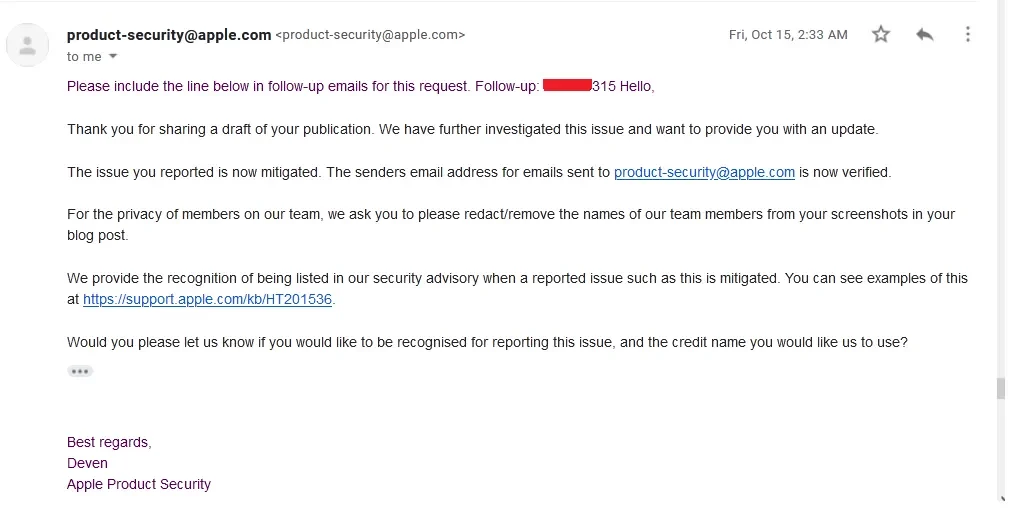
- On 15 October 2021 Apple replied about the bug fix and asked for hall of fame credit.
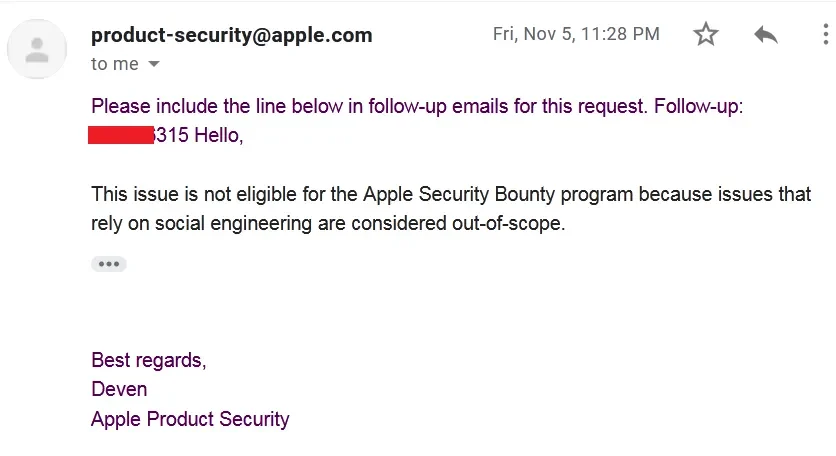
- The researcher asked about a bounty, and on 5 November 2021 Apple replied that the bug was not eligible under the Apple security bounty because it relies on social engineering.
Root cause
The researcher's tests showed that a reply from another email address quoting a report identifier was accepted and answered to that address. In the tests, the replies went to the attacker's email address rather than the victim's.
The researcher's impact statement notes that the reports are in number format, so an attacker can reply to them and also obtain information from them.
Impact
An attacker who knows or guesses a report identifier can add comments to that report, including credit requests, and can retrieve information from it such as the report title. The researcher tested only on their own reports, so the impact on other reporters is not demonstrated. The researcher tested only on their own reports with two test email addresses, so the write-up does not demonstrate the attack against a third party's report. Apple's own position, stated on 5 November 2021, was that the bug is not eligible for a bounty because it relies on social engineering.
Fix
Apple told the researcher on 14 May 2021 that the issue would be addressed in a future security update, and on 18 June 2021 that it would be addressed with a long term solution. The report does not describe the change that was made. A fix would need to bind each follow-up to the address on file for the report, or otherwise require a secret that is not the guessable identifier, before accepting a comment or returning report data.
Variants to test
- Identifier enumeration on other vendors' report portals. Submit follow-ups from an unrelated address with sequential or nearby identifiers. A positive result is a confirmation or report detail returned to the unrelated address.
- Write without read. Try adding a comment or credit request to an identifier you do not own. A positive result is a confirmation that the record was updated.
- Read without write. Request metadata such as the title for an identifier you do not own. A positive result is the title or other metadata arriving at your address.
- Recipient confusion. Check whether confirmations for a report go to the address that wrote in rather than the address on file. A positive result is a reply to your address for a report you do not own.
- Format assumptions. Where identifiers are short and numeric, test whether the system accepts them without any additional proof of ownership, and whether the response differs between a valid and an invalid identifier.
What happened, in plain words
Apple runs a system for receiving security reports from researchers. When you send Apple a security report, the system gives it a nine digit number, something like 123654987. That number is how you follow up later: you reply to the report, add extra information, or ask how it is going. The researcher found that the nine digit report number could be used to update reports and to obtain information from them.
That is the problem. If the number alone decides which report a message is attached to, then anyone who knows the number can write into that report. The researcher tested this against their own reports, using two test email addresses, and found that they could add comments to a report and read information out of it from an address that did not own it.
Before going further, a few words on the pieces involved, since this is a beginner's walkthrough:
- A security report is a message in which a researcher tells a company about a weakness they found in the company's products. Companies like Apple run a bug bounty or vulnerability disclosure programme to receive these reports.
- A report identifier (or report ID) is the number the company assigns to each report so it can be tracked. Think of it like a ticket number at a repair shop: you quote the number and the staff can find your item.
- An email address is the sender's identity here. Normally a system should check that the person writing in is the person who owns the report.
- Authentication means proving who you are. Authorisation means being allowed to do something. A good system checks both before letting you touch a record.
This article walks through what the researcher did, step by step, and what Apple said at each stage.
Setting up the test
The researcher needed two email addresses:
- One acting as the victim, the legitimate owner of a report.
- One acting as the attacker, an unrelated address trying to touch that report.
The attacker address used in the write-up is [redacted]. The victim address is not shown. Two of the researcher's own reports were used as the victim reports, referred to as XXXXXX552 and XXXXXX885. The original report about the flaw itself is referred to as XXXXXX315. The identifiers are redacted in the published text, but the format is the nine digit number described above.
No special tools are needed. Everything happens over ordinary email: you reply to the report address and put a chosen report number in the message.
How the researcher found it
The researcher tested whether a reply sent from another email address, quoting a report number, would be accepted as a follow-up to that report. The researcher then checked this against their own reports rather than against a third party's.
In plain terms: the system was treating the report number as both a label (which report is this?) and a password (are you allowed to touch it?). A label is not a password. If the only thing you need to know is a number that appears on correspondence, then anyone who has seen that number can act as the owner.
Trying it out
Step 1: adding a comment to a victim report
From the attacker email address, the researcher replied to the victim report XXXXXX552, asking to credit the information in the report. The message was accepted as a follow-up to that report.
The image shows the attacker address [redacted] replying to the victim report identifier XXXXXX552 in order to credit the information.
Why this step? The goal was to see whether the system would accept a message from an address that did not own the report. If it did, that would be a write action: changing the contents of somebody else's record.
Step 2: the system confirms the update to the attacker
One day later, the reply came back to the attacker's address, [redacted], stating that the credit had been updated in the records. The important detail is the recipient: the confirmation went to the attacker's email, not to the victim's email.
The image shows the reply to the attacker's address confirming that the credit was updated in the records and that the reply was sent to the attacker rather than the victim.
Why this matters: the confirmation going to the wrong address is a second sign of the same flaw. The system did not just accept the message; it also treated the attacker as the owner when replying.
Step 3: retrieving information about a victim report
Next, the researcher tried to retrieve information from another report, XXXXXX885, again from the attacker address [redacted]. The request was for the title of the report.
Why this step? Step 1 showed a write. This step tests a read: can an unrelated address pull data out of a report it does not own? The title is a small piece of metadata, and it came back to the attacker's address.
Step 4: the title is disclosed to the attacker
After three days, the reply containing the title of the report arrived at the attacker's address, [redacted].
At this point both behaviours are demonstrated: writing to a report the sender does not own, and reading metadata from a report the sender does not own.
What Apple said, and when
- On 6 February 2021 the researcher reported the bug to the Apple security team.
- The next day Apple responded that they were investigating the issue.
- On 14 May 2021, after a delay of about three months, Apple replied that they were planning to address the issue in a future security update.
- On 18 June 2021 Apple security replied that they would address the issue with a long term solution.
- The researcher asked for updates over the following months.
- On 17 September 2021 Apple security said they were unable to locate the report with
XXXXXX315, and asked for the email address and for verification of the report identifier that had been submitted.
- On 12 October 2021 Apple replied to the original report,
XXXXXX315, saying that it was not treated as a security issue.
- Also on 12 October 2021 the researcher produced a write-up and sent it to Apple for approval for a blog post.
- On 15 October 2021 Apple replied about the bug fix and asked for hall of fame credit.
- The researcher asked about a bounty, and on 5 November 2021 Apple replied that the bug was not eligible under the Apple security bounty because it relies on social engineering.
A quick note on terms used above: a hall of fame is a public list of researchers a company thanks for their reports. A bounty is a cash reward. Social engineering means tricking a person rather than breaking a technical control; Apple's position was that the bug depended on that kind of trickery.
Why it worked
The researcher's tests showed that a reply from another email address quoting a report identifier was accepted and answered to that address. The confirmation is then sent to whichever address wrote in, which is how the attacker learns that the write succeeded and receives the data that was read back.
The researcher's impact statement notes that the reports are in number format, so an attacker can reply to them and also obtain information from them.
In everyday terms: imagine a hotel where the room number is the only thing the front desk asks before handing over a key. Anyone who overhears a room number can walk up and ask for the key. The fix is to ask for something only the guest knows, such as a booking reference tied to their name.
Who is affected
An attacker who knows or guesses a report identifier can add comments to that report, including credit requests, and can retrieve information from it such as the report title. The researcher tested only on their own reports, so the impact on other reporters is not demonstrated. The researcher tested only on their own reports with two test email addresses, so the write-up does not demonstrate the attack against a third party's report. Apple's own position, stated on 5 November 2021, was that the bug is not eligible for a bounty because it relies on social engineering.
What a fix looks like
Apple told the researcher on 14 May 2021 that the issue would be addressed in a future security update, and on 18 June 2021 that it would be addressed with a long term solution. The report does not describe the change that was made. A fix would need to bind each follow-up to the address on file for the report, or otherwise require a secret that is not the guessable identifier, before accepting a comment or returning report data.
Similar things to test elsewhere
If you are learning, these are the kinds of checks a beginner can try, always on your own accounts or with permission:
- Identifier enumeration on other vendors' report portals. Submit follow-ups from an unrelated address with sequential or nearby identifiers. A positive result is a confirmation or report detail returned to the unrelated address.
- Write without read. Try adding a comment or credit request to an identifier you do not own. A positive result is a confirmation that the record was updated.
- Read without write. Request metadata such as the title for an identifier you do not own. A positive result is the title or other metadata arriving at your address.
- Recipient confusion. Check whether confirmations for a report go to the address that wrote in rather than the address on file. A positive result is a reply to your address for a report you do not own.
- Format assumptions. Where identifiers are short and numeric, test whether the system accepts them without any additional proof of ownership, and whether the response differs between a valid and an invalid identifier.
Glossary
- Authentication: proving who you are, for example by logging in or by sending from a known email address.
- Authorisation: being allowed to do a particular action, such as editing a specific record.
- Bounty: a cash reward a company pays for a valid security report.
- Bug bounty programme: a scheme where a company invites researchers to report weaknesses and rewards them.
- Email address: the sender identity used in this report; the system should check it against the owner on file.
- Hall of fame: a public list of researchers a company thanks for their reports.
- Identifier (report ID): the nine digit number assigned to each security report so it can be tracked.
- Logic flaw: a weakness in how a system's rules are applied, rather than in its code or cryptography.
- Metadata: data about a record, such as its title, rather than its full contents.
- Read action: retrieving information from a record.
- Report identifier: see identifier.
- Security report: a message telling a company about a weakness in its products.
- Selector: the value used to pick which record a message refers to.
- Social engineering: tricking a person into doing something, rather than breaking a technical control.
- Write action: changing or adding to a record.




