Exploitable Format String Vulnerability in curl_mfprintf Function
The curl_mfprintf function in curl_printf.h passes user-controlled input directly as a format string, allowing an attacker to inject format specifiers. This can lead to memory disclosure, application crashes, or further exploitation depending on context.

- Disclosed after 38 hours
Summary:
The curl_mfprintf function in the curl_printf.h file contains a format string vulnerability that allows an attacker to inject arbitrary format specifiers. This can lead to unauthorized access to memory content, potential application crashes, or leakage of sensitive data.
Steps To Reproduce:
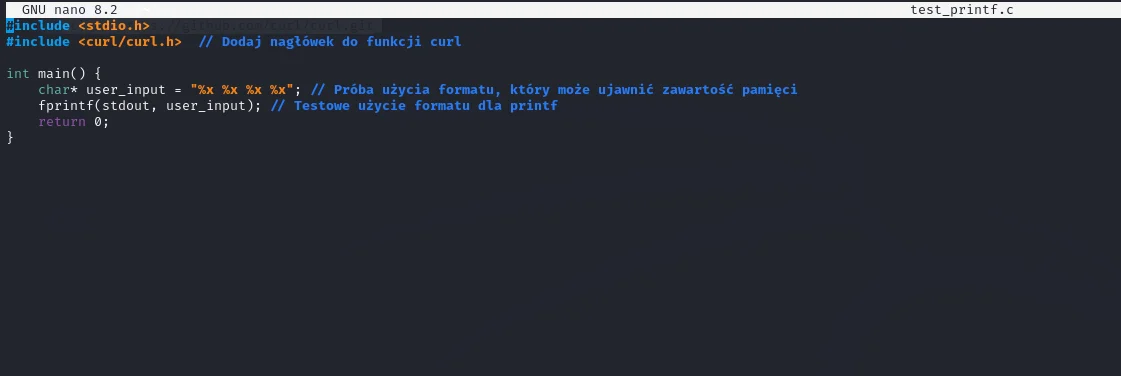
Prepare the Test Code: Create a new file named test_printf.c with the following content:
#include <stdio.h> #include "curl_printf.h"
int main() { char* user_input = "%x %x %x %x"; // Attempt to read memory content curl_mfprintf(stdout, user_input); // Passing user-controlled input to the vulnerable function return 0; }
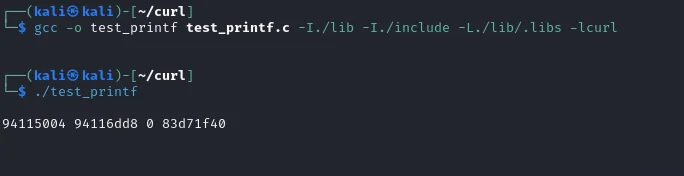
Compile the Code: Compile the test program with the following command:
bash
gcc -o test_printf test_printf.c -I./lib -I./include -L./lib/.libs -lcurl
Execute the Code: Run the compiled program:
bash
./test_printf

Observe the Output: The output should display memory content, which confirms that the vulnerability is exploitable.
Impact
This vulnerability allows an attacker to use format string specifiers to access arbitrary memory locations. By exploiting this issue, an attacker could potentially:
Leak sensitive information from the process memory.
Cause a denial-of-service by crashing the application.
Further exploit the application depending on the context of the memory exposure.
Attachments
Not written yet. The AI write-up for this report has not been written yet. The Original tab links to the source.
How it worked
Root cause
Likely, the function curl_mfprintf passes its format argument directly to a printf-style function without validating that it contains no format specifiers, so user input is treated as a format string.
Impact
An attacker could leak sensitive information from process memory, cause a denial-of-service by crashing the application, or further exploit the application depending on the context of the memory exposure.
What the attacker needed
Attacker controls input passed to curl_mfprintf
How it was found
- Create a test C file that includes curl_printf.h and calls curl_mfprintf with user-controlled input containing format specifiers.
- Compile the test program with gcc, linking against libcurl.
- Run the compiled program.
- Observe that the output displays memory content, confirming exploitability.
Explained by bugbounty.wiki with AI from the original and checked against quotes from it; it can still be wrong. Read the original before relying on a detail.
Not written yet. The AI write-up for this report has not been written yet. The Original tab links to the source.
A format string is a template that tells a program how to print text, like '%s' for a string or '%x' for a number in hexadecimal. If a program lets a user supply that template, the user can ask the program to print things it should not, such as values from memory. Here, a function in the curl library does exactly that, so a malicious input could reveal secrets or crash the program.
What is Memory corruption?
Native code reads or writes memory it should not: overflows, use-after-free, type confusion. The core of browser, kernel and parser bugs.

