Attacker shall recieve order updates on whatsapp for users who have activated whatsapp notification
A validation flaw and caching overwrite in the WhatsApp subscription flow allowed an attacker to receive limited order status updates for orders that had WhatsApp notifications enabled. The attacker could not view other user details or alter orders.

- Triaged in 4 days
- Fixed in 5 days
- Paid in 4 days
- Disclosed after 9 days
Summary by the program
Researcher was able to determine a scenario where it was possible for an attacker to view limited order status updates for orders that meet certain prerequisites.
Prerequisites for this scenario were following:
- WhatsApp status order updates should have been enabled first for the order from the primary number of the user.
- Order should not have been in the terminal state (not completed/cancelled).
Limited Status updates were shown till the order was moved to a terminal state (cancelled/completed). Moreover, past events that were already published were not pushed again.
Apart from the order status updates (picked up, on the way, delivered),
- It was not possible to view/extract any other information including user details
- It was not possible to alter/update/cancel order
Root cause of this was due to missing early exit of the validation layer and caching overwrite on the flow that handled subscription request.
Thanks to @schutzx0r for responsibly disclosing this issue to us.
The report
H
Summary:
- Order ID are IDOR ( Insecure Direct Object Reference )
- When users activated whats app notification an attacker would start receiving the notification without user interaction about their order.
Proof Of Concept:-
When an user order on a restaurant he/she can start whatsapp notification on their order.
██████████
Steps to Reproduce:-
-
When the user activates whats app notification by sending the message with order id. His order notification's vulnerable.
-
Now the attacker sends the message with above vulnerable order id ( Order id is IDOR - eg:15625383 )
-
He will get the error notification, though he will start receiving the updates.
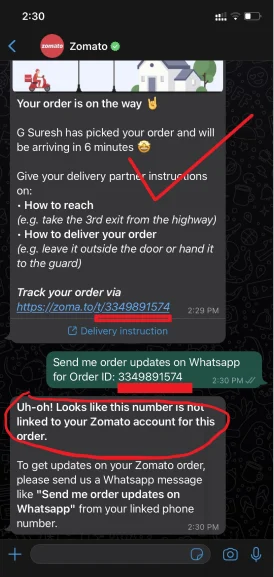
3.1 the updates would be 3.1.1 delivery partner assigned. 3.1.2 when he will reach 3.1.2 once he delivered the order.
Impact
business logic error.
Not written yet. The AI write-up for this report has not been written yet. The Original tab links to the source.
How it worked
Root cause
Likely a missing early exit in the validation layer combined with a caching overwrite in the subscription request handler, allowing an attacker to subscribe to another user's order updates.
Impact
An attacker could receive limited order status updates (delivery partner assigned, arrival, delivery) for orders that had WhatsApp notifications enabled and were not in a terminal state; no other user details could be viewed and orders could not be altered.
What the attacker needed
WhatsApp notifications enabled for the order; Order not in terminal state (not completed/cancelled); Attacker knows the order ID
How it was found
- The user enables WhatsApp notifications for their order by sending a message with the order ID.
- The attacker sends a message with the vulnerable order ID (which is an IDOR).
- The attacker receives an error notification but starts receiving order updates.
Explained by bugbounty.wiki with AI from the original and checked against quotes from it; it can still be wrong. Read the original before relying on a detail.
Not written yet. The AI write-up for this report has not been written yet. The Original tab links to the source.
When you order food, you can opt to get updates on WhatsApp. The system that signs you up for those updates had a mistake in its validation and caching, so someone else could start getting your order updates.
What is IDOR?
One user can read or change another user's data, usually by changing an identifier the server trusts without checking who is asking. One of the most paid bug classes on web programs.


