CVE-2017-13253: Buffer overflow in multiple Android DRM services
A buffer overflow in Android's DRM services allowed an unprivileged app to overwrite memory in a privileged process by supplying a destination buffer that fits within the shared heap but is smaller than the data to be copied. This could lead to code execution in the vulnerable service and potentially escalate to root on some devices.
 Published on blog.zimperium.com
{{media:0}}As part of our platform research in Zimperium zLabs, we recently disclosed a buffer overflow vulnerability affecting multiple Android DRM services to Google. Google classified it as high-severity, designated it as CVE-2017-13253 and have patched it in the March security update.
The full write-up lives on its author's site
It belongs to its author, so we link to it rather than copy it. The other two tabs are our own rewrites, checked against it.
Context
Android's security model leans heavily on inter-process communication. Untrusted code in an unprivileged app talks to privileged services over Binder and asks them to perform narrowly defined actions. The model only holds if each service validates every input it receives, so bugs in that validation are a direct route to privilege escalation. In Android the IPC mechanism is Binder, and its C++ library, libbinder, lets code call methods on remote C++ objects almost as if they lived in the same process.
Each object exposed over Binder is built from a small set of classes:
- an interface class, prefixed with
I, defining the callable methods; - a client-side class, prefixed with
Bp, which serialises input and deserialises output; - a server-side class, prefixed with
Bn, which deserialises input and serialises output.
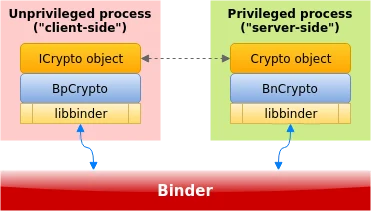
The Bn side traditionally lives in the privileged service, so it is where input validation starts and continues into the methods it calls. That is the interesting surface for research.
The specific target here is the mediadrmserver service, which provides an interface to a Crypto object, named ICrypto. Its purpose is to let unprivileged apps decrypt DRM data that needs higher privileges, such as access to the TEE. The encryption itself is out of scope; the input validation is what matters. ICrypto has several methods, but the central one is decrypt.

The signature is complex, and complex input means complex validation: every parameter crosses Binder and has to be verified. Two of the parameters are the source and destination buffers, whose types look like this:
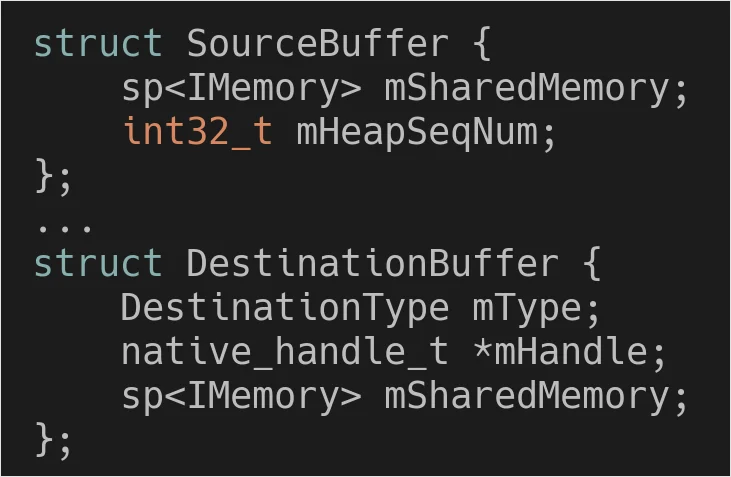
The relevant members are mHeapSeqNum and both mSharedMemory members. The rest of DestinationBuffer covers the case where the destination is not shared memory, which is not relevant here. The heap is the actual shared memory you mmap. mHeapSeqNum identifies a heap previously shared through another ICrypto method, setHeap. Both mSharedMemory members only carry an offset and a size inside that heap. So although mHeapSeqNum sits inside the source struct, it is relevant to both buffers.
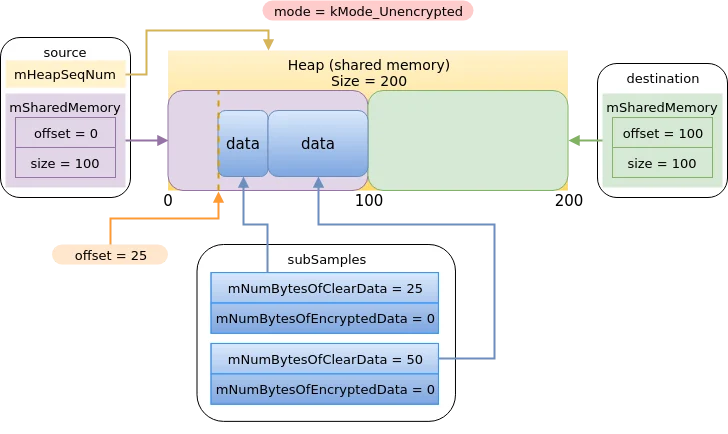
Some of this structure is odd. mSharedMemory is an IMemory, connected to its own heap and meant to represent a buffer inside it, yet that heap is ignored and the offset and size are applied to the mHeapSeqNum heap. And mHeapSeqNum lives in the source struct while relating to both source and destination. These oddities come from Project Treble.
Project Treble and the Crypto Plugin path
Project Treble arrived with Android 8.0 to make system updates easier by separating AOSP from the vendor, and Google also claims it benefits security through added isolation. For a service like mediadrmserver, Treble means splitting into multiple processes. Decryption code belongs to the vendor, so it moves into vendor processes called HAL, one per DRM scheme. mediadrmserver now just moves data between the app and the relevant HAL. That communication is still Binder, but in a different domain and using libhwbinder. The rename from Crypto to CryptoHal reflects that the class now only converts data to libhwbinder's format and passes it to the HAL.
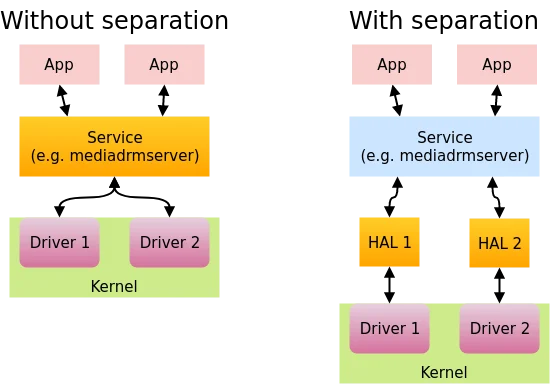
The figure shows the claimed security benefit: permissions are split across processes, each HAL can only talk to its own driver, and untrusted apps no longer interact directly with the high-privileged process. As of Android 8.1 the separation is still optional and vendor-dependent. On the Nexus 5X, for example, all HALs sit inside the mediadrmserver process; the data is still converted to HAL format but never crosses a process boundary.
Each DRM scheme is handled by a plugin, a Crypto Plugin in this case. Vendors provide them, but AOSP contains useful code, including a full open-source ClearKey plugin. Devices commonly ship the open-source ClearKey plugin plus a closed-source Widevine plugin, as on Nexus and Pixel devices. Because plugins now receive data in HAL format, AOSP added a default Crypto Plugin implementation that converts HAL format back to the legacy format and passes it to the original plugin code. It was meant as a temporary bridge until plugins were updated, otherwise you are left with redundant conversions in both directions.
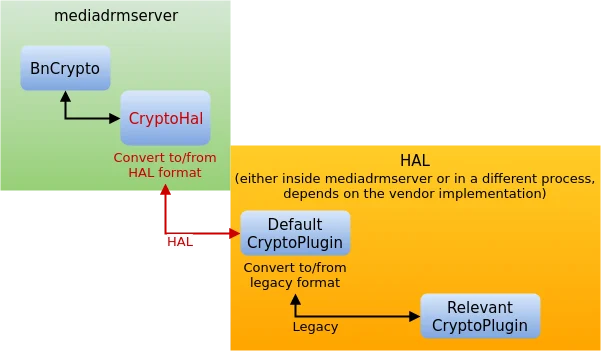
Setup
The code references in the write-up point at Android 8.0 source (8.0.0_r4). No accounts or special roles are involved: the precondition is simply an unprivileged app able to reach the ICrypto interface exposed by mediadrmserver and to share a heap through setHeap. The full proof of concept source is linked from the write-up on GitHub. The affected processes depend on the vendor: without HAL separation, mediadrmserver itself; with separation, every HAL service for a Crypto Plugin that uses the default Crypto Plugin code.
Finding it
The validation of the shared memory buffers is where the bug lives. It starts in BnCrypto, the server side of ICrypto.
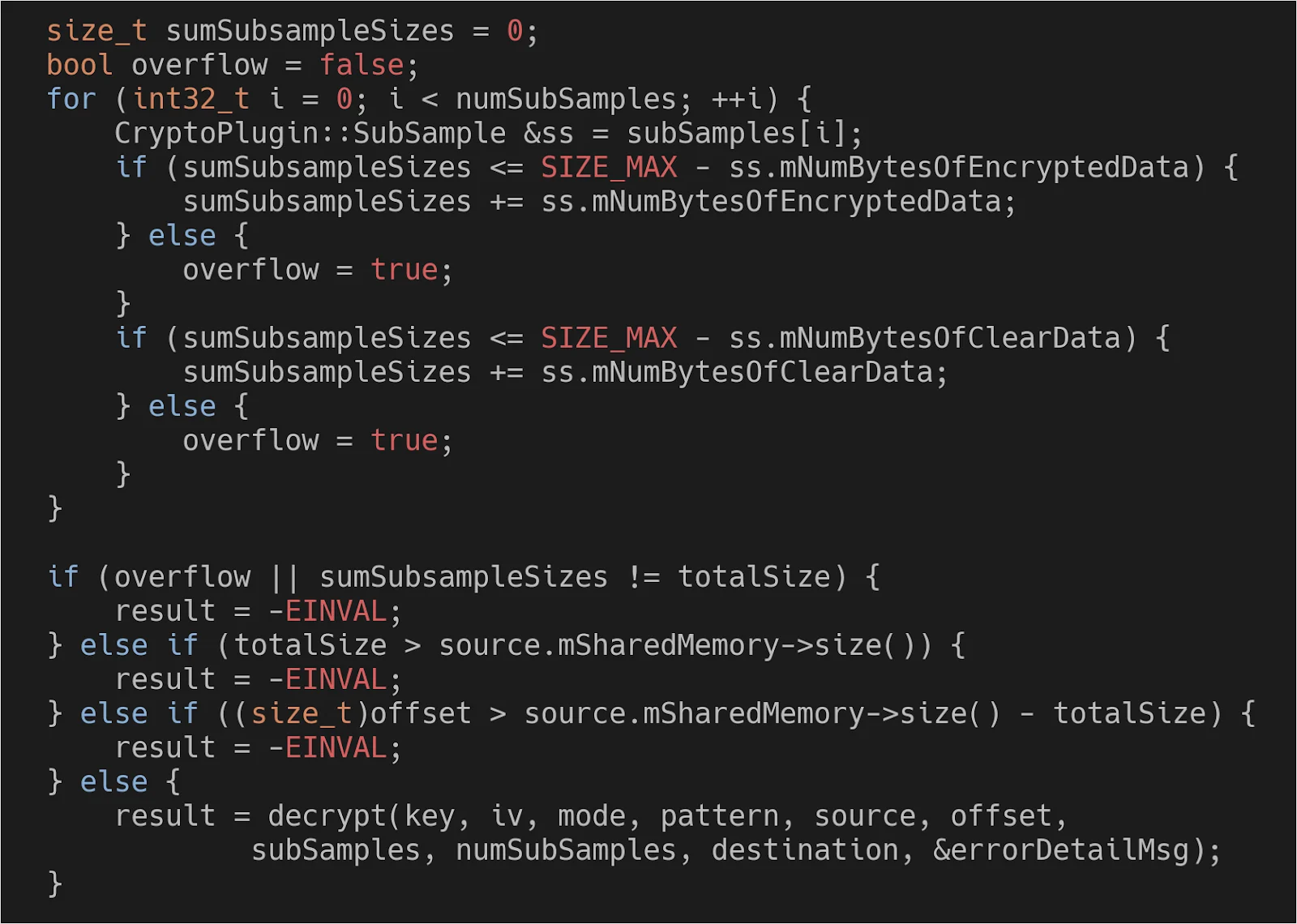
In order, BnCrypto:
- Checks that the sum of the subsample sizes is valid and does not overflow. That sum is the size of the data to be copied.
- Checks that the sum matches
totalSize, another parameter sent over Binder which is largely redundant, since the sum already determines the total. - Checks that the data size does not exceed the size of the source buffer.
- Checks that the data size plus the offset still does not exceed the source buffer.
From there CryptoHal converts to HAL format and sends the data to the plugin, with no interesting validation in between. The default Crypto Plugin implementation, possibly in another process, converts back to legacy format and continues validating.
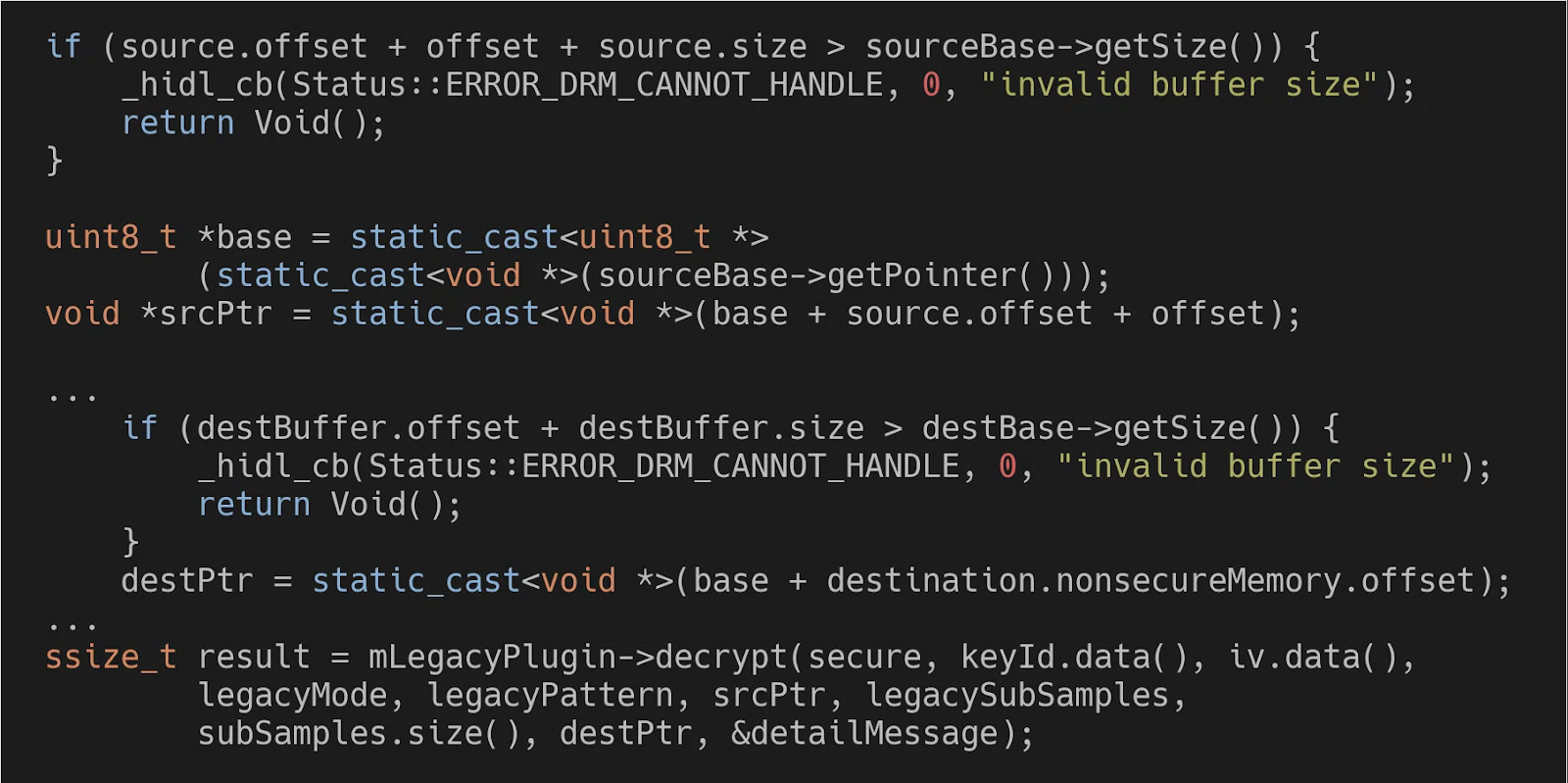
The author notes this code is messy: several dest and source variables, sourceBase and destBase are actually the same thing (the heap), and there are no comments. It is entirely new in Android 8.0, and the messiness likely contributed to the bug, because it makes reviewing the whole validation path harder.
- The first check is that the sum of both offsets and the buffer size does not exceed the heap size.
sourceBaseis the heap;sourceis what wassource.mSharedMemory. The two offsets are the one insidemSharedMemoryand the separate offset parameter ofdecrypt. - The second check does the same for the destination buffer.
destBufferis what wasdestination.mSharedMemory, anddestBaseis the same heap assourceBase. The offset parameter is not involved this time.
After that, each buffer is reduced to a pointer into memory: the offset is folded into the pointer and the buffer size is dropped. The data size is then taken from the subSamples array.
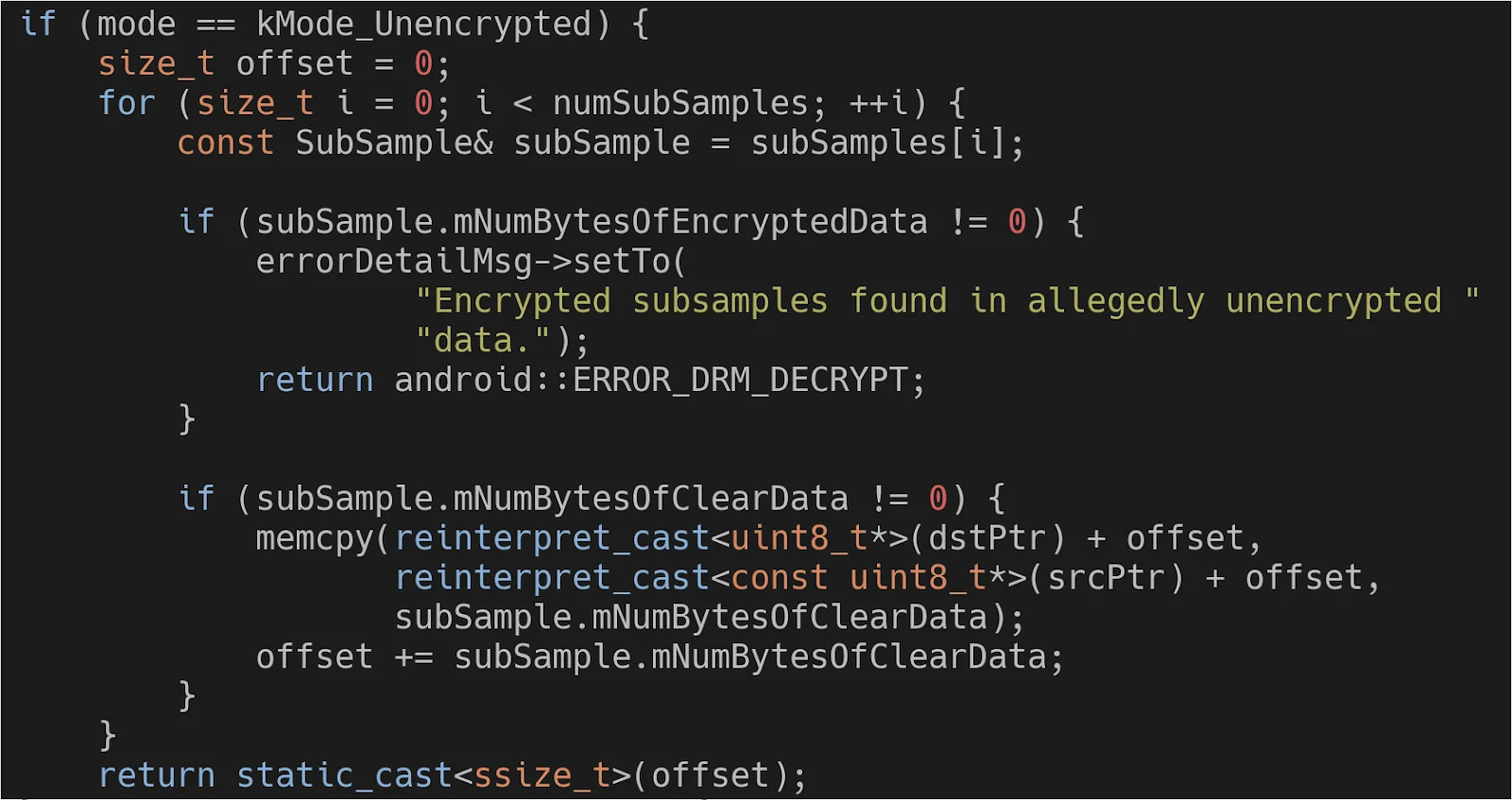
The ClearKey plugin shows the final step: when the data is unencrypted it is simply copied from one place to another.
What is missing is any check that the amount of data copied does not exceed the destination buffer. The source buffer gets such a check (the third BnCrypto check, and the fourth even adds the extra offset). The only destination-related check is the second check of the default Crypto Plugin, which merely confirms the buffer lies inside the heap and does not exceed it. That is not enough.
Exploitation
Step 1: choose sizes that pass every check
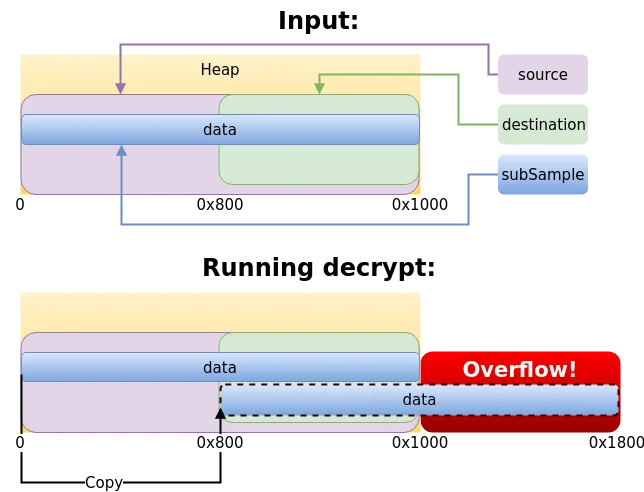
Take a data size of 0x1000. Since the size comes from the subsamples array, that is one entry with 0x1000 clear bytes and 0 encrypted bytes. The heap is also 0x1000 bytes, and the source buffer points at the whole heap (offset 0, size 0x1000). The destination buffer is the interesting part: offset 0x800, size 0x800. That still fits inside the heap, so it passes the default Crypto Plugin check.
Step 2: trigger the copy
The copy writes 0x1000 bytes into a destination that starts at offset 0x800 of a 0x1000-byte heap. The result is an overflow: 0x800 bytes are written after the heap.
Step 3: the proof of concept
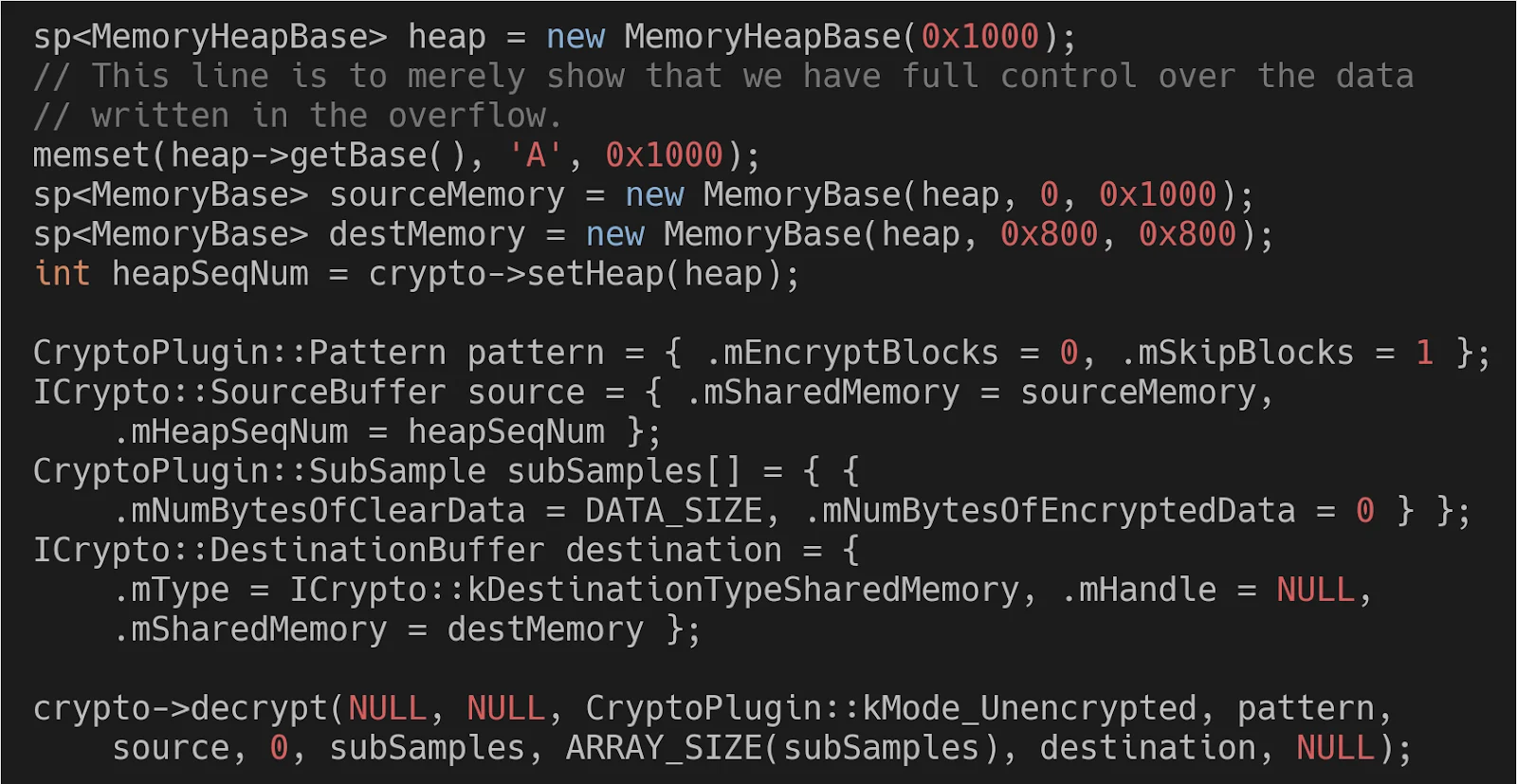
The PoC code implements exactly the example above and triggers the vulnerability. A note on the mechanics: MemoryBase objects are the implementation of the IMemory libbinder interface, so this uses Binder's ability to pass references to other Binder objects. It is also a case where the roles are reversed: the privileged process is the client side, asking for information over Binder and responsible for validating it.
Root cause
The mistake is the absence of a check that the copied data size fits the destination buffer. The source is validated twice, once for size and once for size plus offset. The destination is validated only for containment inside the heap, which says nothing about how much will be written there. Because the default Crypto Plugin reduces the destination to a bare pointer and derives the size only from the subsamples, vendor code downstream has no way to tell it received malformed data. No matter how well written the vendor part is, it stays vulnerable.
The overflow is at the memory page level, so there is no mitigation comparable to a stack canary. It is constrained: the write must begin inside the shared memory, because of the default Crypto Plugin check, so only memory directly after the shared memory can be overwritten. Many areas of memory are unallocated or unwritable, and writing there causes a segmentation fault.
The changes introduced by Project Treble created the bug; before them, the destination buffer could not be set in this format at all. The author is careful not to blame refactoring as such. The point is that messy or redundant code raises the chance of vulnerabilities because it makes review harder; some parts took a long time to understand relative to what they actually do.
Impact
An attacker can overwrite memory in the target process with arbitrary data, subject to the placement constraint above. The affected process depends on the vendor implementation: mediadrmserver if HALs are not separated, otherwise every HAL service for a Crypto Plugin using the default Crypto Plugin code.
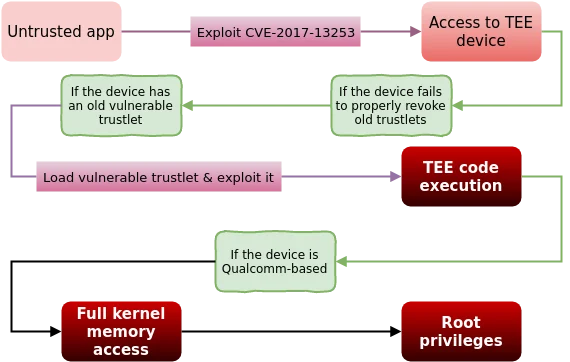
What follows is explicitly speculative: no exploit was written. If an attacker elevates to the privileges of the vulnerable service, SELinux still limits them heavily, but one permission remains very interesting: full access to the TEE device. Gal Beniamini's research shows many devices fail to revoke old vulnerable TEE trustlets, so an attacker on a device with such a trustlet could use that access to load the trustlet and exploit it into code execution on the TEE. Beniamini also demonstrated how, on Qualcomm-based devices, TEE code execution could lead to root privileges.
Google classified the issue as high severity, assigned CVE-2017-13253, and patched it in the March 2018 security update.
Fix
Google distributed patches on 5 March 2018, published in the March security bulletin. The write-up does not describe the patch contents. The author argues that messy or redundant code raises the chance of vulnerabilities because it makes review harder, and that some parts should be improved.
Variants to test
- A positive result is a destination offset plus data size that exceeds the heap while each individual check passes.
- A positive result is a copy whose length comes from one field while the bound was checked against the other.
- A positive result is a conversion after which the length is taken from an attacker-controlled array rather than from the buffer descriptor.
- A positive result is a crash or memory corruption in mediadrmserver reachable from an unprivileged app.
Timeline
- 20.12.2017: vulnerability discovered
- 28.12.2017: details and PoC sent to Google
- 29.12.2017: initial response from Google
- 05.03.2018: Google distributed patches
What happened, in plain words
A security researcher found a bug in Android that could let an ordinary app overwrite memory in a privileged DRM service. The bug was in the software that handles DRM (Digital Rights Management), the technology that protects movies and music from being copied. Google rated the bug as high severity, gave it the identifier CVE-2017-13253, and fixed it in the March 2018 security update. This article explains, from scratch, what the bug was, how it was found, and why it mattered.

Background: how Android apps talk to privileged services
Android is built so that most apps run with very few permissions. They cannot directly access the hardware, the file system, or other sensitive resources. Instead, when an app needs something done, it asks a privileged service (a program running with higher permissions) to do it on its behalf. This back-and-forth is called inter-process communication (IPC): a way for two programs to exchange messages.
Think of it like a restaurant. You (the app) cannot go into the kitchen (the privileged service). You give your order to a waiter (the IPC mechanism), and the kitchen prepares it. The kitchen must check that your order makes sense: if you ask for a dish that doesn't exist, or for 10,000 portions, the kitchen should refuse. If the kitchen blindly trusts every order, chaos follows. In Android, the waiter is a system called Binder.
Binder is Android's IPC mechanism. It lets an app send a request to a service and get a response. The service must validate every input it receives, because the app could be malicious. A bug in that validation is a direct route for an attacker to make the service do something it shouldn't, potentially escalating their privileges.
Binder's C++ library
Android provides a C++ library called libbinder that makes it easier to write code that uses Binder. With libbinder, you can call methods on an object in another process almost as if it were in your own process. Each object that can be accessed over Binder is implemented using a few classes:
- An interface class, whose name starts with
I, defines the methods that can be called remotely. - A client-side class, whose name starts with
Bp, is responsible for packaging the input into a message and unpacking the output. - A server-side class, whose name starts with
Bn, is responsible for unpacking the input and packaging the output.
The image shows an example of how libbinder is used with the ICrypto interface. The Bn side (server side) usually lives inside the privileged service, so that is where input validation begins. That makes it the most interesting part for security research.
The target: mediadrmserver and the ICrypto interface
The specific service involved here is mediadrmserver, which handles DRM media. It exposes an interface called ICrypto to a Crypto object. The purpose of this interface is to allow unprivileged apps to decrypt DRM-protected data that requires higher privileges, such as access to the TEE (Trusted Execution Environment, a secure area inside the phone's processor). The details of the encryption itself are not important for this bug; what matters is how the inputs are validated.
ICrypto has several methods, but the most important one is decrypt.
The image shows the signature of the decrypt method. A signature is the part of a function that lists its name and the types of its parameters. The signature here is complex, with many parameters. Complex input means complex validation: every parameter is sent over Binder and must be checked. That is where bugs can hide.
Let's look at the types of the source and destination parameters:
The image shows the C++ structs for the source and destination buffers. A struct is a way to group several variables together under one name. The relevant members here are mHeapSeqNum and both mSharedMemory members. The rest of DestinationBuffer deals with the case where the destination is not shared memory, which is not relevant to this vulnerability.
To understand these, we need to explain shared memory. Normally, two processes cannot directly read or write each other's memory. Shared memory is a technique where the operating system sets aside a region of memory that both processes can access. It is like a whiteboard in a meeting room that two people can both write on. In Android, shared memory is often created with a system call called mmap. The term heap here refers to that shared memory region.
mHeapSeqNum is an identifier for a shared memory region that was previously shared using another method of ICrypto called setHeap. Both mSharedMemory members only contain an offset and a size within that heap. So even though mHeapSeqNum is inside the source struct, it actually applies to both source and destination.
The image shows an example of parameters for a call to decrypt with clear (unencrypted) data. Some parts of this structure are odd. mSharedMemory is an IMemory object, which is connected to its own heap and is supposed to represent a buffer inside that heap. Yet that heap is ignored; instead, the offset and size are applied to the heap identified by mHeapSeqNum. Also, mHeapSeqNum is in the source struct but relates to both source and destination. These oddities are a result of recent changes to the code made as part of Project Treble.
Project Treble
Project Treble was introduced in Android 8.0. Its main goal is to make system updates easier by separating the Android Open Source Project (AOSP) code from the vendor-specific code. Google also claims that Project Treble improves security by adding more isolation between components.
For a service like mediadrmserver, Project Treble means splitting it into multiple processes. The code that actually performs decryption belongs to the vendor, so it is moved into separate vendor processes called HAL (Hardware Abstraction Layer), one for each DRM scheme. mediadrmserver's role is now reduced to passing data between the app and the appropriate HAL process. The communication between mediadrmserver and the HALs also uses Binder, but in a different domain and using a different library called libhwbinder. The change from Crypto to CryptoHal reflects that the class now only converts data into libhwbinder's format and passes it to the HAL.
The image shows the separation introduced by Project Treble. Permissions are split across processes: each HAL can only communicate with its own driver, and untrusted apps no longer interact directly with the high-privileged process. That is the claimed security benefit.
Note that as of Android 8.1, this separation is still optional and depends on the vendor. On the Nexus 5X, for example, all HALs are inside the mediadrmserver process. The data is still converted to HAL format but does not cross a process boundary.
Crypto Plugins
Each DRM scheme is handled by a plugin, called a Crypto Plugin in this context. Vendors provide these plugins, but AOSP contains useful code, including a full open-source implementation of a plugin for the ClearKey DRM scheme. Devices commonly have the open-source ClearKey plugin and a closed-source Widevine plugin, as is the case on Nexus and Pixel devices.
The issue with the Project Treble changes is that plugins now receive data in the HAL format. To make the transition easy without updating every plugin, AOSP added a default Crypto Plugin implementation. This implementation converts the data from HAL format back to the legacy format and passes it to the original plugin code. Ideally, this is a temporary solution until plugins are updated; otherwise, there are redundant conversions (to and from HAL).
The image shows the flow of data format conversions.
Finding the vulnerability
Now let's look at the validation code for the shared memory buffers. This is where the vulnerability was found. Validation usually starts in the Bn classes, in this case BnCrypto, the server side of the ICrypto interface.
The image shows part of BnCrypto's validation code. Let's go through the checks it performs:
- It checks that the sum of the subsample sizes is valid and does not overflow. The subsamples array describes how the data is split into chunks; the sum of the sizes is the total amount of data to be copied.
- It checks that this sum matches
totalSize, another parameter passed over Binder. This is largely redundant because the sum already determines the total size. - It checks that the data size does not exceed the size of the source buffer.
- It checks that the data size plus the offset still does not exceed the source buffer.
After these checks, CryptoHal converts the data into HAL format and sends it to the relevant plugin. There is no interesting validation code there.
Next, the default Crypto Plugin implementation (which may or may not be in a different process) converts the data back to the legacy format and continues validating it.
The image shows part of the default Crypto Plugin's validation code. The author notes that this code is messy: there are multiple dest and source variables, sourceBase and destBase are actually the same thing (the heap), and there are no comments. This code is entirely new in Android 8.0, and the messiness likely contributed to the vulnerability because it makes it harder to review the entire validation path.
- The first check is that the sum of both offsets and the buffer size does not exceed the heap size.
sourceBaseis the heap;sourceis what was previouslysource.mSharedMemory. The two offsets are the one insidemSharedMemoryand the separate offset parameter ofdecrypt. - The second check is similar but for the destination buffer.
destBufferis what wasdestination.mSharedMemory, anddestBaseis the same heap assourceBase. This time the offset parameter is not involved.
Eventually, each buffer is simplified into just a pointer to memory: the offset is now part of the pointer, and the buffer size is omitted. To determine the data size, the plugin uses the subSamples array.
The image shows the ClearKey plugin code for when the data is unencrypted. When the data is unencrypted, it is simply copied from one place to another.
By now, you have enough information to potentially spot the vulnerability yourself. If you want to try, go back and read the code again. It can be difficult to give enough information to spot it while keeping it a challenge, so don't worry if you can't see it immediately.
The vulnerability
The problem is that there is no check that the amount of data being copied does not exceed the destination buffer. There is a similar check for the source buffer (the third check in BnCrypto, and the fourth even adds the extra offset). The only check related to the destination buffer is the second check in the default Crypto Plugin, which ensures the buffer lies inside the heap and does not exceed it. But that is not enough.
Let's look at an example. Suppose the size of the data to copy is 0x1000 (in hexadecimal, which is 4096 in decimal). Since this size is represented by the subsamples array, we have one entry with 0x1000 clear bytes and 0 encrypted bytes. The heap is also 0x1000 bytes, and the source buffer points to the entire heap (offset = 0, size = 0x1000). The destination buffer is where it gets interesting. Suppose the offset is 0x800 and the size is 0x800. This still fits inside the heap, so it passes the check of the default Crypto Plugin. In this case, there will be an overflow: 0x800 bytes will be written after the heap.
The image illustrates this overflow: the destination buffer starts at offset 0x800 in a 0x1000-byte heap, but the copy writes 0x1000 bytes, so 0x800 bytes spill past the end of the heap.
Proof of concept
The image shows the code for the example above that triggers the vulnerability. A proof of concept (PoC) is a small program that demonstrates the bug. A link to the full PoC can be found at the end of the blog post.
Note: MemoryBase objects are the implementation of the IMemory libbinder interface. This is an example where Binder's ability to transfer references to other Binder objects is used. It is also an example where the roles are reversed: the privileged process is the client side, so it is asking for information over Binder and is responsible for validating it.
The effect of the vulnerability
This vulnerability allows an attacker to overwrite memory in the target process with arbitrary data. Since this is an overflow at the memory page level, there is currently no mitigation to prevent it (like a stack canary for a stack overflow). A stack canary is a known value placed on the stack that, if changed, indicates a buffer overflow. The overflow is still restricted: the data must begin inside the shared memory because of the check in the default Crypto Plugin. This means only memory directly after the shared memory can be overwritten. Also, many areas of memory are either unallocated or unwritable, so trying to write there will cause a segmentation fault (a crash).
The affected processes depend on the vendor implementation. If the vendor does not separate the HALs into different processes, then mediadrmserver is affected. If the vendor does separate them, then every HAL service for a Crypto Plugin that uses the default Crypto Plugin code is affected. Since the default Crypto Plugin code only leaves a pointer to the destination buffer, and the size is determined only by the subsamples, the vendor code afterwards has no way to tell that it received malformed data. This means that no matter how well written the vendor part is, it will still be vulnerable.
Possible impact
Suppose an attacker manages to exploit this vulnerability to elevate privileges to those of the vulnerable service. Let's look at what they can achieve. Note that this part is mostly speculative: the author has not written an exploit but has some ideas about how this vulnerability could theoretically be used to gain full root privileges.
This is where Android's SELinux rules come into play. SELinux (Security-Enhanced Linux) is a security module that enforces mandatory access controls, limiting what processes can do even if they have root. Even though the vulnerable service has more permissions, SELinux still limits them heavily. However, one permission remains very interesting: full access to the TEE device.
So what can you do with full access to the TEE? Gal Beniamini's research shows that many devices fail to properly revoke old vulnerable TEE trustlets. A trustlet is a small application that runs inside the TEE. This means that if you attack a device that has an old vulnerable trustlet, you could use the access to the TEE device to load the trustlet and exploit it to achieve code execution on the TEE. Furthermore, Gal Beniamini has also demonstrated how, on Qualcomm-based devices, TEE code execution could lead to root privileges.
The image shows a possible attack flow up to root privileges.
The origin of the vulnerability
The author has mentioned multiple times how Project Treble caused major modifications to this area of the code. It probably won't surprise you to learn that these changes actually introduced this vulnerability. Before the changes, the destination buffer could not even be set in this format.
Of course, you cannot solely blame the major refactoring for making the code vulnerable, as that would imply that code refactoring should not happen, which is not true. The thing is that, as already pointed out, multiple parts of this code are messy or redundant. While this in itself does not necessarily make code vulnerable, it does raise the chances because it makes the code harder to review. Some parts of the code took the author quite a long time to understand compared to the complexity of what they actually do. So while vulnerabilities can sometimes be very hard to spot, messy or redundant code is usually easier to notice. The author acknowledges that it is easier to criticise bad code design from the point of view of a reviewer than it is to actually write good code, but still thinks there are parts that should be improved.
Conclusion
Google claims that Project Treble benefits Android security, yet in this example it actually did the opposite. Project Treble is not necessarily bad in itself; the key issue is that the implementation was not handled very well.
Full source code for the PoC that triggers the vulnerability can be found on GitHub, along with some extra information.
Timeline
- 20.12.2017: Vulnerability discovered
- 28.12.2017: Vulnerability details and PoC sent to Google
- 29.12.2017: Initial response from Google
- 05.03.2018: Google distributed patches
The author thanks Google for their quick and professional response, Simone Margaritelli (@evilsocket), Nikias Bassen (@pimskeks), and the rest of the Zimperium zLabs team.
Glossary
- API: Application Programming Interface; a set of rules and definitions that allows one piece of software to communicate with another.
- Binder: Android's inter-process communication (IPC) mechanism, allowing apps and services to exchange messages.
- Buffer: A region of memory used to temporarily hold data.
- Buffer overflow: A bug where more data is written to a buffer than it can hold, causing data to spill into adjacent memory.
- C++: A programming language commonly used for system software.
- CVE: Common Vulnerabilities and Exposures; a unique identifier for a publicly known security vulnerability.
- DRM: Digital Rights Management; technology that controls access to copyrighted digital content.
- HAL: Hardware Abstraction Layer; a vendor-provided software layer that allows Android to communicate with hardware without knowing the hardware details.
- Heap: A region of memory used for dynamic allocation; in this context, it refers to shared memory.
- ICrypto: An interface in Android that provides methods for decrypting DRM data.
- IMemory: An interface in libbinder that represents a memory buffer that can be shared between processes.
- IPC: Inter-process communication; the mechanism by which processes exchange data.
- libbinder: The C++ library that implements Binder.
- libhwbinder: A variant of libbinder used for communication with HALs.
- mediadrmserver: An Android service that handles DRM media.
- mmap: A system call that maps files or devices into memory; used to create shared memory.
- Pointer: A variable that stores a memory address.
- Privilege escalation: Gaining higher permissions than intended.
- Project Treble: An Android initiative to separate vendor code from the Android framework to ease updates.
- Root: The highest level of privilege on a Unix-like system, allowing full control.
- SELinux: Security-Enhanced Linux; a security module that enforces access controls.
- Shared memory: A memory region that multiple processes can access.
- Stack canary: A known value placed on the stack to detect buffer overflows.
- Struct: A composite data type that groups variables.
- Subsample: A chunk of data; in this context, an array describing how data is split.
- TEE: Trusted Execution Environment; a secure area of a processor that runs code in isolation.
- Trustlet: A small application that runs inside the TEE.
- Vulnerability: A weakness in software that can be exploited to cause harm.



