The story of a fuzzing integration reward
The author ported the OpenSSL fuzzers to LibreSSL and integrated the library into OSS-Fuzz, which then found 14+ new vulnerabilities, four of them memory corruption issues. One such bug was an ASN1_INTEGER size problem fixed by adding range checks.
 Published on blog.doyensec.com
In my first month at Doyensec I had the opportunity to bring together both my work and my spare time hobbies. I used the 25% research time offered by Doyensec to integrate the LibreSSL library into OSS-Fuzz.
The full write-up lives on its author's site
It belongs to its author, so we link to it rather than copy it. The other two tabs are our own rewrites, checked against it.
Context
LibreSSL is an API compatible replacement for OpenSSL, forked from the OpenSSL TLS/crypto stack in 2014 with the goals of modernising the codebase, improving security and applying best practice development procedures. After Heartbleed it is considered a full-fledged replacement for OpenSSL on OpenBSD, macOS and VoidLinux. The LibreSSL codebase is now nearly 70% the size of OpenSSL (237558 cloc versus 335485 cloc) while implementing a similar API on all the major modern operating systems.
OSS-Fuzz is an effort to provide, for free, Google infrastructure to perform fuzzing against the most popular open source libraries. One of the first projects performing these tests was OpenSSL, which included fuzzers in [redacted] and was integrated into OSS-Fuzz later in 2016.
commit [redacted]
Refs: OpenSSL_1_1_0-pre5-217-gc38bb72797
Author:     Ben Laurie <[redacted]>
AuthorDate: Sat Mar 26 17:19:14 2016 +0000
Commit:     Ben Laurie <[redacted]>
CommitDate: Sat May 7 18:13:54 2016 +0100
    Add fuzzing!
Because LibreSSL and OpenSSL share most of their codebase, with LibreSSL mainly implementing a secure subset of OpenSSL, porting the OpenSSL fuzzers to LibreSSL looked like a fun and useful project. It resulted in the discovery of several memory related corruption bugs.
Setup
The work was done during the 25% research time offered at Doyensec, by a long time LibreSSL user and VoidLinux maintainer. The integration target was the LibreSSL library, ported into OSS-Fuzz. The crash trace shows the ASN1 fuzzer, whose entry point is FuzzerTestOneInput in libressl.fuzzers/asn1.c. The analysis tools shown are xxd and dumpasn1, and the crash output comes from AddressSanitizer.
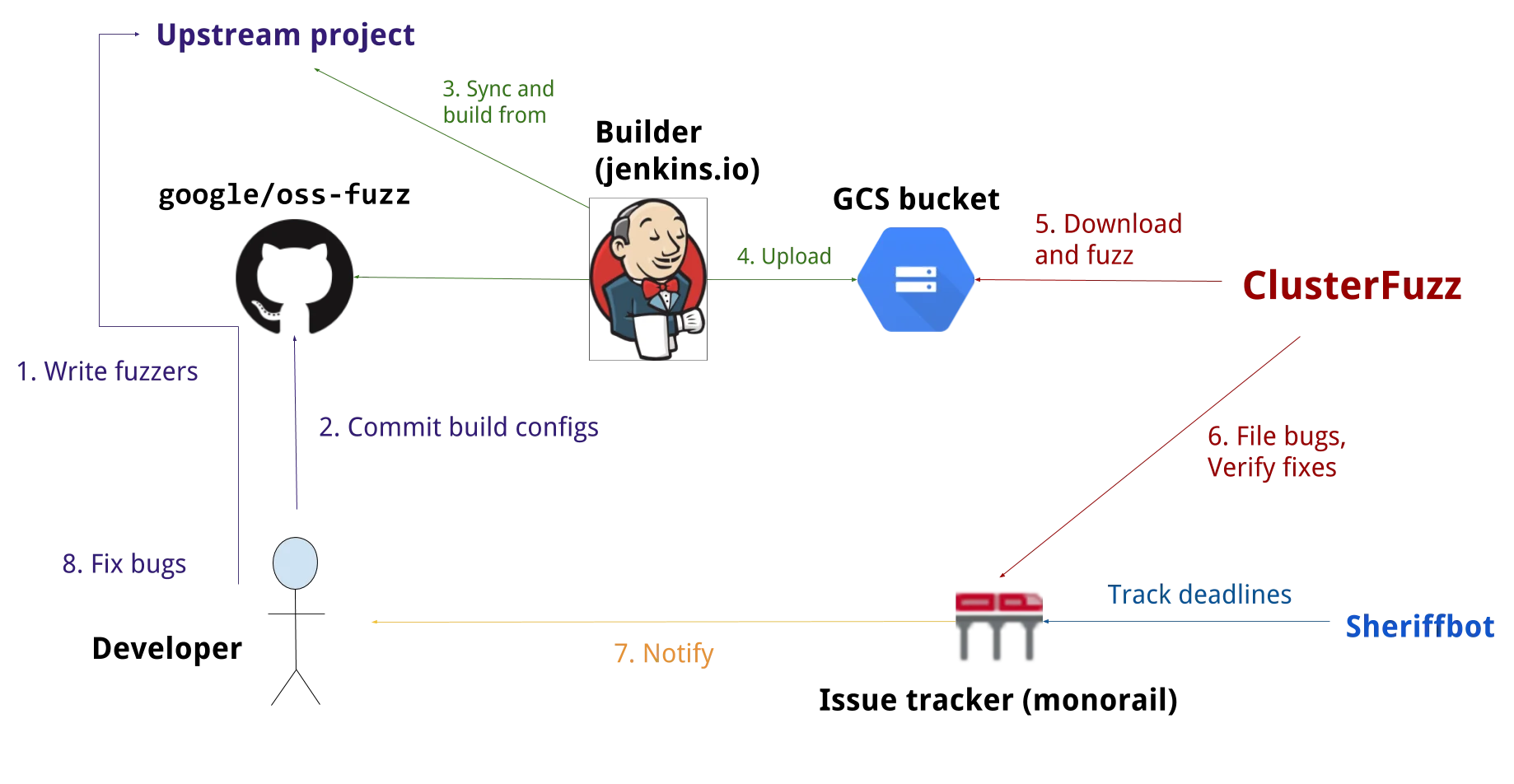
Applying for a new OSS-Fuzz integration proceeds in four logical steps:
- Selection: select a new project that is not yet ported. Check for existing projects in the OSS-Fuzz projects directory, and check whether somebody already tried the same integration in a pull request.
- Feasibility: check the feasibility and the security implications of that project on the Internet. As a general guideline, the more impact the project has on everyday usage of the web, the bigger the bounty will be. At the time of writing, OSS-Fuzz bounties are up to $20,000 with the Google patch-reward program. Good coverage is expected for any integration, so it is easier to integrate projects that already employ fuzzers.
- Technical integration: follow the getting started guide to perform an initial integration.
- Profit: apply for the Google patch-reward program.

Contextually to this research, Google awarded a $10,000 bounty, 100% of which was donated to the Cancer Research Institute. The fuzzer also discovered 14+ new vulnerabilities, four of them directly related to memory corruption.
Finding it
After a crash is found, the OSS-Fuzz infrastructure provides a minimised test case which can be inspected by an analyst. The issue here was found in the ASN1 parser. ASN1 is a formal notation used for describing data transmitted by telecommunications protocols, regardless of language implementation and physical representation of these data, whether complex or very simple. It is also employed for x.509 certificates, the technical base for building public-key infrastructure.
Passing the testcase 0202 ff25 through dumpasn1 shows it erroring out, saying that the integer of length 2 bytes is encoded with a negative value. This is not allowed in ASN1, and it should not even be allowed in LibreSSL. However, as discovered by OSS-Fuzz, this testcase crashes the LibreSSL parser.
Exploitation
Step 1: inspect the minimised test case
The test case is two bytes of ASN1 header followed by the integer content:
$ xxd ./test
xxd ../test
00000000: 0202 ff25                                ...%
$ dumpasn1 ./test
  0   2: INTEGER 65317
       :   Error: Integer is encoded as a negative value.

0 warnings, 1 error.
dumpasn1 decodes the value as 65317 but flags it as an error, saying the integer is encoded as a negative value. ASN1 does not permit an INTEGER to be encoded that way.
Step 2: feed it to the parser
LibreSSL's implementation was not guarded against negative integers. Trying to convert the crafted negative ASN1 integer to the internal BIGNUM representation causes an uncontrolled over-read. AddressSanitizer reports a SEGV on an unknown address caused by a READ memory access, with a wild-address-read scariness of 20:
AddressSanitizer:DEADLYSIGNAL
    =================================================================
    ==1==ERROR: AddressSanitizer: SEGV on unknown address 0x00009fff8000 (pc 0x00000058a308 bp 0x7ffd3e8b7bb0 sp 0x7ffd3e8b7b40 T0)
    ==1==The signal is caused by a READ memory access.
    SCARINESS: 20 (wild-addr-read)
        #0 0x58a307 in BN_bin2bn libressl/crypto/bn/bn_lib.c:601:19
        #1 0x6cd5ac in ASN1_INTEGER_to_BN libressl/crypto/asn1/a_int.c:456:13
        #2 0x6a39dd in i2s_ASN1_INTEGER libressl/crypto/x509v3/v3_utl.c:175:16
        #3 0x571827 in asn1_print_integer_ctx libressl/crypto/asn1/tasn_prn.c:457:6
        #4 0x571827 in asn1_primitive_print libressl/crypto/asn1/tasn_prn.c:556
        #5 0x571827 in asn1_item_print_ctx libressl/crypto/asn1/tasn_prn.c:239
        #6 0x57069a in ASN1_item_print libressl/crypto/asn1/tasn_prn.c:195:9
        #7 0x4f4db0 in FuzzerTestOneInput libressl.fuzzers/asn1.c:282:13
        #8 0x7fd3f5 in fuzzer::Fuzzer::ExecuteCallback(unsigned char const*, unsigned long) /src/libfuzzer/FuzzerLoop.cpp:529:15
        #9 0x7bd746 in fuzzer::RunOneTest(fuzzer::Fuzzer*, char const*, unsigned long) /src/libfuzzer/FuzzerDriver.cpp:286:6
        #10 0x7c9273 in fuzzer::FuzzerDriver(int*, char***, int (*)(unsigned char const*, unsigned long)) /src/libfuzzer/FuzzerDriver.cpp:715:9
        #11 0x7bcdbc in main /src/libfuzzer/FuzzerMain.cpp:19:10
        #12 0x7fa873b8282f in __libc_start_main /build/glibc-Cl5G7W/glibc-2.23/csu/libc-start.c:291
        #13 0x41db18 in _start
The stack shows the path from the fuzzer entry point through ASN1_item_print, asn1_item_print_ctx, asn1_primitive_print and asn1_print_integer_ctx, then i2s_ASN1_INTEGER, ASN1_INTEGER_to_BN and finally BN_bin2bn, where the read happens.
Root cause
The LibreSSL implementation was not guarded against negative integers, which the encoding rules forbid. The conversion of that crafted integer into the internal BIGNUM representation then performed an uncontrolled over-read. The LibreSSL maintainers addressed the vulnerability promptly and also added a further protection to guard against missing ASN1_PRIMITIVE_FUNCS in [redacted]:
commit [redacted]
Author: jsing <>
Date:   Mon Apr 1 15:48:04 2019 +0000

    Require all ASN1_PRIMITIVE_FUNCS functions to be provided.

    If an ASN.1 item provides its own ASN1_PRIMITIVE_FUNCS functions, require
    all functions to be provided (currently excluding prim_clear). This avoids
    situations such as having a custom allocator that returns a specific struct
    but then is then printed using the default primative print functions, which
    interpret the memory as a different struct.
Impact
This wild address read may be employed by malicious actors to perform leaks in security sensitive contexts. The report does not describe a specific end-to-end leak scenario beyond that.
Fix
The commit [redacted] adds range checks to various ASN1_INTEGER functions to ensure the sizes used remain a positive integer, and says it should address OSS-Fuzz issue 13799:
commit [redacted]
Author: beck <>
Date:   Sat Mar 23 18:48:15 2019 +0000

    Add range checks to varios ASN1_INTEGER functions to ensure the
    sizes used remain a positive integer. Should address issue
    13799 from oss-fuzz
    ok tb@ jsing@

 src/lib/libcrypto/asn1/a_int.c    | 56 +++++++++++++++++++++++++++++++++++++++++++++++++++++---
 src/lib/libcrypto/asn1/tasn_prn.c |  8 ++++++--
 src/lib/libcrypto/bn/bn_lib.c     |  4 +++-
 3 files changed, 62 insertions(+), 6 deletions(-)
The follow-up commit [redacted] requires all ASN1_PRIMITIVE_FUNCS functions to be provided (currently excluding prim_clear), so that a custom allocator returning a specific struct cannot have that memory interpreted as a different struct by the default primitive print functions.
Variants to test
What happened, in plain words
A security researcher spent some of his paid research time at a company called Doyensec on a project that turned out to be very valuable. He took a piece of software called LibreSSL, which is a library that many programs use to make secure connections over the internet, and connected it to a free testing service run by Google called OSS-Fuzz. That service automatically throws huge amounts of random and malformed data at software, looking for inputs that make it crash. The idea is simple: if you can make a program crash with a strange input, an attacker might be able to do something worse with that same input.
The connection worked. The fuzzer discovered 14+ new vulnerabilities in LibreSSL, and four of them were directly related to memory corruption. Google paid a $10,000 reward for the work, and the researcher donated all of it to the Cancer Research Institute. The article then walks through one of those bugs in detail: a tiny input that made the LibreSSL parser crash, why it crashed, and how the LibreSSL team fixed it.
This beginner version explains every concept from scratch as it comes up, so you can follow the whole story even if you have never written code.
Background: what LibreSSL and OpenSSL are
When you visit a website with a padlock in your browser, your browser and the website's server are having a private conversation. They agree on secret keys, encrypt everything they send, and check that the website really is who it claims to be. All of that is done by a piece of software called a TLS library. The most famous one is OpenSSL, which for years was used by a huge portion of the internet's servers.
A serious bug called Heartbleed was found in OpenSSL. It let an attacker read small chunks of the server's memory, which could include passwords or secret keys. After that shock, the OpenBSD project created LibreSSL: a copy of OpenSSL that they cleaned up, simplified and hardened. LibreSSL is an API compatible replacement for OpenSSL. An API (Application Programming Interface) is the set of function names and rules that programs use to talk to a library. If two libraries have the same API, a program written for one can be switched to the other without rewriting its code. That is what "compatible replacement" means: same plugs, different engine.
LibreSSL is now about 70% the size of OpenSSL (237,558 lines of code versus 335,485, measured with a tool called cloc, which counts lines of code). Smaller code is easier to review and has fewer places for bugs to hide. LibreSSL is used on OpenBSD, on macOS and on VoidLinux, a Linux distribution the researcher helps maintain.
Background: what OSS-Fuzz is
Fuzzing is a testing technique. Instead of a human writing test cases, a program called a fuzzer generates huge numbers of inputs, many of them random or malformed, and feeds them to the target software. If the software crashes, the fuzzer saves the input that caused the crash. That saved input is called a test case or crash sample. Fuzzing is good at finding memory corruption bugs: situations where a program reads or writes memory it should not touch. A buffer overflow is a classic example, where a program writes more data into a memory area than fits, spilling into neighbouring memory.
OSS-Fuzz is Google's free service that runs fuzzers on popular open source projects using Google's own computers. Open source means the code is public and anyone can read or contribute to it. One of the first projects tested by OSS-Fuzz was OpenSSL, which added its own fuzzers in a commit identified as [redacted] and was integrated into OSS-Fuzz later in 2016. A commit is a saved change to a code repository, with a long identifier (a hash) and a message describing what changed.
commit [redacted]
Refs: OpenSSL_1_1_0-pre5-217-gc38bb72797
Author:     Ben Laurie <[redacted]>
AuthorDate: Sat Mar 26 17:19:14 2016 +0000
Commit:     Ben Laurie <[redacted]>
CommitDate: Sat May 7 18:13:54 2016 +0100
    Add fuzzing!
Line by line: commit followed by the long hash is the unique name of this saved change. Refs is a reference to where this change sits in the project's version history. Author and AuthorDate say who wrote the change and when. Commit and CommitDate say who actually saved it into the project and when. The indented line Add fuzzing! is the commit message, a short human description of what the change does. In this case, it added fuzzing support to OpenSSL.
Because LibreSSL and OpenSSL share most of their code, and LibreSSL mainly implements a safer subset of OpenSSL, the researcher thought it would be fun and useful to take the OpenSSL fuzzers and point them at LibreSSL. That decision is the heart of the story.
How the project was set up
The work happened during the 25% research time that Doyensec gives its employees: one day a week, roughly, to work on security research of their own choosing. The researcher was already a long-time LibreSSL user and a VoidLinux maintainer, so he knew the code well.
The target was the LibreSSL library, connected to OSS-Fuzz. The crash trace shows the ASN1 fuzzer, whose entry point is a function called FuzzerTestOneInput in the file libressl.fuzzers/asn1.c. An entry point is the function the fuzzer calls for every input it generates; whatever that function does with the input is what gets tested. Two small tools were used to look at the crash input: xxd, which shows a file's raw bytes in hexadecimal (base 16, where each byte is two characters from 0 to 9 and a to f), and dumpasn1, which decodes ASN1 data and prints it in a readable form. Crashes were examined through the output of AddressSanitizer, a tool that watches a program while it runs and reports when it touches memory illegally.
Applying to have a new project added to OSS-Fuzz follows four logical steps:
- Selection: pick a project that is not already integrated. Check the OSS-Fuzz projects directory for existing entries, and check whether someone already tried the same integration in a pull request. A pull request is a proposed change to a public code repository that others can review before it is merged.
- Feasibility: check whether the project is important enough and whether testing it makes sense. As a rule of thumb, the more a project affects everyday use of the web, the bigger the reward. At the time of writing, OSS-Fuzz rewards were up to $20,000 under the Google patch-reward program. Good test coverage is expected, so projects that already have fuzzers are easier to integrate.
- Technical integration: follow the getting started guide to do the initial integration.
- Profit: apply to the Google patch-reward program.
The image is titled OSS-Fuzz Fuzzing Process.
As a result of this work, Google awarded a $10,000 reward, all of which was donated to the Cancer Research Institute. The fuzzer also found more than 14 new vulnerabilities, four of them directly related to memory corruption.
Finding the bug
When a fuzzer finds a crash, the OSS-Fuzz infrastructure produces a minimised test case: the smallest input that still triggers the crash. Minimising matters because a small input is much easier for a human to understand. An analyst can then inspect that test case.
The bug here was in the ASN1 parser. ASN1 is a formal notation for describing data sent over telecommunications protocols, independent of the programming language or the physical representation. Think of it as a strict grammar for data: every value has a type tag, a length and content, and the rules say exactly how those must be written. ASN1 is also used for x.509 certificates, the digital documents that websites present to prove their identity, which form the technical base of public-key infrastructure (the system of certificates and authorities that makes secure connections possible).
When the test case 0202 ff25 was passed through dumpasn1, the tool reported an error: the integer of length 2 bytes is encoded with a negative value. ASN1 does not allow that, and LibreSSL should not allow it either. Yet, as OSS-Fuzz discovered, this test case crashes the LibreSSL parser.
Step 1: looking at the minimised test case
The test case is two bytes of ASN1 header followed by the integer content:
$ xxd ./test
xxd ../test
00000000: 0202 ff25                                ...%
$ dumpasn1 ./test
  0   2: INTEGER 65317
       :   Error: Integer is encoded as a negative value.

0 warnings, 1 error.
Line by line: the $ shows a command typed at a terminal. xxd ./test asks the tool to print the file named test as hexadecimal bytes. The next line, xxd ../test, is a second invocation shown in the report. The output line 00000000: 0202 ff25 means: at offset 0 in the file, the bytes are 02, 02, ff and 25. The ...% on the right is the same bytes shown as printable characters where possible. Then dumpasn1 ./test decodes the file as ASN1. It prints 0 2: INTEGER 65317, meaning at position 0 there is an INTEGER of length 2 whose value decodes to 65317, and then it flags an error: the integer is encoded as a negative value. Finally, 0 warnings, 1 error. is the summary.
Why does this matter? In ASN1, 02 is the tag that means "this is an INTEGER". The second 02 is the length: two bytes of content follow. The content is ff25. The first content byte, ff, has its highest bit set to 1. In the encoding rules, that signals a negative number. ASN1 does not permit an INTEGER to be encoded that way, so dumpasn1 correctly complains. LibreSSL's implementation was not guarded against negative integers, and that is the bug.
Step 2: feeding it to the parser
LibreSSL's implementation was not guarded against negative integers. When it tried to convert the crafted negative ASN1 integer into its internal BIGNUM representation (a way of storing arbitrarily large numbers), it performed an uncontrolled over-read: it read past the end of the data it was given. AddressSanitizer reported a SEGV (segmentation fault, meaning the program tried to access memory it is not allowed to) on an unknown address, caused by a READ memory access, with a wild-address-read scariness of 20:
AddressSanitizer:DEADLYSIGNAL
    =================================================================
    ==1==ERROR: AddressSanitizer: SEGV on unknown address 0x00009fff8000 (pc 0x00000058a308 bp 0x7ffd3e8b7bb0 sp 0x7ffd3e8b7b40 T0)
    ==1==The signal is caused by a READ memory access.
    SCARINESS: 20 (wild-addr-read)
        #0 0x58a307 in BN_bin2bn libressl/crypto/bn/bn_lib.c:601:19
        #1 0x6cd5ac in ASN1_INTEGER_to_BN libressl/crypto/asn1/a_int.c:456:13
        #2 0x6a39dd in i2s_ASN1_INTEGER libressl/crypto/x509v3/v3_utl.c:175:16
        #3 0x571827 in asn1_print_integer_ctx libressl/crypto/asn1/tasn_prn.c:457:6
        #4 0x571827 in asn1_primitive_print libressl/crypto/asn1/tasn_prn.c:556
        #5 0x571827 in asn1_item_print_ctx libressl/crypto/asn1/tasn_prn.c:239
        #6 0x57069a in ASN1_item_print libressl/crypto/asn1/tasn_prn.c:195:9
        #7 0x4f4db0 in FuzzerTestOneInput libressl.fuzzers/asn1.c:282:13
        #8 0x7fd3f5 in fuzzer::Fuzzer::ExecuteCallback(unsigned char const*, unsigned long) /src/libfuzzer/FuzzerLoop.cpp:529:15
        #9 0x7bd746 in fuzzer::RunOneTest(fuzzer::Fuzzer*, char const*, unsigned long) /src/libfuzzer/FuzzerDriver.cpp:286:6
        #10 0x7c9273 in fuzzer::FuzzerDriver(int*, char***, int (*)(unsigned char const*, unsigned long)) /src/libfuzzer/FuzzerDriver.cpp:715:9
        #11 0x7bcdbc in main /src/libfuzzer/FuzzerMain.cpp:19:10
        #12 0x7fa873b8282f in __libc_start_main /build/glibc-Cl5G7W/glibc-2.23/csu/libc-start.c:291
        #13 0x41db18 in _start
Line by line: AddressSanitizer:DEADLYSIGNAL is the tool announcing a fatal signal. The ERROR line says a SEGV happened at an unknown address, and gives the program counter (pc), base pointer (bp), stack pointer (sp) and thread (T0) at the moment of the crash. The next line says the signal was caused by a READ memory access, meaning the program tried to read from a memory location it should not. SCARINESS: 20 (wild-addr-read) is AddressSanitizer's own score for how serious the crash looks; a wild address read means the address was essentially arbitrary.
The numbered lines starting with #0 are the stack trace: the chain of function calls that led to the crash, with the innermost call first. Reading from the bottom up: _start and __libc_start_main are the normal startup of any C program; main is the fuzzer's main function; FuzzerDriver and RunOneTest and ExecuteCallback are the fuzzer machinery running one input; FuzzerTestOneInput is the entry point in libressl.fuzzers/asn1.c; then the ASN1 printing code (ASN1_item_print, asn1_item_print_ctx, asn1_primitive_print, asn1_print_integer_ctx); then i2s_ASN1_INTEGER and ASN1_INTEGER_to_BN, which convert the integer; and finally BN_bin2bn in libressl/crypto/bn/bn_lib.c, where the illegal read actually happens. Each line also gives the source file and line number, which is how a developer knows exactly where to look.
Root cause
LibreSSL's implementation was not guarded against an ASN1 INTEGER whose content encodes a negative value, which the encoding rules forbid. The conversion of that crafted integer into the internal BIGNUM representation then performed an uncontrolled over-read. In plain terms: the program trusted the input to follow the rules, the input did not, and the program read memory it should never have touched.
The LibreSSL maintainers fixed the vulnerability promptly and also added a further protection against a related class of mistake, in commit [redacted]:
commit [redacted]
Author: jsing <>
Date:   Mon Apr 1 15:48:04 2019 +0000

    Require all ASN1_PRIMITIVE_FUNCS functions to be provided.

    If an ASN.1 item provides its own ASN1_PRIMITIVE_FUNCS functions, require
    all functions to be provided (currently excluding prim_clear). This avoids
    situations such as having a custom allocator that returns a specific struct
    but then is then printed using the default primative print functions, which
    interpret the memory as a different struct.
Line by line: the commit line names the change, Author says who wrote it, and Date says when. The indented text is the commit message. The first line states the rule: all ASN1_PRIMITIVE_FUNCS functions must be provided. ASN1_PRIMITIVE_FUNCS is a table of functions that tells the ASN1 code how to handle one particular kind of value. The rest explains why: if an ASN1 item supplies its own functions, it must supply all of them (currently except prim_clear). Otherwise you can get a situation where a custom allocator (a function that reserves memory and returns a particular kind of structure) hands back one kind of structure, but the default printing functions then read that memory as if it were a different kind of structure. Reading memory as the wrong type is exactly how memory corruption bugs happen.
Impact
This wild address read could be used by malicious actors to leak information in security-sensitive contexts. The report does not describe a specific end-to-end leak scenario beyond that. In other words, the crash itself is proven; the full attack that an adversary might build on top of it is not spelled out.
Fix
Commit [redacted] adds range checks to various ASN1_INTEGER functions so that the sizes used remain a positive integer, and says it should address OSS-Fuzz issue 13799:
commit [redacted]
Author: beck <>
Date:   Sat Mar 23 18:48:15 2019 +0000

    Add range checks to varios ASN1_INTEGER functions to ensure the
    sizes used remain a positive integer. Should address issue
    13799 from oss-fuzz
    ok tb@ jsing@

 src/lib/libcrypto/asn1/a_int.c    | 56 +++++++++++++++++++++++++++++++++++++++++++++++++++++---
 src/lib/libcrypto/asn1/tasn_prn.c | 8 ++++++--
 src/lib/libcrypto/bn/bn_lib.c     | 4 +++-
 3 files changed, 62 insertions(+), 6 deletions(-)
Line by line: the commit line names the fix, Author and Date identify who and when. The commit message says range checks were added to several ASN1_INTEGER functions so that the sizes used stay a positive integer, and that this should address issue 13799 from oss-fuzz. The line ok tb@ jsing@ records that two other developers reviewed and approved the change. The three lines below are a summary of which files changed and by how much: a_int.c gained 56 lines, tasn_prn.c gained 8 lines, and bn_lib.c gained 4 lines. The final line totals it: 3 files changed, 62 insertions, 6 deletions. A range check is simply a test that a number falls within allowed limits before it is used; here, the size must be positive.
The follow-up commit [redacted] requires all ASN1_PRIMITIVE_FUNCS functions to be provided (currently excluding prim_clear), so that a custom allocator returning a specific struct cannot have that memory interpreted as a different struct by the default primitive print functions.
Variants to test
Glossary
- API: the set of function names and rules that programs use to talk to a library.
- API compatible replacement: a library that offers the same API as another, so programs can switch without rewriting code.
- AddressSanitizer: a tool that watches a running program and reports illegal memory accesses.
- Allocator: a function that reserves memory for a program and returns it in a particular structure.
- ASN1: a formal notation for describing data sent over protocols, with strict rules for tags, lengths and content.
- ASN1 parser: the part of a program that reads ASN1 data and turns it into internal values.
- ASN1_PRIMITIVE_FUNCS: a table of functions that tells the ASN1 code how to handle one kind of value.
- BIGNUM: a way of storing arbitrarily large numbers inside a program.
- Buffer overflow: writing more data into a memory area than fits, spilling into neighbouring memory.
- cloc: a tool that counts lines of code.
- Commit: a saved change to a code repository, identified by a long hash.
- Coverage: how much of a program's code a set of tests actually exercises.
- dumpasn1: a tool that decodes ASN1 data and prints it in readable form.
- Entry point: the function a fuzzer calls for every input it generates.
- Fork: a copy of a project's code that then develops separately.
- Fuzzer: a program that generates many inputs, often malformed, and feeds them to target software to find crashes.
- Fuzzing: the technique of using a fuzzer to find bugs.
- Heartbleed: a serious 2014 vulnerability in OpenSSL that let attackers read server memory.
- Memory corruption: a bug where a program reads or writes memory it should not touch.
- Minimised test case: the smallest input that still triggers a crash.
- Open source: software whose code is public and can be read and contributed to by anyone.
- OSS-Fuzz: Google's free service that runs fuzzers on popular open source projects.
- Over-read: reading past the end of the data a program was given.
- Public-key infrastructure: the system of certificates and authorities that makes secure connections possible.
- Pull request: a proposed change to a public code repository that others can review before merging.
- Range check: a test that a number falls within allowed limits before it is used.
- SEGV: segmentation fault, a crash caused by accessing memory the program is not allowed to access.
- Stack trace: the chain of function calls that led to a crash, innermost first.
- Test case: the saved input that caused a crash.
- TLS library: software that handles encrypted, authenticated connections between programs.
- Vulnerability: a weakness in software that an attacker could exploit.
- x.509 certificate: a digital document a website presents to prove its identity.
- xxd: a tool that shows a file's raw bytes in hexadecimal.

