Uncovering a ChromeOS remote memory corruption vulnerability
A memory corruption vulnerability in ChromeOS's CRAS audio server allowed remote attackers to trigger a heap-based buffer overflow by manipulating audio metadata, potentially causing denial-of-service or remote code execution.
Microsoft 365 Defender Research Team Follow
 Published on microsoft.com
Microsoft discovered a memory corruption vulnerability in a ChromeOS component that can be triggered remotely, allowing attackers to perform either a denial-of-service (DoS) or, in extreme cases, remote code execution (RCE). Following our D-Bus blog post that focused on Linux, we searched for similar D-Bus patterns on…
The full write-up lives on its author's site
It belongs to its author, so we link to it rather than copy it. The other two tabs are our own rewrites, checked against it.
Context
ChromeOS is a Google-proprietary Linux-based operating system that runs on Chromebooks, Chromeboxes, Chromebits and Chromebases. It is a closed-source system with open-source components derived from ChromiumOS, and it uses Google's own Chrome browser as its principal user interface. One of the IPC mechanisms it relies on is D-Bus, the Inter-Process-Communication mechanism popular on desktop platforms, specifically Linux.
CRAS (ChromiumOS Audio Server) is the component at the centre of this story. It owns the D-Bus name org.chromium.cras and sits between the operating system and ALSA (Advanced Linux Sound Architecture), routing audio to newly attached audio-supporting peripherals such as USB speakers and Bluetooth headsets. Among the methods CRAS exports over D-Bus is SetPlayerIdentity, which takes a single string argument called identity.
ChromeOS is well hardened. Its security features include a hardened sandbox called minijail, verified boot, a locked-down filesystem mounted with noexec, nosuid and nodev plus dm-verity, root user restrictions (SECURE_NOROOT), and a wipe of all locally stored data when development mode is entered. Exploiting ChromeOS usually requires chaining vulnerabilities together, which is why public vulnerabilities are relatively rare compared with other operating systems. ChromeOS vulnerabilities generally fall into three classes: ChromeOS-specific logic vulnerabilities, ChromeOS-specific memory-corruption vulnerabilities, and broader threats such as Chrome browser vulnerabilities. The bug described here belongs to the second class.
Setup
The research followed an earlier Microsoft D-Bus blog post that focused on Linux. The team audited D-Bus services and their handler code on other platforms looking for similar patterns. ChromeOS's developer mode offers the dbus-send utility for sending messages over D-Bus, and that is the only tool the write-up relies on for the local reproduction. No accounts, roles or specific versions are described.
The local test uses developer mode, which offers the dbus-send utility. Most users do not enable developer mode, so the remote path described later matters: it needs no developer mode at all.
Finding it
The team enumerated the D-Bus services offered on ChromeOS. Services are usually identified by the org.chromium prefix. Because most D-Bus services support the org.freedesktop.DBus.Introspectable interface, exported methods and signals can be fetched dynamically without reading source code or reverse-engineering binaries, so the process was automated.
Fetching all exported service names is done with:
dbus-send --system --dest=org.freedesktop.DBus --type=method_call --print-reply /org/freedesktop/DBus org.freedesktop.DBus.ListNames
Each service can then be enumerated for its declared methods and signals. The example given is org.chromium.ResourceManager:
dbus-send --system --dest=org.chromium.ResourceManager --type=method_call --print-reply /org/chromium/ResourceManager org.freedesktop.DBus.Introspectable.Introspect
The reasoning was that the more input a method receives, the higher the probability of finding a security issue, so the team focused on methods that export arbitrarily large inputs such as strings or arrays. That led to org.chromium.cras.
Reviewing the exported methods uncovered SetPlayerIdentity, which takes one string argument called identity. Since ChromiumOS is open-sourced, the call path could be traced directly:
- In cras_dbus_control.c, the handler for SetPlayerIdentity is handle_set_player_identity, which extracts the identity argument from the D-Bus message and invokes cras_bt_player_update_identity.
- In cras_bt_player.c, cras_bt_player_update_identity checks that the identity input is not null and differs from the current player identity string (saved under player.identity). If so, it copies the identity variable into player.identity using the C library function strcpy. The player object is a global variable in the cras_bt_player module and includes an identity field among others.
The strcpy call is the red flag: it performs no bounds check and is known to cause memory corruption. Apart from the default message length limits for D-Bus messages, nothing bounds the user-supplied identity argument before strcpy runs, so a heap-based buffer overflow looked certain.
Checking how player.identity is initialised shows it is set in cras_bt_player_init as the result of malloc(128), meaning it is allocated on the user's heap with 128 bytes.
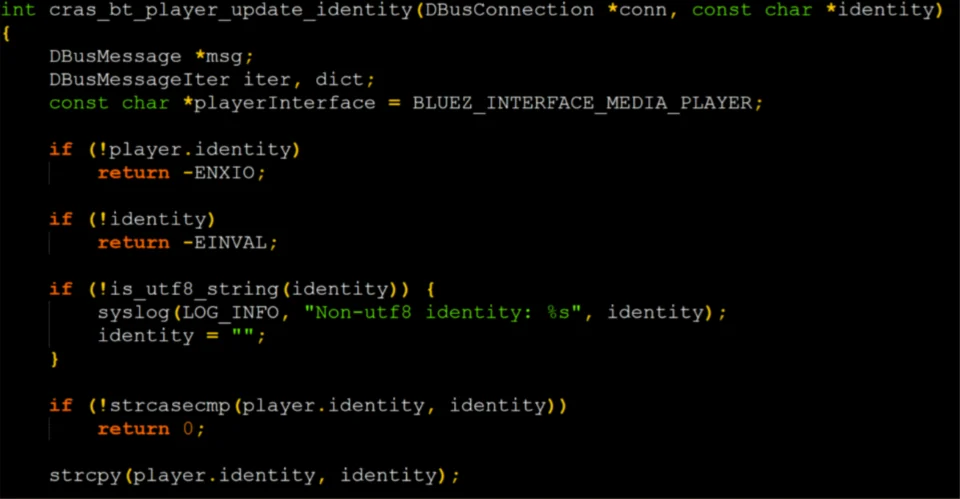
That makes the trigger a single command line: send the identity argument with more than 128 bytes.
Exploitation
Step 1: overflow the heap buffer locally
With developer mode enabled, the following command sends an identity string longer than the 128-byte allocation:
dbus-send --system --dest=org.chromium.cras --type=method_call --print-reply /org/chromium/cras org.chromium.cras.Control.SetPlayerIdentity string:AAAAAAAAAAAAAAAAAAAAAAAAAAAAAAAAAAAAAAAAAAAAAAAAAAAAAAAAAAAAAAAAAAAAAAAAAAAAAAAAAAAAAAAAAAAAAAAAAAAAAAAAAAAAAAAAAAAAAAAAAAAAAAAAAAAAAAAAAAAAAAAAAAAAAAAAAAAAAAAAAAAAAAAAAAAAAAAAAAAAAAAAAAAAAAAAAAAAAAAA
The destination is the CRAS service, the object path is /org/chromium/cras, and the method is org.chromium.cras.Control.SetPlayerIdentity. The string: argument carries the oversized identity. The write-up does not describe the response to this command; the point is that the argument exceeds the 128-byte heap allocation and overflows it through strcpy.
Step 2: find a path that does not need developer mode
Since most users cannot use dbus-send, the next task was to trigger the bug without developer mode. Because the involved functions are only reached through D-Bus, the team looked for callers of the SetPlayerIdentity D-Bus method whose arguments have no bounds checks.
In the open-source ChromiumOS repositories, the CRAS audio client invokes SetPlayerIdentity and exports a function with the same name. That function is in turn called by the CRAS audio handler component's method MediaSessionMetadataChanged, which extracts the identity from a metadata structure representing a song's title.
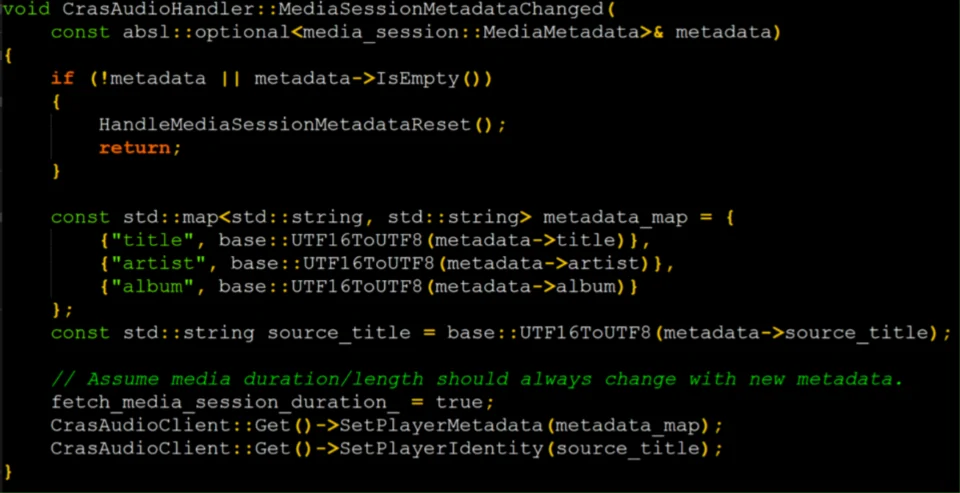
Step 3: reach it through audio metadata
The vulnerability can therefore be triggered by changes to audio metadata. Searching for MediaSessionMetadataChanged invocations revealed two cases, both remotely triggerable:
- From the browser: the browser's media component invokes the function when metadata changes, such as when playing a new song in the browser.
- From Bluetooth: the media session service in the operating system invokes the function when a song's metadata changes, which can happen when playing a new song from a paired Bluetooth device.
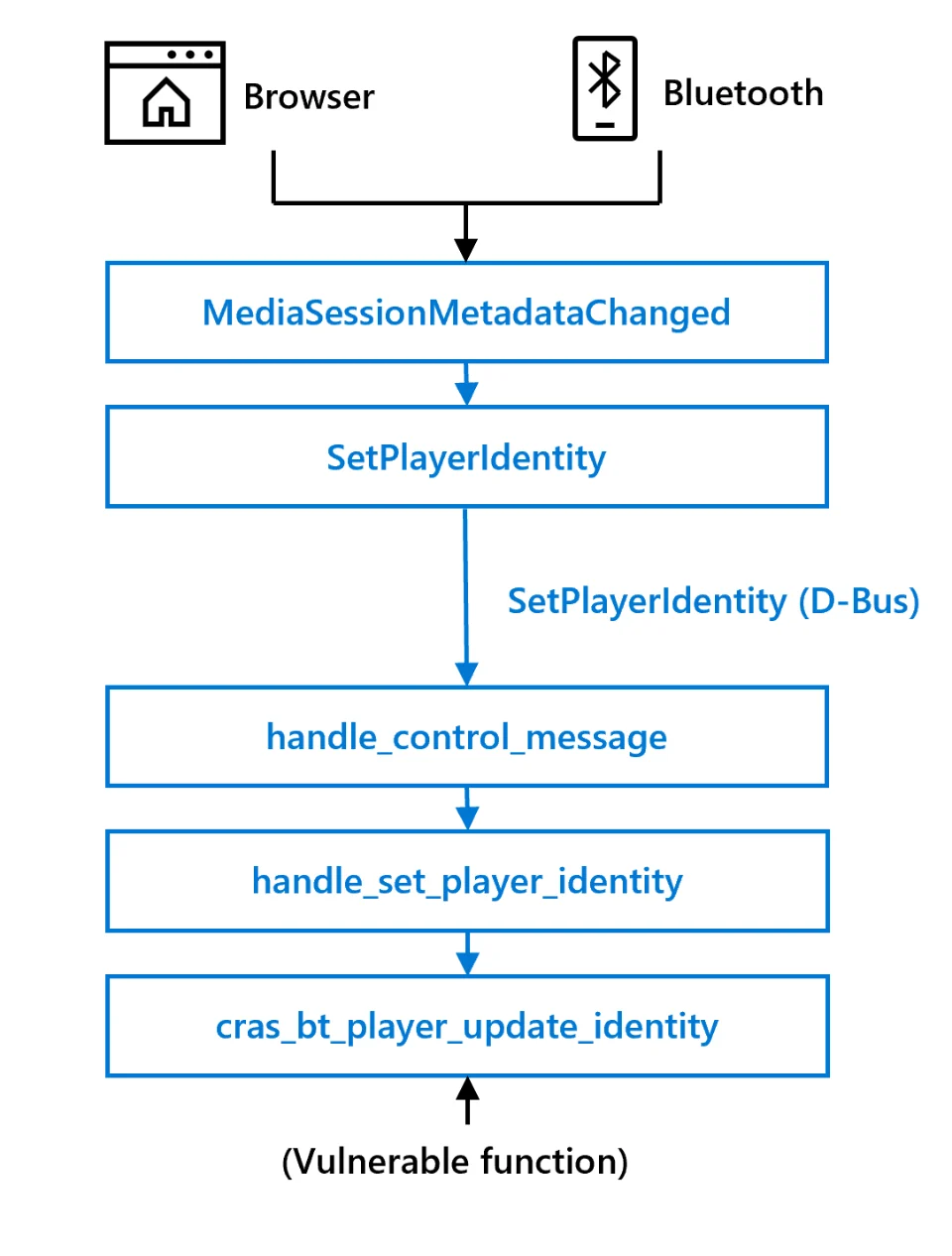
The call tree runs from browser or Bluetooth media metadata changes, through MediaSessionMetadataChanged and SetPlayerIdentity over D-Bus, into handle_set_player_identity, and finally into the vulnerable cras_bt_player_update_identity.
An attacker could lure users into meeting these conditions, for example by simply playing a new song in a browser or from a paired Bluetooth device, or could leverage adversary-in-the-middle (AiTM) capabilities to exploit the vulnerability remotely.
Root cause
The handler cras_bt_player_update_identity copies an attacker-controlled string into a 128-byte heap allocation with strcpy, which performs no bounds check. The only limit on the input is the default D-Bus message length limit. The null check and the comparison against the current identity do not constrain length. The upstream callers, MediaSessionMetadataChanged and the CRAS audio client, pass metadata-derived strings through without bounds checks, which is what turns a local D-Bus issue into a remotely triggerable one.
Impact
The impact of a heap-based buffer overflow ranges from a simple denial of service to full-fledged remote code execution. Heap overflows can lead to arbitrary code execution through means such as overriding a function callback in an allocated object or overriding chunk metadata, which can trigger other unexpected behaviour during the lifetime of the program. In this case, although chunks can be allocated and freed through media metadata manipulation, performing the precise heap grooming is not trivial, and attackers would need to chain the exploit with other vulnerabilities to successfully execute arbitrary code. The vulnerability was rated CVSS 9.8 (critical) and assigned CVE-2022-2587. The team used OSINT to look for indications of in-the-wild exploitation and found none.
Fix
A Microsoft security researcher shared the vulnerability with Google in April 2022 and reported it through the Chromium bug tracking system as Issue 1320917, which was immediately assigned as a priority 1 security bug. The issue was tracked internally in Microsoft Security Vulnerability Research (MSVR). Fixes were quickly released and deployed to end users. Within less than a week the code was committed and, after several merges, made generally available. The report links a fix in cras_bt_player.c.
Variants to test
- Enumerate D-Bus services and introspect their methods, then prioritise methods that accept strings or arrays. A positive result is a method whose handler passes the argument into an unbounded copy such as strcpy.
- Trace every caller of a suspicious method through the open-source tree. A positive result is a caller that forwards metadata or other externally influenced strings without a length check, as MediaSessionMetadataChanged did here.
- Look for metadata-driven paths from the browser or from paired Bluetooth devices into privileged services. A positive result is a chain where changing a song's title or other metadata reaches the vulnerable handler with no developer mode required.
- Check how the destination buffer is allocated. A positive result is a fixed-size heap allocation, such as the malloc(128) here, receiving a longer attacker-controlled string.
What happened, in plain words
Microsoft security researchers found a bug in ChromeOS, the operating system that runs on Chromebooks. The bug let someone who could change the "now playing" information of a song, for example its title, cause a small part of the operating system to write more data into a memory area than that area could hold. This kind of mistake is called a memory corruption vulnerability. In the worst case it can crash the device (a denial of service, or DoS) and, in extreme cases, let an attacker run their own code on the machine (remote code execution, or RCE).
The researchers reported it to Google in April 2022. Google fixed it quickly, and the fix reached users. The bug is tracked as CVE-2022-2587 and was rated 9.8 out of 10 on the CVSS scale, which classifies it as critical. The researchers say they found no signs that anyone had used it in real attacks before the fix.


The rest of this article walks through how the researchers found the bug, how they proved it could be triggered, and what it means. Every technical idea is explained from scratch, so you only need to be comfortable using a computer and a browser.
Background: what ChromeOS is and how its pieces talk
ChromeOS is a Linux-based operating system owned by Google. It runs on Chromebooks, Chromeboxes, Chromebits and Chromebases. It is closed source, meaning the full code is not public, but many of its parts come from an open-source project called ChromiumOS, whose code anyone can read. Its main user interface is Google's own Chrome browser.
One of the ways programs on ChromeOS talk to each other is a mechanism called D-Bus. Think of D-Bus as an internal postal service: one program puts a message in an envelope addressed to another program, and the postal service delivers it. D-Bus is common on Linux desktop systems. Each program that offers a service registers a name, usually starting with org.chromium on ChromeOS, and other programs send messages to that name.
The central character in this story is CRAS, short for ChromiumOS Audio Server. CRAS sits between the operating system and ALSA (Advanced Linux Sound Architecture), the lower layer that actually talks to sound hardware. Its job is to route audio to devices that get plugged in or paired, such as USB speakers and Bluetooth headsets. CRAS owns the D-Bus name org.chromium.cras. Among the operations, or methods, that CRAS offers over D-Bus is one called SetPlayerIdentity, which accepts a single piece of text (a string) called identity.
A method, in this context, is simply a named action a program can ask another program to perform, a bit like choosing an option from a menu. The identity argument is the information sent along with the request, like the text you type into a form field.
How hardened ChromeOS is
ChromeOS is built to be hard to attack. Its protections include:
- A hardened sandbox called minijail. A sandbox is a restricted playpen: a program inside it can only touch a limited set of things, so if it is compromised the damage is contained.
- Verified boot, which checks that the system that starts up is the genuine, unmodified one.
- A locked-down filesystem, mounted with the options noexec, nosuid and nodev, plus a integrity mechanism called dm-verity. In plain terms, these settings stop programs from running files from certain places and stop special file types from being used there.
- Root user restrictions (SECURE_NOROOT), which limit the all-powerful administrator account.
- When development mode is entered, all locally stored data is wiped.
Because of all this, breaking into ChromeOS usually means combining several bugs, each one opening a small door that the next one walks through. That is why public ChromeOS vulnerabilities are relatively rare compared with other operating systems. The researchers group ChromeOS bugs into three classes:
- ChromeOS-specific logic vulnerabilities, where the code makes a wrong decision.
- ChromeOS-specific memory-corruption vulnerabilities, where the code mishandles memory.
- Broader threats such as bugs in the Chrome browser itself.
The bug in this article belongs to the second class.
How the researchers hunted for the bug
The team had previously studied D-Bus on Linux and published a blog post about it. They then asked a simple question: do other platforms use D-Bus in similar ways, and do their services make similar mistakes? So they audited D-Bus services and the code that handles their messages on other platforms.
ChromeOS has a developer mode, a special mode meant for people building and testing software. In that mode a command-line tool called dbus-send is available, and it can send messages over D-Bus by hand. That tool is used in the write-up to reproduce the bug locally. The catch is that most ordinary users never turn on developer mode, so a bug that can only be triggered there would be far less serious. Keep that in mind for later.
To find candidate services, the team listed every D-Bus service on the system. Most D-Bus services support a standard interface called org.freedesktop.DBus.Introspectable. Introspection means a service can describe itself: it can list the methods and signals it offers. That let the researchers fetch the full catalogue of services, methods and signals automatically, without reading source code or reverse-engineering compiled programs. Reverse-engineering means taking a finished program apart to work out what it does.
Listing all the service names is done with this command:
dbus-send --system --dest=org.freedesktop.DBus --type=method_call --print-reply /org/freedesktop/DBus org.freedesktop.DBus.ListNames
Line by line:
dbus-sendis the tool that sends a D-Bus message.--systemsays to use the system-wide D-Bus, the one shared by the whole machine, rather than a private one belonging to a single user session.--dest=org.freedesktop.DBusaddresses the message to the D-Bus service that manages D-Bus itself, the equivalent of the post office's own front desk.--type=method_callsays this is a request for an action, not a reply or a notification.--print-replyasks the tool to print the answer it gets back./org/freedesktop/DBusis the object path, the address inside that service, like a folder path on a disk.org.freedesktop.DBus.ListNamesis the method being called: "list all the names currently registered".
Once the names are known, each service can be asked to describe its own methods and signals. The example used is org.chromium.ResourceManager:
dbus-send --system --dest=org.chromium.ResourceManager --type=method_call --print-reply /org/chromium/ResourceManager org.freedesktop.DBus.Introspectable.Introspect
Line by line:
--dest=org.chromium.ResourceManageraddresses this message to the Resource Manager service instead of the D-Bus front desk./org/chromium/ResourceManageris the object path inside that service.org.freedesktop.DBus.Introspectable.Introspectis the standard "describe yourself" method. It returns the list of methods and signals the service offers.
The researchers' reasoning was practical: the more input a method accepts, the more chances there are that some of it is mishandled. So they focused on methods that accept arbitrarily large inputs, such as strings or arrays. An array is simply an ordered list of values. It did not take long before one service stood out: org.chromium.cras.
The vulnerable code
Reviewing the methods CRAS offers turned up SetPlayerIdentity, which takes one string argument called identity. Because ChromiumOS is open source, the researchers could follow the code from the D-Bus entry point all the way down. The path is:
- In the file cras_dbus_control.c, the function that handles SetPlayerIdentity is handle_set_player_identity. It pulls the identity argument out of the incoming D-Bus message and calls cras_bt_player_update_identity.
- In the file cras_bt_player.c, cras_bt_player_update_identity checks two things: that the incoming identity is not null (not empty or missing) and that it differs from the current player identity string, which is stored under player.identity. If both checks pass, it copies the incoming identity into player.identity using a C library function called strcpy. The player object is a global variable in the cras_bt_player module, meaning it is shared across the whole program, and it has an identity field among others.
A function, in programming, is a named block of code that performs a task. A global variable is a storage slot that any part of the program can read and write, a bit like a whiteboard in a shared office rather than a note kept in one person's drawer.
The red flag is strcpy. This function copies text from one place to another, but it does not check whether the destination has enough room. If the source is longer than the destination, the extra characters spill over into neighbouring memory. That is a buffer overflow: a buffer is a fixed-size area of memory reserved for data, and overflowing it means writing past its edge. Because strcpy performs no bounds check, it is considered unsafe and is a well-known cause of memory corruption bugs.
Apart from the default maximum length of a D-Bus message, nothing limited the size of the user-supplied identity before it reached strcpy. The researchers were therefore confident they could trigger a heap-based buffer overflow. The heap is the pool of memory a program uses for data it creates while running, as opposed to the stack, which is used for short-lived bookkeeping. A heap-based overflow means the spill happens in that pool.
Heap overflows can cause several kinds of harm. They can crash the program, which is the denial-of-service outcome. More seriously, they can lead to arbitrary code execution, for example by overwriting a function callback stored in an allocated object (a callback is a function the program will call later, so redirecting it redirects the program's behaviour), or by overwriting chunk metadata, which is the bookkeeping information the memory manager keeps next to each block. Corrupting that bookkeeping can cause unexpected behaviour later while the program runs.
To know how much room the destination had, the researchers checked how player.identity is initialised. It is set in the function cras_bt_player_init as the result of malloc(128). malloc is the C function that reserves a block of memory, and 128 is the number of bytes reserved. So the destination is a 128-byte block on the user's heap.
Figure 1 shows the vulnerable function with the strcpy call in it.
That makes the trigger a single command line: send an identity argument longer than 128 bytes. The example below does exactly that.
dbus-send --system --dest=org.chromium.cras --type=method_call --print-reply /org/chromium/cras org.chromium.cras.Control.SetPlayerIdentity string:AAAAAAAAAAAAAAAAAAAAAAAAAAAAAAAAAAAAAAAAAAAAAAAAAAAAAAAAAAAAAAAAAAAAAAAAAAAAAAAAAAAAAAAAAAAAAAAAAAAAAAAAAAAAAAAAAAAAAAAAAAAAAAAAAAAAAAAAAAAAAAAAAAAAAAAAAAAAAAAAAAAAAAAAAAAAAAAAAAAAAAAAAAAAAAAAAAAAAAAA
Line by line:
dbus-sendis again the tool sending the message.--systemuses the system-wide D-Bus.--dest=org.chromium.crasaddresses the message to CRAS, the audio server.--type=method_callsays this is a request for an action.--print-replyasks for the answer to be printed./org/chromium/crasis the object path inside CRAS.org.chromium.cras.Control.SetPlayerIdentityis the method being called: set the player identity.string:tells the tool that the next value is a string, and the long run ofAcharacters is the identity itself. It is clearly longer than 128 bytes, so when strcpy copies it into the 128-byte block, the extra characters spill past the end.
The write-up does not describe what reply this command produces. The point is the overflow itself: the argument exceeds the 128-byte allocation and strcpy writes past it.
Triggering the bug without developer mode
At this stage the researchers had a local bug: it could be triggered by someone who already had developer mode and the dbus-send tool. That is a much smaller problem than a bug any user can hit. So the next task was to find a way to reach the same code without developer mode.
Because the functions involved are only reached through D-Bus, the team looked for other code that calls the SetPlayerIdentity method. If a caller passes along text without checking its length, that caller becomes a way in.
Searching the open-source ChromiumOS repositories showed that the CRAS audio client invokes SetPlayerIdentity and also exports a function with the same name. That function is in turn called by a method in the CRAS audio handler component called MediaSessionMetadataChanged. This method takes the identity from a metadata structure that represents a song's title. Metadata here means the descriptive information about a piece of media, such as the title, artist or album, rather than the audio itself.
Figure 2 shows SetPlayerIdentity being triggered from metadata changes.
So the bug could be triggered by changing audio metadata. The researchers then searched for places that call MediaSessionMetadataChanged and found two, both of which can be triggered remotely:
- From the browser: the browser's media component calls the function when metadata changes, for example when you play a new song in the browser.
- From Bluetooth: the media session service in the operating system calls the function when a song's metadata changes, which can happen when you play a new song from a paired Bluetooth device.
Figure 3 shows the call tree. A call tree is a diagram of who calls whom: browser or Bluetooth media metadata changes lead to MediaSessionMetadataChanged, then to SetPlayerIdentity sent over D-Bus, then to handle_control_message, then to handle_set_player_identity, and finally to the vulnerable cras_bt_player_update_identity.
This is what makes the bug serious. An attacker could lure a user into meeting these conditions, for example by simply getting them to play a new song in a browser or from a paired Bluetooth device. Alternatively, an attacker with adversary-in-the-middle (AiTM) capabilities could exploit it remotely. AiTM means sitting between two parties and relaying or altering their communications, like a postal worker who opens letters, changes them and reseals them before delivery.
Why the bug happens
The root cause is a single unchecked copy. The handler cras_bt_player_update_identity copies an attacker-controlled string into a 128-byte heap block using strcpy, which does not check length. The only limit on the input is the default maximum length of a D-Bus message. The null check and the comparison against the current identity do not constrain length at all. The callers upstream, MediaSessionMetadataChanged and the CRAS audio client, pass metadata-derived strings through without length checks. That is what turns a local D-Bus issue into one that can be triggered remotely.
What the impact could be
The impact of a heap-based buffer overflow ranges from a simple denial of service to full remote code execution. As noted, heap overflows can lead to arbitrary code execution by means such as overriding a function callback in an allocated object or overriding chunk metadata, which can cause unexpected behaviour later in the program's life. In this case, although chunks can be allocated and freed through media metadata manipulation, performing the precise heap grooming needed is not trivial. Heap grooming means carefully arranging memory allocations so that the overflow lands on something useful. Attackers would need to chain this exploit with other vulnerabilities to successfully run arbitrary code. The vulnerability was rated CVSS 9.8, critical, and assigned CVE-2022-2587. The team used OSINT, open-source intelligence, meaning searching publicly available information, to look for signs of real-world exploitation and found none.
Reporting and the fix
A Microsoft security researcher shared the vulnerability with Google in April 2022 and reported it through the Chromium bug tracking system as Issue 1320917. It was immediately assigned as a priority 1 security bug. In parallel, the team tracked the issue internally in Microsoft Security Vulnerability Research (MSVR). Fixes were quickly released and deployed to end users. Within less than a week the code was committed and, after several merges, made generally available. The report links a fix in cras_bt_player.c.
What other researchers can try
- Enumerate D-Bus services and introspect their methods, then prioritise methods that accept strings or arrays. A positive result is a method whose handler passes the argument into an unbounded copy such as strcpy.
- Trace every caller of a suspicious method through the open-source tree. A positive result is a caller that forwards metadata or other externally influenced strings without a length check, as MediaSessionMetadataChanged did here.
- Look for metadata-driven paths from the browser or from paired Bluetooth devices into privileged services. A positive result is a chain where changing a song's title or other metadata reaches the vulnerable handler with no developer mode required.
- Check how the destination buffer is allocated. A positive result is a fixed-size heap allocation, such as the malloc(128) here, receiving a longer attacker-controlled string.
Why this matters beyond one bug
This case shows why it is worth auditing the same kind of component on many platforms, and why sharing findings helps everyone. It also shows that even a well-hardened operating system can contain a memory-safety mistake, and that a bug which looks local can turn out to be reachable from ordinary user actions such as playing a song. The researchers note that organisations should monitor all their devices and operating systems, including unmanaged ones, because unmanaged devices are sometimes overlooked and can become a quiet foothold for attackers. Microsoft Defender for Endpoint's device discovery capabilities are mentioned as a way to find such devices, including those running ChromeOS, and to detect when they start interacting with servers and other managed devices in suspicious ways.

Glossary
- API: a defined set of actions one program offers to another, like a menu of requests a program will accept.
- ALSA (Advanced Linux Sound Architecture): the lower layer of Linux that talks to sound hardware.
- Array: an ordered list of values.
- Buffer: a fixed-size area of memory reserved to hold data.
- Buffer overflow: writing more data into a buffer than it can hold, so the extra spills into neighbouring memory.
- Callback: a function a program stores and calls later; redirecting it can change what the program does.
- Chunk metadata: the bookkeeping information the memory manager keeps next to each allocated block.
- CRAS (ChromiumOS Audio Server): the ChromeOS audio server that routes sound to devices such as USB speakers and Bluetooth headsets.
- CVE-2022-2587: the public identifier assigned to this vulnerability.
- CVSS: a scoring system for the severity of vulnerabilities; 9.8 is critical.
- D-Bus: an inter-process communication mechanism, a postal service between programs on the same machine.
- dbus-send: a command-line tool for sending D-Bus messages by hand, available in ChromeOS developer mode.
- Denial of service (DoS): an attack that makes a system or program stop working, for example by crashing it.
- Developer mode: a special ChromeOS mode for building and testing software; entering it wipes locally stored data.
- dm-verity: a mechanism that checks the integrity of the filesystem.
- Function: a named block of code that performs a task.
- Global variable: a storage slot shared across a whole program.
- Heap: the pool of memory a program uses for data created while it runs.
- Heap grooming: carefully arranging memory allocations so that an overflow lands on something useful.
- Introspection: a service describing its own methods and signals, here through org.freedesktop.DBus.Introspectable.
- IPC (Inter-Process Communication): the ways separate programs on a machine exchange data.
- malloc: the C function that reserves a block of memory.
- Memory corruption: a bug where a program writes to memory it should not, leading to crashes or worse.
- Metadata: descriptive information about media, such as a song's title or artist.
- Method: a named action one program can ask another to perform.
- minijail: the hardened sandbox used by ChromeOS.
- MSVR (Microsoft Security Vulnerability Research): the Microsoft team that tracked the issue internally.
- Object path: the address of an object inside a D-Bus service, like a folder path.
- OSINT (open-source intelligence): searching publicly available information.
- Remote code execution (RCE): an attack that lets someone run their own code on a machine.
- Reverse-engineering: taking a finished program apart to work out what it does.
- Sandbox: a restricted environment that limits what a program can touch.
- SECURE_NOROOT: a restriction that limits the all-powerful administrator account.
- strcpy: a C function that copies text without checking whether the destination has room.
- String: a piece of text.
- Verified boot: a check that the system starting up is genuine and unmodified.



