A Creative Way To Get Someones YouTube Videos Deleted + A Copyright Strike Against Their YouTube Channel
An API endpoint that lists Content ID claims for a video lacked access control, allowing an attacker to retrieve the claim ID for any video. A second endpoint that submits a claim dispute also lacked access control, so an attacker could file a fake dispute on someone else's video, which could lead the claimant to issue a takedown and a copyright strike.

Hey All! Welcome back to another blog post of a pretty interesting finding I submitted to Google.
The full write-up lives on its author's site
It belongs to its author, so we link to it rather than copy it. The other two tabs are our own rewrites, checked against it.
Context
YouTube runs a copyright system on top of its video platform. When someone uploads a video that contains material owned by another party, a Content ID claim can be placed against that video. Claims are usually harmless: the claimant may monetise the video, for example by running ads on it so the owner of the material earns from it.
A claim is not the same as a takedown. The uploader can dispute a claim, and the claimant then has a set of options. The report reproduces Google's own description of those options:
- Release the claim: the claimant agrees with the dispute and releases the claim. Monetisation settings are restored automatically once all claims on the video are released.
- Reinstate the claim: the claimant believes the claim is still valid, so the dispute is rejected and the claim stays on the video. The uploader may be able to appeal.
- Submit a takedown request: the claimant submits a copyright takedown request. If the request is valid, the video is removed from YouTube and the channel receives a copyright strike.
- Let the claim expire: if the claimant does not respond within 30 days, the claim expires and is released.
A copyright strike is serious: a channel with strikes is at risk of being deleted entirely. The whole finding in this post turns on that third option. If an attacker can file a dispute on someone else's video, the real claimant is notified and may respond with a takedown, which removes the video and strikes the channel.
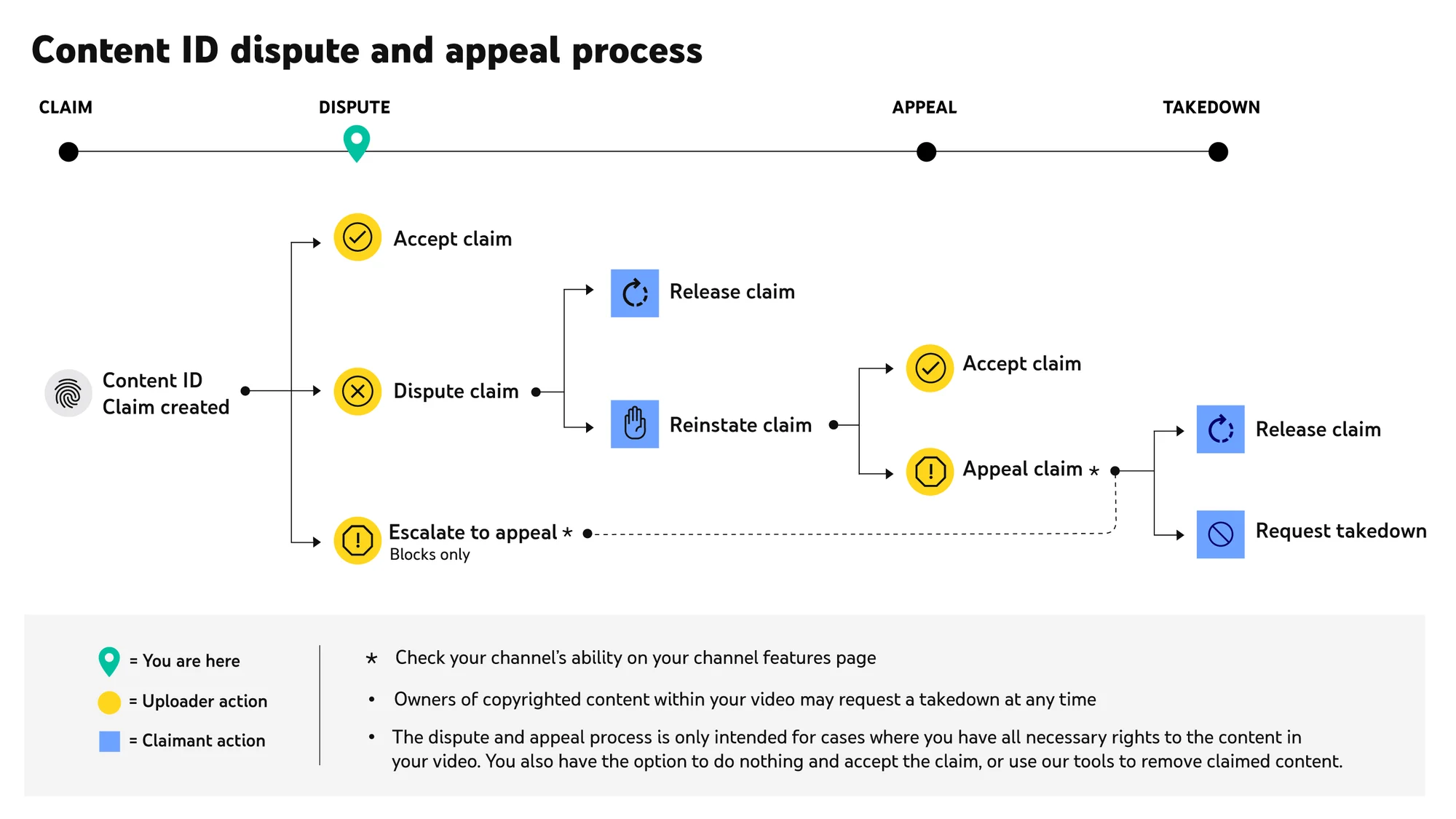
The diagram above is the one Google provides to illustrate the dispute process.
Setup
The research was done against YouTube Studio at:
https://studio.youtube.com
The researcher was testing the Studio API endpoints for missing access control checks. The relevant endpoint was found after the account had uploaded a video that had a Content ID claim against it. No special tooling is described beyond sending requests to the Studio API.
Finding it
The starting point was the obvious attack: calling the API that deletes someone else's video. That attempt returned an access denied error, so direct deletion was properly protected. The question then became what else could be done with the same API surface.
While testing the endpoints, the researcher found a request that lists the Content ID claims received against a video owned by the account:
POST /youtubei/v1/creator/list_creator_received_claims?alt=json&key=[redacted] HTTP/1.1
Host: studio.youtube.com

{"context":{"client":{"clientName":62,"clientVersion":"1.20200105.0.0","hl":"en","gl":"US","experimentsToken":""},"request":{"returnLogEntry":true,"internalExperimentFlags":[{"key":"force_route_innertube_shopping_settings_to_outertube","value":"true"},{"key":"force_live_chat_merchandise_upsell","value":"false"},{"key":"force_route_delete_playlist_to_outertube","value":"false"}]},"clientScreenNonce":"MC41MTczMTA1ODY2MDI3NzMy"},"videoId":"n6c0nOScCCo","criticalRead":false}
The video under test is identified at the bottom of the body:
"videoId":"n6c0nOScCCo"
Replacing that video ID with any other video ID returned the Content ID claims placed against that video. The endpoint had no proper access control check tying the request to the owner of the video, so claims on anyone's videos could be read. The response also contained the claim ID, which raised the question of what could be done with it.
Exploitation
Step 1: leak the claim ID for a target video
Send the list_creator_received_claims request shown above with the videoId of the video you want to target. Because the endpoint does not verify ownership, the response describes the claims on that video, including the claim ID. This is the IDOR: a read of another user's claim data.
Step 2: file a dispute using the leaked claim ID
The researcher then found the endpoint that submits a dispute against a claim:
POST /youtubei/v1/copyright/submit_claim_dispute?alt=json&key=[redacted] HTTP/1.1
Host: studio.youtube.com

{"claimId":{"claimId":"UK9o_XrpTyM","videoId":"n6c0nOScCCo"},"claimDisputeReason":"CLAIM_DISPUTE_REASON_FAIR_USE","fairUseType":"FAIR_USE_TYPE_PROMOTIONAL","justification":"test","signature":"test","channelId":"UCB1Z_cpKu-5V4ag30cndODQ","context":{"client":{"clientName":62,"clientVersion":"1.20200105.0.0","hl":"en","gl":"US","experimentsToken":""},"request":{"returnLogEntry":true,"internalExperimentFlags":[{"key":"force_route_innertube_shopping_settings_to_outertube","value":"true"},{"key":"force_live_chat_merchandise_upsell","value":"false"},{"key":"force_route_delete_playlist_to_outertube","value":"false"}]},"clientScreenNonce":"MC41MTczMTA1ODY2MDI3NzMy"}}
The body ties a claim to a video in the claimId object:
{"claimId":{"claimId":"UK9o_XrpTyM","videoId":"n6c0nOScCCo"},"claimDisputeReason":"CLAIM_DISPUTE_REASON_FAIR_USE",
With the claim ID leaked in step 1, the attacker changes claimId to the leaked value and videoId to the target video. The request then files a dispute on someone else's video, on the attacker's behalf, without any relationship between the attacker and the claim.
Step 3: let the real claimant respond
Once the fake dispute is filed, the actual owner of the material is notified, exactly as they would be for a genuine dispute. They can release the claim, reinstate it, submit a takedown request, or let the claim expire. If they choose the takedown route, the video is removed and the channel receives a copyright strike. The researcher is explicit that this did not directly delete anyone's videos: the deletion and the strike depend on the claimant reacting with a takedown. The dispute is the lever, not the deletion itself.
A video proof of concept accompanies the write-up:
Root cause
The list_creator_received_claims endpoint takes a videoId from the client and returns the claims for that video without checking that the caller owns the video. That is a classic IDOR and it is what makes the claim ID available to an attacker.
The submit_claim_dispute endpoint then accepts a claimId and videoId pair, and the researcher was able to file a dispute on someone else's video by swapping in a leaked claim ID. The two flaws compose: the first leaks the identifier the second needs. The signature field in the dispute body is set to test in the captured request; the report does not analyse it.
Direct deletion was protected, as the access denied error on the delete API showed. The gap was in the claim and dispute workflow around it.
Impact
An attacker who knows a target video ID can read the Content ID claims on that video, including the claim ID, and can file a dispute against the claim on the victim's behalf. The victim's video is not deleted by the attacker directly. The damage comes indirectly: the real claimant is notified of a dispute they did not expect, and if they respond with a takedown request, the video is removed and the channel receives a copyright strike. Because strikes put a channel at risk of deletion, the technique could in principle be used to get someone's YouTube videos deleted and to damage their channel. The report frames this as a creative way that could have achieved deletion, not as a demonstrated deletion.
Fix
The report does not describe the fix or the timeline.
Variants to test
- Other Studio endpoints that take a
videoId. Send each with a video ID from a different account. A positive result is a response containing that video's data instead of an access denied error. - Other endpoints that take a
claimId. Try actions such as reinstating, releasing or responding to a claim with a leaked ID. A positive result is the action succeeding against a claim you do not own. - Identifier swaps in composite objects. Where a body carries a pair such as
claimIdandvideoId, mix an ID you own with one you do not. A positive result is the server accepting the mismatched pair. - Fields that look like integrity checks. The
signaturefield was sent astestin the captured request. Try altering or omitting such fields on similar endpoints. A positive result is the request being accepted without a valid signature. - Workflows that notify a third party. Any feature where your action triggers a notification or a decision by another party, such as a dispute, report or appeal, is worth testing for missing ownership checks, because the harm arrives through the third party's response rather than through your own account.
What happened, in plain words
YouTube has a copyright system. When you upload a video that contains something someone else owns, for example a piece of music, the owner (or a company acting for them) can put a Content ID claim on your video. A claim is not a punishment. Most of the time it just means ads may appear on your video and the money goes to the owner of the material.
If you believe you actually own everything in your video, you can dispute the claim. That starts a conversation with the claimant. Google publishes a diagram of what happens next, and the researcher includes it in the post:
The diagram shows the choices the claimant has once you dispute. The report quotes Google's own description of those choices:
- Release the claim: the claimant agrees with your dispute and lets the claim go. If you were earning money from the video, those settings come back automatically once every claim on the video is released.
- Reinstate the claim: the claimant thinks the claim is still valid, so your dispute is rejected and the claim stays on your video. You may be able to appeal.
- Submit a takedown request: the claimant sends a copyright takedown request. If the request is valid, your video is removed from YouTube and your channel gets a copyright strike.
- Let the claim expire: if the claimant says nothing for 30 days, the claim expires and is released.
A copyright strike is serious. A channel that collects strikes is at risk of being deleted entirely. The whole finding in this post depends on that third option: if an attacker can file a dispute on someone else's video, the real claimant gets notified, and the claimant may answer with a takedown, which removes the video and strikes the channel.
The researcher found two weaknesses in YouTube Studio, the website creators use to manage their videos. The first let anyone read the claims on anyone else's video, including an identifier called the claim ID. The second let the researcher file a dispute using a leaked claim ID on a video that belonged to someone else. Neither weakness deletes a video by itself. Together they let an attacker start a chain that ends with the real owner possibly taking the video down.
Background: what an API is, and what we are poking at
Before the details, a few words for anyone new to this.
A website like YouTube Studio is not one big program. The page you see in your browser asks a server for data and sends actions to it using small messages called API requests. An API (application programming interface) is simply the set of addresses and message formats a server accepts. When you click a button, your browser quietly sends one of these messages in the background.
Each request has a few parts:
- A method and path, such as
POST /youtubei/v1/..., which says what kind of action you want and where. - Headers, small lines of extra information.
Hostsays which site the request is for. - A body, the data you are sending, usually written in JSON, a text format made of names and values in curly braces.
A parameter is one named value inside that request, for example videoId. An endpoint is one specific API address that does one specific job.
When you are logged in, your browser holds a session, a proof that you are you. That proof travels with every request, usually as a cookie (a small piece of data the site stored in your browser) or a token (a string the site gave you). The server reads it and decides what you are allowed to do. That decision is called an access control check. When a server forgets to make that check, and hands you data or performs an action for something that is not yours, we call it broken access control. A common form is IDOR, short for Insecure Direct Object Reference: the request contains an identifier such as a video ID, and the server uses whatever ID you send without asking whether that object belongs to you. A simple comparison: a cloakroom that hands out coats based on the ticket number you say, without checking that the ticket is really yours.
Setup
The research was done against YouTube Studio at:
https://studio.youtube.com
This is the dashboard where a creator uploads videos, sees their statistics and manages claims. The researcher was sending requests to the Studio API and looking for endpoints with missing access control checks.
The relevant endpoint was found after the account had uploaded a video that had a Content ID claim against it. The report does not describe any special tooling beyond sending requests to the Studio API.
Finding it
The starting point was the obvious attack: calling the API that deletes someone else's video. That attempt returned an access denied error, so direct deletion was properly protected. The question then became what else could be done with the same API surface.
While testing the endpoints, the researcher found a request that lists the Content ID claims received against a video owned by the account:
POST /youtubei/v1/creator/list_creator_received_claims?alt=json&key=[redacted] HTTP/1.1
Host: studio.youtube.com

{"context":{"client":{"clientName":62,"clientVersion":"1.20200105.0.0","hl":"en","gl":"US","experimentsToken":""},"request":{"returnLogEntry":true,"internalExperimentFlags":[{"key":"force_route_innertube_shopping_settings_to_outertube","value":"true"},{"key":"force_live_chat_merchandise_upsell","value":"false"},{"key":"force_route_delete_playlist_to_outertube","value":"false"}]},"clientScreenNonce":"MC41MTczMTA1ODY2MDI3NzMy"},"videoId":"n6c0nOScCCo","criticalRead":false}
Line by line:
POST /youtubei/v1/creator/list_creator_received_claims?alt=json&key=...is the address of the endpoint. The name says what it does: list the claims a creator has received.POSTis the method, used here because the request carries a body. The part after the?is the query string, extra settings in the URL.alt=jsonasks for JSON output, andkeyis a value carried in the query string.Host: studio.youtube.comtells the server which site the request is addressed to.- The body is one JSON object.
contextcarries information about the client application:clientNameandclientVersionidentify the app,hlandglare language and country, andexperimentsTokenis empty here. - Inside
request,returnLogEntryandinternalExperimentFlagsare internal switches. They look technical but are not the interesting part. clientScreenNonceis another value sent by the client.videoIdis the important field: it names the video whose claims you want to see.criticalReadis another internal flag.
The video under test is identified at the bottom of the body:
"videoId":"n6c0nOScCCo"
This is the single value that tells the server which video to look at. The researcher replaced it with other video IDs. The server returned the Content ID claims placed against those videos, even though they belonged to other people. In other words, the endpoint had no proper access control check tying the request to the owner of the video, so claims on anyone's videos could be read. That is the IDOR described above.
The response also contained the claim ID, a short identifier for the individual claim. That raised the question of what could be done with it.
Exploitation
Step 1: leak the claim ID for a target video
Send the list_creator_received_claims request shown above with the videoId of the video you want to target. Because the endpoint does not verify ownership, the response describes the claims on that video, including the claim ID. This is the IDOR: a read of another user's claim data. The reason for this step is simple: the next request needs a claim ID, and this is where one can be obtained for a video you do not own.
Step 2: file a dispute using the leaked claim ID
The researcher then found the endpoint that submits a dispute against a claim:
POST /youtubei/v1/copyright/submit_claim_dispute?alt=json&key=[redacted] HTTP/1.1
Host: studio.youtube.com

{"claimId":{"claimId":"UK9o_XrpTyM","videoId":"n6c0nOScCCo"},"claimDisputeReason":"CLAIM_DISPUTE_REASON_FAIR_USE","fairUseType":"FAIR_USE_TYPE_PROMOTIONAL","justification":"test","signature":"test","channelId":"UCB1Z_cpKu-5V4ag30cndODQ","context":{"client":{"clientName":62,"clientVersion":"1.20200105.0.0","hl":"en","gl":"US","experimentsToken":""},"request":{"returnLogEntry":true,"internalExperimentFlags":[{"key":"force_route_innertube_shopping_settings_to_outertube","value":"true"},{"key":"force_live_chat_merchandise_upsell","value":"false"},{"key":"force_route_delete_playlist_to_outertube","value":"false"}]},"clientScreenNonce":"MC41MTczMTA1ODY2MDI3NzMy"}}
Line by line:
POST /youtubei/v1/copyright/submit_claim_dispute?alt=json&key=...is the endpoint that files a dispute. The name says it: submit a claim dispute.Host: studio.youtube.comagain names the site.claimIdis an object with two fields:claimId(UK9o_XrpTyM, the identifier of the claim) andvideoId(n6c0nOScCCo, the video the claim is on). This pair is what ties the dispute to one specific claim on one specific video.claimDisputeReasonsays why you are disputing. Here it isCLAIM_DISPUTE_REASON_FAIR_USE, meaning the uploader claims fair use.fairUseTypeis set toFAIR_USE_TYPE_PROMOTIONALin the captured request.justificationis the free-text explanation. In the captured request it istest.signatureis another field in the body, set totestin the captured request. In the captured request it is alsotest.channelIdidentifies the channel filing the dispute.contextandclientScreenNonceare the same client information as in the first request.
The body ties a claim to a video in the claimId object:
{"claimId":{"claimId":"UK9o_XrpTyM","videoId":"n6c0nOScCCo"},"claimDisputeReason":"CLAIM_DISPUTE_REASON_FAIR_USE",
This is the part that matters. With the claim ID leaked in step 1, the attacker changes claimId to the leaked value and videoId to the target video. The request then files a dispute on someone else's video, on the attacker's behalf, without any relationship between the attacker and the claim. The reason for this step is that the researcher was able to file the dispute on someone else's video using the leaked claim ID.
Step 3: let the real claimant respond
Once the fake dispute is filed, the actual owner of the material is notified, exactly as they would be for a genuine dispute. They can release the claim, reinstate it, submit a takedown request, or let the claim expire. If they choose the takedown route, the video is removed and the channel receives a copyright strike. The researcher is explicit that this did not directly delete anyone's videos: the deletion and the strike depend on the claimant reacting with a takedown. The dispute is the lever, not the deletion itself.
A video proof of concept accompanies the write-up:
Root cause
The list_creator_received_claims endpoint takes a videoId from the client and returns the claims for that video without checking that the caller owns the video. That is a classic IDOR and it is what makes the claim ID available to an attacker.
The submit_claim_dispute endpoint then accepts a claimId and videoId pair and files a dispute without verifying that the caller is entitled to dispute that claim, for example as the uploader of the video. The two flaws compose: the first leaks the identifier the second needs. The signature field in the dispute body is set to test in the captured request; the report does not analyse it.
Direct deletion was protected, as the access denied error on the delete API showed. The gap was in the claim and dispute workflow around it.
Impact
An attacker who knows a target video ID can read the Content ID claims on that video, including the claim ID, and can file a dispute against the claim on the victim's behalf. The victim's video is not deleted by the attacker directly. The damage comes indirectly: the real claimant is notified of a dispute they did not expect, and if they respond with a takedown request, the video is removed and the channel receives a copyright strike. Because strikes put a channel at risk of deletion, the technique could in principle be used to get someone's YouTube videos deleted and to damage their channel. The report frames this as a creative way that could have achieved deletion, not as a demonstrated deletion.
Fix
The report does not describe the fix or the timeline.
Variants to test
- Other Studio endpoints that take a
videoId. Send each with a video ID from a different account. A positive result is a response containing that video's data instead of an access denied error. - Other endpoints that take a
claimId. Try actions such as reinstating, releasing or responding to a claim with a leaked ID. A positive result is the action succeeding against a claim you do not own. - Identifier swaps in composite objects. Where a body carries a pair such as
claimIdandvideoId, mix an ID you own with one you do not. A positive result is the server accepting the mismatched pair. - Fields that look like integrity checks. The
signaturefield was sent astestin the captured request. Try altering or omitting such fields on similar endpoints. A positive result is the request being accepted without a valid signature. - Workflows that notify a third party. Any feature where your action triggers a notification or a decision by another party, such as a dispute, report or appeal, is worth testing for missing ownership checks, because the harm arrives through the third party's response rather than through your own account.
Glossary
- API: the set of addresses and message formats a server accepts, so programs and pages can ask it for data or actions.
- Access control check: the server's decision about whether you are allowed to do what you are asking.
- Broken access control: a flaw where the server fails to make that decision correctly.
- Claim ID: the short identifier for one Content ID claim, used to refer to that claim in later requests.
- Content ID claim: a notice placed on a video saying it contains material owned by someone else.
- Cookie: a small piece of data a site stores in your browser, often used to remember that you are logged in.
- Copyright strike: a penalty on a YouTube channel after a valid copyright takedown; several strikes put the channel at risk of deletion.
- Dispute: the uploader's formal challenge to a Content ID claim.
- Endpoint: one specific API address that performs one specific job.
- Header: a line of extra information sent with a request, such as
Host. - IDOR (Insecure Direct Object Reference): a flaw where a request carries an identifier and the server uses it without checking that the object belongs to you.
- JSON: a text format for data, made of names and values in curly braces.
- Method: the kind of action a request asks for, such as
POST. - Parameter: one named value inside a request, for example
videoId. - Query string: the part of a URL after the
?, carrying extra settings. - Session: the state that proves you are logged in as a particular user.
- Takedown request: a formal copyright complaint asking YouTube to remove a video.
- Token: a string a site gives you to prove who you are or to authorise a request.
- YouTube Studio: the website creators use to manage their videos, statistics and claims.



