URL Given leading to end users ending up in malicious sites
The profile page allowed users to include clickable links, and the reporter argued that a malicious user could point such a link at a phishing page or other harmful site. The reporter acknowledged that exploitation depends entirely on the end user choosing to click the link.

- Disclosed after 12 hours
Hi,
I found a design issue in the profile statement for the registered user. This is dependant on the end user however.
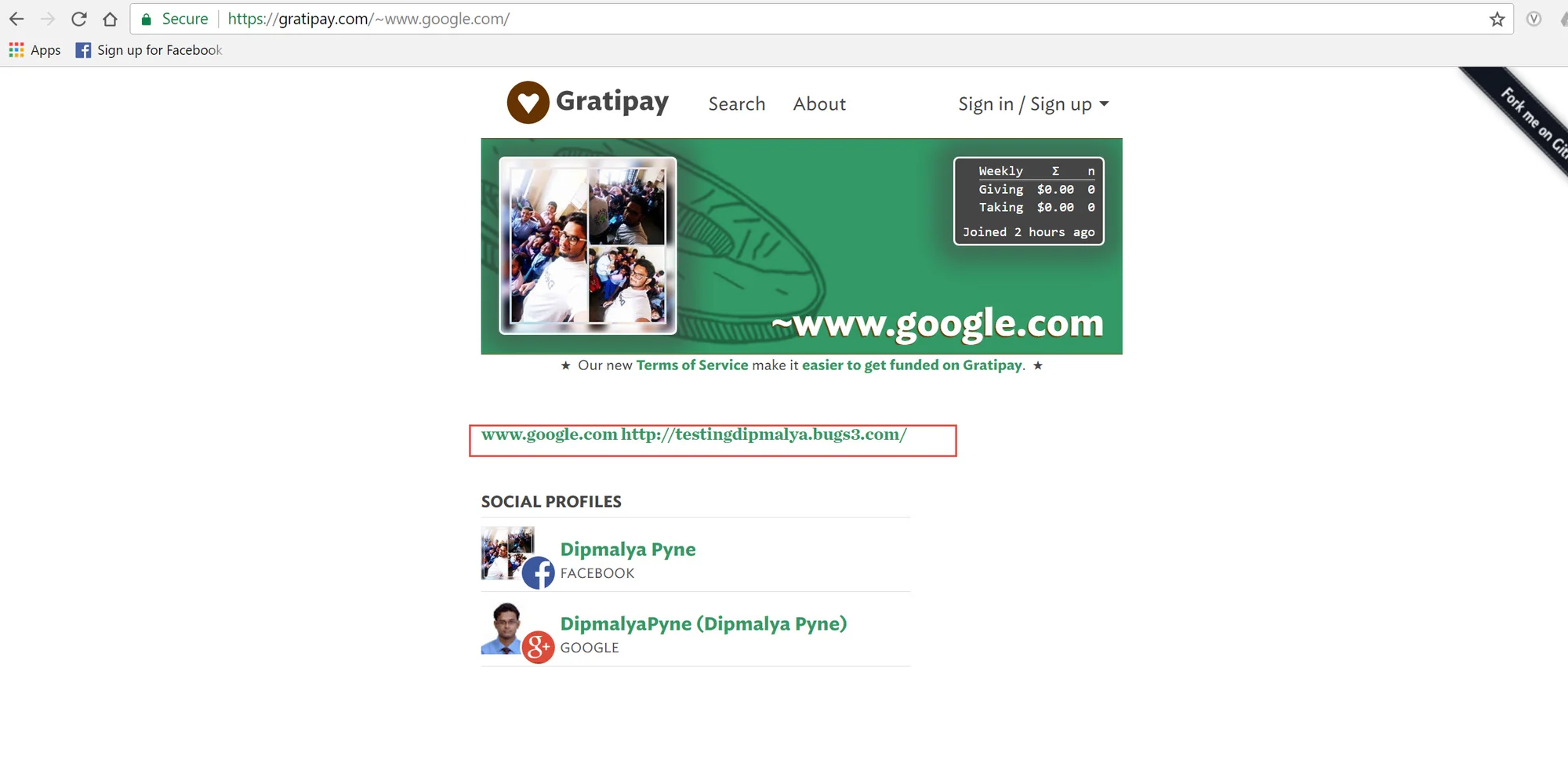
In the profile statement, one can write something as well giving links is allowed. This, I think is by design. However, let us suppose the authenticated user creates a website of his own which is basically a phishing page. Or he gives links to malicious websites.
Next he sends the link of his page to the victim. Try out this page. https://gratipay.com/~www.google.com/.
Here the first link is to www.google.com. However, the next link is unknown and can be malicious.
Yes, this depends on the end user completely but I still think this is an issue.
Mitigation: Allow only alphabets or display the entire thing as text. The end user can copy paste the link in the browser if it is that relevant.
Thanks & Regards, Dipmalya Pyne
Attachments
Not written yet. The AI write-up for this report has not been written yet. The Original tab links to the source.
How it worked
Root cause
Likely the profile statement rendered user-supplied URLs as clickable links without restricting or warning about where they point.
Impact
A victim who chooses to click a link in a profile could be taken to a phishing or malicious site; the reporter notes this depends entirely on the end user.
What the attacker needed
A registered account; victim views the profile and clicks the link
The fix
The reporter suggested allowing only letters or displaying the link as plain text so users must copy and paste it themselves.
How it was found
- Create a profile statement that contains a link to a site you control.
- Send the profile page link to a victim and encourage them to click the embedded link.
Explained by bugbounty.wiki with AI from the original and checked against quotes from it; it can still be wrong. Read the original before relying on a detail.
Not written yet. The AI write-up for this report has not been written yet. The Original tab links to the source.
A profile page let people type in web addresses that became clickable links. The reporter worried that someone could make a link that looks harmless but actually goes to a fake login page or a harmful site. The reporter also admitted that nothing happens unless the person reading the profile decides to click the link.
What is Open redirect?
A trusted site forwards users to any address an attacker picks; rarely paid alone, often the missing link in a chain.