Authorization Bypass in Delivery Chat Logs
The mobile API endpoint for order delivery chat logs did not verify that the requesting user owned the order, so any authenticated user could read other users' chat messages and order details by changing the order delivery ID. The response also included Firebase tokens, though the reporter could not exploit them.

- Fixed in 10 hours
- Paid in 10 hours
- Disclosed after 5 months
An authorization issue in the mobile app API allows any Instacart user to gain access to other users' order delivery chat logs. The /api/v2/order_deliveries/:order_delivery_id/order_change_logs endpoint does not sufficiently check if the user has permissions to access that particular order's chat logs.
Steps to Reproduce
I used Burp Suite to intercept the traffic between my iPhone and the Instacart API. When I found the "View Chat Logs" button on one of my past orders, I noticed it triggered the following API request:
GET /api/v2/order_deliveries/261932226/order_change_logs HTTP/1.1
Host: www.instacart.com
Accept: */*
[...]
This request is answered by the API with a JSON blob that contains chat messages that were exchanged between the buyer and the shopper. As well as a few other details like when the order was placed and if any changes were made to the order due to out of stock items.
However, if you change the ID in the URL to something else, you will notice the API actually responds with the chat log and order data, regardless of who made the order. I tried with 261972220 and you can confirm this delivery does not belong to the user with account ███, but for instance 261972226 does.
Risk
This vulnerability leaks private messages exchanged between shopper, driver, and customer. It may also include product names that were on the order if something had to be changed about the order.
Here is an example:
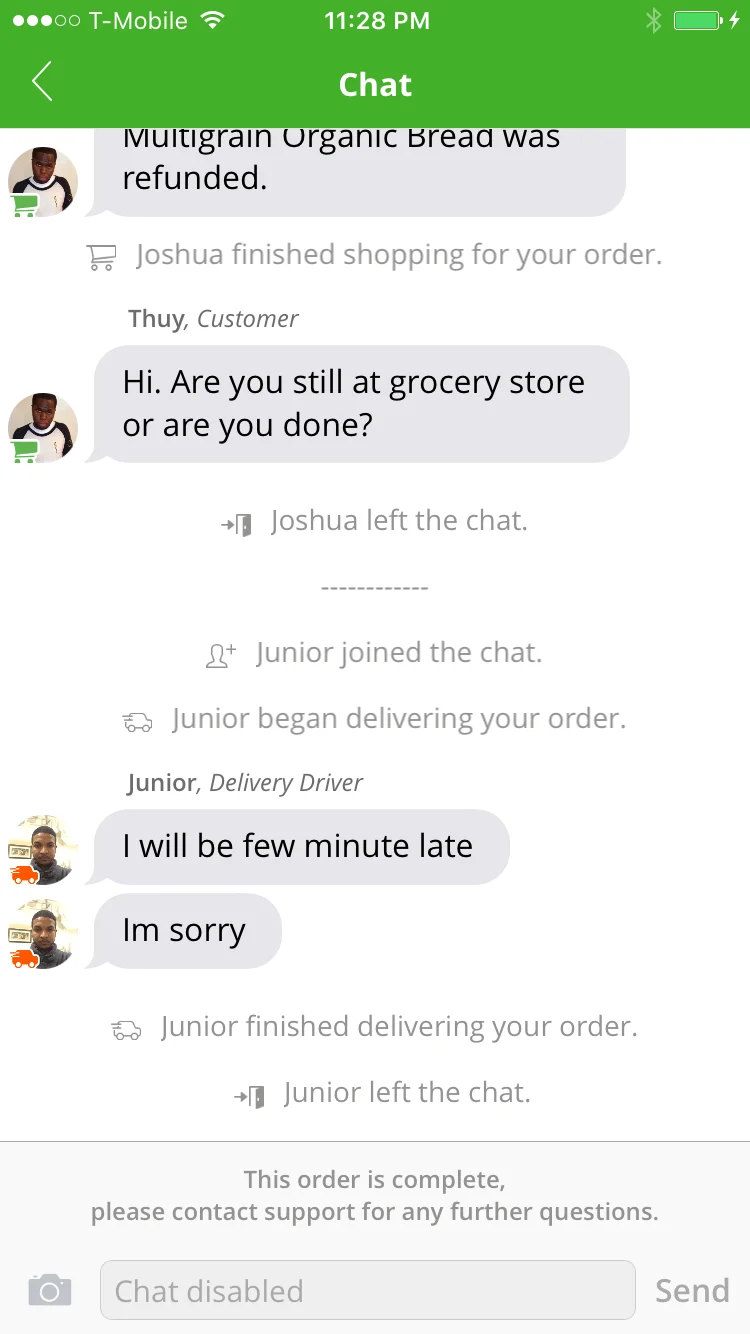
This could lead to greater compromise, since the API returns the Firebase tokens for a few objects as well. So far I have not been able to do anything interesting with the Firebase tokens, but I'm not a Firebase expert.
Here is an example (id: 261972220):
michiel@msp ~ $ curl https://instacart.firebaseio.com/order_deliveries/xy8TcFsDZiKm1JwnqqFp.json
{"46671792":"","46671794":"","46671795":"","46671802":"","46671804":"","46872067":"","46872104":"","46872195":"","46872357":""}%
Mitigation
Implement an authorization check that makes sure only a users' own orders can be accessed.
Context
Instacart's mobile app exposes an order delivery chat log feature. When a buyer opens a past order and taps "View Chat Logs", the app fetches the messages exchanged between the buyer and the shopper for that delivery. The data is served by the Instacart web API under the /api/v2/order_deliveries/:order_delivery_id/order_change_logs endpoint, keyed by an order delivery identifier.
The report describes an authorization flaw in that endpoint: it does not sufficiently check whether the requesting user has permission to access the chat logs of the particular order being requested. Any authenticated Instacart user can therefore read other users' delivery chat logs by supplying a different delivery ID.
Setup
The researcher used their own Instacart account and the Instacart iPhone app, with Burp Suite configured to intercept the traffic between the phone and the Instacart API. No special role or privilege was needed: a normal user account with at least one past order was enough, because the "View Chat Logs" button on that order provides a legitimate request to start from.
Finding it
While reviewing intercepted traffic, the researcher opened the "View Chat Logs" button on one of their own past orders. The app issued the following request:
GET /api/v2/order_deliveries/261932226/order_change_logs HTTP/1.1
Host: www.instacart.com
Accept: */*
[...]
The only thing tying the request to the caller's own order is the numeric order_delivery_id in the path. The API answered with a JSON blob containing the chat messages exchanged between the buyer and the shopper, plus a few other details such as when the order was placed and whether any changes were made because of out of stock items.
Because nothing else in the request identifies the order as belonging to the caller, the natural next step was to change the identifier.
Exploitation
Step 1: Capture a legitimate request
Intercept the app's request for your own order's chat logs, as shown above. This establishes the endpoint, the path parameter and the expected response shape.
Step 2: Swap the delivery ID
Change the ID in the URL to another value. The API responds with the chat log and order data regardless of who placed the order. The researcher tried 261972220 and confirmed that this delivery does not belong to the user with account [redacted], whereas, for instance, 261972226 does. In other words, the endpoint returns data for deliveries outside the caller's account with no further manipulation.
Step 3: Read the leaked content
The response contains the private messages exchanged between shopper, driver and customer. It may also include product names that were on the order if something had to be changed. The researcher included a screenshot of an example response:
Step 4: Note the Firebase tokens
The response also returns Firebase tokens for a few objects. The researcher states that they were not able to do anything interesting with these tokens so far, and notes that they are not a Firebase expert. As an example for delivery id 261972220, they queried the Firebase instance directly:
michiel@msp ~ $ curl https://instacart.firebaseio.com/order_deliveries/xy8TcFsDZiKm1JwnqqFp.json
{"46671792":"","46671794":"","46671795":"","46671802":"","46671804":"","46872067":"","46872104":"","46872195":"","46872357":""}%
The response is a JSON object whose keys are numeric identifiers with empty string values. The researcher presents this as an example, without claiming a working exploit against it.
Root cause
The endpoint takes the order_delivery_id from the path and returns the associated chat log and order data without sufficiently verifying that the authenticated user owns or is otherwise entitled to that delivery. The identifier is the only thing selecting the record, and the researcher showed that a different valid ID returned another user's data. The report does not describe the server-side implementation, so the exact check that is missing, or where it should sit, is not stated; the observable behaviour is that ownership is not enforced.
Impact
The flaw leaks private messages exchanged between shopper, driver and customer, and may also reveal product names from the order where items had to be changed. Because the API also returns Firebase tokens for a few objects, the researcher flags the possibility of greater compromise, while being explicit that they have not been able to do anything interesting with those tokens. The report does not quantify how many deliveries are exposed or whether IDs can be enumerated at scale; it demonstrates access to at least one delivery belonging to another account.
Fix
The report's mitigation is to implement an authorization check that ensures only a user's own orders can be accessed. The report does not say what was actually changed.
Variants to test
- Sequential or guessable object IDs on other endpoints. Take any endpoint that takes an order, delivery, chat or log identifier in the path and substitute an ID from another account. A positive result is a
200with another user's data rather than a403or404. - Chat and messaging features in mobile apps. Intercept the app's request for conversation history and swap the conversation or delivery ID. A positive result is message content belonging to a different user.
- Secondary data stores referenced by the API. Where a response includes tokens or keys for a backend such as Firebase, try reading the referenced path directly, as the researcher did with the
order_deliveriesobject. A positive result is readable data at that path without further authorization. - Same endpoint with different HTTP methods or parameters. If the API accepts the identifier elsewhere (query string, body), check whether the authorization check is applied consistently. A positive result is the same data returned through the alternate route.
Hunting notes
This kind of bug tends to hide in mobile app APIs where the client sends a bare numeric identifier and the server trusts it, especially on secondary features such as chat logs, change logs and delivery history that are bolted onto an order flow. During recon, watch for endpoints whose path contains an object ID and whose response contains personal content: messages, addresses, order contents. The signal is a request that carries no other ownership context than the ID itself.
The researcher showed impact by starting from a legitimate request generated by the app, changing only the ID, and demonstrating that the returned delivery belonged to a different account. The bounty for this report was 100.00 USD.
What happened, in plain words
Instacart is a grocery delivery service. You order food through its website or mobile app, a shopper picks the items in a store, and a driver brings them to you. The app has a chat feature: after an order, you can open a past order and tap a button called "View Chat Logs" to read the messages you exchanged with the shopper or driver about that delivery.
A security researcher found that this chat feature had a serious flaw. The app asks Instacart's servers for the chat log of a particular delivery by sending a request that contains a delivery number. The server did not properly check that the delivery number belonged to you. So if you changed the number in the request to somebody else's delivery number, the server happily sent back that other person's private chat messages, along with some order details.
In security terms this is an authorization bypass (also called a privilege escalation or broken access control). "Authentication" means proving who you are, for example by logging in with a password. "Authorization" means deciding what you are allowed to do once you are logged in. Here, authentication worked: you had to be a logged-in Instacart user. Authorization failed: the server did not check that the delivery you asked for was yours.
A simple everyday comparison: imagine a hotel where the front desk gives you a key card after you show your ID. That is authentication. But if the key card opens every room in the building, not just yours, the hotel has an authorization problem. The researcher's finding is the digital equivalent: any guest's key card opened any room's chat log.
Background: the pieces involved
Before walking through the steps, here are the concepts you need. Each one is explained from scratch.
What an API is
An API (Application Programming Interface) is the set of doors a program uses to talk to a server. When you tap a button in a mobile app, the app does not usually contain all the data itself. Instead it sends a request over the internet to the company's servers, and the server sends back a response. The API is the collection of addresses (called endpoints) that the app is allowed to call, and the rules for what each one returns.
Think of a restaurant. The menu is the API: it lists what you can order and what you will get. The kitchen is the server. You do not walk into the kitchen yourself; you tell the waiter what you want from the menu, and the waiter brings it back. In the same way, the app asks the API for data, and the API returns it.
What an endpoint is
An endpoint is one specific address on the API, usually written as a path such as /api/v2/order_deliveries/261932226/order_change_logs. Each endpoint does one job: fetch a chat log, place an order, list your past orders, and so on. The path often contains numbers or words that tell the server which particular record you mean. Those parts are called path parameters.
What a request and a response look like
When your browser or app talks to a server, it sends an HTTP request. The request has a few parts:
- A method, such as
GET(please give me something) orPOST(please create or change something). - A path, such as
/api/v2/order_deliveries/261932226/order_change_logs, which says which endpoint you want. - Headers, which are extra labels with information such as what kind of data you accept.
- Sometimes a body, which carries data you are sending, for example when you submit a form.
The server replies with an HTTP response. The response has a status code (a number such as 200 for success, 403 for forbidden, 404 for not found) and usually a body containing the data, often in JSON format.
What JSON is
JSON (JavaScript Object Notation) is a simple text format for structured data. It uses curly braces {} for objects (a collection of named values), square brackets [] for lists, and quotes around names and text. For example, {"name": "Alice", "age": 30} is a JSON object with two fields. APIs commonly return JSON because both humans and programs can read it easily.
What a cookie or token is
When you log in to a website, the server needs a way to recognise you on the next request. HTTP itself is stateless: each request is independent, and the server does not automatically remember that the previous request came from the same person. To solve this, the server gives your browser (or app) a small piece of data called a session cookie or a token. Your browser sends it back with every subsequent request, and the server uses it to look up who you are.
Think of a wristband at a festival. You show your ticket once at the entrance, and you get a wristband. For the rest of the day, the staff check the wristband, not your ticket. The wristband is the session token: it proves you already authenticated, without you having to log in again for every request.
In this report, the researcher was logged in to their own Instacart account, so their requests carried their own session. The server knew who they were. The problem was that it did not check what they were allowed to see.
What Burp Suite is
Burp Suite is a tool used by security researchers and developers to inspect and modify the traffic between an app or browser and a server. It works as a proxy: you configure your phone or browser to send its traffic through Burp, and Burp shows you each request and response. You can pause a request, change a value, and let it continue. This is how the researcher captured the app's request and then changed the delivery number.
A simple comparison: Burp is like a mailroom where every letter passes through your desk. You can read each letter, and you can also swap the contents before sending it on.
What Firebase is
Firebase is a cloud service (originally independent, now owned by Google) that provides databases and other backend features for apps. Apps can store data in a Firebase database and read it back through a URL. In this report, the Instacart API response included Firebase tokens for a few objects, and the researcher also queried a Firebase database directly. A token here is like a key that grants access to a particular part of the Firebase data.
What the product and feature do
Instacart's mobile app lets a customer place a grocery order, chat with the shopper who is picking the items, and review past orders. The "View Chat Logs" button on a past order opens the conversation for that delivery. Behind the scenes, the app calls an API endpoint to fetch those messages. The endpoint is named /api/v2/order_deliveries/:order_delivery_id/order_change_logs. The :order_delivery_id part is a placeholder: in a real request it is replaced by a number that identifies one specific delivery.
Setup: what the researcher used
The researcher used:
- Their own normal Instacart account. No special role or admin access was needed.
- The Instacart iPhone app.
- Burp Suite, configured to intercept the traffic between the phone and the Instacart API.
Having at least one past order was enough, because the "View Chat Logs" button on that order produces a legitimate request to start from. The researcher did not need to guess the endpoint or its parameters: the app itself showed them.
Finding it: capturing a legitimate request
While reviewing the intercepted traffic, the researcher opened the "View Chat Logs" button on one of their own past orders. The app sent this request:
GET /api/v2/order_deliveries/261932226/order_change_logs HTTP/1.1
Host: www.instacart.com
Accept: */*
[...]
Line by line, in plain words:
GET /api/v2/order_deliveries/261932226/order_change_logs HTTP/1.1is the request line.GETmeans "give me this data". The path/api/v2/order_deliveries/261932226/order_change_logsnames the endpoint and includes the delivery number261932226.HTTP/1.1is the version of the HTTP protocol being used.Host: www.instacart.comtells the server which website the request is for. One server can host many sites, so the host header says which one you want.Accept: */*says the client will accept any kind of response format. The*/*is a wildcard meaning "anything".[...]is not part of the actual request. It is a placeholder meaning "other headers were here but are not shown". In a real request there would be more headers, including the session cookie or token that identifies the logged-in user.
The only thing in this request that selects which order's chat log to return is the numeric order_delivery_id in the path. Nothing else in the visible request says "this is my order". The server is expected to look up the logged-in user from the session and check that the delivery belongs to them.
The API answered with a JSON blob containing the chat messages exchanged between the buyer and the shopper, plus a few other details such as when the order was placed and whether any changes were made because of out of stock items. A JSON blob here just means a chunk of JSON data, possibly nested and not very pretty to read by eye.
Because nothing else in the request identifies the order as belonging to the caller, the natural next step was to change the identifier.
Exploitation: step by step
Step 1: Capture a legitimate request
The first step is to intercept the app's request for your own order's chat logs, as shown above. The purpose is to establish three things: the endpoint address, the path parameter that selects the record, and the shape of the expected response. Without this baseline, you would not know what a normal, successful response looks like, and you could not tell whether a modified request returned real data or an error.
Step 2: Swap the delivery ID
Change the ID in the URL to another value. The API responds with the chat log and order data regardless of who placed the order. The researcher tried 261972220 and confirmed that this delivery does not belong to the user with account [redacted], whereas, for instance, 261972226 does. In other words, the endpoint returns data for deliveries outside the caller's account with no further manipulation.
Why this works: the server takes the number from the path and uses it to look up the delivery. It does not compare that delivery's owner with the logged-in user. So any logged-in user who supplies a valid delivery number receives that delivery's data. The researcher did not need to forge a session, guess a password, or use any special tool beyond changing one number.
Step 3: Read the leaked content
The response contains the private messages exchanged between shopper, driver and customer. It may also include product names that were on the order if something had to be changed, for example when an item was out of stock and the shopper substituted something else. The researcher included a screenshot of an example response:
The screenshot shows an example of the kind of data returned: chat messages and order details that belong to a delivery other than the researcher's own. This is the concrete proof that private conversations are exposed.
Step 4: Note the Firebase tokens
The response also returns Firebase tokens for a few objects. The researcher states that they were not able to do anything interesting with these tokens so far, and notes that they are not a Firebase expert. As an example for delivery id 261972220, they queried the Firebase instance directly:
michiel@msp ~ $ curl https://instacart.firebaseio.com/order_deliveries/xy8TcFsDZiKm1JwnqqFp.json
{"46671792":"","46671794":"","46671795":"","46671802":"","46671804":"","46872067":"","46872104":"","46872195":"","46872357":""}%
Line by line, in plain words:
michiel@msp ~ $is the shell prompt. It shows the user name (michiel), the machine name (msp), the current directory (~, meaning the home directory), and the$symbol indicating that the shell is ready for a command. This is not part of the command itself.curlis a command-line tool for making HTTP requests. It is like a browser, but in text form: you give it a URL and it prints the response.https://instacart.firebaseio.com/order_deliveries/xy8TcFsDZiKm1JwnqqFp.jsonis the URL being requested. It points at a Firebase database (instacart.firebaseio.com) and a path inside it (order_deliveries/xy8TcFsDZiKm1JwnqqFp.json). The.jsonat the end tells Firebase to return the data in JSON format. The stringxy8TcFsDZiKm1JwnqqFpis an identifier for a particular object in that database.- The line below is the response. It is a JSON object whose keys are numeric identifiers (
46671792,46671794, and so on) and whose values are empty strings"". In other words, the Firebase path returned a list of numeric IDs with no data attached. - The
%at the very end is the shell prompt reappearing after the command finished. It is not part of the response.
The researcher presents this as an example of what the Firebase tokens reach, without claiming a working exploit against it. The point is that the API response hands out Firebase tokens, which the researcher flags as a possible path to greater compromise. The researcher is explicit that they did not achieve anything further with these tokens.
Root cause: why the bug exists
The endpoint takes the order_delivery_id from the path and returns the associated chat log and order data without sufficiently verifying that the authenticated user owns or is otherwise entitled to that delivery. The identifier is the only thing selecting the record, and the researcher showed that a different valid ID returned another user's data.
Enumerating means trying a series of numbers or identifiers one after another, for example 261932226, 261932227, 261932228, and so on, to see which ones exist. If IDs are sequential, enumeration is easy: you just count upwards. The report does not say whether the IDs are strictly sequential or how many deliveries are exposed, only that the researcher demonstrated access to at least one delivery belonging to another account.
The report does not describe the server-side implementation, so the exact check that is missing, or where it should sit, is not stated. The observable behaviour is that ownership is not enforced. In plain terms: the server knows who you are, but it does not ask whether the thing you requested is yours.
Impact: what an attacker could do
The flaw leaks private messages exchanged between shopper, driver and customer. Those messages are private conversations between shopper, driver and customer. The response may also reveal product names from the order where items had to be changed, which discloses what someone bought.
Because the API also returns Firebase tokens for a few objects, the researcher flags the possibility of greater compromise, while being explicit that they have not been able to do anything interesting with those tokens. The report does not quantify how many deliveries are exposed or whether IDs can be enumerated at scale; it demonstrates access to at least one delivery belonging to another account.
Fix: what the report recommends
The report's mitigation is to implement an authorization check that ensures only a user's own orders can be accessed. In practice, that means the server should look up the delivery, compare its owner with the logged-in user, and refuse the request if they do not match, for example with a 403 Forbidden or 404 Not Found response.
Variants to test: where else this pattern appears
Once you understand this bug, you can look for the same pattern elsewhere. The common thread is an endpoint that takes an object identifier from the client and trusts it without checking ownership.
- Sequential or guessable object IDs on other endpoints. Take any endpoint that takes an order, delivery, chat or log identifier in the path and substitute an ID from another account. A positive result is a
200with another user's data rather than a403or404. - Chat and messaging features in mobile apps. Intercept the app's request for conversation history and swap the conversation or delivery ID. A positive result is message content belonging to a different user.
- Secondary data stores referenced by the API. Where a response includes tokens or keys for a backend such as Firebase, try reading the referenced path directly, as the researcher did with the
order_deliveriesobject. A positive result is readable data at that path without further authorization. - Same endpoint with different HTTP methods or parameters. If the API accepts the identifier elsewhere (query string, body), check whether the authorization check is applied consistently. A positive result is the same data returned through the alternate route.
Hunting notes: how to find bugs like this
This kind of bug tends to hide in mobile app APIs where the client sends a bare numeric identifier and the server trusts it, especially on secondary features such as chat logs, change logs and delivery history that are bolted onto an order flow. During recon, watch for endpoints whose path contains an object ID and whose response contains personal content: messages, addresses, order contents. The signal is a request that carries no other ownership context than the ID itself.
The researcher showed impact by starting from a legitimate request generated by the app, changing only the ID, and demonstrating that the returned delivery belonged to a different account. The bounty for this report was 100.00 USD.
Glossary
- API: the set of addresses and rules a program uses to talk to a server; like a menu of things you can ask for.
- Endpoint: one specific address on an API, such as
/api/v2/order_deliveries/261932226/order_change_logs. - HTTP request: a message a client sends to a server, containing a method, a path, headers and sometimes a body.
- HTTP response: the server's reply, containing a status code and usually a body of data.
- Method: the verb of an HTTP request, such as
GET(fetch) orPOST(create or change). - Path: the part of a URL that names the endpoint, for example
/api/v2/order_deliveries/261932226/order_change_logs. - Path parameter: a part of the path that selects a specific record, such as the delivery number in this report.
- Header: an extra label in a request or response, such as
HostorAccept. - Status code: a number in the response saying what happened, such as
200(success),403(forbidden) or404(not found). - JSON: a text format for structured data, using
{}for objects and[]for lists. - JSON blob: a chunk of JSON data, possibly nested and not very readable by eye.
- Cookie: a small piece of data a website stores in your browser and sends back with each request.
- Session cookie: a cookie that identifies your logged-in session, so the server recognises you without a new login each time.
- Token: a piece of data that proves identity or grants access, similar to a key or a wristband.
- Authentication: proving who you are, for example by logging in.
- Authorization: deciding what you are allowed to do once you are logged in.
- Authorization bypass: a flaw where the server fails to enforce what a user is allowed to access.
- Privilege escalation: gaining access to data or actions beyond what your account should allow.
- Broken access control: the general category of bugs where access rules are missing or wrong.
- Burp Suite: a tool that sits between your app or browser and the server, letting you inspect and modify traffic.
- Proxy: an intermediary that forwards requests and responses, often used for inspection.
- Intercept: to pause a request or response in a proxy so you can read or change it before it continues.
- Firebase: a cloud service providing databases and backend features, accessible through URLs.
- Firebase token: a key that grants access to a particular part of a Firebase database.
- curl: a command-line tool for making HTTP requests and printing the response.
- Shell prompt: the text in a terminal showing that the shell is ready for a command, such as
michiel@msp ~ $. - Enumeration: trying a series of identifiers one after another to discover which ones exist.
- Recon: the information-gathering phase of security testing, where you map out endpoints and features.
- Triage: the process a security team uses to review and prioritise a reported bug.
- Bounty: a payment made to a researcher for a valid security report.