Host Header Injection/Redirection in: https://www.instacart.com/
The web server redirects to whatever value is supplied in the HTTP Host header, so an attacker can craft a request that causes a redirect to an arbitrary domain. This could be used in phishing or cache poisoning, though the report only demonstrates the redirect.

- Fixed in 46 hours
- Paid in 46 hours
- Disclosed after 32 days
Summary by the program
We NO LONGER accept similar reports about Host header Injections (including X-Forwarded-Host, etc)
The report
Hi,
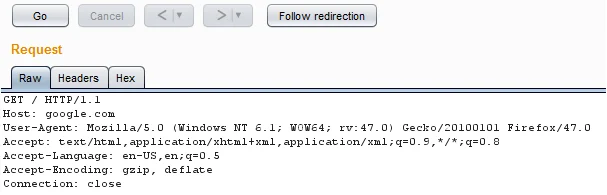
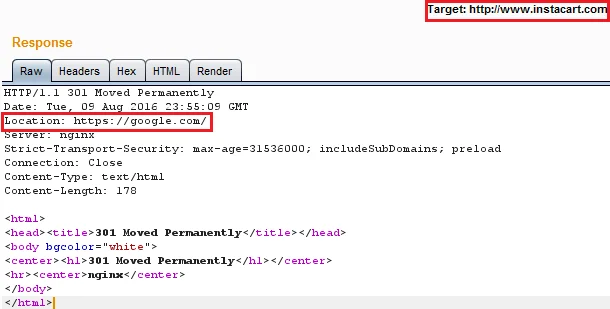
Your website is vulnerable to Host Header Injection because the host header can be changed to something outside the target domain
In many cases, developers are trusting the HTTP Host header value and using it to generate links, import scripts and even generate password resets links with its value. This is a very bad idea, because the HTTP Host header can be controlled by an attacker. This can be exploited using web-cache poisoning and by abusing alternative channels like password reset emails.
GET / HTTP/1.1 Host: google.com User-Agent: Mozilla/5.0 (Windows NT 6.1; WOW64; rv:47.0) Gecko/20100101 Firefox/47.0 Accept: text/html,application/xhtml+xml,application/xml;q=0.9,/;q=0.8 Accept-Language: en-US,en;q=0.5 Accept-Encoding: gzip, deflate Connection: close
HTTP/1.1 301 Moved Permanently Date: Tue, 09 Aug 2016 23:55:09 GMT Location: https://google.com/ Server: nginx Strict-Transport-Security: max-age=31536000; includeSubDomains; preload Connection: Close Content-Type: text/html Content-Length: 178
Reference: https://www.acunetix.com/vulnerabilities/web/host-header-attack
Regards, Clarck
Attachments
Not written yet. The AI write-up for this report has not been written yet. The Original tab links to the source.
How it worked
Root cause
Likely the server uses the Host header value directly when constructing redirect URLs without validating it against an allowlist.
Impact
An attacker could redirect users to a malicious site, potentially enabling phishing or cache poisoning, though the report only shows the redirect itself.
What the attacker needed
Ability to send custom HTTP requests
How it was found
- Send a request to the site with a modified Host header pointing to an external domain.
- Observe that the server responds with a redirect to that external domain.
Explained by bugbounty.wiki with AI from the original and checked against quotes from it; it can still be wrong. Read the original before relying on a detail.
Not written yet. The AI write-up for this report has not been written yet. The Original tab links to the source.
When you visit a website, your browser sends a 'Host' header telling the server which site you want. This server trusted that header and used it to build a redirect link, so an attacker could make the site send visitors to a different, malicious site.
What is Open redirect?
A trusted site forwards users to any address an attacker picks; rarely paid alone, often the missing link in a chain.






