Critical Deadlock Vulnerability in Monero RPC Leading to Complete Node Paralysis
The report claims that Monero's JSON-RPC interface can be driven into a deadlock by a remote, unauthenticated attacker sending batched requests, leaving the node unresponsive to RPC, P2P and admin traffic. The claimed effect is a complete denial of service that only a forced kill can clear.

- Triaged in 2 hours
- Fixed in 49 days
- Disclosed after 8 months
Summary:
A deadlock vulnerability in Monero's JSON-RPC interface allows a remote, unauthenticated attacker to completely paralyze any Monero node with a single HTTP request containing specific batch methods, leading to permanent denial of service.
Releases Affected:
- Monero 'Fluorine Fermi' (v0.18.4.2-2987b7200)
- Likely all previous versions
- All operating systems (Linux, Windows, macOS)
- All run modes (mainnet, testnet, offline, restricted-rpc)
Severity: CVSS 3.0: 10.0 – Critical:
- CVSS:3.0/AV:N/AC:L/PR:N/UI:N/S:C/C:H/I:H/A:H
Rationale:
- Remote, network-based attack
- No privileges required
- Immediate node paralysis
Affects availability, integrity, and potentially confidentiality
Steps To Reproduce:
-
Start Monero node with any configuration: ./monerod \ ─╯ --testnet
--data-dir ~/monero-testnet/blockchain
--rpc-bind-port 28081
--p2p-bind-port 28080
--restricted-rpc
--confirm-external-bind
--add-exclusive-node 127.0.0.1:28080
--log-level 4 \ -
Run the script
python3 exploit/PoC.py http://localhost:28081/json_rpc 50 500
- Observe:
- Node becomes completely unresponsive (RPC, P2P, admin)
- Standard termination signals (SIGTERM/SIGINT) do not work
- Only kill -9 can terminate the process
Proof of Concept The PoC demonstrates:
- Multithreaded adaptive load: 50 threads sending batched JSON-RPC requests.
Mix of request types:
- Valid Monero RPC methods (get_block_headers_range, get_output_distribution, etc.)
- Invalid or malformed requests
- Resource-heavy requests triggering memory allocation
- Adaptive batch size and memory usage based on server responses (413 / 429 / request too large)
- Gzip compression for large payloads
- User-Agent and X-Forwarded-For randomization to bypass basic filtering
- Effect: 29+ threads blocked, node deadlocked, requires SIGKILL to recov
Supporting materials/links:
- gdb_thread_dump.txt (blocked threads)
- process_status.txt (thread states)
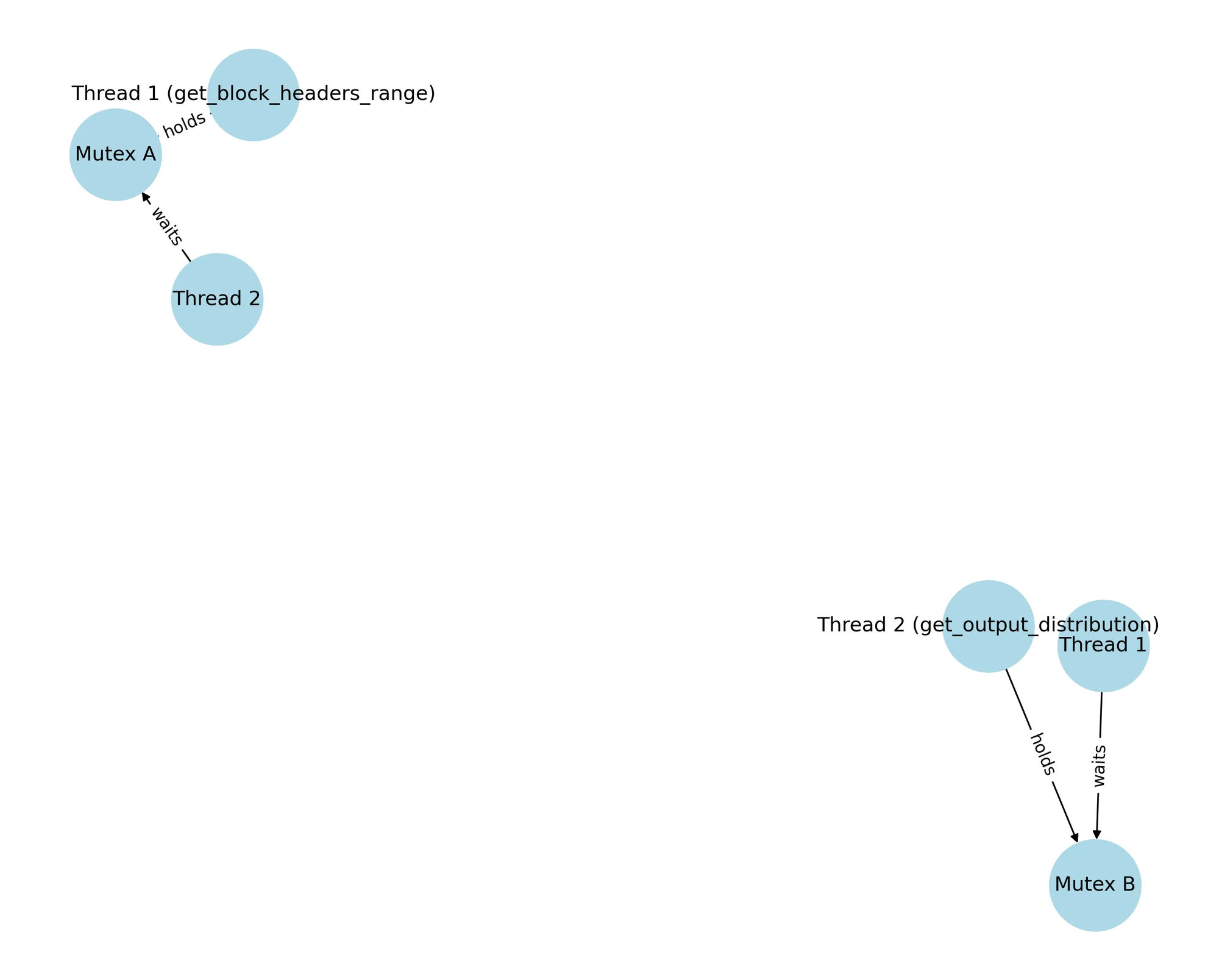
- deadlock_graph.png (visualization of blocked threads)
- Vulnerability demonstration script (PoC.py)
Technical Details: Deadlock occurs when Monero RPC threads enter circular wait on shared resources during batch request handling. The PoC script triggers this using any combination of RPC methods, demonstrating that the vulnerability is not limited to a single method. Node remains unresponsive even with --restricted-rpc or offline mode. The adaptive script proves the attack is resilient against server-side throttling or batch limits.
Housekeeping: I've read the rules. XMR address for receiving the reward: 44eM3rY8uNrc2tEZn8VrmnN45mEjpVVTBZEHpn5iefjvK23HsaXCCZYcJye4aXoh5Xfrj1q6TkWpKYLXs4yZY6nuPwpVp1T
Impact
- Availability: Complete and permanent node DoS
- Integrity: Potential blockchain corruption during forced restart
- Confidentiality: Possible leakage of sensitive data during unsafe shutdown
- Ease of attack: Trivial, requires 1 network request, no privileges
Attachments
Not written yet. The AI write-up for this report has not been written yet. The Original tab links to the source.
How it worked
Root cause
Likely RPC worker threads handling batched requests acquire shared resources in an order that lets them wait on each other in a cycle.
Impact
The node could be rendered completely unresponsive, requiring a forced kill, and the report claims this holds even with restricted RPC or offline mode, though the evidence offered is a thread dump and a load script rather than a minimal trigger.
What the attacker needed
Network access to the JSON-RPC port; no authentication required
How it was found
- Start a Monero node with the given testnet and restricted-RPC options.
- Run the supplied Python proof-of-concept script against the node's JSON-RPC endpoint with a thread count and batch size.
- Observe that the node stops responding on RPC, P2P and admin interfaces and ignores normal termination signals.
Explained by bugbounty.wiki with AI from the original and checked against quotes from it; it can still be wrong. Read the original before relying on a detail.
Not written yet. The AI write-up for this report has not been written yet. The Original tab links to the source.
A deadlock is when two or more parts of a program each wait for something the other holds, so none of them can continue. Here the claim is that the node's request-handling threads get stuck this way, so the node stops answering anyone. The report is thin on proof: it describes a load script rather than showing the exact circular wait.
What is DoS?
A request that exhausts resources or crashes a component. Many programs forbid testing it; reports usually show it from code, not by attacking.


