RPC service DOS

- Triaged in under an hour
- Fixed in 42 days
- Disclosed after 16 months
Summary:
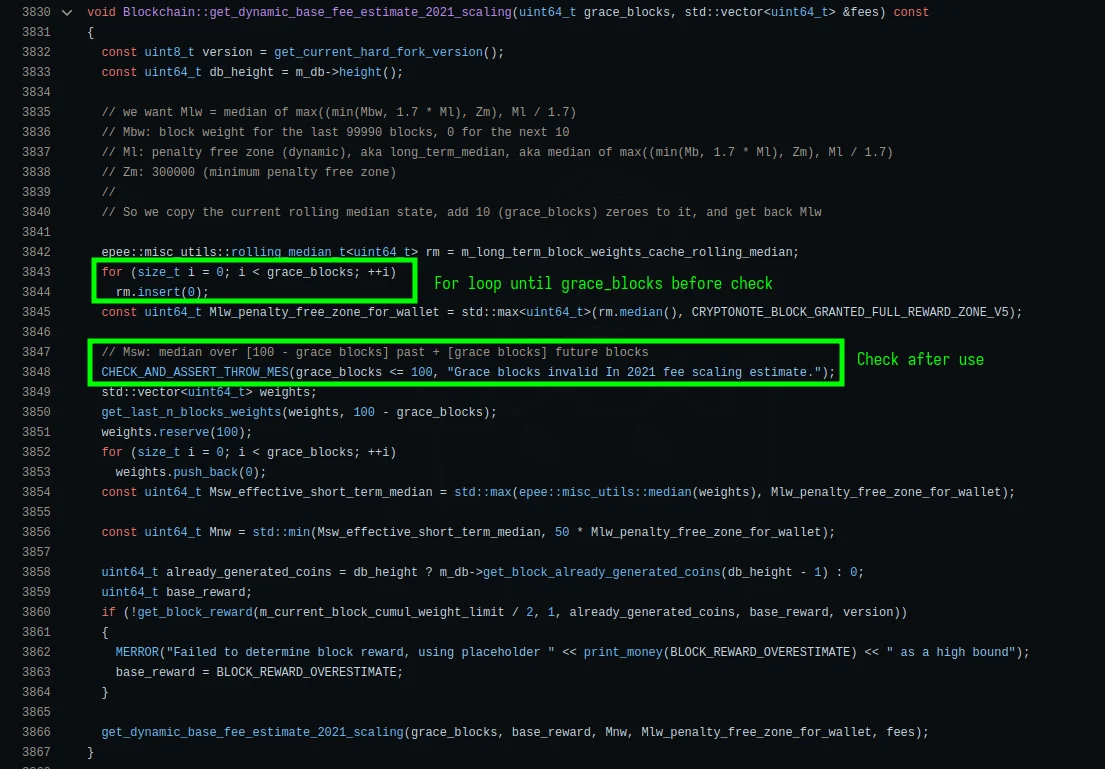
The RPC service running port 18081 (or 28081, 38081) is vulnerable to a DOS rendering the service unusable. This is due to the possibility of a for loop going up until uint64_t's max range (1<<64 - 1).
On the get_fee_estimate JSON RPC endpoint, a uint64_t parameter grace_blocks can be passed. If this parameter is big and the node is on a hard_fork version 15 or above, get_dynamic_base_fee_estimate_2021_scaling will be called.
https://github.com/monero-project/monero/blob/v0.18.3.1/src/rpc/core_rpc_server.h#L177

This handler will then be called: https://github.com/monero-project/monero/blob/v0.18.3.1/src/rpc/core_rpc_server.cpp#L2956
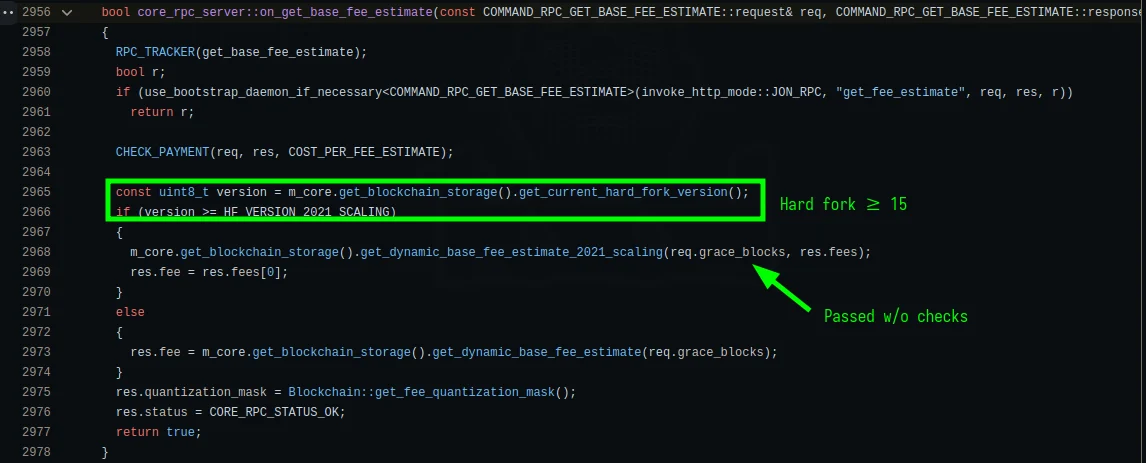
This function is then called https://github.com/monero-project/monero/blob/v0.18.3.1/src/cryptonote_core/blockchain.cpp#L3830
Releases Affected:
From my research, all versions after commit b030f207517f59a5122409398549a02ac23829ae are vulnerable.
- v0.18.3.1
- v0.18.3.0
- v0.18.2.2
- v0.18.2.1
- v0.18.2.0
- v0.18.1.2
- v0.18.1.1
- v0.18.1.0
- v0.18.0.0
Steps To Reproduce:
- Start a Monero node with the RPC port opened.
- Verify the node is using
hard_forkversion15or above - To do this, you can do thehard_fork_infoJSON RPC request - Perform a few asynchronous requests to the
get_fee_estimateJSON RPC endpoint withgrace_blocksset to a very very large integer (can go up to 18446744073709551615) - The server should now not be responsive on the RPC port.
Supporting Material/References:
Attached is a PoC script using Python's requests module to send 500 requests to a server.
To run the script, make sure to change the HOST variable at the top of the file. You can just replace 127.0.0.1 with any IP you want where a Monero node is running.
CPU exhaustion in htop. From my understanding, the RPC server runs on two threads.
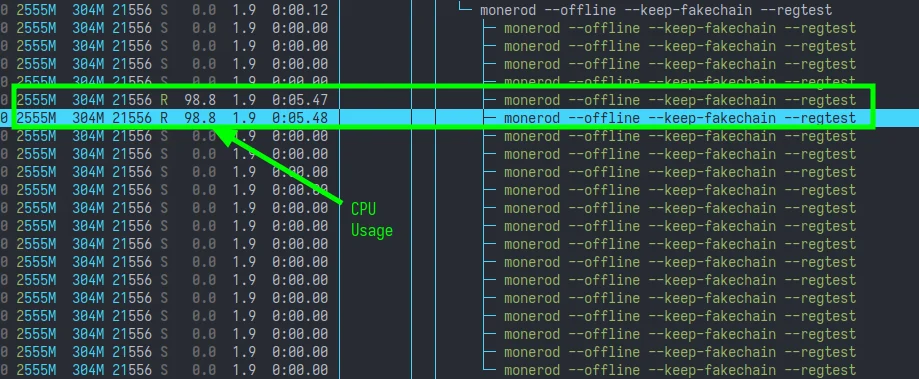
After this, any request to the port times out, furthermore, it is not shown in Monero's log (with seg_log 4)
Housekeeping
- Be sure to read our policy before submitting
- Provide an XMR address within the report if you wish to receive bounty (assuming that the report is valid)
47ZpAkp3sYGhHM6HEMUMDK7WBi6uLXy2H9LtB3aVNJfB54a3c12LybvWH3EjAF3echFrthjMvw17k7hn9Sbwr5Uh9VgKNNS
Impact
An attacker could find all open Monero RPC services using a Censys query such as:
services.port = 18081 and (services.port = 18080 and services=monero)
And bring all those services down.
Not written yet. The AI write-up for this report has not been written yet. The Original tab links to the source.
What is known
A medium-severity doS bug in Monero, rated CVSS 5.3. HackerOne made it public on 23 May 2025.
About DoS
A request that exhausts resources or crashes a component. Many programs forbid testing it; reports usually show it from code, not by attacking.
Not written yet. The AI write-up for this report has not been written yet. The Original tab links to the source.
What is DoS?
A request that exhausts resources or crashes a component. Many programs forbid testing it; reports usually show it from code, not by attacking.



