Spamming highly nested JSON RPC requests cause node to disconnect from p2p network
The Epee JSON parser allows deeply nested objects and duplicate fields, so a crafted JSON-RPC request with many nested objects causes excessive CPU usage during parsing. An attacker can spam such requests to a restricted RPC port, locking the node from syncing with the P2P network for hours.

- Disclosed after 8 months
Summary:
By forging a highly nested JSON payload, and spamming it through a restricted RPC interface, an adversary can remotely lock monerod from syncing with the rest of the p2p network. This vulnerability apply to syncing node as well synced one (which then become outdated) Epee JSON parser allow duplicated fields and set a recursion limit reasonably too high (100). By appending 1747 Json object of depth 98, an attacker can forge a JSON RPC payload that will cause CPU intensive parsing operations, locking the rest of the node from syncing with the P2P network.
This apply to monerod (master branch a1dc85c)
Proof of Concept:
A rust written proof of concept is shared at the bottom of this document. You can compile it using the latest stable rust toolchain and importing the corresponding crate in your Cargo.toml file
Additional information:
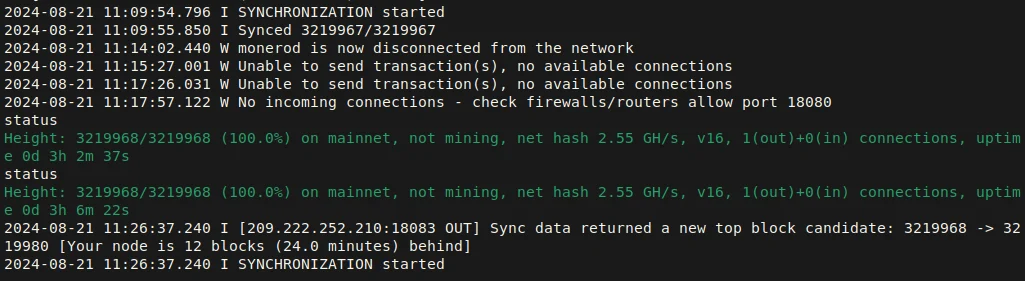
The proof of concept has been only tested against 18089 restricted rpc port and using the get_info method. I was able to effectively lock a synced node from syncing during a period of 3 hour. monerod was running on an AMD Ryzen 7 5800X. Another test has been performed with a single and empty params field, which concluded in no overhead for the Monero daemon.
Other I/O requesting methods could be exploited as well (get_blocks). if multiple params fields are set, only the last one being parsed will be used. You can therefore replace the last params field with genuine arguments and still trigger the execution of the routine. Combined with a low vulnerability (that will be submitted soon after this report), this could lead to I/O overhead by both writing and reading at high bandwith.
Potential mitigation:
- Lower the 1MB limit set by
m_net_server.get_config_object().m_max_content_length = MAX_RPC_CONTENT_LENGTHinsrc/rpc/core_rpc_server.cpp - Disable duplicated fields (as recommended by RFC 8259).
- Reduce
EPEE_JSON_RECURSION_LIMIT_INTERNAL(contrib/epee/include/storages/portable_storage_from_json.h) to a reasonable amount: 10~20. - Enable an iteration limit to objects and arrays. Potentially 1000 as it is the maximum number of blocks a restricted
get_blockscall can process. - Move JSON RPC parsing to another thread.
- Implement API throttling for the HTTP RPC Server. At my understanding, an API throttling already exist for P2P, maybe could it be reused ?
XMR Address: ███
Impact
At individual scale, it enable remote and temporary (or definitive) disconnection of nodes from the p2p network. Used at higher scale, it can be used against mining pool nodes to prohibit them from syncing and enable easier 51% attack.
Attachments

Not written yet. The AI write-up for this report has not been written yet. The Original tab links to the source.
How it worked
Root cause
Likely the JSON parser allows deeply nested objects and duplicate fields, and the recursion limit is set too high, so parsing a crafted request consumes excessive CPU.
Impact
An attacker could remotely and temporarily (or permanently) disconnect individual nodes from the P2P network; at scale, this could target mining pool nodes to hinder syncing and potentially ease a 51% attack.
What the attacker needed
Access to restricted RPC port; ability to send many requests
The fix
The report suggests lowering the maximum content length, disabling duplicate fields, reducing the recursion limit to 10–20, adding an iteration limit, moving JSON parsing to another thread, and implementing API throttling.
How it was found
- Craft a JSON-RPC request with many nested objects (e.g., 1747 objects of depth 98) and duplicate 'params' fields.
- Send the request repeatedly to the restricted RPC port (18089) using the 'get_info' method.
- Observe that the node's CPU is saturated and it stops syncing with the P2P network.
Explained by bugbounty.wiki with AI from the original and checked against quotes from it; it can still be wrong. Read the original before relying on a detail.
Not written yet. The AI write-up for this report has not been written yet. The Original tab links to the source.
A node is a computer that helps run a cryptocurrency network. The node accepts requests in a format called JSON, and its parser can be tricked into doing a lot of work by sending a request with many nested layers. This keeps the node busy so it cannot talk to other nodes, effectively disconnecting it from the network.
What is DoS?
A request that exhausts resources or crashes a component. Many programs forbid testing it; reports usually show it from code, not by attacking.


