IDOR Leads To User Profile Modification https://mtnmobad.mtnbusiness.com.ng/app/updateUser
The user profile update endpoint lacked an authorization check, allowing an authenticated attacker to modify another user's profile details by changing the user ID and email in the request. This could let an attacker alter a victim's company name and phone number to commit fraud in their name.

- Triaged in 11 hours
- Fixed in 4 months
- Disclosed after 24 months
Summary by the researcher
It was possible for a remote authenticated attacker to update the profile details of all users due to insufficient authorization check. The profile details include Mobile Number,Residential Address,Username
The report
Summary:
Hello Team,
https://mtnmobad.mtnbusiness.com.ng/app/updateUser allows authenticated users to alter their account profile. But, however, there is no authorization check when updating another user's profile thus, allowing attacker to modify anyone's profile info such as Username, Address, Mobile Number, Company Name and Company Size
Steps To Reproduce:
Requirements:
Create two Test Accounts (Attacker & Victim) Login into attacker's account In Mozilla Firefox at https://mtnmobad.mtnbusiness.com.ng/#/login1.
- Visit https://mtnmobad.mtnbusiness.com.ng/#/userProfile
- Goto to Burp and turn Intercept is on to capture request.
- Locate this endpoint
POST /app/updateUser HTTP/1.1while still proxying traffic through Burp. Notice, json blob data being presented. - Record
"id":"/###", "email":"[email protected]"for attacker's account and Logout. - Now, Login into victim's account and repeat step [1, 2 & 3] and Logout.
Attack Steps
Login into attacker's account in Mozilla Firefox and Victim's Account in Google Chrome.
- Using attacker's account in Firefox, visit https://mtnmobad.mtnbusiness.com.ng/#/userProfile and capture request with Burp.
- Switch attacker's "id":"/redacted", "email":"[email protected]" to victim "id":"/redacted" "email":"[email protected]" and forward request.
- Go to victim's account in google chrome and refresh the page.
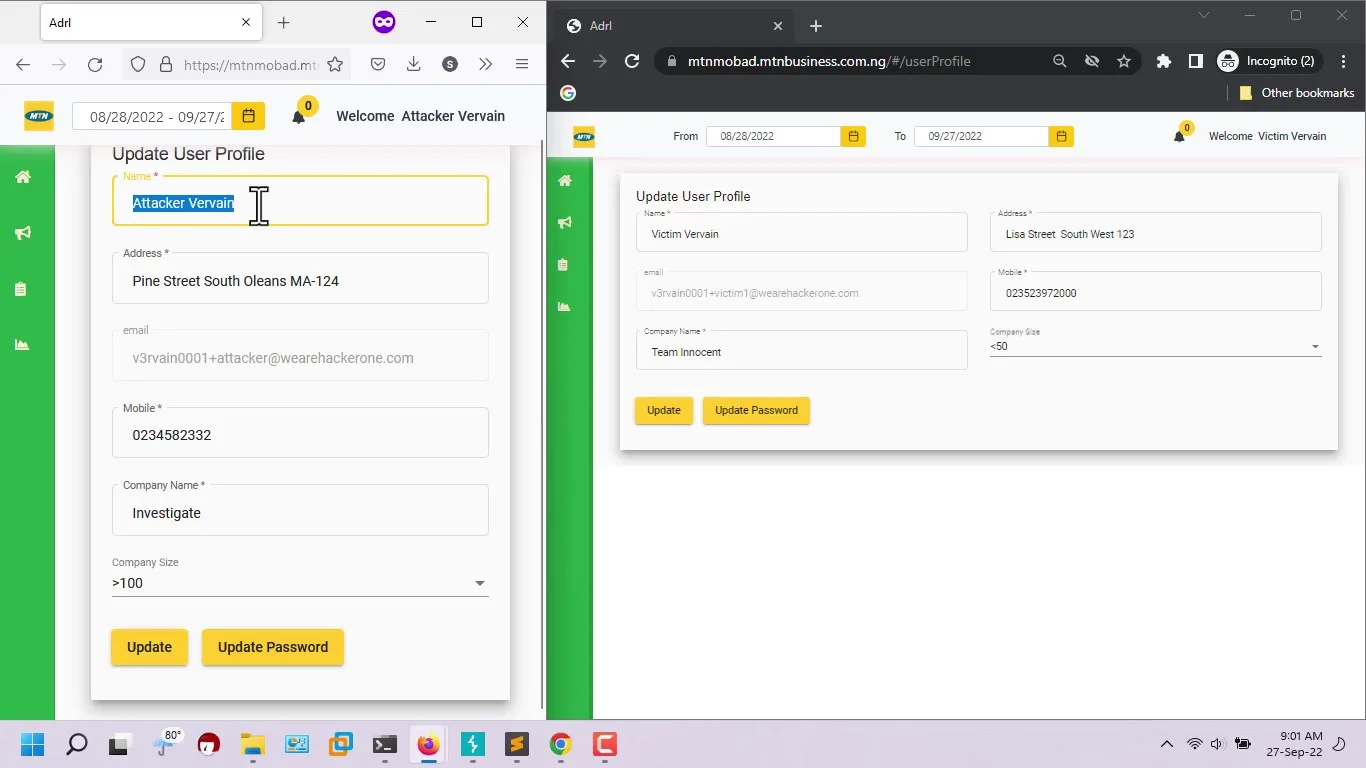
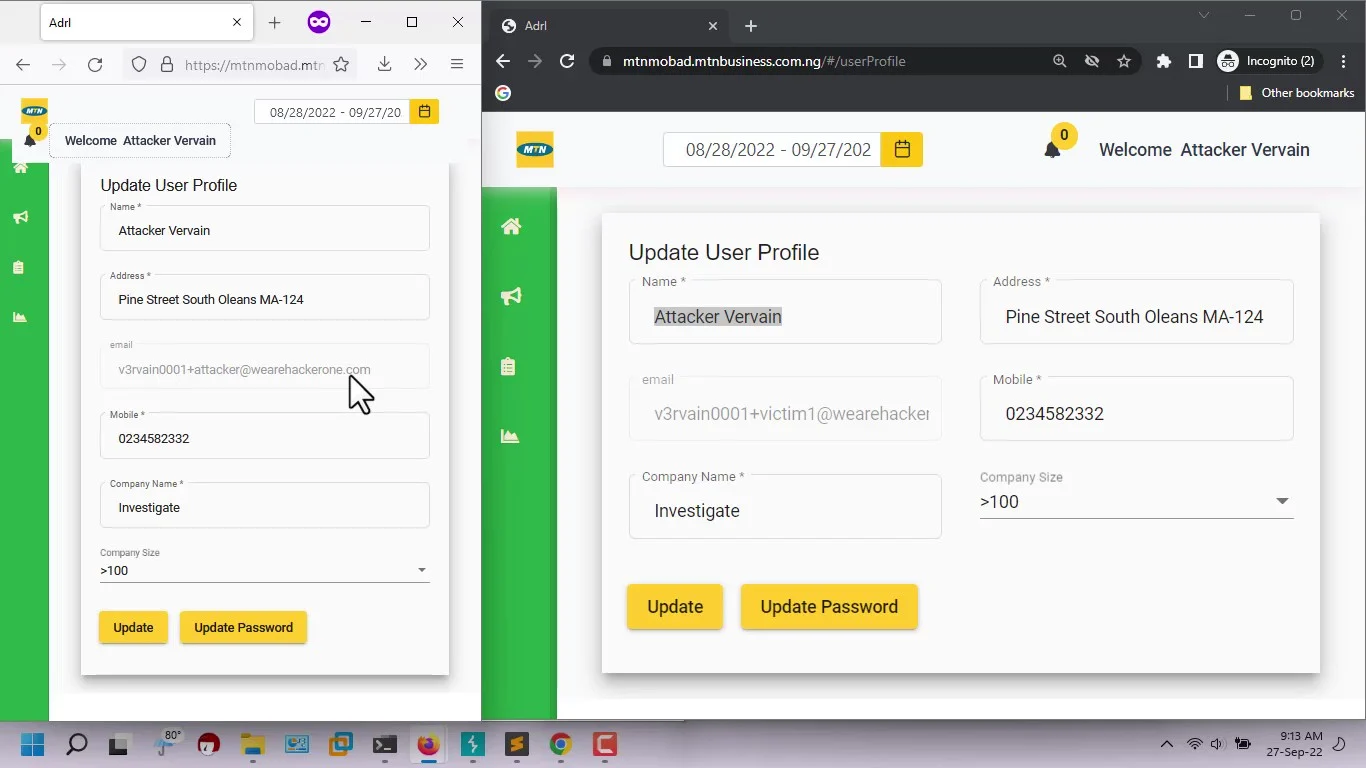
- Visit victim's profile and notice, attacker has successfully updated the user's Profile without their knowledge.
Recommendation/Remediation:
Implement stringent authorization controls to make sure a user has the necessary rights before allowing them to make such a harmful request on another account.
Generate random userIds to prevent attacker from predicting such userIds.
Supporting Material/References:
Video:
Screenshots:
Before:
After:
- [attachment / reference]
Tools
BurpSuite Community Edition: [v2022.8.4] Morzila Firefox: 105.0.1 (64-bit) Google Chrome: Version 105.0.5195.127 (Official Build) (64-bit) OS: Microsoft Windows [Version 10.0.22000.856]
Impact
An attacker will be able to use this technique to change any user's (advertiser's) profile, for example, a company name and phone number under the attacker's control to commit a crime entirely in the victim's name.
Regards! @v3rvain0001
Not written yet. The AI write-up for this report has not been written yet. The Original tab links to the source.
How it worked
Root cause
Likely the server trusted the user-supplied ID in the profile update request without verifying that it matched the authenticated user.
Impact
An attacker could change any user's profile, such as company name and phone number, to commit fraud in the victim's name.
What the attacker needed
Two accounts (attacker and victim); attacker logged in; ability to intercept requests
The fix
The server should enforce authorization checks to ensure the authenticated user owns the profile being updated, and use unpredictable user IDs.
How it was found
- Create two test accounts, one attacker and one victim, and log in as the attacker.
- Visit the user profile page and capture the profile update request with Burp.
- Note the attacker's user ID and email in the request, then log out.
- Log in as the victim, capture the same request, and note the victim's ID and email.
- As the attacker, replace the attacker's ID and email with the victim's in the captured request and forward it.
- Refresh the victim's profile to see that the attacker's changes were applied.
Explained by bugbounty.wiki with AI from the original and checked against quotes from it; it can still be wrong. Read the original before relying on a detail.
Not written yet. The AI write-up for this report has not been written yet. The Original tab links to the source.
When you update your profile, the website sends a request containing your user ID. The server should check that the ID belongs to you before making changes. Here, it did not, so an attacker could swap in someone else's ID and edit their profile instead.
What is IDOR?
One user can read or change another user's data, usually by changing an identifier the server trusts without checking who is asking. One of the most paid bug classes on web programs.



