Window.opener protection Bypass
A wiki-style document editor added rel="noreferrer" to links so that opened pages could not reach back to the parent window, but a crafted URL using a backslash-slash prefix slipped past that protection. An attacker could then make a victim's original page navigate to an attacker-chosen address after the victim clicked a shared link.

- Fixed in under an hour
- Paid in under an hour
- Disclosed after 30 days
SUMMURY
If you create a post/comment with a link like http://x.com in fabricator then server add rel="norefferrer" to anchor tag . So child window dont have access to parent window.
But it can be bypassed with url like /\x.com/index.php and child window can change the location property of parent window.
STEP TO REPRODUCE
-
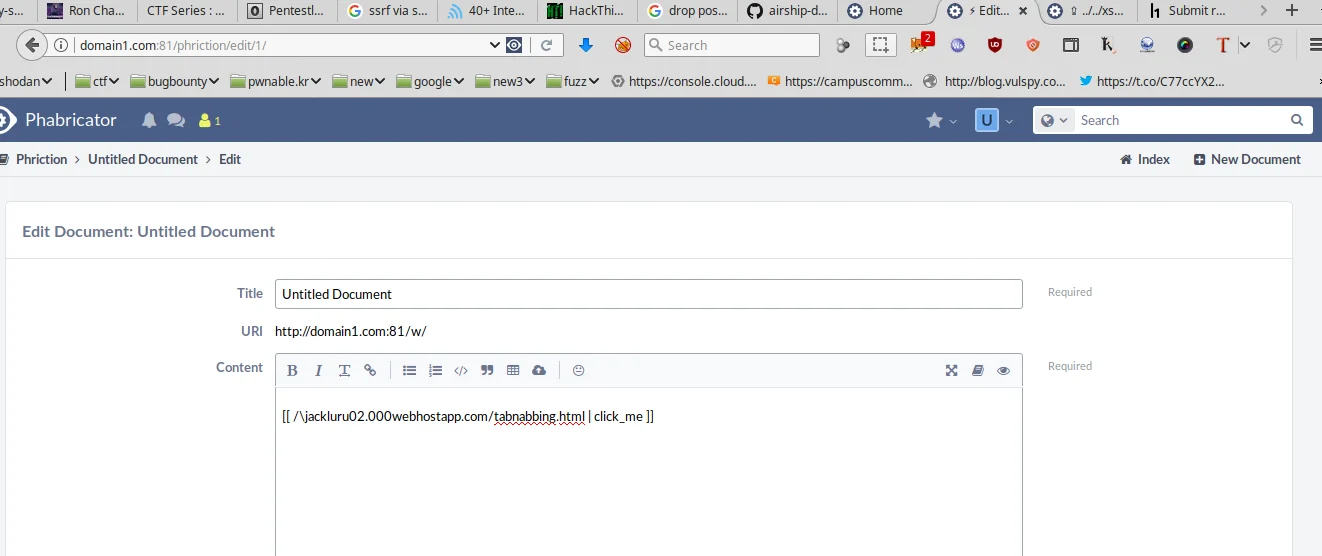
goto http://domain/w/ and create new document.
-
Now paste this code in content
[[ /\jackluru02.000webhostapp.com/tabnabbing.html | click_me ]]
code of this my url is
<script>
window.opener.location.replace('http://example.com');
</script>
-
now save it and share this document to other user.
-
When user click this click , malicious link opened in new window and parent window location will be changed.
Impact
attacker can perform malicious activity to other user using this attack.
mongoose
Not written yet. The AI write-up for this report has not been written yet. The Original tab links to the source.
How it worked
Root cause
Likely the link sanitiser decided whether to add rel="noreferrer" by inspecting the URL string, and a backslash-based URL form was treated as safe while the browser still resolved it to an external host.
Impact
An attacker could redirect a victim's original tab to an attacker-chosen page; the report gives no further detail.
What the attacker needed
Ability to create and share a document; victim clicks the shared link
How it was found
- Create a new document in the wiki editor.
- Insert a link written with a backslash-slash prefix pointing at an external page that runs a script.
- Save the document and share it with another user.
- When the victim clicks the link, the new window changes the location of the original page.
Explained by bugbounty.wiki with AI from the original and checked against quotes from it; it can still be wrong. Read the original before relying on a detail.
Not written yet. The AI write-up for this report has not been written yet. The Original tab links to the source.
When a link opens a new tab, the new page can sometimes control the tab it came from through a browser feature called window.opener. Sites try to block this by adding a tag to links that cuts that connection. Here the check was fooled by a link written in an unusual way, so the new page could still redirect the original tab to another site.
What is Open redirect?
A trusted site forwards users to any address an attacker picks; rarely paid alone, often the missing link in a chain.







