Denial Of Service (Out Of Memory) on Updating Bounty Table [Urgent]
A corrupted bounty table page caused the browser to run out of memory and crash when visited. An attacker could make any hacker who opens the affected bounty table experience a browser crash and high CPU/RAM usage.
 Originally disclosed on HackerOne
- Triaged in 13 days
- Fixed in 2 months
- Disclosed after 2 months
Summary by the program
@ahmd_halabi reported a client-side Denial of Service vulnerability to us. A video proof of concept detailing the issue can be found in https://youtu.be/NJUikSh1uro.
The report
Hello,
Summary: There is a bug in Updating Bounty Table section causing Denial Of Service , specifically loading up the memory usage (Out Of Memory). This happens when you visit a corrupted bounty table of a target program.
I didn't figure out yet how this issue happened but I am reporting it now immediately because it affects all hackers who view the bounty table of the target affected program.
Description:
The issue happened with me when I was clicking on a notification telling that Clario has updated their bounty table.
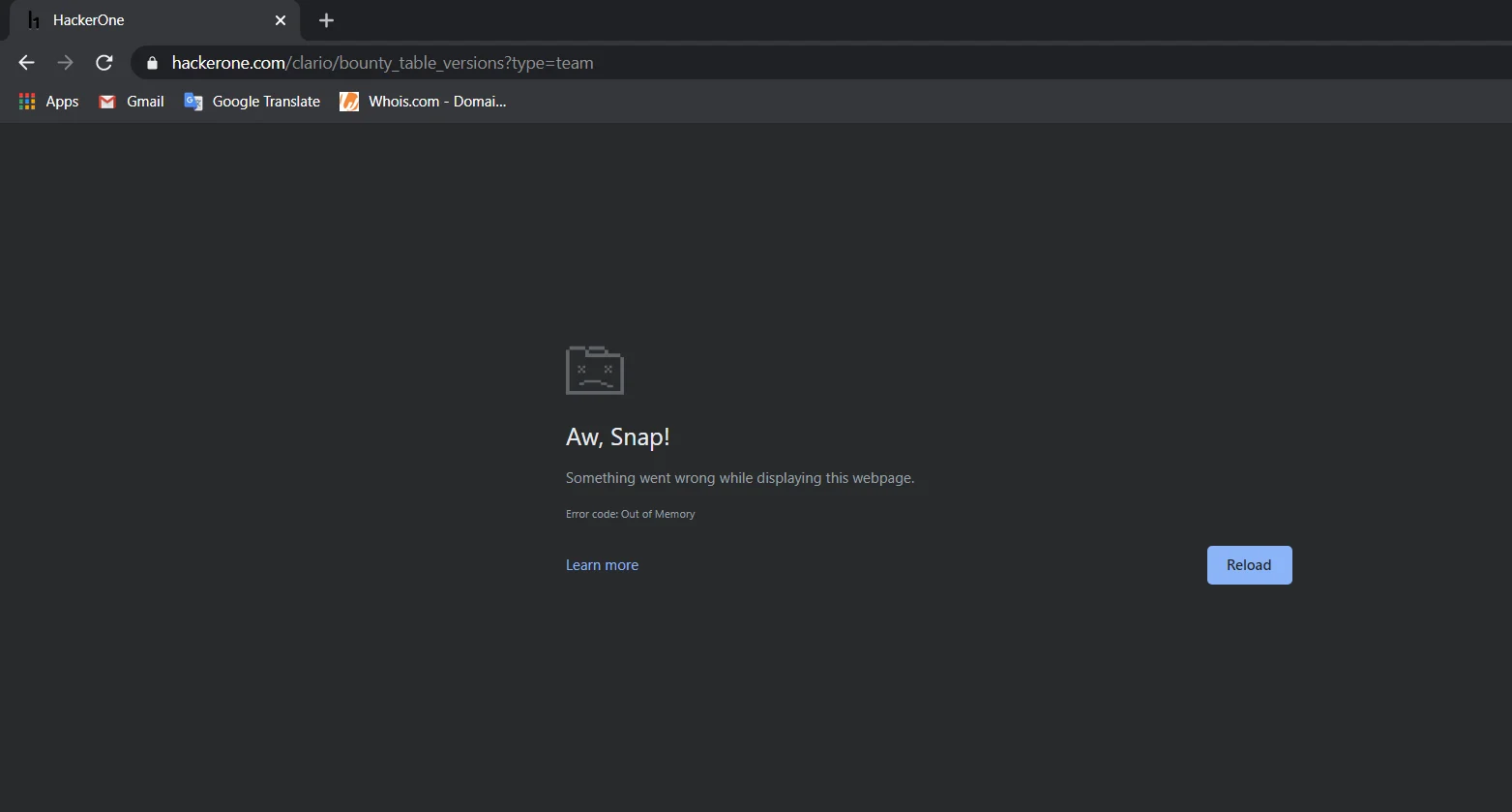
So I clicked on it to see the updated bounty table and suddenly my browser tab crashed and a message showed telling Error code: Out Of Memory.
I tried it from two hackerone accounts and they results with the same issue.
Steps To Reproduce
- Navigate to the notification: https://hackerone.com/clario/bounty_table_versions?nid=115515717&utm_campaign=user_652675&utm_content=team_url&utm_medium=email&utm_source=bounty_table_update
- You will not be able to click on any button (Ex: profile or Inbox).
- After short while, Browser will crash.
Optional: Your Environment (Browser version, Device, etc)
Google Chrome.
Optional: Supporting Material/References (Screenshots)
Please see the attached image and quick video PoC
██████████
Optional: Did you use recon data made available by HackerOne to find this vulnerability?
no
Impact
Denial Of Service (Out Of Memory) - Crashing whole Browser (happened with me) and loading up computer resources (CPU and RAM).
Kind Regards.
Not written yet. The AI write-up for this report has not been written yet. The Original tab links to the source.
How it worked
Root cause
Likely a client-side rendering or data-handling flaw in the bounty table page that causes runaway memory consumption.
Impact
Visiting the corrupted bounty table could crash the whole browser and consume high CPU and RAM, affecting any hacker who views it.
What the attacker needed
Victim visits the corrupted bounty table page
How it was found
- Open the notification link to the updated bounty table.
- Observe that no buttons on the page can be clicked.
- Wait briefly and the browser crashes.
Explained by bugbounty.wiki with AI from the original and checked against quotes from it; it can still be wrong. Read the original before relying on a detail.
Not written yet. The AI write-up for this report has not been written yet. The Original tab links to the source.
A denial of service (DoS) is when a system is deliberately or accidentally made unusable. Here, a web page for a bounty table was malformed in a way that made the browser use more and more memory until it crashed. The reporter did not yet know why the page was broken, but anyone opening it would have their browser crash.
What is DoS?
A request that exhausts resources or crashes a component. Many programs forbid testing it; reports usually show it from code, not by attacking.





