Homograph fix Bypass
The signature check on HackerOne's redirect endpoint validated the punycode form of an internationalised domain name, but the same signature also accepted the original Unicode form and a variant with extra slashes. An attacker could craft a signed redirect link that displays a lookalike domain in the warning page while actually sending the victim to a different site.

- Triaged in 17 hours
- Fixed in 15 days
- Paid in 22 days
- Disclosed after 22 days
Hello Hackerone! I have possibly found a way to bypass your current Homograph Attack Fix.
Lets look at two HACKERONE Redirect URL: CASE 1: https://hackerone.com/redirect?signature=829727b4188c43dcf394fd841fd19a8b7f391bd1&url=https%3A%2F%2Fwww.yelp.com%2F
{Got the above link generated by posting "https://www.yelp.com/" on Hackerone Platform}
If I change even a single character in the URL parameter above the link gets Invalid. We get "Something went wrong" Response. For Example (try changing yelp.com to yelk.com) https://hackerone.com/redirect?signature=829727b4188c43dcf394fd841fd19a8b7f391bd1&url=https%3A%2F%2Fwww.yelk.com%2F
Now Lets look at a sample Hackerone Redirect URL of a IDN HOMOGRAPH Link:
CASE 2:
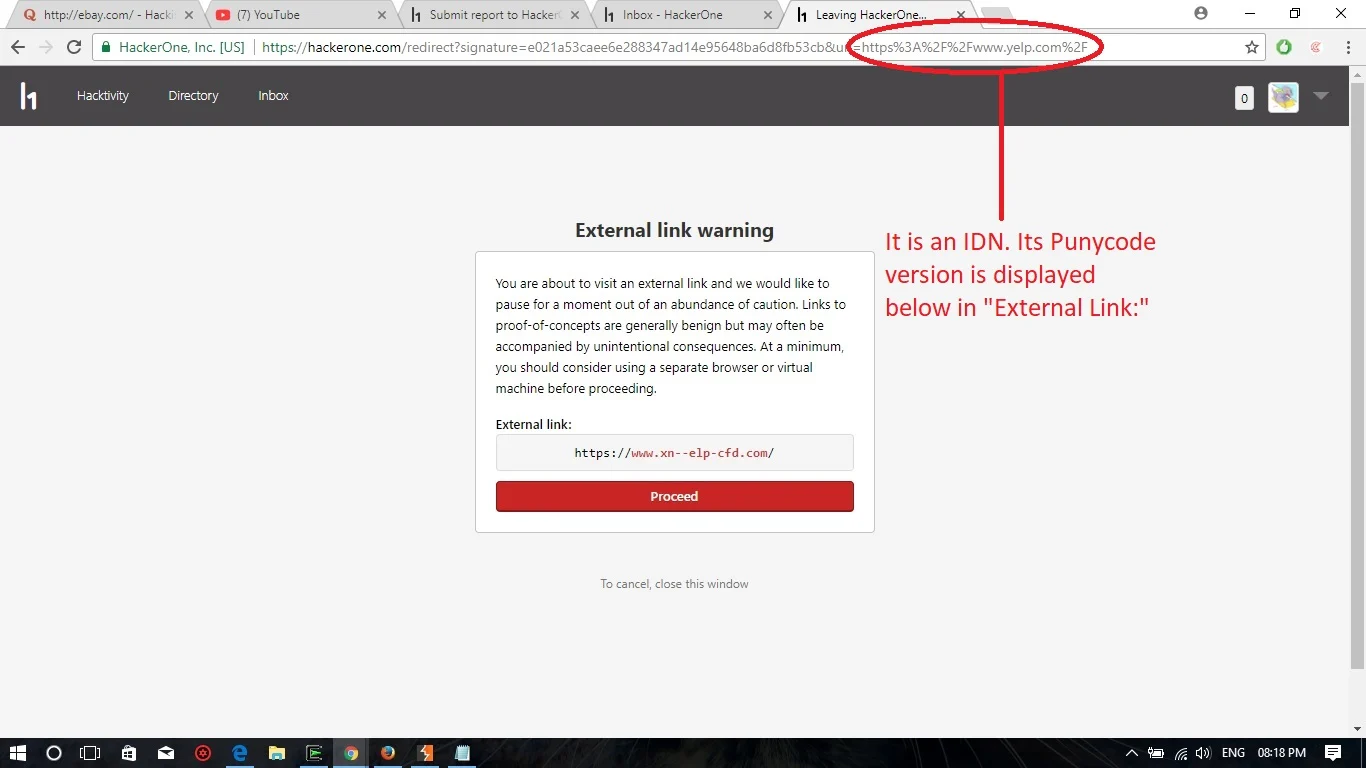
{Got this link generated by posting https://www.уelp.com/ on hackerone platform. NOTE: Here "уelp.com" is actually an IDN and its punycode version is "xn--elp-cfd.com" & that's why it automatically got converted by Hackerone to its punycode representation in the above URL*}
Now lets replace "xn--elp-cfd.com" to the original IDN i.e "уelp.com" in the above URL.
As Infered from CASE 1, Upon changing any character in the URL parameter, Ideally we should get an error and the link should become invalid.
But,that is not the case here when we are dealing with IDN Links. The link is still valid even after changing value of the URL parameter-From Punycode version to IDN.
Have a look at the changed URL here: https://hackerone.com/redirect?signature=e021a53caee6e288347ad14e95648ba6d8fb53cb&url=https%3A%2F%2Fwww.%D1%83elp.com%2F
NOTE: Till Now the External Link Warning Page Displays : "https://www.xn--elp-cfd.com/"
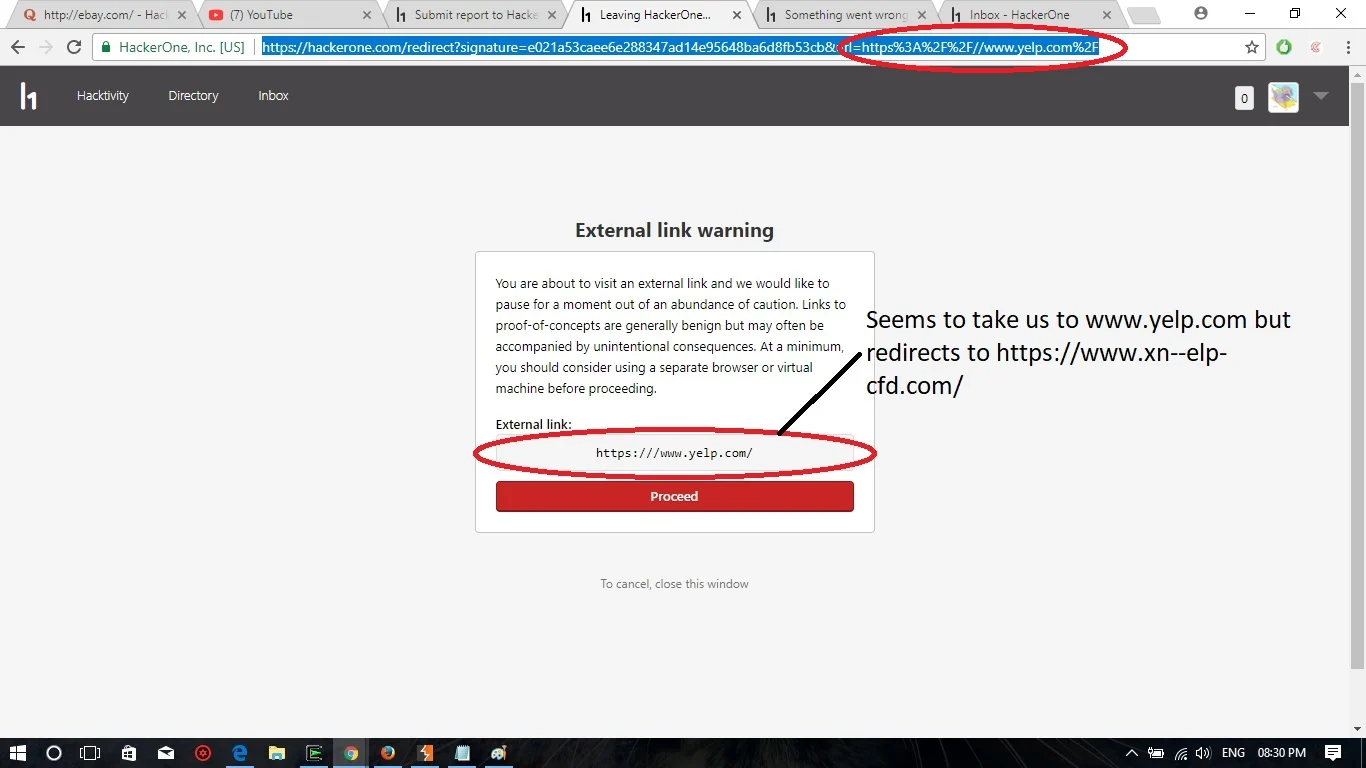
Now, IF we Add extra "//" after "https:%3A%2F%2F" in the above url we get the following URL:
***You can see that the above link displays "https:///www.yelp.com/" but actually redirects us to "https://www.xn--elp-cfd.com/" ***
And thus the current fix for Homograph attack seems to be bypassed. Mobile phone users are more likely to be affected by the above vulnerability.
Attachments
Not written yet. The AI write-up for this report has not been written yet. The Original tab links to the source.
How it worked
Root cause
Likely the signature was computed over the punycode form of the URL, but validation normalised or compared the supplied URL inconsistently, so an equivalent Unicode form and a slash-variant still matched the signature.
Impact
A victim, especially on a mobile phone, could see a trusted-looking address in the warning page while being redirected to the lookalike IDN site.
What the attacker needed
Victim clicks a crafted signed link; attacker can post links on the platform
How it was found
- Post a link containing an internationalised lookalike domain on the platform to obtain a signed redirect URL.
- Replace the punycode form in the url parameter with the original Unicode form and observe the link still works.
- Add extra slashes after the scheme in the url parameter.
- Observe the warning page shows one address while the redirect goes to the lookalike domain.
Explained by bugbounty.wiki with AI from the original and checked against quotes from it; it can still be wrong. Read the original before relying on a detail.
Not written yet. The AI write-up for this report has not been written yet. The Original tab links to the source.
Some web addresses use non-Latin letters that look identical to Latin ones, so a site can look like a trusted brand but point elsewhere; this is called a homograph attack. HackerOne added a signature to its outbound redirect links so the destination cannot be swapped, but the check compared only one written form of the address. By supplying a different but equivalent written form, the same signature still passed, so the warning page showed one address while the browser went to another.
What is Open redirect?
A trusted site forwards users to any address an attacker picks; rarely paid alone, often the missing link in a chain.





