Link vulnerability leads to phishing attacks
Slack's link parser split a URL into two clickable links when a soft hyphen character was inserted between letters. An attacker could register the second domain and send a message that appears to be a single legitimate link, tricking the victim into clicking the malicious part.

- Disclosed after 34 days
Hello Guys,
Hope you are doing great. I'm sending this email to let you know about a vulnerability i stumbled upon while using slack (it's a great app!).
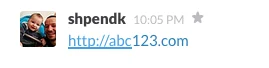
While copy-pasting a link from a pdf to slack (desktop/web), i noticed that the resulting link(s) looked a bit messed up (1.png)
Firing up burp and investigating this issue, it seems like the link parser is having problems with what in burp appears to be dash. Further analysis led to the following two characters causing this issue: %c2%ad
When inserting the above (after url decoding it) between a link, it will actually split the link into two different clickable links (2.png)
As you can see, this looks like a perfectly valid domain, however when hovering over it you can see that there are two clickable areas, one for http://abc, and one for 123.com.
Follow these steps to reproduce:
- Login to Slack using the Web, in a browser that goes through Burp intercepting proxy
- Choose a colleague to send a direct message
- Enter your link as message: http://google.com
- Turn on Interception in Burp and hit enter to send the message. The intercepted message should appear in burp.
- Between the letter 'g' and 'oogle.com', insert %c2%ad
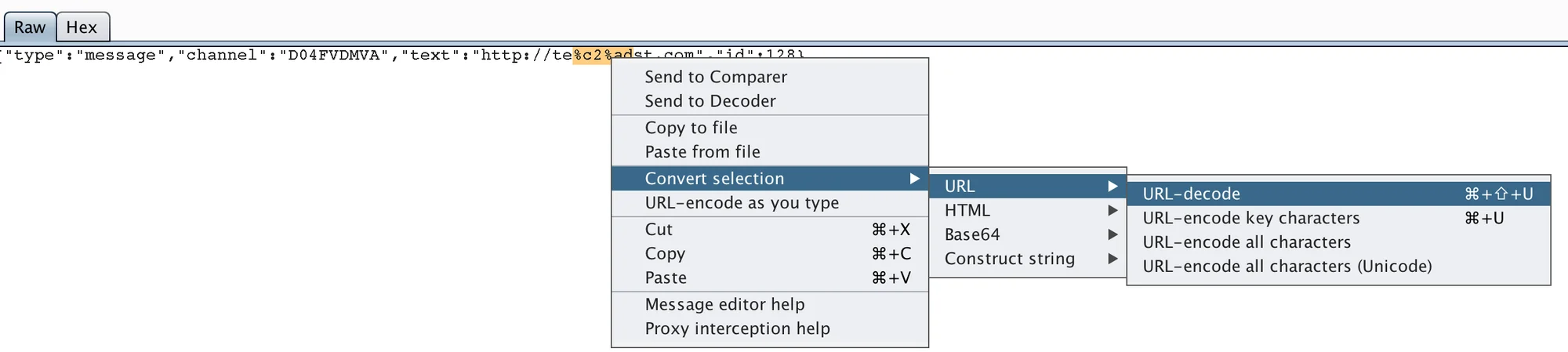
- Now select the insertion (%c2%ad), and right-click on it, select "convert selection->url->url decode" (3.png)
7. After url decode, it should appear as a dash. Forward the request. 8 Back to slack, you can see that http://g is clickable, as well as oogle.com -end replication steps
The attack scenario here would be someone registering oogle.com (or ogle.com or any part for that matter) and sending this to the victim. With a high probably, that victim will click the second area that sends you to oogle.com instead of the 'g'. Good chances to phish for passwords.
Let me know if you have problems reproducing or need additional information.
Regards, Shpend
Attachments

Not written yet. The AI write-up for this report has not been written yet. The Original tab links to the source.
How it worked
Root cause
Likely the link parser did not treat the soft hyphen as part of the URL and instead used it as a boundary, splitting the text into two separate links.
Impact
A victim could be tricked into clicking the second part of the link, which the attacker controls, and be phished for passwords.
What the attacker needed
Slack account; Ability to send a direct message; Victim clicks the second link part
How it was found
- Log in to Slack on the web with a proxy intercepting traffic.
- Open a direct message with a colleague.
- Type a normal link as the message and enable interception before sending.
- In the intercepted request, insert the encoded soft hyphen between two letters of the link.
- URL-decode the inserted value so it becomes a dash character, then forward the request.
- Observe in Slack that the link is now split into two separately clickable parts.
Explained by bugbounty.wiki with AI from the original and checked against quotes from it; it can still be wrong. Read the original before relying on a detail.
Not written yet. The AI write-up for this report has not been written yet. The Original tab links to the source.
A soft hyphen character can be inserted inside a web address. Slack treated it as a break point, so one link became two separate clickable links. An attacker could own the second half and use it to phish.
What is Open redirect?
A trusted site forwards users to any address an attacker picks; rarely paid alone, often the missing link in a chain.





