Uber Hacking: How we found out who you are, where you are and where you went
The Uber rider and partner apps and web endpoints had several access-control flaws, including a token parameter that accepted another user's UUID, allowing retrieval of private email addresses and trip details. Attackers could also brute-force promo codes and view driver waybills by knowing a driver UUID.
 Published on medium.com
Here at Integrity we love to be challenged, so whenever there is some free time, there is encouragement to do research or to break some things (http://labs.integrity.pt/advisories/) in addition to play foosball.
The full write-up lives on its author's site
It belongs to its author, so we link to it rather than copy it. The other two tabs are our own rewrites, checked against it.
Context
Uber ran a public bug bounty programme whose scope covered https://*.uber.com/, http://*.uberinternal.com/ (added later), http://petition.uber.org, http://ubermovement.com, and the iPhone and Android Rider and Partner applications. The work described here was carried out by three researchers from Integrity (@r0t1v, @fjreis, @fabiopirespt) during free time set aside for research.
The features involved are ordinary product surfaces: promotion codes redeemed on the payment page of riders.uber.com, the in-app Help form that sends questions to support, the fare split invitation that takes a phone number from the contact list, the Partner/Driver app login and activation flow, the driver waybill, and the trip history endpoint used by the Rider app.
Setup
No special accounts or roles are described beyond ordinary rider and driver accounts created during testing. The researchers note that their accounts were locked several times because of the nature of the tests, and that unlocking them required going to the security team directly after support did not help much.
The tooling was deliberately simple:
- DNS brute-force to enumerate Uber subdomains.
nmapagainst the enumerated hosts to check banners, page titles and page redirects, plus exploit-db and security blogs for known vulnerabilities.- jd-gui to read the Java classes of the mobile apps and map the mobile endpoints.
- MobSF later in the process.
- Interception of mobile traffic during a real Uber trip.
Finding it
The engagement started with two open redirects, one in trip.uber.com and one in riders.uber.com, reported immediately. Both had already been reported by other researchers. Rather than stopping there, the team went back to the programme scope and built a methodology around it.
Information gathering began with a DNS brute-force against Uber subdomains.
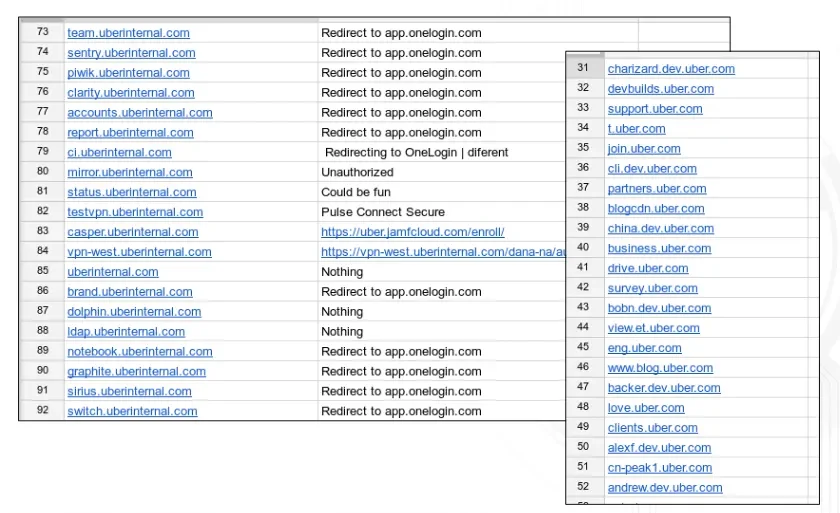
With the subdomains enumerated, nmap was used to look for banners, page titles and redirects, and public sources were checked for known vulnerabilities. For the mobile apps, the Java classes were decompiled to map endpoints.
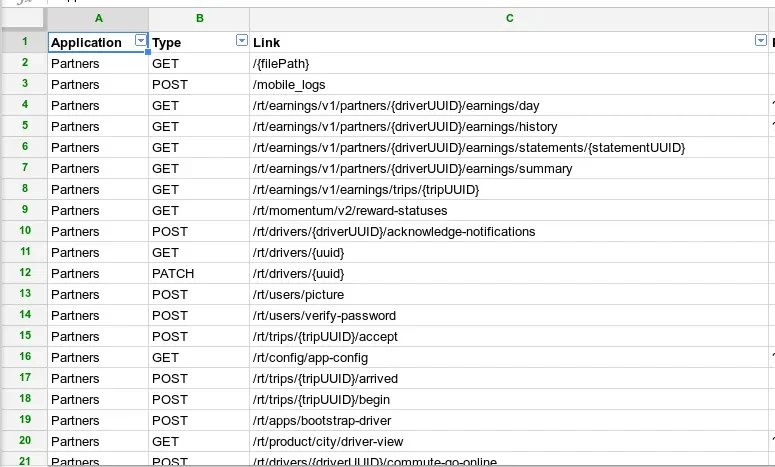
Each of the six findings below came out of that map: a promotion code form with no throttling, a Help form whose token field accepted a UUID, a fare split response that leaked identifiers, a login response with an activation flag the client could set, a waybill endpoint with broken access control, and a trip history endpoint that authenticated on GET parameters.
Exploitation
0x01: brute-forcing promotion codes on riders.uber.com
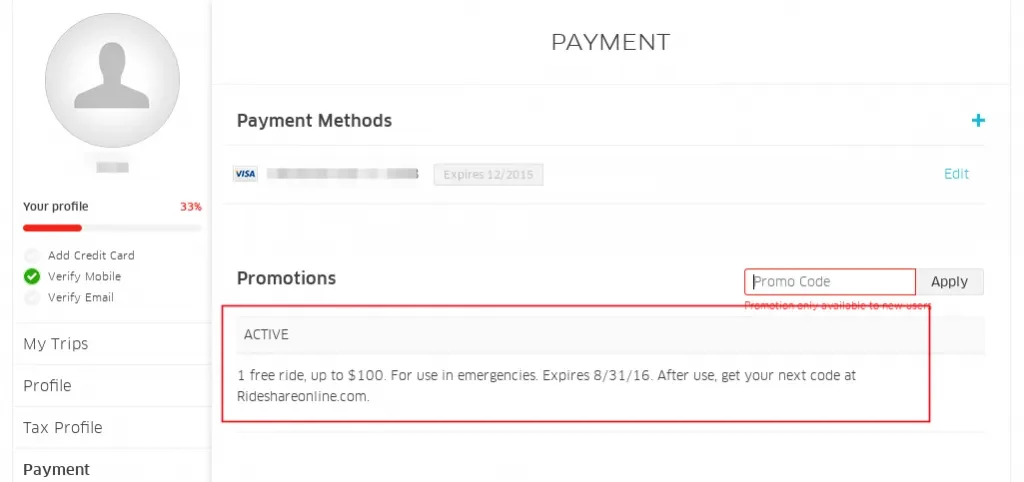
The payment page of riders.uber.com accepts promotion codes, which can be issued by other users or by companies. After adding a new promotion code, the request was captured and the application was found to have no protection against brute-force attacks. That allowed many different promotion codes to be found.
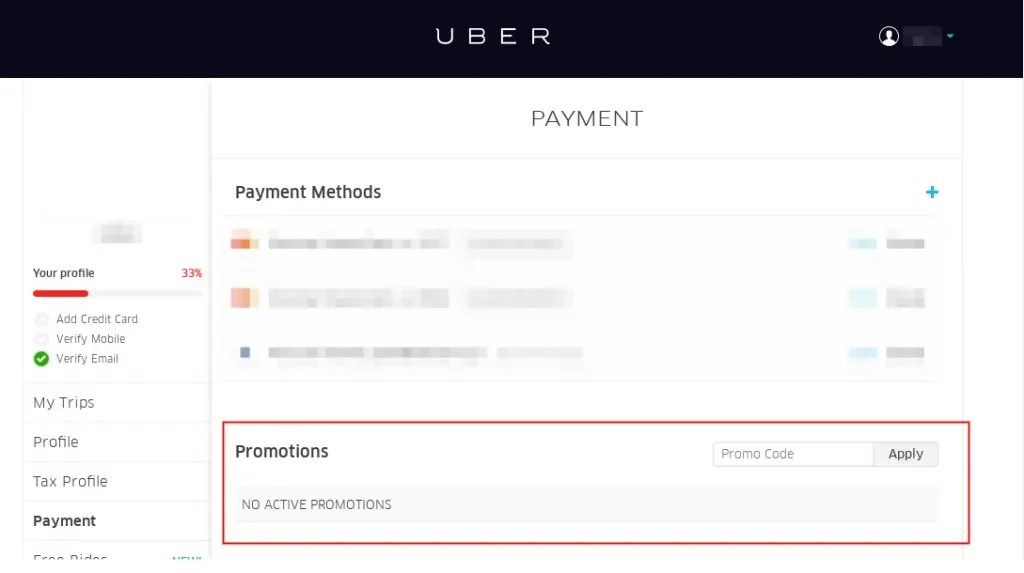
The brute-force results could be told apart by response length:
| Response length | Meaning |
|---|---|
| 1951 | Valid code |
| 1931 | Not valid |
| 1921 | Code expired |
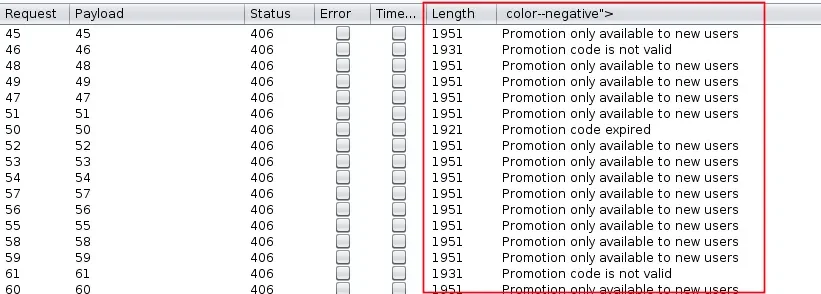
Uber lets promotion codes be customised, and all the default codes began with the word uber. That prefix cut the brute-force time considerably and more than 1000 valid codes were found.
The issue was initially not considered valid, on the grounds that promotion codes are meant to be public and given out by anyone. That changed when a $100 ERH (Emergency Ride Home) code was found that the uber-sec team had no knowledge of. ERH codes behave differently from all the others: even if a promotion code is already applied, an ERH code can still be added.
Disclosure timeline:
- 23 March 2016: reported to Uber.
- 23 March 2016: status changed to Informative.
- 24 March 2016: new information provided.
- 24 March 2016: status changed to Triaged.
- 19 April 2016: status changed to Resolved.
- 2 May 2016: bounty awarded.
0x02: private email address from a UUID
The Rider mobile application has a Help section that lets users send questions directly to support. The Partners application was later found to have the same forms.
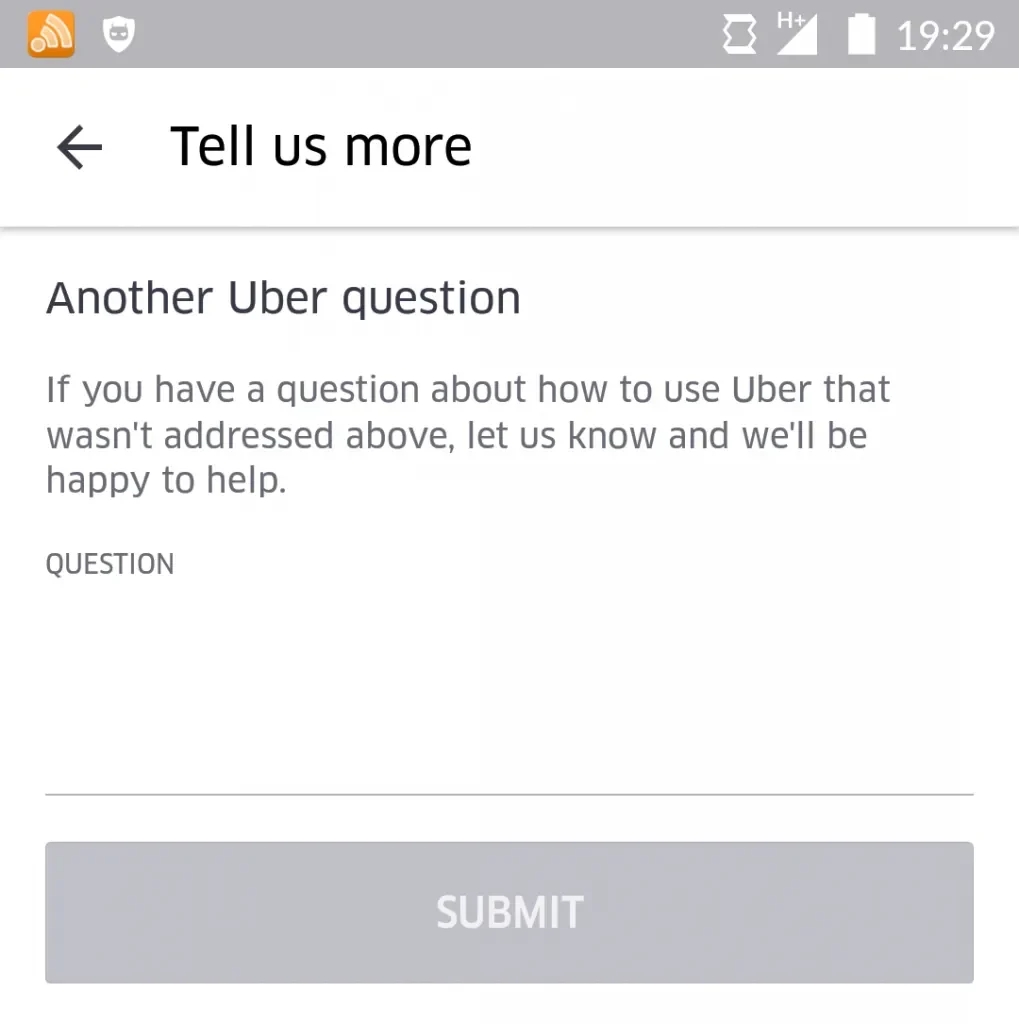
After a question is submitted, the server replies with the message: "We've received your request and will be in touch as soon as possible via <my-email-address>". That reply suggested user emails might be enumerable.
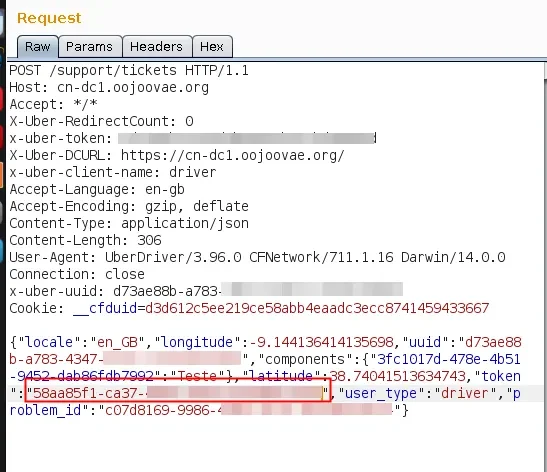
The request has two places that might return another user's email if changed to another valid UUID: the x-uber-uuid header and the uuid parameter. Both were changed, but the server returned the same email again. There is also a token parameter. Fuzzing it was the first approach, but in the end it was changed to another user's UUID, and the web server returned the email address for that user.
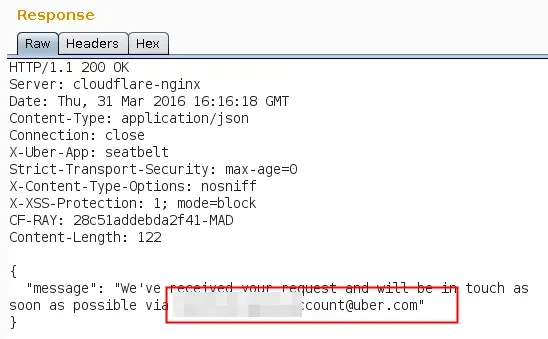
Why a UUID is interpreted as a valid token is hard to say, but it is. Since the endpoint did not throttle requests, a small set of UUIDs was collected and all the emails corresponding to those UUIDs were retrieved. The UUIDs themselves came from the fare split issue described next.
Disclosure timeline:
- 31 March 2016: reported to Uber.
- 31 March 2016: status changed to Triaged.
- 11 April 2016: status changed to Resolved.
- 13 April 2016: bounty awarded.
0x03: enumerating user IDs with phone numbers
To find features that are not easily discovered, the researchers took their phones and computers, called an Uber, and intercepted all the requests during the trip. One request stood out.
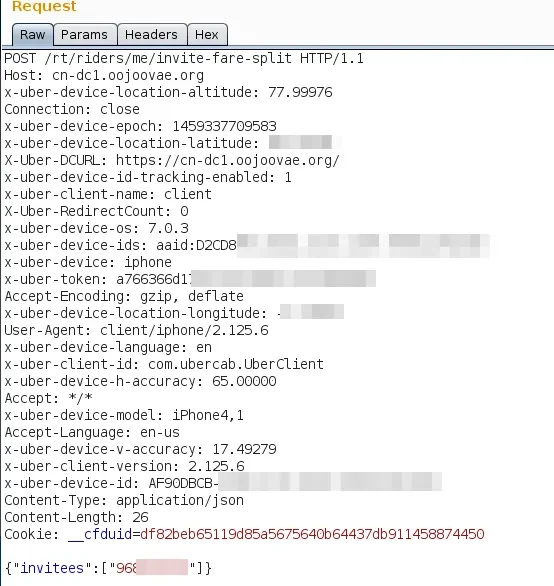
That request is made when a user splits the fare with others. To invite someone, the user adds a phone number from the contact list. The response leaks too much information: the driver UUID, the invitees' UUIDs and the invitees' picture, all before the fare split is accepted.
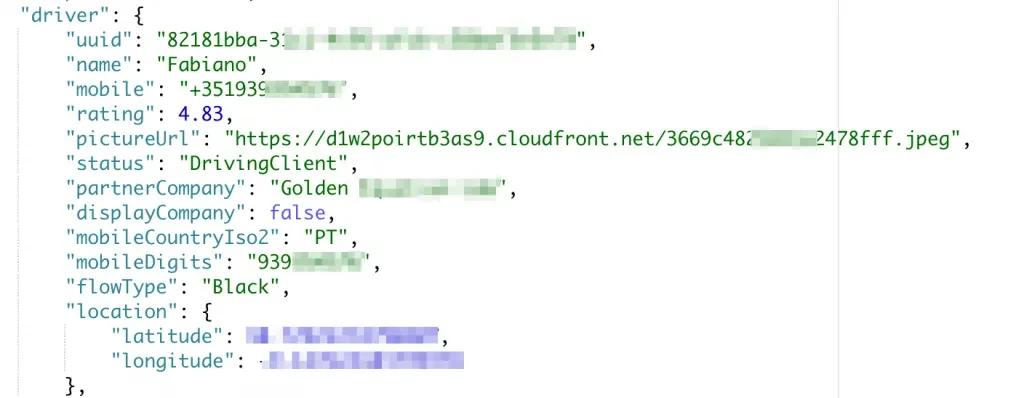
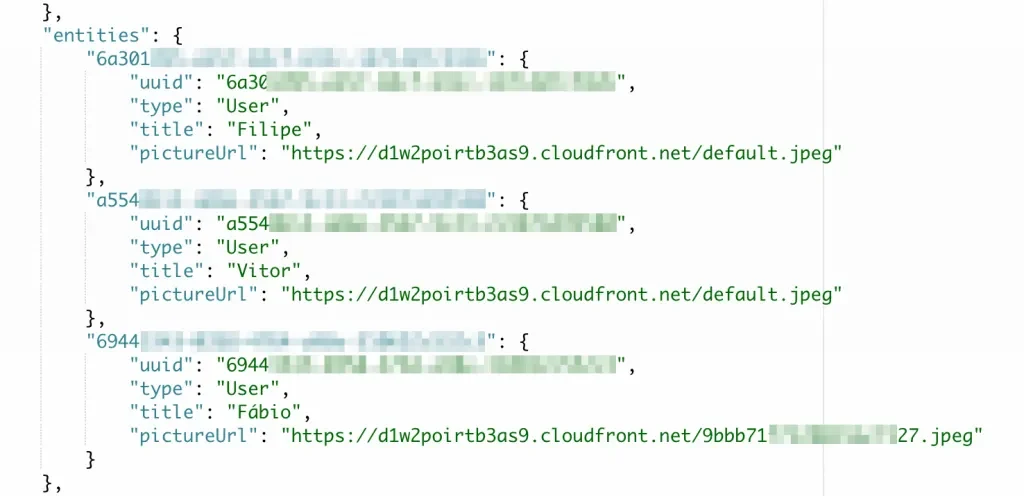
This is where the UUID list used in 0x02 came from. Chaining the two issues, any email address associated with a phone number could be obtained.
The report was marked Duplicate.
Disclosure timeline:
- 6 April 2016: reported to Uber.
- 7 April 2016: status changed to Needs more info.
- 7 April 2016: new information provided.
- 7 April 2016: status changed to Duplicate.
0x04: using the Partner/Driver app without activation
Any user can create a driver account, but it stays inactive until Uber verifies all the driver documents. Testing the Partner/Driver app showed that entry into the mobile app is only possible after the activation process.
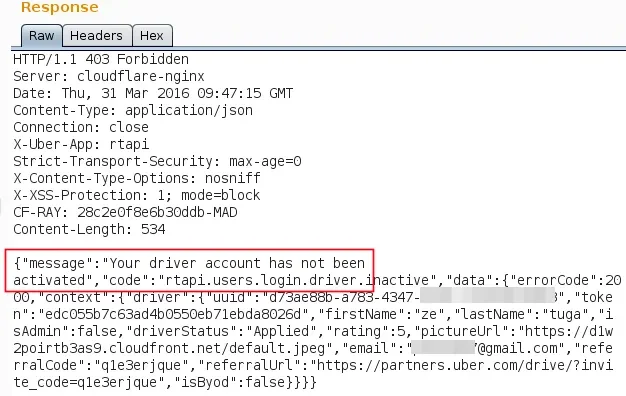
The request behind that response contains a parameter called allowNotActivated, with the value false.
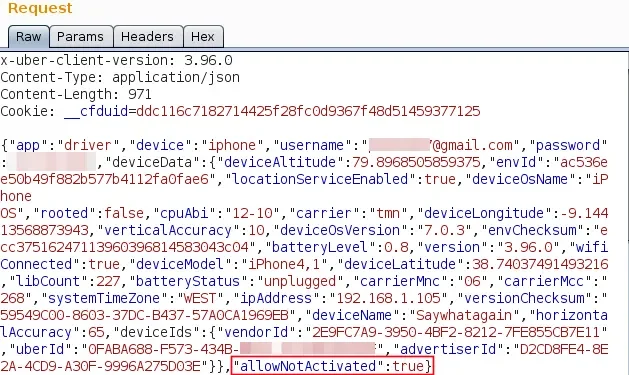
By manipulating the login request and changing allowNotActivated to true, a valid session token was obtained. The server creates a valid token even when the account is not activated.
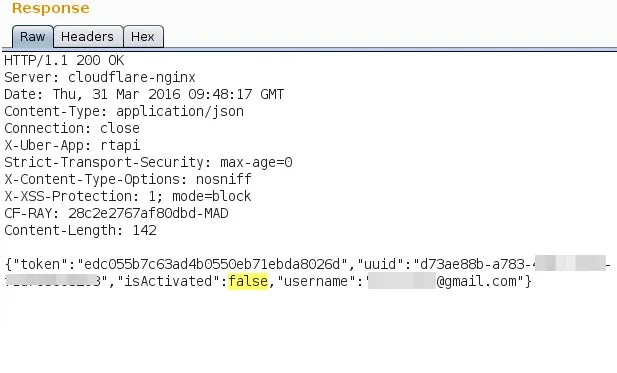
The response also contains a field called isActivated, set to false. Changing it to true allowed entry into the app.
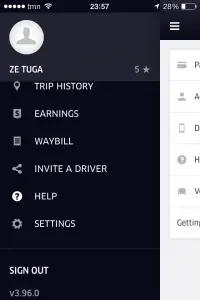
That gave a set of new features to test, which led to the next finding.
The report was marked Duplicated.
Disclosure timeline:
- 31 March 2016: reported to Uber.
- 31 March 2016: status changed to Needs more info.
- 31 March 2016: new information provided.
- 7 April 2016: status changed to Duplicated.
0x05: viewing a driver's waybill via the driver UUID
Using the previous issue, a functionality called waybill could be tested. Crafting the request the app sends showed a broken access control vulnerability that allowed the last trip of every driver to be seen, knowing only the driver's UUID.
A driver UUID can be obtained by requesting a random car, letting the driver accept the trip and then cancelling it; the driver UUID can be captured in the meantime.
The response returned the driver name, licence plate, last trip UUID, last passenger name, number of passengers, and the origin and destination of the trip.
The response contains a TRIP #. To get the full path of the trip, a new functionality was discovered that returns the full path of the trip, the driver name, client name, licence plate and even the car model. The report says this functionality could not be detailed at that moment and would be discussed once the researchers were authorised.
Disclosure timeline:
- 31 March 2016: reported to Uber.
- 1 April 2016: status changed to Triaged.
- 13 April 2016: status changed to Resolved.
- 18 April 2016: bounty awarded.
0x06: trips belonging to other users
This builds on 0x03, where changing the token to a UUID allowed impersonation of another user.
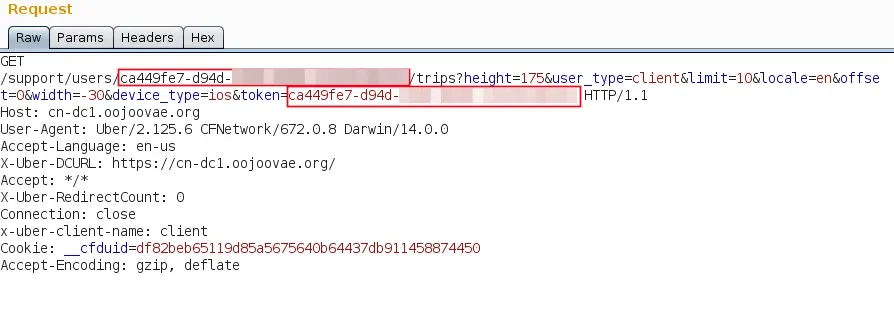
The request above lets a user view their own trips. It carries no session headers or session cookies: all the session details are sent as GET parameters.
Changing the highlighted uuid while keeping the original token returns a 403 unauthorised access. Changing both the UUID and the token to the UUID of the user whose trips are wanted returns a lot of new information.
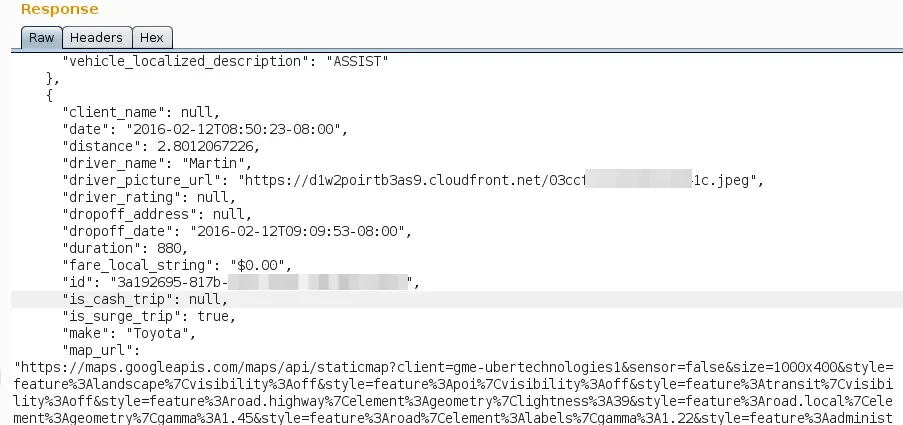
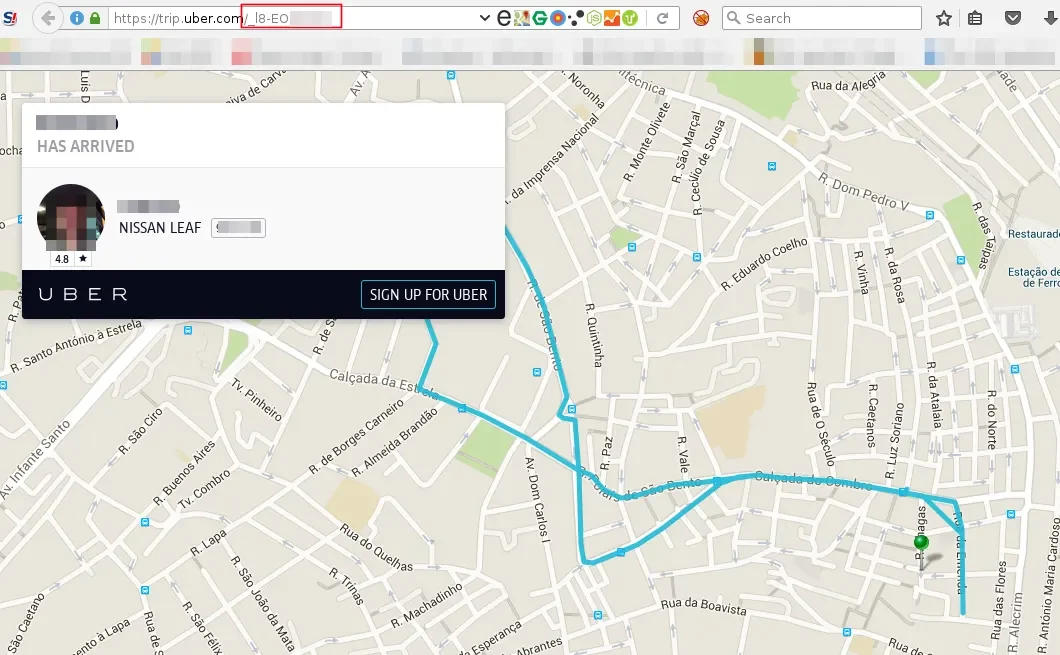
The response shown is for a request that sends the same value in the UUID and TOKEN fields. It returned the date of the trip, the driver name and picture, the id and cost of the trip, and a map of where the user had been. The response shown demonstrates a single trip, but the full response gives all the trips made by the user.
Disclosure timeline:
- 31 March 2016: reported to Uber.
- 31 March 2016: status changed to Triaged.
- 5 April 2016: status changed to Resolved.
- 13 April 2016: bounty awarded.
Root cause
Each finding is a separate mistake, and the report does not show the server-side code for any of them.
- Promotion codes (0x01): the redemption endpoint had no rate limiting or attempt limiting, so codes could be guessed at will. The default
uberprefix and the customisable format reduced the search space. ERH codes are additive, so they can be applied on top of an existing promotion, which made a valid ERH code worth more than a normal one. - Email disclosure (0x02): the
tokenparameter was accepted with a UUID as its value, so a user identifier was treated as a valid token. The endpoint also did not throttle requests. Why the server accepts a UUID as a token is not explained in the report. - Fare split (0x03): the invitation response included driver and invitee identifiers and the invitee's picture before the invitation was accepted, so the response exposed more than the flow needed.
- Driver activation (0x04): the login flow trusted client-supplied flags.
allowNotActivatedandisActivatedwere both taken from the request, and the server issued a valid session token for an account that was not activated. - Waybill (0x05): the waybill endpoint had broken access control, so knowing a driver UUID was enough to read that driver's last trip.
- Trip history (0x06): the endpoint authenticated on GET parameters rather than on a session. Sending the same UUID in both the UUID and TOKEN fields returned another user's trips.
Impact
- 0x01: an attacker could find valid promotion codes, including more than 1000 valid codes in this test, and could add ERH codes even when a promotion was already applied. The report notes that promotion codes are meant to be public, which is why the issue was first marked Informative; the ERH code the security team did not know about changed that assessment.
- 0x02: an attacker holding a UUID could retrieve the email address associated with it, without throttling. The UUIDs themselves came from 0x03.
- 0x03: an attacker who knows a phone number could obtain the associated user's UUID, and by chaining with 0x02, the email address associated with that phone number. The leak happens before the fare split is accepted.
- 0x04: an attacker could obtain a valid session token and enter the Partner/Driver app without completing activation, which opened the app's features for testing.
- 0x05: an attacker who knows a driver UUID could read that driver's last trip: driver name, licence plate, last trip UUID, last passenger name, number of passengers, origin and destination. A further functionality returned the full path of the trip, driver name, client name, licence plate and car model; the report does not detail it.
Fix
What it records is the status of each issue: 0x01, 0x02, 0x05 and 0x06 were resolved and paid, while 0x03 and 0x04 were closed as duplicates.
Variants to test
- Promotion code redemption: submit a code and compare response lengths for valid, invalid and expired codes. A positive result is a stable difference in length or body that distinguishes the three states, with no lockout after repeated attempts.
- Customisable code formats: if the target lets users choose their own codes, check whether a fixed prefix or pattern is enforced. A positive result is a large set of guessable codes and a shorter brute-force.
- Additive codes: try applying a second code while one is already active. A positive result is a code that is accepted on top of an existing promotion.
- Token parameters: in any request with a
tokenparameter, substitute a UUID belonging to another account. A positive result is a response containing that account's data instead of an authentication error. - Identifier headers and parameters: change
x-uber-uuid-style headers anduuidparameters one at a time and together. A positive result is another user's data being returned. - Help and support forms: submit a support request and inspect the confirmation message for reflected account data. A positive result is an email address or other identifier that changes with the submitted identifier.
- Fare split invitations: invite a phone number and inspect the response before acceptance. A positive result is driver or invitee UUIDs, pictures or other identifiers in the response.
- Activation flags: in a login request, flip boolean fields such as
allowNotActivatedandisActivated. A positive result is a valid session token for an unactivated account, or entry into the app. - Waybill endpoints: capture a driver UUID by requesting and cancelling a trip, then request the waybill with that UUID. A positive result is the driver's last trip details.
- GET-parameter sessions: for endpoints that carry session details in GET parameters, send the same identifier in the UUID and token fields. A positive result is another user's trip history, including dates, costs and maps.
- Rate limiting: repeat requests to any of the above endpoints in quick succession. A positive result is no throttling, lockout or CAPTCHA after many attempts.
What happened, in plain words
Uber, the ride-hailing company, ran a public bug bounty programme. A bug bounty programme is a deal: a company says "if you find a security problem in our systems and tell us privately, we will pay you a reward (a bounty) and fix it". The company publishes a list of what is in scope, meaning which websites and apps you are allowed to test. For Uber that list was:
https://*.uber.com/http://*.uberinternal.com/(added later into the programme)http://petition.uber.orghttp://ubermovement.com- iPhone Rider Application
- iPhone Partner Application
- Android Rider Application
- Android Partner Application
The * in *.uber.com is a wildcard: it means every subdomain, such as riders.uber.com or trip.uber.com. A subdomain is a smaller site that lives under the main domain, the way a department lives inside a company.
Three researchers from a company called Integrity (@r0t1v, @fjreis, @fabiopirespt) used their free time for this. They started with two open redirects, one in trip.uber.com and one in riders.uber.com, and reported them straight away. An open redirect is a link on a site that sends you to another site chosen by whoever made the link; attackers use it to make a fake login page look like it belongs to the real company. Both had already been reported by other researchers, so no reward there. Instead of giving up, the team went back to the scope and built a repeatable method.
The method started with information gathering: finding out which Uber subdomains exist, what software they run, and which parts of the mobile apps talk to which servers. From that map they found six issues:
- A promotion code form that let you guess codes as fast as you liked.
- A Help form whose token field accepted a user identifier instead of a real token, which returned that user's email address.
- A fare split invitation that leaked identifiers and a picture before the invitation was even accepted.
- A driver app login that trusted a flag sent by the app, so an unactivated driver account could get a valid session.
- A driver waybill page with broken access control, so knowing a driver's identifier was enough to read their last trip.
- A trip history page that checked identity using values in the URL rather than a session, so one user's trips could be read by another.
Four of these were fixed and paid; two were closed as duplicates. The bounties listed were $5000 for the promotion code brute-force, $3000 for the waybill, $5000 for the email disclosure and $5000 for the trips of other users.
The process and methodology
Before any testing, the team read the programme scope again. A scope is the boundary of what you may touch; testing outside it is not allowed. The scope above is wide: many subdomains plus four mobile apps.
A short word on the vocabulary used throughout, because it comes up constantly:
- Request: what your browser or app sends to a server when you click something. It has a method (GET to fetch, POST to submit), a URL, headers (extra labels such as who you are) and sometimes a body (the data you submit).
- Response: what the server sends back, usually a status code (200 means OK, 403 means forbidden), headers and a body.
- API: the set of URLs a program talks to in order to get and change data. Think of a restaurant: the menu is the API, the kitchen is the server, and you never walk into the kitchen yourself.
- Endpoint: one specific URL in that API, for example the one that redeems a promotion code.
- Token / cookie: a short value the server gives you after you log in, which you send back with every later request so the server knows it is you. A cookie is stored by the browser; a token is often stored by an app. Think of a cloakroom ticket: whoever holds the ticket gets the coat.
- UUID: a universally unique identifier, a long random-looking string such as
550e8400-e29b-41d4-a716-446655440000that identifies one user or one object. It is not secret by design, but it is also not meant to be a password. - Header: a labelled line in a request, such as
x-uber-uuid: ..., carrying extra information. - Parameter: a value in the URL after a
?, such as?uuid=..., or a field in the body of a POST. - Brute-force: trying many possibilities quickly until one works, like trying every key on a keyring. It only works when the server does not slow you down.
- Rate limiting / throttling: the server refusing or slowing repeated attempts. Without it, brute-force is cheap.
- IDOR (Insecure Direct Object Reference): when a server lets you read an object just by naming its identifier, without checking that the object is yours.
- Broken access control: the general name for the family of bugs where the server does not check whether you are allowed to do what you asked.
- Information disclosure: leaking data that should not be visible, such as an email address or a photo.
- Logic flaw: a mistake in how the program decides things, rather than in a low-level technical detail. Trusting a flag sent by the client is a classic example.
Information gathering
To find Uber subdomains, the team ran a DNS brute-force. DNS is the phone book of the internet: it turns a name like riders.uber.com into the address of a server. A DNS brute-force means trying a long list of likely names (dev, test, api, admin, and so on) and seeing which ones exist. It is like ringing every flat in a building to see who answers.
With the subdomains listed, the next step was nmap, a tool that probes a server and reports what it finds: banners (the greeting a service gives, which often names the software and version), page titles and page redirects. The team also read exploit-db, a public database of known vulnerabilities, and security blogs, to see whether any of the software found had known problems.
For the mobile apps, they used jd-gui to read the Java classes inside the app. Mobile apps are compiled programs, but the compiled form can be turned back into readable code; reading it shows which server addresses and endpoints the app uses. Later they also used MobSF, a framework that automates this kind of inspection.
With that map in hand, they felt they had enough to start looking for vulnerabilities.
The vulnerabilities
0x01: brute-forcing promotion codes on riders.uber.com
A promotion code is a short string that gives you a discount or credit when entered on the payment page. Uber lets users and companies hand them out. The payment page of riders.uber.com accepted these codes, so the team added a new promotion code, captured the request their browser sent, and looked at it. They found no protection against repeated attempts: no rate limit, no lockout, no CAPTCHA. That meant codes could be guessed at speed.
The results of the guessing could be told apart by the length of the response. Different outcomes produced bodies of different sizes:
| Response length | Meaning |
|---|---|
| 1951 | Valid code |
| 1931 | Not valid |
| 1921 | Code expired |
Why length matters: the server's reply for a working code contains extra text (a success message, the discount applied), so it is a few bytes longer. A tool can send thousands of guesses and sort the replies by size, and the odd ones out are the winners.
Uber also lets promotion codes be customised, and all the default codes began with the word uber. Knowing that prefix removes a huge part of the guessing space, the way knowing a safe's first three digits removes most of the work. That cut the brute-force time considerably and more than 1000 valid codes were found.
At first Uber did not consider this a valid issue, because promotion codes are meant to be public and given out by anyone. That changed when the team found a $100 ERH (Emergency Ride Home) code that the uber-sec team had no knowledge of. ERH codes behave differently from all the others: even if a promotion code is already applied, an ERH code can still be added. In other words, normal codes are one per ride, but ERH codes stack on top.
Disclosure timeline:
- 23 March 2016: reported to Uber.
- 23 March 2016: status changed to Informative.
- 24 March 2016: new information provided.
- 24 March 2016: status changed to Triaged.
- 19 April 2016: status changed to Resolved.
- 2 May 2016: bounty awarded.
A word on those statuses: Informative means the company read it but does not treat it as a security bug; Triaged means it has been accepted and is being worked on; Resolved means it has been fixed.
0x02: private email address from a UUID
The Rider mobile app has a Help section that lets users send questions directly to support. The Partners app was later found to have the same forms.
After a question is submitted, the server replies with the message: "We've received your request and will be in touch as soon as possible via <my-email-address>". Seeing your own email echoed back made the team wonder whether the email could be made to change to someone else's.
The request has two places that might return another user's email if changed to another valid UUID: the x-uber-uuid header and the uuid parameter. Both were changed, but the server returned the same email again. There is also a token parameter. Fuzzing it (sending many different values to see how the server reacts) was the first approach, but in the end it was changed to another user's UUID, and the web server returned the email address for that user.
Why a UUID is interpreted as a valid token is hard to say, but it is. Since the endpoint did not throttle requests, a small set of UUIDs was collected and all the emails corresponding to those UUIDs were retrieved. The UUIDs themselves came from the fare split issue described next.
Disclosure timeline:
- 31 March 2016: reported to Uber.
- 31 March 2016: status changed to Triaged.
- 11 April 2016: status changed to Resolved.
- 13 April 2016: bounty awarded.
0x03: enumerating user IDs with phone numbers
To find features that are not easily discovered, the researchers took their phones and computers, called an Uber, and intercepted all the requests during the trip. Intercepting means putting a proxy between the phone and the internet so every request and response can be read and edited. It is like opening the post to read the letters before delivering them.
One request stood out. It is made when a user splits the fare with others. To invite someone, the user adds a phone number from the contact list. The response leaks too much information: the driver UUID, the invitees' UUIDs and the invitees' picture, all before the fare split is accepted.
This is where the UUID list used in 0x02 came from. Chaining the two issues, any email address associated with a phone number could be obtained: the fare split gives you the UUID for a phone number, and the Help form gives you the email for a UUID.
The report was marked duplicated, meaning someone else had already reported the same issue.
Disclosure timeline:
- 6 April 2016: reported to Uber.
- 7 April 2016: status changed to Needs more info.
- 7 April 2016: new information provided.
- 7 April 2016: status changed to Duplicate.
0x04: using the Partner/Driver app without activation
Any user can create a driver account, but it stays inactive until Uber verifies all the driver documents. Testing the Partner/Driver app showed that entry into the mobile app is only possible after the activation process.
The request behind that response contains a parameter called allowNotActivated, with the value false.
By manipulating the login request and changing allowNotActivated to true, a valid session token was obtained. The server creates a valid token even when the account is not activated. By changing allowNotActivated to true, a valid session token was obtained even though the account was not activated.
The response also contains a field called isActivated, set to false. Changing it to true allowed entry into the app.
That gave a set of new features to test, which led to the next finding.
The report was marked duplicated.
Disclosure timeline:
- 31 March 2016: reported to Uber.
- 31 March 2016: status changed to Needs more info.
- 31 March 2016: new information provided.
- 7 April 2016: status changed to Duplicated.
0x05: viewing a driver's waybill via the driver UUID
Using the previous issue, a functionality called waybill could be tested. A waybill is the record of a trip: who drove, which car, where the trip started and ended. Crafting the request the app sends showed a broken access control vulnerability that allowed the last trip of every driver to be seen, knowing only the driver's UUID.
A driver UUID can be obtained by requesting a random car, letting the driver accept the trip and then cancelling it; the driver UUID can be captured in the meantime.
The response returned the driver name, licence plate, last trip UUID, last passenger name, number of passengers, and the origin and destination of the trip.
The response contains a TRIP #. To get the full path of the trip, a new functionality was discovered that returns the full path of the trip, the driver name, client name, licence plate and even the car model. The report says this functionality could not be detailed at that moment and would be discussed once the researchers were authorised.
Disclosure timeline:
- 31 March 2016: reported to Uber.
- 1 April 2016: status changed to Triaged.
- 13 April 2016: status changed to Resolved.
- 18 April 2016: bounty awarded.
0x06: trips belonging to other users
This builds on 0x03, where changing the token to a UUID allowed impersonation of another user.
The request above lets a user view their own trips. It carries no session headers or session cookies: all the session details are sent as GET parameters. A GET parameter is a value in the URL after the ?. Putting session details in the URL is risky because URLs get logged, shared and saved in browser history.
Changing the highlighted uuid while keeping the original token returns a 403 unauthorised access. Changing both the UUID and the token to the UUID of the user whose trips are wanted returns a lot of new information.
The response shown is for a request that sends the same value in the UUID and TOKEN fields. It returned the date of the trip, the driver name and picture, the id and cost of the trip, and a map of where the user had been. The response shown demonstrates a single trip, but the full response gives all the trips made by the user.
Disclosure timeline:
- 31 March 2016: reported to Uber.
- 31 March 2016: status changed to Triaged.
- 5 April 2016: status changed to Resolved.
- 13 April 2016: bounty awarded.
Root cause
Each finding is a separate mistake, and the report does not show the server-side code for any of them.
- Promotion codes (0x01): the redemption endpoint had no rate limiting or attempt limiting, so codes could be guessed at will. The default
uberprefix and the customisable format reduced the search space. ERH codes are additive, so they can be applied on top of an existing promotion, which made a valid ERH code worth more than a normal one. - Email disclosure (0x02): the
tokenparameter was accepted with a UUID as its value, so a user identifier was treated as a valid token. The endpoint also did not throttle requests. Why the server accepts a UUID as a token is not explained in the report. - Fare split (0x03): the invitation response included driver and invitee identifiers and the invitee's picture before the invitation was accepted, so the response exposed more than the flow needed.
- Driver activation (0x04): the login flow trusted a client-supplied flag.
allowNotActivatedwas taken from the request, and the server issued a valid session token for an account that was not activated;isActivatedin the response was also changed to true. - Waybill (0x05): the waybill endpoint had broken access control, so knowing a driver UUID was enough to read that driver's last trip.
- Trip history (0x06): the endpoint authenticated on GET parameters rather than on a session. Sending the same UUID in both the UUID and TOKEN fields returned another user's trips.
Impact
- 0x01: an attacker could find valid promotion codes, including more than 1000 valid codes in this test, and could add ERH codes even when a promotion was already applied. The report notes that promotion codes are meant to be public, which is why the issue was first marked Informative; the ERH code the security team did not know about changed that assessment.
- 0x02: an attacker holding a UUID could retrieve the email address associated with it, without throttling. The UUIDs themselves came from 0x03.
- 0x03: an attacker who knows a phone number could obtain the associated user's UUID, and by chaining with 0x02, the email address associated with that phone number. The leak happens before the fare split is accepted.
- 0x04: an attacker could obtain a valid session token and enter the Partner/Driver app without completing activation, which opened the app's features for testing.
- 0x05: an attacker who knows a driver UUID could read that driver's last trip: driver name, licence plate, last trip UUID, last passenger name, number of passengers, origin and destination. A further functionality returned the full path of the trip, driver name, client name, licence plate and car model; the report does not detail it.
Fix
What it records is the status of each issue: 0x01, 0x02, 0x05 and 0x06 were resolved and paid, while 0x03 and 0x04 were closed as duplicates. The bounties listed for the triaged or closed issues are $5000 for the promotion code brute-force, $3000 for the waybill, $5000 for the email disclosure and $5000 for the trips of other users.
Variants to test
These are the same ideas generalised, so you can look for them on other sites. Each one states what a positive result looks like.
- Promotion code redemption: submit a code and compare response lengths for valid, invalid and expired codes. A positive result is a stable difference in length or body that distinguishes the three states, with no lockout after repeated attempts.
- Customisable code formats: if the target lets users choose their own codes, check whether a fixed prefix or pattern is enforced. A positive result is a large set of guessable codes and a shorter brute-force.
- Additive codes: try applying a second code while one is already active. A positive result is a code that is accepted on top of an existing promotion.
- Token parameters: in any request with a
tokenparameter, substitute a UUID belonging to another account. A positive result is a response containing that account's data instead of an authentication error. - Identifier headers and parameters: change
x-uber-uuid-style headers anduuidparameters one at a time and together. A positive result is another user's data being returned. - Help and support forms: submit a support request and inspect the confirmation message for reflected account data. A positive result is an email address or other identifier that changes with the submitted identifier.
- Fare split invitations: invite a phone number and inspect the response before acceptance. A positive result is driver or invitee UUIDs, pictures or other identifiers in the response.
- Activation flags: in a login request, flip boolean fields such as
allowNotActivatedandisActivated. A positive result is a valid session token for an unactivated account, or entry into the app. - Waybill endpoints: capture a driver UUID by requesting and cancelling a trip, then request the waybill with that UUID. A positive result is the driver's last trip details.
- GET-parameter sessions: for endpoints that carry session details in GET parameters, send the same identifier in the UUID and token fields. A positive result is another user's trip history, including dates, costs and maps.
- Rate limiting: repeat requests to any of the above endpoints in quick succession. A positive result is no throttling, lockout or CAPTCHA after many attempts.
Glossary
- API: the set of URLs a program uses to read and change data; the menu the app orders from.
- Banner: the greeting a network service gives when you connect, often naming the software and its version.
- Boolean: a value that is either true or false.
- Broken access control: a bug where the server does not check whether you are allowed to do what you asked.
- Brute-force: trying many possibilities quickly until one works.
- Bug bounty programme: a deal where a company pays researchers for reporting security problems privately.
- CAPTCHA: a test meant to tell humans from automated tools, used to slow down guessing.
- Cookie: a small value stored by your browser and sent back with each request, often used to remember who you are.
- DNS: the internet's phone book, turning names into server addresses.
- DNS brute-force: trying a long list of likely subdomain names to see which exist.
- Duplicate: a report of an issue that someone else already reported.
- Endpoint: one specific URL in an API.
- ERH (Emergency Ride Home): a kind of Uber promotion code that can be added even when another promotion is already applied.
- Exploit-db: a public database of known vulnerabilities and proof-of-concept code.
- Fuzzing: sending many varied or unexpected values to see how a program reacts.
- GET parameter: a value in a URL after the
?, such as?uuid=.... - Header: a labelled line in a request or response carrying extra information.
- IDOR (Insecure Direct Object Reference): reading an object just by naming its identifier, without the server checking it is yours.
- Information disclosure: leaking data that should not be visible.
- Informative: a report status meaning the company read it but does not treat it as a security bug.
- Interception / proxy: placing a tool between an app and the internet so requests and responses can be read and edited.
- jd-gui: a tool that turns compiled Java back into readable code.
- Logic flaw: a mistake in how a program decides things, rather than in a low-level technical detail.
- MobSF: a framework that automates inspection of mobile apps.
- Needs more info: a report status meaning the company wants more detail before deciding.
- nmap: a tool that probes servers and reports what services and versions they run.
- Open redirect: a link on a site that sends you to another site chosen by whoever made the link.
- Parameter: a named value sent in a URL or in the body of a request.
- Promotion code: a short string that gives a discount or credit when entered at payment.
- Request: what a browser or app sends to a server.
- Response: what the server sends back, including a status code and a body.
- Resolved: a report status meaning the issue has been fixed.
- Scope: the list of systems a bug bounty programme allows you to test.
- Session: the state of being logged in, usually represented by a token or cookie.
- Status code: a number in a response saying what happened, such as 200 (OK) or 403 (forbidden).
- Subdomain: a smaller site under a main domain, such as
riders.uber.comunderuber.com. - Token: a short value given after login and sent back with later requests so the server knows it is you.
- Triaged: a report status meaning the company has accepted the issue and is working on it.
- UUID: a long random-looking string that uniquely identifies a user or object.
- Waybill: the record of a trip, including driver, car, origin and destination.
- Wildcard: the
*symbol in a scope, meaning every possible name in that position.



