[IODR] Get business trip via organization id
An endpoint for retrieving business trip data did not properly check that the requesting user belonged to the organisation whose ID was supplied. By changing the organisation ID in the request, an attacker could read another organisation's trip information if they knew or could guess a valid ID.

- Triaged in 12 days
- Fixed in 13 days
- Paid in 19 days
- Disclosed after 31 days
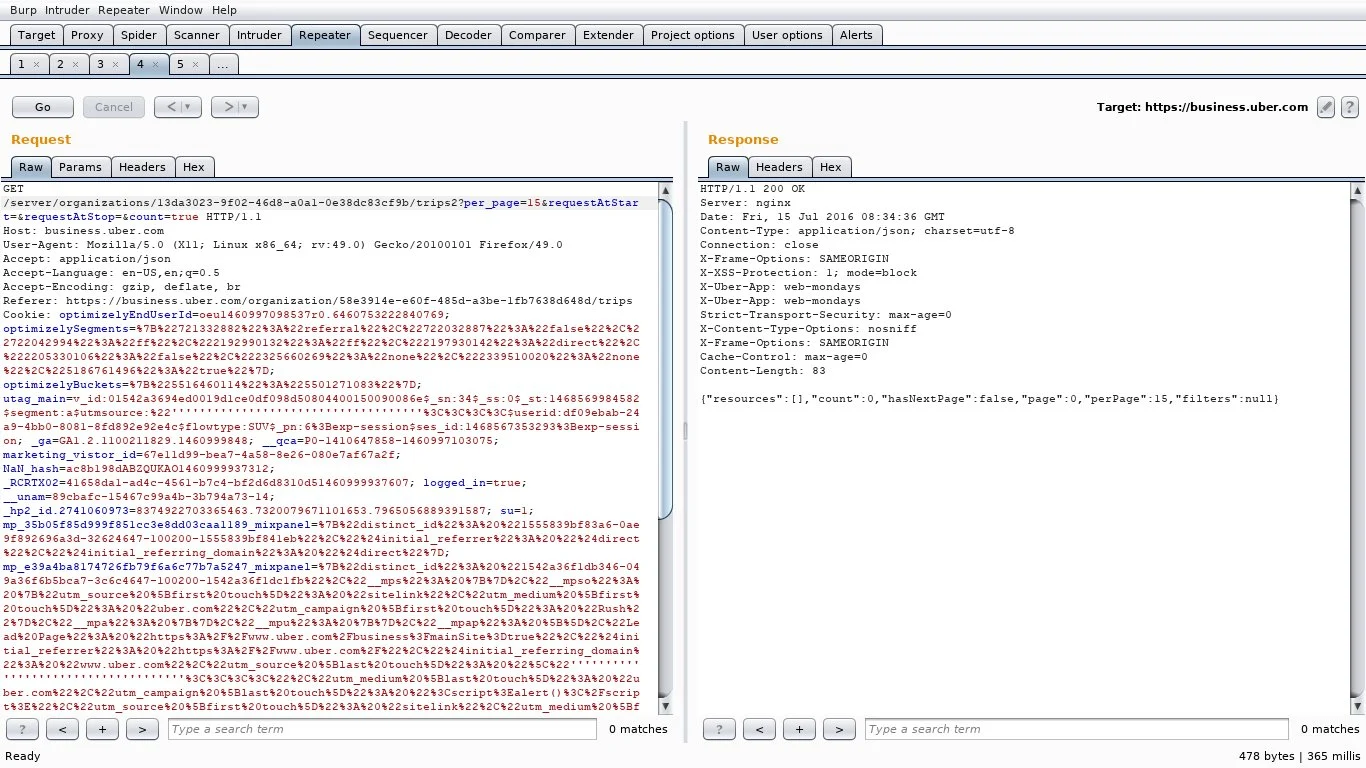
Hi Uber, I found issue on https://business.uber.com/server/organizations/[id]/trips2?per_page=15&requestAtStart=&requestAtStop=&count=true
Step to reproduce:
- Get https://business.uber.com/server/organizations/[your_organization_id]/trips2?per_page=15&requestAtStart=&requestAtStop=&count=true
- Chang to victim organization If valid id, it will return result, but if not it will show error with internal state
{"error":{"name":"TchannelUnexpectedError","fullType":"tchannel.unexpected","type":"tchannel.unexpected","message":"Unexpected Error: 'validation_error.must_be_a_valid_uuid_v4'","isErrorFrame":true,"codeName":"UnexpectedError","errorCode":5,"originalId":2,"remoteAddr":"10.160.14.41:21306"}}
In employee_invites, it return 403.
As previous I report #151465 , I can get organization id or just enum it ( very difficult).
Best regards, Severus
Attachments
Context
Uber runs a business travel product at business.uber.com. Organisations (companies) have their own accounts there, and the product exposes a server-side API under the /server/ path that the front end calls to render data. One of those endpoints returns the trips belonging to an organisation, keyed by the organisation id in the URL path.
The report describes an access control problem on that trips endpoint: the organisation id in the path is trusted, and a user who is authenticated to the product can ask for another organisation's trips by changing the id. The weakness is classified as improper authentication, and the report was disclosed on 15 August 2016 with a bounty of 2,000 USD.
Setup
To reproduce, you need an account on business.uber.com that belongs to at least one organisation, so that you have a valid organisation id of your own to start from. No special role is mentioned. The only tool needed is a browser or an intercepting proxy to edit the request, plus a way to obtain a victim organisation id.
Finding it
The trips endpoint takes the organisation id in the URL path:
https://business.uber.com/server/organizations/[id]/trips2?per_page=15&requestAtStart=&requestAtStop=&count=true
The query string carries paging and filtering parameters: per_page=15, an empty requestAtStart, an empty requestAtStop, and count=true.
Exploitation
Step 1: request your own organisation's trips
Send the request with your own organisation id in the path:
https://business.uber.com/server/organizations/[your_organization_id]/trips2?per_page=15&requestAtStart=&requestAtStop=&count=true
This is the first step of the reproduction.
Step 2: change the id to the victim organisation
Replace [your_organization_id] with the victim's organisation id and send the same request. If the id is valid, the endpoint returns the result for that organisation. If the id is not valid, the server returns an error that leaks internal state:
{"error":{"name":"TchannelUnexpectedError","fullType":"tchannel.unexpected","type":"tchannel.unexpected","message":"Unexpected Error: 'validation_error.must_be_a_valid_uuid_v4'","isErrorFrame":true,"codeName":"UnexpectedError","errorCode":5,"originalId":2,"remoteAddr":"[redacted]:21306"}}
The error body reveals the internal RPC framework (TChannel), the validation rule applied to the id (must_be_a_valid_uuid_v4), an error code and an internal address.
Step 3: compare with employee_invites
The researcher also tested the employee_invites resource. There, the same kind of cross-organisation request returns 403. So employee_invites returned 403 for the same kind of request, while trips2 returned results for a valid id.
Step 4: obtaining the victim id
The researcher notes that the organisation id can be obtained as described in an earlier report, #151465, or enumerated, adding that enumeration is very difficult. The report does not describe the enumeration method or the contents of #151465.
Root cause
The endpoint takes the organisation id from the URL path, and a valid foreign id returned results. The employee_invites resource shows the expected behaviour (403), so the check is implemented elsewhere in the product but not on trips2.
The malformed-id error returned internal framework details, including the RPC error type and an internal address.
Impact
A request with another organisation's valid id returned results instead of an error. The report does not enumerate which fields the trips response contains, so the exact sensitivity of the exposed data is not stated. The practical limit is knowledge of the victim's organisation id: the researcher says it can be obtained as in the earlier report or enumerated, but that enumeration is very difficult.
Fix
The report does not describe a fix.
Variants to test
- A positive result is a 200 with another organisation's data where a sibling route returns 403.
- A positive result is data for an organisation you do not belong to.
Hunting notes
The researcher showed that a valid id returns results while an invalid one produces an error, and that `employee_invites` returned 403.
What happened, in plain words
Uber runs a website for companies to manage business travel, at business.uber.com. A company that signs up there is called an organisation, and each organisation gets its own account and its own identifier, a long string of characters that the website uses to tell one company apart from another.
The website's pages do not fetch their data by themselves. Behind the scenes, the page asks a server for the data it needs, and the server answers with a structured reply. That kind of server interface is called an API. On this product the API lives under a path that starts with /server/, and one of its addresses returns the list of trips that belong to an organisation.
The trips address takes the organisation identifier from the URL path. A request with another organisation's valid identifier returned results. Changing the identifier to another company's valid identifier returned a result instead of an error. The report classifies the weakness as improper authentication. The report classifies it as improper authentication, and it was disclosed on 15 August 2016 with a bounty of 2,000 USD.
Setting up
To try this yourself you need an account on business.uber.com that belongs to at least one organisation. That gives you a valid organisation identifier of your own to start from. The report does not mention any special role being required.
The only tools needed are a browser, or a program that lets you look at and edit the requests your browser sends (often called an intercepting proxy), plus a way to learn a victim organisation's identifier.
Finding it
The researcher located the trips address and noticed that the organisation identifier is part of the URL path, the part of the address that names a resource, rather than being taken from the user's session. A session is the server's memory of who you are after you log in; normally the server should look up your organisation from there, not from the address you type.
https://business.uber.com/server/organizations/[id]/trips2?per_page=15&requestAtStart=&requestAtStop=&count=true
Reading this address piece by piece:
https://business.uber.comis the website./server/organizations/[id]/trips2is the API path.organizationssays which kind of thing is being asked about,[id]is the placeholder where an organisation identifier goes, andtrips2names the trips resource.- The part after the question mark is the query string, a set of settings sent along with the request.
per_page=15asks for 15 results per page.requestAtStart=andrequestAtStop=are empty, so no time filter is applied.count=trueasks the server to include a count.
Because the identifier comes from whoever sends the request, the obvious test is to replace it with an identifier that belongs to someone else and see whether the server still hands back data.
Exploitation
Step 1: request your own organisation's trips
First, send the request with your own organisation identifier in the path:
https://business.uber.com/server/organizations/[your_organization_id]/trips2?per_page=15&requestAtStart=&requestAtStop=&count=true
Here [your_organization_id] is replaced by the identifier of the organisation you legitimately belong to. This is the first step of the reproduction. The query string is unchanged from the address above.
Step 2: change the identifier to the victim organisation
Now replace [your_organization_id] with the victim's organisation identifier and send the same request. If the identifier is valid, the endpoint returns the result for that organisation. If the identifier is not valid, the server answers with an error that reveals details about its internal workings:
{"error":{"name":"TchannelUnexpectedError","fullType":"tchannel.unexpected","type":"tchannel.unexpected","message":"Unexpected Error: 'validation_error.must_be_a_valid_uuid_v4'","isErrorFrame":true,"codeName":"UnexpectedError","errorCode":5,"originalId":2,"remoteAddr":"[redacted]:21306"}}
This reply is a JSON object, a common text format for structured data. Going through its fields:
nameisTchannelUnexpectedError, andfullTypeandtypeare bothtchannel.unexpected. TChannel is the internal framework the backend uses to talk between its own services, and this tells the reader which one it is.messagesaysUnexpected Error: 'validation_error.must_be_a_valid_uuid_v4'. A UUID is a long identifier in a standard format, andv4is one version of that format. So the server is saying the identifier you sent does not look like a valid identifier of the expected shape.isErrorFrame,codeName,errorCodeandoriginalIdare further internal error details.remoteAddris an internal network address of the machine that produced the error.
Why does this matter? The error body tells an attacker several useful things: which internal framework is in use, the exact rule applied to the identifier (it must be a valid UUID v4), an error code, and an internal address.
Step 3: compare with employee_invites
The researcher also tested a different resource, employee_invites, which deals with invitations for employees. There, the same kind of request for another organisation returns HTTP status 403. HTTP status codes are short numbers a server sends to describe the outcome; 403 means "forbidden", that is, you are not allowed to see this. So employee_invites returned 403 for the same kind of request, while trips2 returned results for a valid identifier.
Step 4: obtaining the victim identifier
The researcher notes that the organisation identifier can be obtained as described in an earlier report, #151465, or by enumeration, which means trying many possible values until one works. The report adds that enumeration is very difficult. It does not describe the enumeration method or the contents of #151465.
Root cause
The endpoint takes the organisation identifier from the URL path, and a valid foreign identifier returned results. The employee_invites resource shows the expected behaviour, a 403, so the check is implemented elsewhere in the product but not on trips2.
The malformed-identifier error returned internal framework details, including the internal error type and an internal address.
Impact
A request with another organisation's valid identifier returned results instead of an error. The report does not list which fields the trips response contains, so the exact sensitivity of the exposed data is not stated. The practical limit is knowing the victim's organisation identifier: the researcher says it can be obtained as in the earlier report or enumerated, but that enumeration is very difficult. Cross-tenant means reading data that belongs to a different company on the same shared platform.
Fix
Variants to test
- A positive result is a 200 (success) with another organisation's data where a neighbouring route returns 403.
- A positive result is data for an organisation you do not belong to.
Hunting notes
Multi-tenant means one product serving many separate companies from the same system. The researcher showed that a valid identifier returns results while an invalid one produces an error, and that employee_invites returned 403.
Glossary
- API: a server interface that a website's pages call to fetch or send data, usually in a structured format.
- Access control: the rules that decide who is allowed to see or change which data.
- Improper authentication: a weakness where the system does not properly establish or check who the user is, or which account they belong to.
- Organisation: a company account on the business product, identified by its own identifier.
- Identifier (id): a value that uniquely names a thing, here a company.
- URL: the web address typed into or sent by a browser.
- URL path: the part of the address that names the resource, before the question mark.
- Query string: the settings after the question mark in a URL, such as
per_page=15. - Endpoint: one specific address on an API that performs one job.
- Session: the server's memory of who you are after you log in.
- Intercepting proxy: a tool that lets you view and edit the requests your browser sends.
- JSON: a text format for structured data, made of names and values.
- TChannel: an internal framework used by the backend services to communicate.
- UUID: a long identifier in a standard format;
v4is one version of that format. - HTTP status code: a number a server returns to describe the outcome, such as 200 for success and 403 for forbidden.
- 403: the status meaning "forbidden", that is, you are not allowed to access this.
- 200: the status meaning the request succeeded.
- Enumeration: trying many possible values until one is found to be valid.
- Cross-tenant: reading or changing data that belongs to a different company on the same shared platform.
- Multi-tenant: one product serving many separate companies from the same system.
- Recon: the early phase of looking around a product to find interesting endpoints and behaviour.
- Bounty: a payment a company makes to a researcher who reports a valid security issue.



