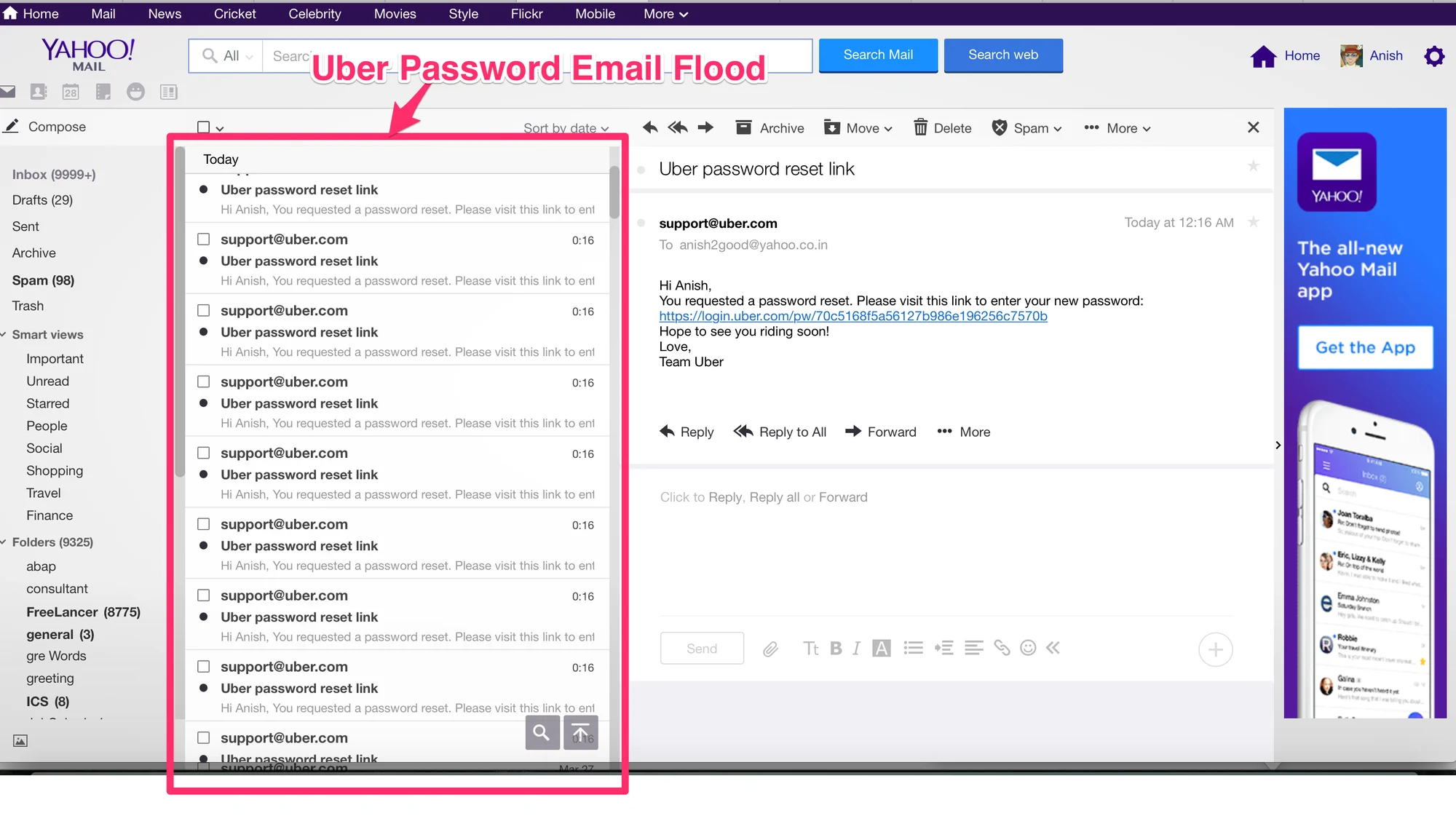
Uber password reset link EMAIL FLOOD
Replaying the password reset request sent many reset emails, flooding the inbox; the report does not say whether rate limiting existed.
 Originally disclosed on HackerOne
- Disclosed after 3 months
Step to reproduce Uber password reset link EMAIL FLOOD POC Video https://youtu.be/PPJkO_Eo6Mw
- Used OWSAP ZAP Proxy
- Generated the forgotten password Link of my account ([email protected])
- Used ZAP to replay the packet
- The Number of replay resulting into number of password link email which causing the USER Inbox to flood with UBER SCAM
- Attaching the POC as Video https://youtu.be/PPJkO_Eo6Mw
Attachments
Not written yet. The AI write-up for this report has not been written yet. The Original tab links to the source.
How it worked
Root cause
Likely the password reset endpoint lacked rate limiting or throttling, allowing unlimited repeated requests.
Impact
Replaying the reset request floods the user's inbox with password reset emails.
What the attacker needed
Ability to send HTTP requests; victim's email address
How it was found
- Use a proxy tool to capture the password reset request.
- Request a password reset link for your own account.
- Replay the captured request many times.
- Observe that each replay sends another password reset email to the inbox.
Explained by bugbounty.wiki with AI from the original and checked against quotes from it; it can still be wrong. Read the original before relying on a detail.
Not written yet. The AI write-up for this report has not been written yet. The Original tab links to the source.
A password reset email can be requested repeatedly, so the same address can receive many emails, which is annoying and can hide messages.
What is DoS?
A request that exhausts resources or crashes a component. Many programs forbid testing it; reports usually show it from code, not by attacking.