1st Bounty Story | Rewarded 300$ (IDOR)
The site used a client ID in the review submission request to identify the user, and an attacker could change that ID to another user's ID to modify their review rating. The attacker could change a victim's 5-star rating to a lower rating.

This is My 1st Bounty Rewarded Story and 1st Writeup.I am still learner not a pro man and week in english so ignor mistake spelling.My internet journey begin 2015. The first hacking word I could Found on My Facebook NewsFeed.
The full write-up lives on its author's site
It belongs to its author, so we link to it rather than copy it. The other two tabs are our own rewrites, checked against it.
Context
This is the story of a first bounty, rewarded at 300 USD, found on a site the author does not name because the report was still unresolved at the time of writing. The target was reached through a bug bounty programme on Bugcrowd: the author picked a site from the programme and then enumerated its subdomains. The vulnerable feature is a review section on the site's dashboard, where a logged-in user sees a five star review. The bug is an IDOR (insecure direct object reference): the review request carries a client id that identifies the user, and the server trusts whatever client id the client sends.
Setup
- A Bugcrowd account and a chosen programme site.
- Sublist3r for subdomain enumeration.
- A browser to visit each discovered domain.
- Two accounts created on the target, each with its own client id.
- Burp Suite to capture and modify the review request.
The author had been on their bug bounty journey for about a year and a half before this, following write-ups and the resources listed at the end of the post.
Finding it
The author ran Sublist3r against the programme's site, collected many domains, and checked them one by one in the browser. On one of them a new account was created. After logging in, the dashboard showed a five star review section:
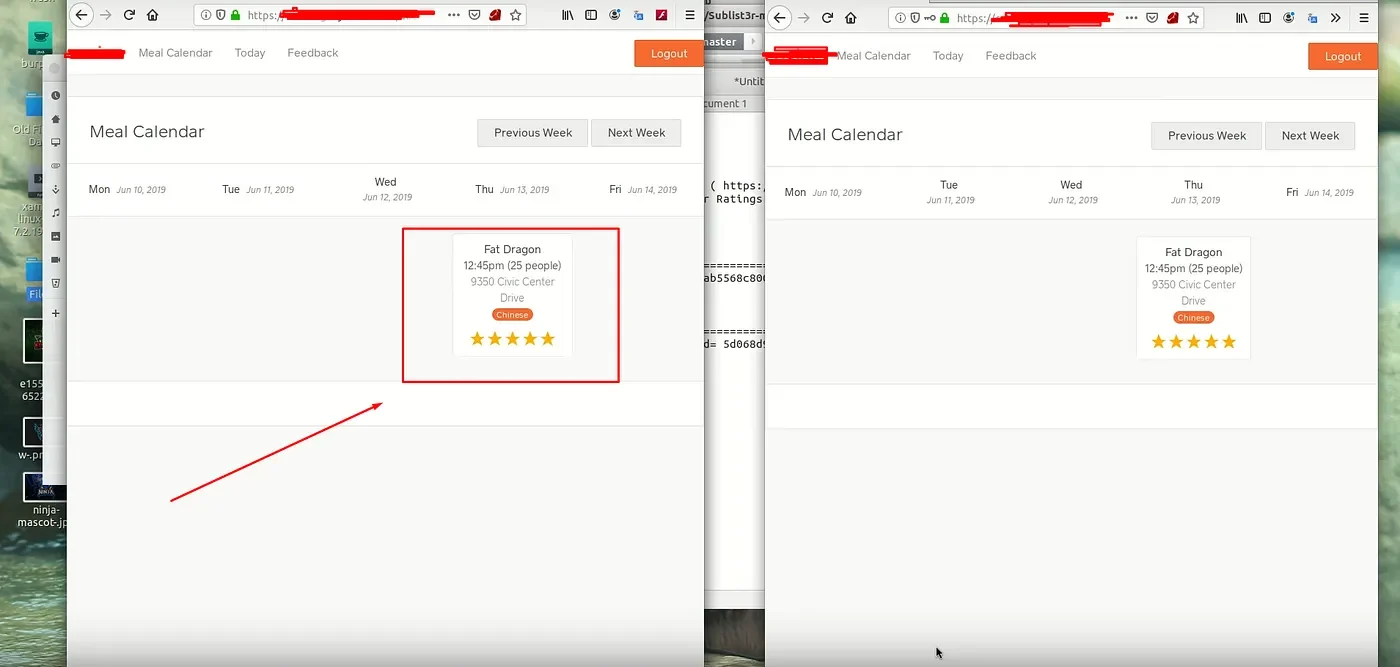
The review section is the feature of interest: it displays a rating tied to the logged-in user. The next step was to create a second account so that two client ids could be compared. The author copied the client id of each account:
user Profile (A)
[redacted] > client id= 5d0687ab5568c800dc14aaae

Attacker Profile (B)
[redacted] > client id= 5d068d935568c800df14aa97
Both ids are visible to the user who owns the account. That is what made the request worth tampering with.
Exploitation
Step 1: capture the review request
With profile A logged in, the author submitted a review and captured the resulting request in Burp Suite:
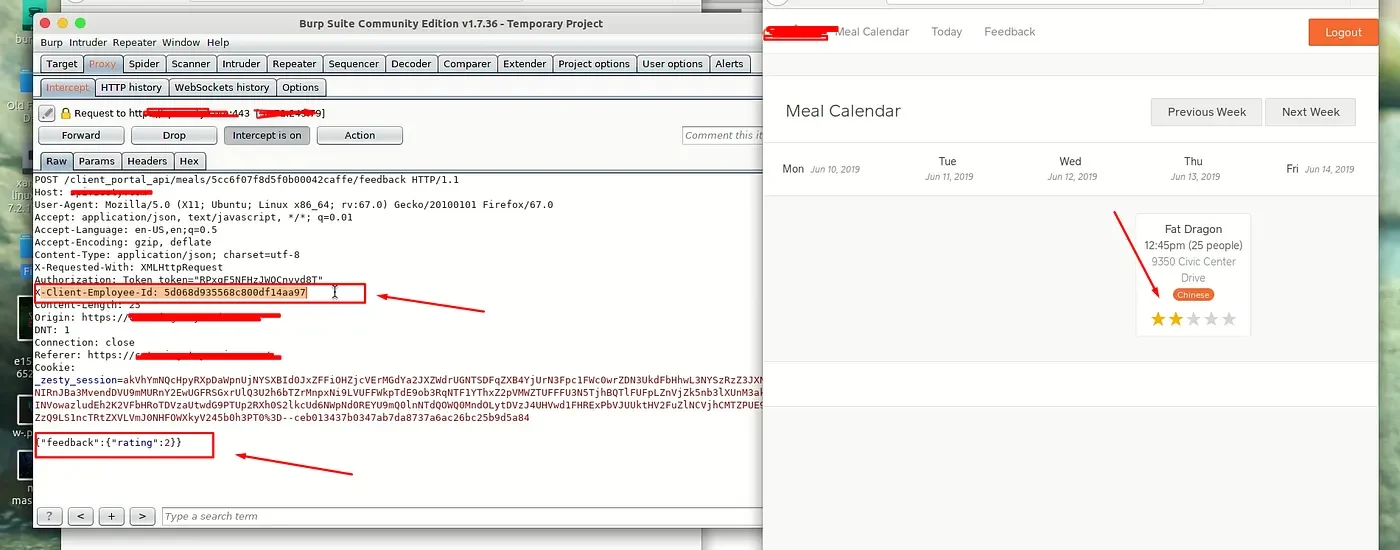
The captured request is the one that writes the review. Its important part is the client id parameter, which carries the value belonging to the account that is logged in, plus the star rating being submitted.
Step 2: swap the client id and change the rating
The author replaced profile A's client id with profile B's client id and changed the five star value to two stars, then forwarded the request:
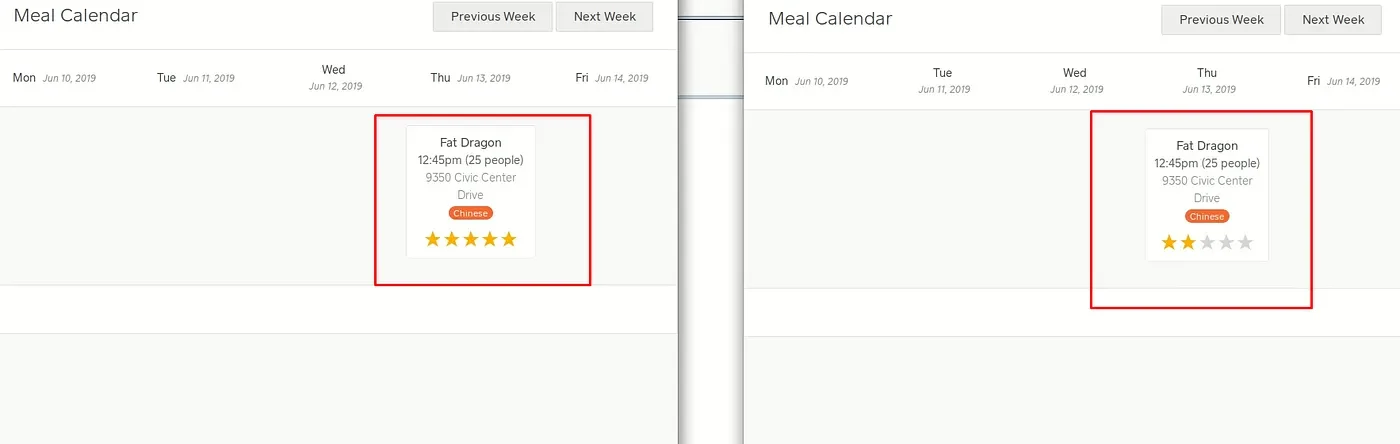
The client id was replaced and the star value changed, then the request was forwarded.
Step 3: observe the result
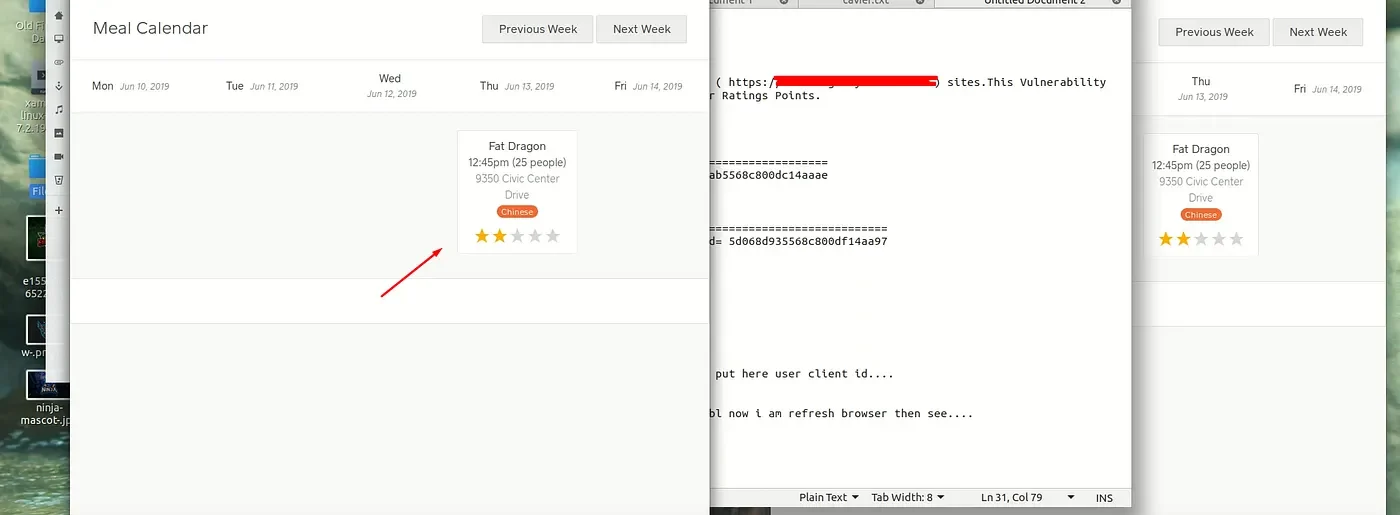
The server accepted the request. Profile A's five star rating was changed to a two star rating:
The author's reaction to the first bounty:

Root cause
The review write endpoint identifies the user whose review is being modified solely by the client id supplied in the request. The server accepted a request where the client id belonged to a different account, so the review owner appears to be taken from the client-supplied id. This is the classic IDOR pattern: an object reference is exposed to the client and the authorisation check is missing on the server side. The report does not describe any other defence, such as a signed or server-side token, that would have prevented the swap.
Impact
In the demonstrated case an authenticated attacker modified another user's review and rating by swapping in that user's client id. In the demonstrated case the change was from five stars to two stars. The report does not describe any further actions, such as reading other users' data or deleting reviews, and the site name is withheld because the report was unresolved.
Fix
The change that addresses the root cause is to derive the review owner from the authenticated session on the server rather than from a client-supplied id, and to reject requests where the supplied id does not belong to the caller.
Variants to test
- Swap the client id in other write requests (profile updates, comments, orders) and check whether the response reflects the change on the other account.
- Try ids that are sequential or otherwise guessable, and confirm whether a review belonging to an account you do not control changes.
- Send the request with the session of one account and the id of another, as here, and look for a success response rather than an authorisation error.
- Check whether the same id appears in read requests, which would allow reading other users' reviews or profile data.
- Test whether the server validates the id format only (for example, length or type) without checking ownership, by sending a valid but foreign id.
What happened, in plain words
A security researcher found a bug on a website that let one logged-in user change another user's star rating. The site had a review section where each user could leave a rating, shown as stars. The request that saves a review contained a value called a client id, which is a long string of letters and numbers that identifies which user the review belongs to. The server trusted whatever client id the browser sent, so by swapping one user's client id for another's, the researcher could edit someone else's review. This kind of bug is called an IDOR, short for Insecure Direct Object Reference. The researcher was paid 300 USD for the report, which was their first bounty. The site is not named because the report was still unresolved when it was written.
Background: how the researcher got here
The researcher had been on their bug bounty journey for about a year and a half, reading write-ups and following the resources listed at the end of the post. They had a Bugcrowd account. Bugcrowd is a platform where companies list their websites and offer money to anyone who finds security problems in them; these listings are called programmes. The researcher picked a site from a programme and started looking at it.
The tools used
Before the steps, here is what each tool does, in everyday terms:
- A browser: the same kind of program you use to visit websites. The researcher used it to open each discovered domain and sign up.
- Sublist3r: a small program that takes a main domain name and finds other names that belong to the same organisation, called subdomains. If the main site is like a building's front door, subdomains are the side doors and service entrances. Some of them are less protected than the front door, which is why researchers look at them.
- Two accounts on the target site: one to act as the victim (profile A) and one to act as the attacker (profile B). Having two accounts lets you compare what is different between them.
- Burp Suite: a program that sits between your browser and the website and lets you see and edit every request before it is sent. A request is the message your browser sends to a server, for example "save this review with five stars". Burp Suite is like a mail room where you can open each letter, change a word, and send it on.
Finding the review section
The researcher ran Sublist3r against the programme's site, collected many domains, and checked them one by one in the browser. On one of them a new account was created. After logging in, the dashboard showed a five star review section:
The image shows the review section on the dashboard, with the five star rating displayed. This is the feature of interest: it shows a rating that belongs to the logged-in user. The researcher wanted to know how that rating is saved, because anything a browser sends to a server can potentially be changed.
Creating two accounts and comparing client ids
The next step was to create a second account so that two client ids could be compared. A client id is a value the site uses to tell one user apart from another. It is not a password; it is more like a customer number printed on a receipt. The researcher copied the client id of each account:
user Profile (A)
[redacted] > client id= 5d0687ab5568c800dc14aaae

Attacker Profile (B)
[redacted] > client id= 5d068d935568c800df14aa97
Line by line: the first block is profile A, the account that will act as the victim, with its email address and the client id the site assigned to it. The second block is profile B, the account that will act as the attacker, with its own email address and its own client id. Both ids are visible to the user who owns the account. That is what made the request worth tampering with: if the server only looks at this number to decide whose review to change, then anyone who can send a different number can change a different review.
Exploitation
Step 1: capture the review request
With profile A logged in, the researcher submitted a review and captured the resulting request in Burp Suite:
The image shows the captured request in Burp Suite. The captured request is the one that writes the review. Its important part is the client id parameter, which carries the value belonging to the account that is logged in, plus the star rating being submitted. Capturing it first is necessary because you cannot change a message you have not seen; Burp Suite holds the request so it can be edited before it reaches the server.
Step 2: swap the client id and change the rating
The researcher replaced profile A's client id with profile B's client id and changed the five star value to two stars, then forwarded the request:
The image shows the edited request with the swapped client id and the changed star value. The client id was replaced and the star value changed, then the request was forwarded. A session is the state of being logged in; the browser proves it with a cookie or token, which is like a wristband you get at an event and show to get back in. The point of the test is that the wristband still says profile A, while the client id in the message says profile B. If the server accepts that combination, it is trusting the message over the wristband.
Step 3: observe the result
The server accepted the request. Profile A's five star rating was changed to a two star rating:
The image shows the rating after the change, now at two stars. This confirms the bug: a request sent from one account was able to modify another account's review. The researcher's reaction to the first bounty:
Why this is a vulnerability
The review write endpoint identifies the user whose review is being modified solely by the client id supplied in the request. The server accepted a request where the client id belonged to a different account, so the review owner appears to be taken from the client-supplied id. This is the classic IDOR pattern: an object reference is exposed to the client and the authorisation check is missing on the server side. Authorisation means deciding whether the person asking is allowed to do the thing they are asking for. Here the server checked that someone was logged in, but not that the logged-in person owned the review being changed. The report does not describe any other defence, such as a signed or server-side token, that would have prevented the swap.
Impact
In the demonstrated case an authenticated attacker modified another user's review and rating by swapping in that user's client id. In the demonstrated case the change was from five stars to two stars. The report does not describe any further actions, such as reading other users' data or deleting reviews, and the site name is withheld because the report was unresolved.
Fix
The change that addresses the root cause is to derive the review owner from the authenticated session on the server rather than from a client-supplied id, and to reject requests where the supplied id does not belong to the caller. In everyday terms: the server should look at the wristband, not at the number written on the message.
Variants to test
Once you understand the pattern, the same idea can be tried in other places. These are the directions the technical write-up lists:
- Swap the client id in other write requests (profile updates, comments, orders) and check whether the response reflects the change on the other account.
- Try ids that are sequential or otherwise guessable, and confirm whether a review belonging to an account you do not control changes.
- Send the request with the session of one account and the id of another, as here, and look for a success response rather than an authorisation error.
- Check whether the same id appears in read requests, which would allow reading other users' reviews or profile data.
- Test whether the server validates the id format only (for example, length or type) without checking ownership, by sending a valid but foreign id.
Resources the researcher followed
Glossary
- Bug bounty programme: a scheme run by a company or platform that pays people for reporting security problems in its systems.
- Bugcrowd: a platform that hosts bug bounty programmes for many companies.
- Subdomain: a name that sits under a main domain, such as shop.example.com under example.com; often a separate service with its own security.
- Sublist3r: a tool that finds subdomains of a given domain.
- Request: the message a browser sends to a server, for example to save a review.
- Response: the message a server sends back after a request.
- Burp Suite: a tool that intercepts, displays and lets you edit requests between your browser and a website.
- Parameter: a named value inside a request, such as a client id or a star rating.
- Client id: a value the site uses to identify a user account; here it appears in requests and is visible to the account owner.
- Session: the state of being logged in, usually proven by a cookie or token the browser sends with each request.
- Cookie / token: a small piece of data the browser stores and sends to prove who is logged in, like a wristband at an event.
- Authenticated: logged in and recognised by the server.
- Authorisation: the server's decision about whether a logged-in user is allowed to perform a particular action.
- IDOR (Insecure Direct Object Reference): a bug where the server uses a value supplied by the client to pick which object to act on, without checking that the client is allowed to access that object.
- Object reference: the value that points to a specific item on the server, such as one user's review.
- Endpoint: a specific address on a server that performs one action, such as saving a review.
- Root cause: the underlying reason a bug exists, as opposed to its visible symptom.
- Impact: what an attacker could actually do by exploiting the bug.
- Variant: a different place or way the same bug pattern might appear.



