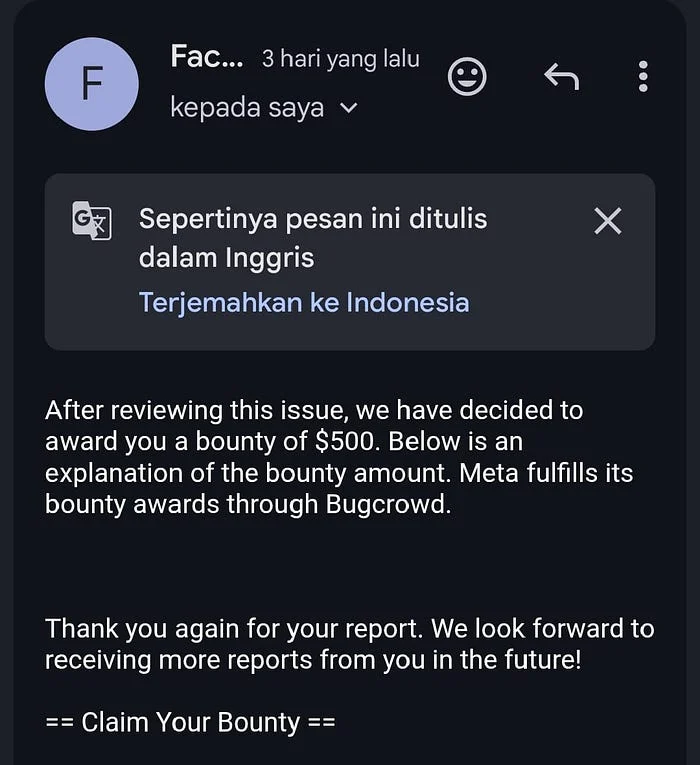
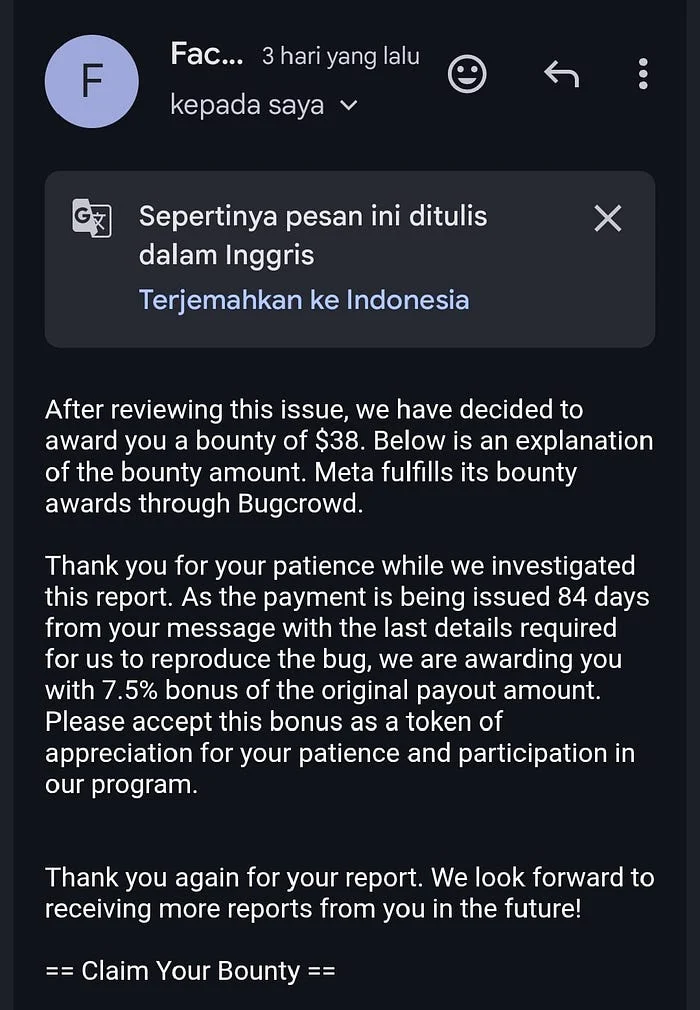
[$538] IDOR allows friends to edit the date on their friends’ timeline posts on Facebook
A Facebook user could change the creation date of a timeline post that a friend had written on their profile, even though the interface offers no such option. By swapping the post identifier in a GraphQL backdate request, the attacker could alter the displayed date and so undermine the authenticity of the post.
 Published on infosecwriteups.com
Meta Bug Bounty
The full write-up lives on its author's site
It belongs to its author, so we link to it rather than copy it. The other two tabs are our own rewrites, checked against it.
Context
Facebook lets a user create a post on a friend's timeline. The post is authored by the friend, but it lives on the other user's profile. The timeline owner can see the post and interact with it through the three-dot menu, but the product does not offer a way to change the date of a post that someone else wrote on their timeline. The date shown on a timeline post is part of the post's presentation, so being able to change it means the profile owner can make a friend's post appear to have been written on a different day.
The researcher, Rohmad Hidayah, found that the timeline owner could backdate a friend's post by swapping the story ID in the captured mutation. The result was an IDOR: the timeline owner could backdate a friend's post. The report records that on 18 August 2026 a bounty was awarded.
Setup
The test used two accounts and a normal friendship between them:
- User A and User B, who are friends.
- Environment: timeline post.
- Browser: Firefox.
- OS: Windows.
No special tooling is named beyond the browser; the request in step 6 was captured while intercepting it.
Finding it
User B can post on User A's timeline. When User A opens the three-dot menu on that post, there is no "Edit date" option. The same menu on a post User A wrote themselves does contain "Edit date". That difference is the signal: the UI hides the feature for posts authored by someone else, but the backend mutation that implements it may not make the same distinction.
Exploitation
Step 1: User A logs in
User A signs in at https://web.facebook.com/.
Step 2: User A sends a friend request
User A visits User B's profile and sends a friend request.
Step 3: User B accepts
User B logs in at https://web.facebook.com/, receives the notification, and accepts the request.
Step 4: User B posts on User A's timeline
User B visits User A's profile and creates a post on the timeline.
Step 5: User A inspects the post
User A gets a notification about the new post, opens the three-dot menu on it, and confirms that "Edit date" is absent. User A then obtains the post ID of that post. That ID is the target of the attack.
Step 6: Capture the mutation on a post User A owns
To learn the request shape, User A creates a post of their own, opens the three-dot menu, chooses "Edit date", picks a date and time, and clicks "Done" while intercepting the request. The captured request looks like this:
POST /api/graphql/ HTTP/1.1
Host: web.facebook.com
Cookie: USER_A_COOKIE
User-Agent: Mozilla/5.0 (Windows NT 10.0; Win64; x64; rv:150.0) Gecko/20100101 Firefox/150.0
Accept: */*
Accept-Language: en-US,en;q=0.9
Accept-Encoding: gzip, deflate, br
Content-Type: application/x-www-form-urlencoded
X-Fb-Friendly-Name: ProfileCometBackdateStoryMutation
X-Fb-Lsd: 9ItuW9eyhJVQ_euOL6I1_D
X-Asbd-Id: 359341
Content-Length: 4100
Origin: [https://web.facebook.com](https://web.facebook.com)
Referer: [https://web.facebook.com/petanijagungg](https://web.facebook.com/petanijagungg)
Sec-Fetch-Dest: empty
Sec-Fetch-Mode: cors
Sec-Fetch-Site: same-origin
Priority: u=0
Te: trailers
Connection:
``` keep-alive

av=61554410315919&__aaid=0&__user=61554410315919&__a=1&__req=39&__hs=20579.HYP%3Acomet_pkg.2.1…0&dpr=1&__c cg=GOOD&__rev=1038839325&__s=h2rhw1%3A9kkh8o%3A10yb8k&__hsi=7636672146002294756&__dyn=7xeUjGUW13xt0mUyEqxemh0 [redacted]-E4a3a4oaEnxO0Bo7O2l2Utwqo5W1 ywiE4u9x-[redacted]–5pUfEe88o4qum7–[redacted] g2fwxyo566k1fxC13xecwBwUU-4rwEKufxamEbbxG1fBG2–1mwto46fwk83KwHwOyUqxG0K83jxG3m&__csr=gesdMKxY9gzkWqs5_NsAY9MhNq [redacted]-qThKXpqQlJ lpkbvVmVdt4VFFquBj-[redacted] Fbypa-HQi9AGbLBiKm68Wuu8AxOmbDy-[redacted]-[redacted] [redacted]-2S5rG79Ey2K2a9GUlByk2G [redacted]-i4o4a3O2WcyEy49bwFxW9wDx11e4Egw [redacted] [redacted]–[redacted] [redacted]&__hsdp=gd10AxIgwhf8OEqwCAGEN244-gIop [redacted] [redacted]-t4Dta9epauF6HaN3hS58CQh4hR [redacted] [redacted]-[redacted]-bgcorCz EO6O0YDG6u1facwmo4q3fAJwCF0lo99–2–[redacted] [redacted]–0B81Co2FwbC0jC1b [redacted]-[redacted]&__hblp=0wDZ0PhFh1213 [redacted] [redacted]-5rK7od8kCxm1 EyEpCwiy3o4m4U4q2e4o4–[redacted] [redacted] K1kw860KUS220Xu0GE4y0EUkwFwCKfzWxS3J7wHw8uE6619wjFEy16KcxO18wuE6O6824x60sW1PyU2kwsFEtg3cwxx6i15wQhEohU2Vwbm1lx_ yU4K1by8boC1PwBwywio2lwQg8846Ui-3Cewyzo5m1JwTwe-2G0BUtwAxZ0s42u789986XyE8o5F0a-[redacted] 2O4E8E5S2_xm3K0pZ0UBwMCwhE&__sjsp=gd10AxIgwhf8OEqwCAGEN244-[redacted] [redacted] [redacted]-bwq4mQl0yxy9g 3sxV1J0NK2R0gA2B0kA3R0nA-3d0FwZg7R0d908y3St02ko0Y-0Fk7U0lmU&__comet_req=15&fb_dtsg=NAftuP0jqa0qp5kfzYszLPOwu73Sw XMPfawONOqTgAxdnZOItf_Nn7A%3A5%3A1767594021&jazoest=25732&lsd=9ItuW9eyhJVQ_euOL6I1_D&__spin_r=1038839325&__spin_ b=trunk&__spin_t=1778051291&__crn=comet.fbweb.CometProfileTimelineListViewRoute&qpl_active_flow_ids=30605361&fb_api_caller_class=RelayModern&fb_api_req_friendly_name=ProfileCometBackdateStoryMutation&server_timestamps=true&variables=%7B%22input%22%3A%7B%22backdate_info%22%3A%7B%22day%22%3A6%2C%22hour%22%3A1%2C%22minute%22%3A15%2C%22month%22%3A5%2C%22year%22%3A2026%7D%2C%22story_id%22%3A%[redacted]%3D%22%2C%22actor_id%22%3A%2261554410315919%22%2C%22client_mutation_id%22%3A%2214%22%7D%7D&doc_id=9660071250706684&fb_api_analytics_tags=%5B%22qpl_active_flow_ids%3D30605361%22%5D
The important parts of the body:
fb_api_req_friendly_name=ProfileCometBackdateStoryMutationnames the mutation that changes a story's date.fb_dtsgandlsdare the anti-CSRF values the web client sends with GraphQL calls.variablesis a URL-encoded JSON object. Decoded, itsinputcontainsbackdate_info(the chosenday,hour,minute,monthandyear),story_id,actor_idandclient_mutation_id.story_idis the base64-encoded identifier of the story being edited. In this capture it is the post User A created.actor_idis the numeric ID of the account performing the edit.
Step 7: Swap the story ID
User A takes the story_id value from the captured request and replaces it with the ID of the post User B created on User A's timeline (obtained in step 5). The rest of the request is left as captured, including User A's cookie and the actor_id of User A. User A sends the modified request.
The server responds with 200 OK.
Step 8: Verify
User A returns to the browser, refreshes the page, and looks at the post User B created on the timeline. The creation date has changed to the date supplied in backdate_info.
Root cause
The mutation ProfileCometBackdateStoryMutation accepts a story_id from the client, and swapping it for another user's post ID still returned 200 OK. The UI hides "Edit date" on posts written by other people, but that is only a client-side restriction; the server-side authorisation check on the mutation is missing. Because the timeline owner can see the friend's post and knows its ID, and because the mutation only needs a valid session and the standard fb_dtsg/lsd values, the owner can submit the edit for a story they do not own. The anti-CSRF tokens protect against cross-site request forgery, not against a logged-in user editing someone else's object, so they do not help here.
Impact
A user can change the date of a timeline post that another person created on their profile. The report frames this as a compromise of the authenticity of timeline post content: the post still belongs to the friend, but its displayed creation date no longer reflects when it was written. The report does not describe any other effect, such as editing the post body, changing posts on profiles the attacker does not own, or affecting posts outside the timeline-owner relationship.
Fix
The report does not state what change was made.
Variants to test
- Other story-editing mutations. Look for mutations that take a
story_idor similar object identifier and apply a change (edit text, change privacy, pin, delete). A positive result is a200 OKand the change appearing on an object the caller does not own. actor_idmismatch. Send a request whereactor_idis the victim's ID while authenticated as the attacker. A positive result is the server accepting the request and attributing the change to the victim.- Posts on pages or groups. Try the same
story_idswap against posts authored by another admin or member. A positive result is the date changing on a post the caller did not write. - Removed friendship. Repeat the flow after unfriending. A positive result is the edit still succeeding, which would show the check is not tied to the friendship at all.
- Other GraphQL endpoints. Check whether the same mutation is reachable through mobile or other GraphQL surfaces with weaker checks. A positive result is the same
200 OKand a changed date from a surface where the UI never exposes the feature.
What happened, in plain words
Facebook has a feature called the timeline. Your timeline is the collection of posts that appear on your profile page, in date order. A friend can write a post that appears on your timeline: the post is written by the friend, but it is shown on your profile. When you look at such a post, you can open a small menu (the three dots) and do things with it, but one option is missing: you cannot change the date that the post shows. That option, called "Edit date", only appears on posts you wrote yourself.
The researcher, Rohmad Hidayah, found that the date of a friend's post could be changed by swapping the post identifier in the request. The website is a program running in your browser, and it talks to Facebook's servers behind the scenes. When you click "Edit date" on your own post, your browser sends a message to the server asking it to change the date. The researcher captured that message and changed one value in it: the identifier of the post. Instead of naming his own post, he named the post his friend had written on his timeline. The server returned 200 OK, and after a refresh the date of the friend's post had changed.
This kind of bug is called an IDOR, short for Insecure Direct Object Reference. The name sounds complicated, but the idea is simple. Imagine a hotel where every room key is just a number written on a card, and the reception never checks whether the number belongs to you. If you are in room 12 and you write 13 on your card, you can open room 13. The server here behaved the same way: it received a post identifier and returned 200 OK for a post the caller did not write.
The report records that on 18 August 2026 a bounty was awarded. The report does not give the exact date it was submitted; the author says he forgot it. It records that on 18 August 2026 the bounty and bonus were awarded.
The pieces you need to know
Before walking through the steps, here are the few ideas the report relies on.
The product and the feature. Facebook's timeline shows posts on a profile. A friend can create a post on your timeline. Each post has a creation date shown next to it. Facebook also lets you backdate your own posts: you open the three-dot menu, choose "Edit date", pick a day and time, and confirm. The report calls the server operation behind this the "backdate" feature.
The browser and the server. The page you see is drawn by your browser. Anything you click usually causes the browser to send a request to a server, which does the real work and sends back an answer. The page is only the shop window; the server is the stockroom.
An API. An API is the set of addresses and message formats a program uses to ask a server to do something. Facebook's web page uses one called GraphQL. In GraphQL, the browser sends a single request that names an operation (here, a "mutation", which is an operation that changes data) and passes it some values. You can think of it as a form with a fixed name at the top and a list of fields to fill in.
A cookie. When you log in, the server gives your browser a small piece of data called a cookie. The browser sends it back with every later request, and that is how the server knows which account is asking. In the captured request below, the cookie is replaced with USER_A_COOKIE so the real value is not published.
An intercepting proxy. A proxy is a program that sits between your browser and the server. An intercepting proxy lets you pause a request on its way out, look at it, change it, and then let it continue. The request in step 6 was captured while intercepting it. The report does not name which proxy was used.
An IDOR. As above: the server takes an identifier from the request (here, the identifier of a post) and acts on it without checking that the caller is allowed to touch that object. The identifier is not a secret; the timeline owner can see the friend's post and therefore knows its identifier. The missing piece is the permission check on the server.
Anti-CSRF values. CSRF stands for Cross-Site Request Forgery: a trick where another website makes your browser send a request to a site you are logged into. To stop that, sites include a value in each state-changing request that another site cannot guess. Here those values are called fb_dtsg and lsd. They prove the request came from Facebook's own page, but they say nothing about whether you are allowed to edit a particular post. That is why they did not prevent this bug.
The setup
The test used two ordinary accounts with a normal friendship between them:
- User A and User B, who are friends.
- Environment: timeline post.
- Browser: Firefox.
- OS: Windows.
No other tooling is named beyond the browser and the intercepting proxy needed to capture and change the GraphQL request.
Finding it
User B can post on User A's timeline. When User A opens the three-dot menu on that post, there is no "Edit date" option. The same menu on a post User A wrote contains "Edit date". That difference is the clue: the page hides the feature for posts written by someone else, but the server operation behind the feature may not make the same distinction. The researcher set out to test whether the server would accept the edit anyway.
Exploitation, step by step
Step 1: User A logs in
User A signs in at https://web.facebook.com/. Logging in gives the browser the cookie that identifies User A to the server for all later requests.
Step 2: User A sends a friend request
User A visits User B's profile and sends a friend request. The friendship matters because it is what allows User B to post on User A's timeline in the first place.
Step 3: User B accepts
User B logs in at https://web.facebook.com/, receives the notification, and accepts the request. Now the two accounts are friends.
Step 4: User B posts on User A's timeline
User B visits User A's profile and creates a post on the timeline. This is the post whose date will later be changed. It is written by User B, so User A is not its author.
Step 5: User A inspects the post
User A gets a notification about the new post, opens the three-dot menu on it, and confirms that "Edit date" is absent. User A then obtains the post identifier of that post. That identifier is the target of the attack: it is the number on the hotel key card that the server will fail to check.
Step 6: Capture the request on a post User A owns
To learn what the request looks like, User A creates a post of their own, opens the three-dot menu, chooses "Edit date", picks a date and time, and clicks "Done" while intercepting the request. The captured request looks like this:
POST /api/graphql/ HTTP/1.1
Host: web.facebook.com
Cookie: USER_A_COOKIE
User-Agent: Mozilla/5.0 (Windows NT 10.0; Win64; x64; rv:150.0) Gecko/20100101 Firefox/150.0
Accept: */*
Accept-Language: en-US,en;q=0.9
Accept-Encoding: gzip, deflate, br
Content-Type: application/x-www-form-urlencoded
X-Fb-Friendly-Name: ProfileCometBackdateStoryMutation
X-Fb-Lsd: 9ItuW9eyhJVQ_euOL6I1_D
X-Asbd-Id: 359341
Content-Length: 4100
Origin: [https://web.facebook.com](https://web.facebook.com)
Referer: [https://web.facebook.com/petanijagungg](https://web.facebook.com/petanijagungg)
Sec-Fetch-Dest: empty
Sec-Fetch-Mode: cors
Sec-Fetch-Site: same-origin
Priority: u=0
Te: trailers
Connection:
``` keep-alive

av=61554410315919&__aaid=0&__user=61554410315919&__a=1&__req=39&__hs=20579.HYP%3Acomet_pkg.2.1…0&dpr=1&__c cg=GOOD&__rev=1038839325&__s=h2rhw1%3A9kkh8o%3A10yb8k&__hsi=7636672146002294756&__dyn=7xeUjGUW13xt0mUyEqxemh0 [redacted]-E4a3a4oaEnxO0Bo7O2l2Utwqo5W1 ywiE4u9x-[redacted]–5pUfEe88o4qum7–[redacted] g2fwxyo566k1fxC13xecwBwUU-4rwEKufxamEbbxG1fBG2–1mwto46fwk83KwHwOyUqxG0K83jxG3m&__csr=gesdMKxY9gzkWqs5_NsAY9MhNq [redacted]-qThKXpqQlJ lpkbvVmVdt4VFFquBj-[redacted] Fbypa-HQi9AGbLBiKm68Wuu8AxOmbDy-[redacted]-[redacted] [redacted]-2S5rG79Ey2K2a9GUlByk2G [redacted]-i4o4a3O2WcyEy49bwFxW9wDx11e4Egw [redacted] [redacted]–[redacted] [redacted]&__hsdp=gd10AxIgwhf8OEqwCAGEN244-gIop [redacted] [redacted]-t4Dta9epauF6HaN3hS58CQh4hR [redacted] [redacted]-[redacted]-bgcorCz EO6O0YDG6u1facwmo4q3fAJwCF0lo99–2–[redacted] [redacted]–0B81Co2FwbC0jC1b [redacted]-[redacted]&__hblp=0wDZ0PhFh1213 [redacted] [redacted]-5rK7od8kCxm1 EyEpCwiy3o4m4U4q2e4o4–[redacted] [redacted] K1kw860KUS220Xu0GE4y0EUkwFwCKfzWxS3J7wHw8uE6619wjFEy16KcxO18wuE6O6824x60sW1PyU2kwsFEtg3cwxx6i15wQhEohU2Vwbm1lx_ yU4K1by8boC1PwBwywio2lwQg8846Ui-3Cewyzo5m1JwTwe-2G0BUtwAxZ0s42u789986XyE8o5F0a-[redacted] 2O4E8E5S2_xm3K0pZ0UBwMCwhE&__sjsp=gd10AxIgwhf8OEqwCAGEN244-[redacted] [redacted] [redacted]-bwq4mQl0yxy9g 3sxV1J0NK2R0gA2B0kA3R0nA-3d0FwZg7R0d908y3St02ko0Y-0Fk7U0lmU&__comet_req=15&fb_dtsg=NAftuP0jqa0qp5kfzYszLPOwu73Sw XMPfawONOqTgAxdnZOItf_Nn7A%3A5%3A1767594021&jazoest=25732&lsd=9ItuW9eyhJVQ_euOL6I1_D&__spin_r=1038839325&__spin_ b=trunk&__spin_t=1778051291&__crn=comet.fbweb.CometProfileTimelineListViewRoute&qpl_active_flow_ids=30605361&fb_api_caller_class=RelayModern&fb_api_req_friendly_name=ProfileCometBackdateStoryMutation&server_timestamps=true&variables=%7B%22input%22%3A%7B%22backdate_info%22%3A%7B%22day%22%3A6%2C%22hour%22%3A1%2C%22minute%22%3A15%2C%22month%22%3A5%2C%22year%22%3A2026%7D%2C%22story_id%22%3A%[redacted]%3D%22%2C%22actor_id%22%3A%2261554410315919%22%2C%22client_mutation_id%22%3A%2214%22%7D%7D&doc_id=9660071250706684&fb_api_analytics_tags=%5B%22qpl_active_flow_ids%3D30605361%22%5D
What each part of this request does:
POST /api/graphql/ HTTP/1.1is the first line.POSTmeans "I am sending data"./api/graphql/is the address on the server that handles GraphQL calls.HTTP/1.1is the version of the language the browser and server speak.Host: web.facebook.comsays which website the request is for.Cookie: USER_A_COOKIEis where the login cookie would go. It is replaced here so the real value is not published. This is what tells the server the request comes from User A's account.User-Agentdescribes the browser: Firefox 150.0 on 64-bit Windows.Accept,Accept-LanguageandAccept-Encodingsay which formats and languages the browser can handle.Content-Type: application/x-www-form-urlencodedsays the body is a list ofname=valuepairs joined with&, the same format a web form uses.X-Fb-Friendly-Name: ProfileCometBackdateStoryMutationis a header naming the operation. "Mutation" in GraphQL means an operation that changes data, as opposed to one that only reads it. "Backdate" means setting a date in the past.X-Fb-Lsd: 9ItuW9eyhJVQ_euOL6I1_Dis one of the anti-CSRF values, repeated in the body aslsd.X-Asbd-Id,Content-Length,Origin,Referer,Sec-Fetch-*,Priority,TeandConnectionare supporting headers.OriginandReferersay which page the request came from;Content-Lengthsays how long the body is; theSec-Fetch-*headers tell the server what kind of request this is.- The body is one long line of
name=valuepairs. Most of them (__dyn,__csr,__hsdp,__hblp,__sjspand similar) are internal bookkeeping values the page sends along. The important ones are listed next.
Inside the body, the parts that matter:
fb_api_req_friendly_name=ProfileCometBackdateStoryMutationnames the operation being called: the one that changes a story's date. "Story" is Facebook's internal word for a post.fb_dtsg=...andlsd=...are the anti-CSRF values the web page sends with GraphQL calls. They show the request came from Facebook's own page, not from another site.variables=...is a URL-encoded JSON object. URL encoding replaces characters that are not allowed in a URL with%codes, so%7Bis{,%22is a double quote,%3Ais a colon and%2Cis a comma. Decoded, theinputobject containsbackdate_info(the chosenday,hour,minute,monthandyear),story_id,actor_idandclient_mutation_id.story_idis the encoded identifier of the post being edited. In this capture it is the post User A created. The value ends in%3D, which is an encoded=, a common padding character in base64 encoding.actor_idis the numeric identifier of the account performing the edit, here User A's.client_mutation_idis a small number the page uses to match the answer to the request.doc_ididentifies the stored GraphQL document (the query text) on the server, so the browser does not have to send the whole query.
Step 7: Swap the story identifier
User A takes the story_id value from the captured request and replaces it with the identifier of the post User B created on User A's timeline, obtained in step 5. Everything else stays as captured, including User A's cookie and User A's actor_id. User A then sends the modified request.
The server answers 200 OK. That is the standard "it worked" answer. This is the moment the missing permission check shows itself.
Step 8: Check the result
User A returns to the browser, refreshes the page, and looks at the post User B created on the timeline. The creation date has changed to the date supplied in backdate_info.
Why it worked
The operation ProfileCometBackdateStoryMutation accepts a story_id from the client, and swapping it for another user's post ID still returned 200 OK. The page hides "Edit date" on posts written by other people, but that is only a restriction in the browser. The server-side permission check on the operation is missing. Because the timeline owner can see the friend's post and therefore knows its identifier, and because the operation only needs a valid login and the standard fb_dtsg/lsd values, the owner can submit the edit for a post they do not own. The anti-CSRF values protect against another website forging a request; they do not stop a logged-in user from editing someone else's object, so they do not help here.
What it means
A user can change the date of a timeline post that another person created on their profile. The report frames this as a compromise of the authenticity of timeline post content: the post still belongs to the friend, but the date shown no longer reflects when it was written.
The fix
Other places to look
- Other post-editing operations. Look for operations that take a
story_idor similar object identifier and apply a change (edit text, change privacy, pin, delete). A positive result is a200 OKand the change appearing on an object the caller does not own. actor_idmismatch. Send a request whereactor_idis the victim's identifier while logged in as the attacker. A positive result is the server accepting the request and attributing the change to the victim.- Posts on pages or groups. Try the same
story_idswap against posts written by another admin or member. A positive result is the date changing on a post the caller did not write. - Removed friendship. Repeat the flow after unfriending. A positive result is the edit still succeeding, which would show the check is not tied to the friendship at all.
- Other GraphQL endpoints. Check whether the same operation is reachable through mobile or other GraphQL surfaces with weaker checks. A positive result is the same
200 OKand a changed date from a surface where the page never shows the feature.
Timeline
The author says he forgot the date he sent the report. On 18 August 2026 the bounty and a bonus were awarded.
Glossary
- API: the set of addresses and message formats a program uses to ask a server to do something.
- GraphQL: an API style where the browser sends one request naming an operation and its values, instead of many separate addresses.
- Mutation: in GraphQL, an operation that changes data, as opposed to one that only reads it.
- Story: Facebook's internal word for a post.
- Backdate: to set the date of something to an earlier date than the real one.
- Timeline: the collection of posts shown on a profile page, in date order.
- Cookie: a small piece of data the server gives your browser at login, which the browser sends back with later requests so the server knows which account is asking.
- Session: the logged-in state that a cookie represents.
- Header: a labelled line at the top of a request or response carrying information about it, such as the browser type or the content format.
- Request body: the part of a request that carries the data being sent, after the headers.
application/x-www-form-urlencoded: a body format made ofname=valuepairs joined with&.- URL encoding: replacing characters that are not allowed in a URL with
%codes, such as%22for a double quote. - JSON: a text format for structured data, built from names, values, lists and objects.
- Base64: an encoding that turns binary data into letters, digits and a few symbols; it often ends with
=padding. - Identifier (ID): a value that names a particular object, such as a post or an account.
story_id: the identifier of the post being edited in the backdate operation.actor_id: the numeric identifier of the account performing an action.- IDOR (Insecure Direct Object Reference): a bug where the server takes an object identifier from the request and acts on it without checking that the caller is allowed to touch that object.
- Authorisation: the check that a logged-in user is allowed to perform a particular action on a particular object.
- Authentication: proving who you are, usually by logging in.
- CSRF (Cross-Site Request Forgery): a trick where another website makes your browser send a request to a site you are logged into.
- Anti-CSRF value: a value included in state-changing requests that another site cannot guess, used to block CSRF. Here:
fb_dtsgandlsd. - Intercepting proxy: a program between browser and server that can pause, inspect and change requests.
200 OK: the standard HTTP answer meaning the request succeeded.- Bounty: a reward paid by a company for a valid security report.
- Bonus: an extra payment on top of the bounty.




