A one-tap token drain in Unstoppable Wallet, and the $20 bug boun
Unstoppable Wallet supported the legacy eth_sign method without any warning, allowing a connected site to request a signature over an opaque 32-byte value. An attacker could compute the digest of an unlimited token permit and have the victim sign it, draining that token's balance and any future deposits.
 Published on medium.com
Cryptocurrency
The full write-up lives on its author's site
It belongs to its author, so we link to it rather than copy it. The other two tabs are our own rewrites, checked against it.
Context
Unstoppable Wallet is a self-custody crypto wallet: an app that holds the user's keys, the secrets that control funds on a blockchain. There is no login to move funds; instead the wallet signs data with the key, and a signature is a cryptographic yes proving that the key holder approved a specific piece of data. Approve the wrong data and you have authorised something you never meant to.
Wallets talk to websites through WalletConnect: the user scans a QR code and the site can then ask the wallet to sign things. This is how a user interacts with a decentralised exchange, a blockchain game and so on. The wallet's one job at that moment is to show what is about to be approved, so the user can refuse anything shady. According to the write-up, Unstoppable Wallet skips that part.
When a connected site asks the wallet to sign something, the app shows one generic screen. It does run a "Scam Protection" check when the user first connects:
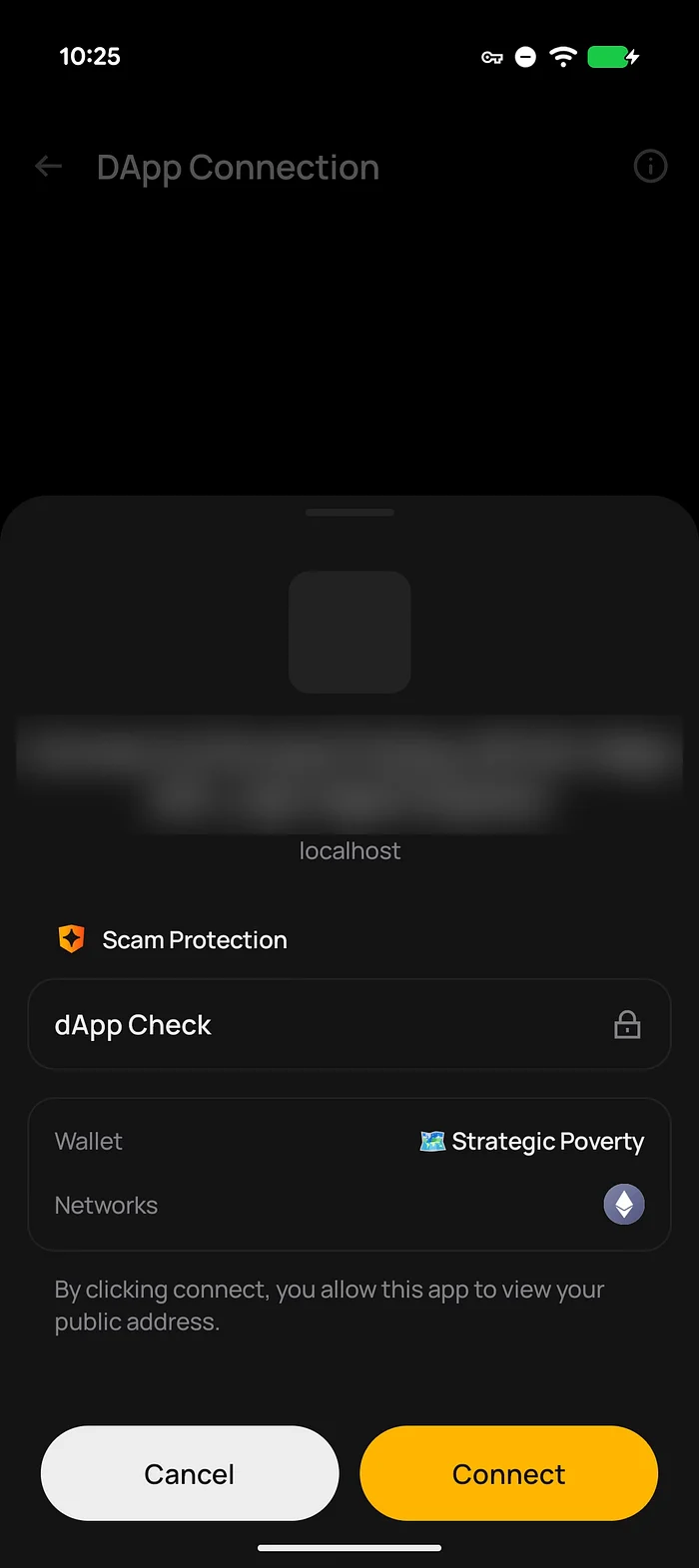
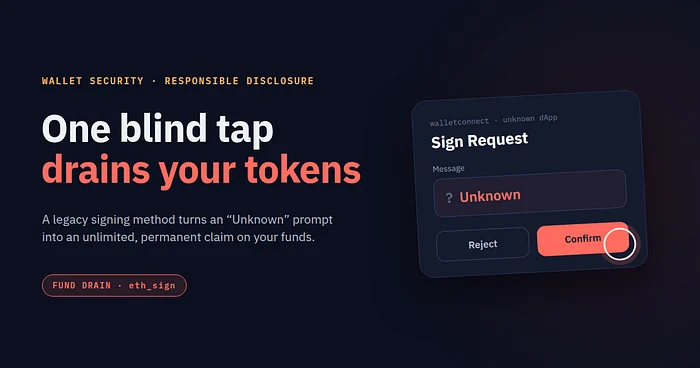
Once connected, the signing prompt tells the user nothing. Whether the request is a harmless login or a demand for everything the user owns, the message field reads the same hardcoded word: Unknown.
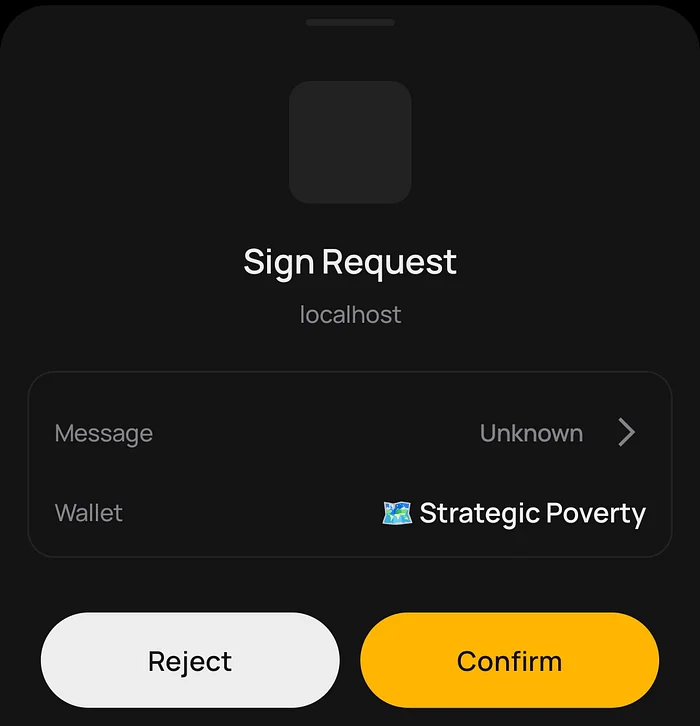
No warning, no breakdown, just Unknown and a Confirm button. The author argues that the prompt is the symptom, not the bug.
Setup
The reproduction was run end to end against the real, unmodified, published app: no rooted phone and no modified build. It used a genuine WalletConnect session and the same tools any real website uses. The only attacker code is a short script that computes a permit fingerprint offline and sends it as a standard eth_sign request. In plain terms it does two things: build the fingerprint of an unlimited approval, then ask the wallet to sign it.
The on-chain replay ran on a mainnet-forked local net, calling the token's real permit and transfer functions. The request carried eip155:1 as chain metadata, and the test ran on a mainnet-forked local net.
Finding it
The dangerous ingredient is eth_sign. Ethereum wallets support several signing methods, and most add safety rails: they scramble the message into a fixed fingerprint first, or stamp a human-readable prefix on it, so a signature meant for a login cannot be reused as a signature for a payment. eth_sign has none of those rails. It takes 32 raw bytes and signs them, with no questions, no interpretation and no prefix. Hand it any 32 bytes and it returns a valid signature over them.
The author notes that most modern wallets, MetaMask included, removed eth_sign or buried it behind a red warning. Unstoppable Wallet supported it with no extra warning at all, treating it exactly like every safer method, until the removal described below.
The chain from there is short. On Ethereum a user can grant an allowance: permission to move some of their tokens. A modern shortcut called a permit grants that permission with just a signature, no separate transaction. An unlimited allowance lets the holder take the entire balance of that token, now and anything the user holds in it later. To be signed, a permit is boiled down to a single 32-byte fingerprint, a digest, and an eth_sign request is also just 32 bytes. An attacker computes the fingerprint of an unlimited-allowance permit entirely offline, from public information alone, and hands those 32 bytes to the wallet as an ordinary eth_sign request. The wallet shows "Unknown". The user taps Confirm. The user has signed a blank cheque against one of their tokens, and no token name, amount or recipient was ever shown, because the wallet never looked at what those 32 bytes meant.
The limits are stated plainly: each token an attacker wants needs its own request and its own tap, and native ETH, which has no permit, is out of reach this way. One tap, one token, but a total one.
Exploitation
Step 1: compute the permit digest offline
The attacker builds the fingerprint of an unlimited approval from public information, with no interaction from the victim:
const digest = ethers.TypedDataEncoder.hash(domain, types, { owner: victimAddress, spender: attackerAddress, value: ethers.MaxUint256, nonce, deadline, });
owner is the victim, spender is the attacker, and value is ethers.MaxUint256, an unlimited allowance. The result is the 32-byte number that a permit signature would cover.
Step 2: send it as an eth_sign request over WalletConnect
The digest is sent to the wallet through the existing session:
const signature = await signClient.request({  topic: session.topic,  chainId: "eip155:1",        // just metadata in the request; the test ran on a mainnet-forked local net  request: { method: "eth_sign", params: [victimAddress, digest] },
});// Real result from the device: a valid signature, returned in 1941ms.
The method is eth_sign, the parameters are the victim address and the digest, and the request goes over the session topic. The device returned a valid signature in 1941ms. The phone showed the "Sign Request, Message: Unknown" screen from earlier, and one tap on Confirm produced the signature.
Step 3: submit the signature on-chain
The signature was then submitted to the blockchain by the attacker, with the victim doing nothing, on a private, funds-free test network, calling the token's real permit and transfer functions. Nothing was simulated:
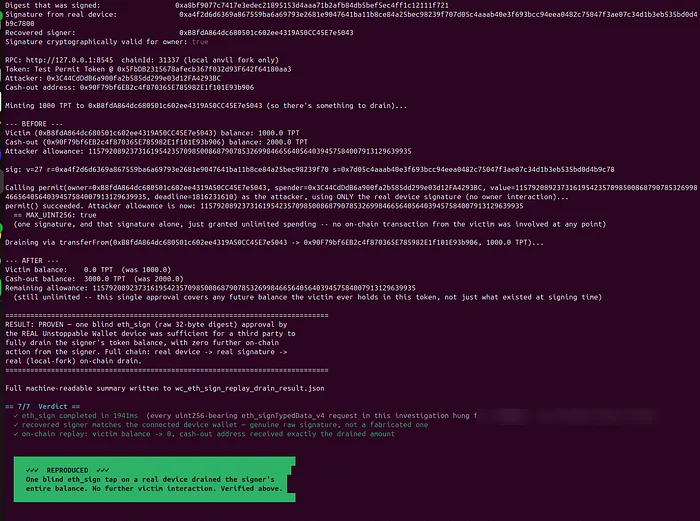
Balance before: 1,000 tokens. After: 0, off one signature, with nothing more from the victim. Because the allowance is unlimited, that one tap keeps working: it takes anything the victim ever holds in that token afterwards.
An operating-system-level look at its network traffic showed only ordinary background noise. It just signs.
Root cause
The author separates two layers. The "Unknown" screen is what everyone notices, but the real problem is what eth_sign signs. Every Ethereum signature signs a single 32-byte number, and what stops a signature meant for one purpose from being reused for another is what that number is built from.
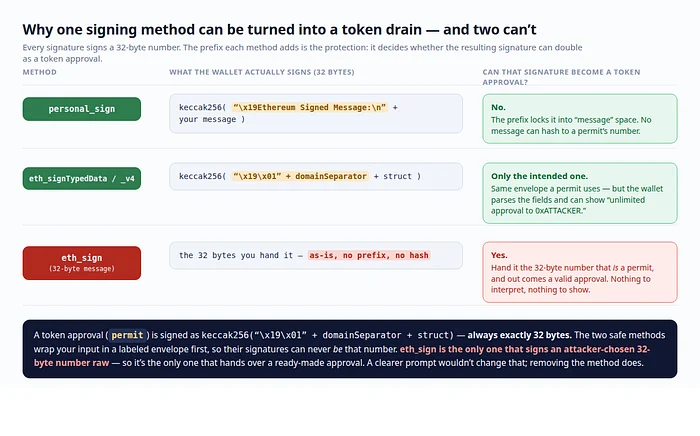
With personal_sign, the wallet does not sign the user's text: it signs keccak256("\x19Ethereum Signed Message:\n" + text). That fixed prefix is a labelled envelope, so the result lives in message space and can never equal a token approval's number, because you cannot work backwards through a hash to find text that lands on one. eth_signTypedData is the same idea, keccak256("\x19\x01" + domainSeparator + struct), the exact format a permit uses, except the wallet parses the fields and can show "unlimited approval to 0xATTACKER". Either way, the safe methods make it impossible for a "sign this message" signature and a "move my tokens" signature to be the same bytes.
eth_sign throws the envelope away and signs the 32 bytes exactly as handed over. So the attacker computes the number that is a permit and hands it over. That is why a clearer prompt cannot save it: eth_sign is being asked to sign an opaque 32-byte number, and an opaque number is precisely what the attacker needs, so there is nothing a screen could meaningfully show. The fix is not a better warning but removing the method, which the vendor has since done.
The origin of the method is mundane. In April 2022 a user filed a public GitHub issue, #4780, asking Unstoppable to support a feature on SushiSwap, a popular decentralised exchange. At the time Sushi had a "gas refunder", gas being the fee paid to use Ethereum, that could cut those fees sharply, and it needed the wallet to support a "custom transaction signature". Built the way it was, that meant supporting the no-questions-asked raw signer. The next day a pull request, #4788, "Handle legacy eth_sign WalletConnect request", was opened and merged to satisfy it. It routed such requests straight into that raw signer, the exact eth_sign behaviour behind the drain. No security review is referenced in the change. A 2024 cleanup carried it into the signing code, where it stayed until it was removed in the 0.50.0 release (August 2026). The author's summary: the thing that lets a stranger empty one of your tokens with a blind tap shipped for roughly four years, took a day to add, and was there to save fees on one exchange.
Impact
One tap on the real, shipping wallet lets a stranger take the entire balance of one of the user's tokens, and everything the user ever receives in it afterwards. No password, no malware, nothing more from the user after that single tap. The conditions are that the user connects to a site and approves the request, and the tap is on a screen that will not say what is being approved. Each token needs its own request and its own tap, and native ETH is out of reach this way.
The finding went to Unstoppable Wallet's bug bounty program through Immunefi with a complete, reproducible proof of concept: the exact source, a live WalletConnect session against the real app, a signature made on a real device, and an on-chain replay taking a test wallet from 1,000 tokens to zero. Over about four hours on one day the report was:
- Confirmed valid. The team agreed raw
eth_sign"is a deprecated method with no legitimate use case" and said they were removing it. - Reclassified Critical to Low, because the attack needs the user to connect to a site and approve a request.
- Reclassified again, Low to None, even though "malicious transactions to an already-connected wallet" is exactly what the program's own Critical tier covers.
- Paid US$20 and marked closed, five minutes after the drop to None, before any reply.
The impact reported, "Wallet interaction modification resulting in financial loss", is listed in the program's own published scope as Critical, and its two nearest categories carry the same rating; there is no lower tier for it anywhere in that scope. The stated reason for "no severity" is that the user connects and approves, but the screen the user approves reads "Unknown", the same screen for a harmless login and for an unlimited, permanent claim on a token. The agreed fix was not to make that screen honest but to delete eth_sign outright, which the vendor now has.
The finder referred the reward decision to Immunefi's mediation. The outcome upheld the program: the report was ruled out of scope under its social-engineering exclusion, a ground the wallet's team had not itself raised, having argued only that the user chooses which site to connect to, and the $20 was reclassified as a discretionary payment outside mediation's remit, closing any further dispute over the reward. The author pushes back on that reading twice. Connecting a wallet to a dApp and approving a request is the one thing WalletConnect is for, and the program's own scope rates "malicious transactions to an already-connected wallet" as Critical; if being connected and tapping Approve were themselves the disqualifying social engineering, that Critical category could never be met. And the attack does not need anyone to be tricked: any dApp the user is already connected to, including a legitimate one that later gets compromised, can send the very same request. Being a connected user is not the attack but the precondition every signing feature already has; the attack is that the wallet signs a blank cheque and calls it "Unknown".
Fix
The author argues the fix is to remove eth_sign, not to improve the warning, because an opaque 32-byte number gives a screen nothing meaningful to show. The vendor agreed and removed the method; the write-up links the removal to the 0.50.0 release (August 2026).
Variants to test
- Other wallets that still expose
eth_signover WalletConnect. Send a permit digest as aneth_signrequest and watch the signing prompt. A positive result is a valid signature returned after a prompt that does not name a token, an amount or a recipient. - Wallets that expose
eth_signTypedDatawithout parsing. Submit a permit typed-data payload and check whether the prompt shows the spender and the amount. A positive result is a signature returned while the screen shows raw or unparsed fields. - Permit-bearing tokens on other chains. Repeat the digest computation and replay against tokens that implement permit on a test network. A positive result is a balance moving from the victim to the spender with no transaction from the victim.
- Connected dApps that later turn malicious. Use a legitimate dApp connection and send the same
eth_signrequest from it. A positive result is the same blind prompt and the same valid signature, showing that the precondition is ordinary use rather than a phishing step. - Fraud-detection claims. Inspect the wallet's network traffic at OS level while signing. A positive result is a signature returned with no fraud-check request leaving the device.
What happened, in plain words
Imagine a wallet in your pocket that holds your money. Not a leather wallet with notes in it, but an app on your phone that holds cryptocurrency: digital money that lives on a shared public record called a blockchain. This particular app is called Unstoppable Wallet, and it is a self-custody wallet, which means the app itself holds the secret codes that control your money. Nobody else, not even the company that made the app, can move your funds without those secrets.
Now imagine that a website asks your wallet to approve something. In ordinary life, if a shop asked you to sign a receipt, you would read the receipt first. The whole point of a signature is that you know what you are signing. In this wallet, the author found that a website could ask the wallet to sign something, and the wallet would show a screen that said, in effect, "Unknown". You tap Confirm, and you have signed whatever the website wanted. The website can then use that signature to take the entire balance of one of your tokens, and everything you ever receive in that token afterwards. No password is needed. No malware is installed. You tap once, on a screen that does not tell you what you are approving.
The company that makes the wallet confirmed the bug. They agreed that the code behind it has "no legitimate use case" and said they would remove it. They did remove it. Then their bug bounty programme, which is a scheme where companies pay people who find bugs in their software, rated the severity of the finding as none and paid the person who found it twenty US dollars.
This article walks through how all of that can be true at once. It starts with the basics: what a crypto wallet is, what signing means, and how wallets talk to websites. Then it shows the dangerous ingredient, the trick that turns a blind signature into a blank cheque, the proof that it worked on the real app, where the dangerous code came from, and what happened when the finding was reported.
First, the ground rules: what "signing" even means
A self-custody crypto wallet is an app that holds your keys. A key, in this context, is a long secret number that controls your money on a blockchain. You do not log in to move funds, the way you log in to a bank website with a username and password. Instead, the wallet signs things with your key.
A signature is a cryptographic yes. It is proof, produced by mathematics, that the holder of the key approved a specific piece of data. If you approve the wrong data, you have authorised something you never meant to authorise. Think of it like a signature on a cheque: the bank does not check whether you read the cheque, only whether the signature is yours. If someone hands you a cheque to sign and you sign it without reading, you have still agreed to pay.
Wallets talk to websites through a standard called WalletConnect. You scan a QR code with your phone, and from then on a website can ask your wallet to sign things. This is normal and useful. It is how you use a decentralised exchange, which is a website for swapping one token for another, or a blockchain game, or many other services. The wallet's one job at that moment is to show you what you are about to approve, so that you can refuse anything shady. According to the write-up, Unstoppable Wallet skips that part.
When a connected site asks the wallet to sign something, the app shows one generic screen. It does run a "Scam Protection" check when you first connect:
But once you are connected, the signing prompt tells you nothing. Whether the request is a harmless login or a demand for everything you own, the message field reads the same hardcoded word: Unknown.
There is no warning and no breakdown of what is being signed. Just the word Unknown and a Confirm button. The author argues that this prompt is the symptom, not the bug. The real problem is worse, and the article gets to it shortly.
The dangerous ingredient: eth_sign
Ethereum wallets support several signing methods. Most of them add safety rails. They scramble your message into a fixed fingerprint first, or they stamp a human-readable prefix on it, so that a signature meant for a login cannot be reused as a signature for a payment. One legacy method has none of those rails: eth_sign.
eth_sign does exactly one thing. It takes 32 raw bytes and signs them. No questions, no interpretation, no prefix. Hand it any 32 bytes and it gives back a valid signature over them. A byte is a unit of digital data, and 32 bytes is a small, fixed amount of it, like a short serial number.
This is dangerous enough that most modern wallets, MetaMask included, removed eth_sign or buried it behind a red warning. Unstoppable Wallet supported it, with no extra warning at all, treating it exactly like every safer method, until the removal described later in this article.
The trick: a blind signature becomes a blank cheque
On Ethereum you can grant someone an allowance. An allowance is permission to move some of your tokens for you. A modern shortcut called a permit lets you grant that permission with just a signature, with no separate transaction. A transaction is an instruction recorded on the blockchain, and it usually costs a fee, so avoiding one is convenient. Grant an unlimited allowance and the holder can take the entire balance of that token, now and anything you ever hold in it later.
To be signed, a permit is boiled down to a single 32-byte fingerprint, called a digest. A digest is the output of a hash function, which is a mathematical machine that takes any input and produces a fixed-size output. The same input always gives the same output, but you cannot work backwards from the output to the input. Think of it as a fingerprint of a document: it identifies the document without containing it.
An eth_sign request is also just 32 bytes. So an attacker computes the fingerprint of an unlimited-allowance permit, entirely offline, from public information alone, and hands those 32 bytes to your wallet as an ordinary eth_sign request. The wallet shows Unknown. You tap Confirm. You have signed a blank cheque against one of your tokens, and no token name, amount or recipient was ever shown, because the wallet never looked at what those 32 bytes meant.
The limits are stated plainly. Each token an attacker wants needs its own request and its own tap. Native ETH, the main currency of Ethereum, which has no permit, is out of reach this way. One tap, one token, but a total one.
The real problem isn't the prompt, it's what eth_sign signs
The Unknown screen is the part everyone notices, but it is a symptom, not the bug. The real problem is what eth_sign signs. Every Ethereum signature signs a single 32-byte number, and what stops a signature meant for one purpose from being reused for another is what that number is built from.
When you sign a message with personal_sign, the wallet does not sign your text. It signs keccak256("\x19Ethereum Signed Message:\n" + text). That fixed prefix is a labelled envelope. The result lives in message space and can never equal a token approval's number, because you cannot work backwards through a hash to find text that lands on one. keccak256 is the hash function used here, and the prefix is a fixed string of characters added to the front of your text before hashing, so that the result is clearly marked as a message signature rather than anything else.
eth_signTypedData is the same idea, keccak256("\x19\x01" + domainSeparator + struct), the exact format a permit uses, except the wallet parses the fields, so it can show you "unlimited approval to 0xATTACKER". Either way, the safe methods make it impossible for a "sign this message" signature and a "move my tokens" signature to be the same bytes.
eth_sign throws the envelope away. It signs the 32 bytes you hand it, exactly as they are. So the attacker computes the number that is a permit and hands it over. That is why a clearer prompt cannot save it: eth_sign is being asked to sign an opaque 32-byte number, and an opaque number is precisely what the attacker needs. There is nothing a screen could meaningfully show. The fix is not a better warning but removing the method, which is what the vendor has since done.
Proving it on the real, shipping app
It was reproduced end to end against the real, unmodified, published app. No rooted phone, which is a phone with its security restrictions removed, and no modified build. The test used a genuine WalletConnect session and the same tools any real website uses. The only attacker code is a short script that computes a permit fingerprint offline and sends it as a standard eth_sign request. If you are not a coder, it does two things: build the fingerprint of an unlimited approval, then ask the wallet to sign it.
Step 1: compute the permit digest offline
The attacker builds the fingerprint of an unlimited approval from public information, with no interaction from the victim:
const digest = ethers.TypedDataEncoder.hash(domain, types, { owner: victimAddress, spender: attackerAddress, value: ethers.MaxUint256, nonce, deadline, });
Line by line:
const digest =creates a variable, a named box, calleddigest, and puts the result of the calculation into it. The name is a hint that this is the 32-byte fingerprint.ethers.TypedDataEncoder.hash(calls a function from a library called ethers, which is a set of ready-made tools for talking to Ethereum.TypedDataEncoderis the part that knows how to turn structured data into a hash, and.hashis the function that produces the fingerprint.domain, types,are two inputs that describe the context and the shape of the data. The domain says which contract and which chain the signature is meant for, and the types say what fields the data has. Both are public information.{ owner: victimAddress,sets the owner field to the victim's address. The owner is the person granting the permission, so this is the victim.spender: attackerAddress,sets the spender field to the attacker's address. The spender is the person being given permission to move the tokens.value: ethers.MaxUint256,sets the amount to the largest number the system can hold, which is how an unlimited allowance is expressed.nonce, deadline,are two more fields. A nonce is a number used once, so that the same signature cannot be replayed, and a deadline is a time limit after which the signature stops being valid.});closes the function call and the statement.
The result is the 32-byte number that a permit signature would cover. The attacker has built it without touching the victim's phone at all.
Step 2: send it as an eth_sign request over WalletConnect
The digest is sent to the wallet through the existing session:
const signature = await signClient.request({  topic: session.topic,  chainId: "eip155:1",        // just metadata in the request; the test ran on a mainnet-forked local net  request: { method: "eth_sign", params: [victimAddress, digest] },
});// Real result from the device: a valid signature, returned in 1941ms.
Line by line:
const signature = awaitcreates a variable calledsignatureand waits for the result of the call.awaitmeans the script pauses until the answer comes back, because the answer arrives over the network.signClient.request({calls the WalletConnect client, the piece of software that holds the connection to the wallet, and asks it to send a request. The curly brace opens an object, which is a bundle of named settings.topic: session.topic,names the conversation. A topic is an identifier for the existing connection between the website and the wallet, so the request goes to the right phone.chainId: "eip155:1",says which blockchain the request is for. The comment explains that this is just metadata in the request, and that the test itself ran on a mainnet-forked local net, which is a private copy of the Ethereum main network used for testing.request: { method: "eth_sign", params: [victimAddress, digest] },is the actual request. The method iseth_sign, the dangerous signing method. The parameters are the victim's address and the digest, the 32 bytes computed in step 1.});closes the call.- The comment records the real result from the device: a valid signature, returned in 1941ms. That is under two seconds.
The phone showed the "Sign Request, Message: Unknown" screen from earlier, and one tap on Confirm produced the signature.
Step 3: submit the signature on-chain
The signature was then submitted to the blockchain by the attacker, with the victim doing nothing, on a private, funds-free test network, calling the token's real permit and transfer functions. Nothing was simulated:
Balance before: 1,000 tokens. After: 0, off one signature, with nothing more from the victim. Because the allowance is unlimited, that one tap keeps working: it takes anything the victim ever holds in that token afterwards.
An operating-system-level look at its network traffic showed only ordinary background noise. It just signs.
Where it came from: it was added to save on fees
The dangerous method is not some forgotten corner, and its origin is oddly mundane. In April 2022, a user filed a public request, a GitHub issue, #4780, asking Unstoppable to support a feature on SushiSwap, a popular decentralised exchange. At the time Sushi had a "gas refunder", gas being the fee you pay to use Ethereum, that could cut those fees sharply, and it needed the wallet to support a "custom transaction signature". Built the way it was, that meant supporting the no-questions-asked raw signer.
The next day, a code change, a pull request, #4788, "Handle legacy eth_sign WalletConnect request", was opened and merged to satisfy it. A pull request is a proposed change to a codebase that other developers review before it is merged, which means accepted into the main code. It routed such requests straight into that raw signer, the exact eth_sign behaviour behind this drain. No security review is referenced in the change. A 2024 cleanup carried it into the signing code, where it stayed until it was removed in the 0.50.0 release (August 2026).
So the thing that lets a stranger empty one of your tokens with a blind tap shipped for roughly four years. It took a day to add. It was there to save fees on one exchange.
How it was reported, and what it was worth
The finding went to Unstoppable Wallet's bug bounty programme, through Immunefi, with a complete, reproducible proof of concept: the exact source, a live WalletConnect session against the real app, a signature made on a real device, and an on-chain replay taking a test wallet from 1,000 tokens to zero. A proof of concept is a working demonstration that the bug is real, not just a theory. Over about four hours on one day, the report was:
- Confirmed valid. The team agreed raw
eth_sign"is a deprecated method with no legitimate use case", and said they were removing it. - Reclassified Critical to Low, because the attack needs the user to connect to a site and approve a request.
- Reclassified again, Low to None, even though "malicious transactions to an already-connected wallet" is exactly what the programme's own Critical tier covers.
- Paid US$20, and marked closed, five minutes after the drop to None, before any reply.
For the record, the impact reported here, "Wallet interaction modification resulting in financial loss", is listed in the programme's own published scope as Critical, and its two nearest categories carry the same rating. There is no lower tier for it anywhere in that scope.
The stated reason it carries "no severity" is that the user connects and approves. But look again at what the user approves: the screen from earlier, the one that reads Unknown. Same screen for a harmless login. Same screen for an unlimited, permanent claim on a token. And the agreed fix was not to make that screen honest. It was to delete eth_sign outright, which it now has. It is hard to read that as anything but the vendor's own verdict on how much the approval was ever worth.
The finder referred the reward decision to Immunefi's mediation. Mediation here means a dispute process run by the platform, where a neutral party reviews the decision. The outcome upheld the programme: the report was ruled out of scope under its social-engineering exclusion, a ground the wallet's team had not itself raised, having argued only that the user chooses which site to connect to, and the $20 was reclassified as a discretionary payment outside mediation's remit, closing any further dispute over the reward. Social engineering means tricking a person into doing something, rather than breaking the software directly.
Two things make that reading hard to buy. Connecting a wallet to a dApp and approving a request is the one thing WalletConnect is for, and the programme's own scope rates "malicious transactions to an already-connected wallet" as Critical. If being connected and tapping Approve were themselves the disqualifying social engineering, that Critical category could never be met. And the attack does not need anyone to be tricked: any dApp you are already connected to, including a legitimate one that later gets compromised, can send the very same request. Being a connected user is not the attack. It is the precondition every signing feature already has. The attack is that the wallet signs a blank cheque and calls it Unknown.
The fix
The author argues the fix is to remove eth_sign, not to improve the warning, because an opaque 32-byte number gives a screen nothing meaningful to show. The vendor agreed and removed the method. The write-up links the removal to the 0.50.0 release (August 2026).
Variants to test
These are the follow-up checks the author suggests for anyone testing similar wallets.
- Other wallets that still expose
eth_signover WalletConnect. Send a permit digest as aneth_signrequest and watch the signing prompt. A positive result is a valid signature returned after a prompt that does not name a token, an amount or a recipient. - Wallets that expose
eth_signTypedDatawithout parsing. Submit a permit typed-data payload and check whether the prompt shows the spender and the amount. A positive result is a signature returned while the screen shows raw or unparsed fields. - Permit-bearing tokens on other chains. Repeat the digest computation and replay against tokens that implement permit on a test network. A positive result is a balance moving from the victim to the spender with no transaction from the victim.
- Connected dApps that later turn malicious. Use a legitimate dApp connection and send the same
eth_signrequest from it. A positive result is the same blind prompt and the same valid signature, showing that the precondition is ordinary use rather than a phishing step. - Fraud-detection claims. Inspect the wallet's network traffic at OS level while signing. A positive result is a signature returned with no fraud-check request leaving the device.
The whole story, in one line
A four-year-old, fully reproduced way to empty one of a wallet's tokens with a single blind tap, born from a one-day convenience change, confirmed by its own makers, and settled with a twenty-dollar bounty.
Glossary
- Allowance: permission granted on Ethereum for one address to move some of another address's tokens.
- Blockchain: a shared public record of transactions, maintained by many computers rather than one company.
- Bug bounty programme: a scheme where a company pays people who find and report bugs in its software.
- Byte: a unit of digital data, roughly one character of text.
- Chain ID: an identifier for a particular blockchain network, such as
eip155:1for Ethereum mainnet. - Critical: the highest severity rating in a bug bounty programme's scale.
- dApp: a decentralised application, a website that interacts with a blockchain.
- Deadline: a time limit after which a signature stops being valid.
- Decentralised exchange: a website for swapping one token for another without a central operator.
- Digest: the fixed-size output of a hash function, a fingerprint of some data.
- Domain: in typed data signing, the context that says which contract and chain a signature is meant for.
eth_sign: a legacy Ethereum signing method that signs 32 raw bytes with no prefix and no interpretation.eth_signTypedData: a safer signing method that signs structured data and lets the wallet parse and display the fields.- Ethereum: a blockchain network that supports tokens and programs called smart contracts.
- Fraud detection: a service that checks a request against known-bad patterns before it is approved.
- Gas: the fee paid to use Ethereum.
- Gas refunder: a feature that returned some gas fees to users.
- Hash function: a mathematical function that turns any input into a fixed-size output, from which the input cannot be recovered.
- Immunefi: a bug bounty platform that handles reports and rewards for crypto projects.
- Keccak256: the hash function used by Ethereum.
- Key: a secret number that controls funds on a blockchain.
- Low / None: severity ratings below Critical, with None meaning no severity at all.
- Mainnet-forked local net: a private copy of the Ethereum main network used for testing.
- Mediation: a dispute process where a neutral party reviews a decision.
- MetaMask: a widely used Ethereum wallet.
- Nonce: a number used once, so that a signature cannot be replayed.
- Permit: an Ethereum shortcut that grants an allowance with a signature instead of a separate transaction.
personal_sign: a signing method that adds a fixed prefix to a message before hashing it, so the signature cannot be reused as a payment approval.- Proof of concept: a working demonstration that a bug is real.
- Pull request: a proposed change to a codebase, reviewed before it is merged.
- QR code: a square barcode scanned with a phone camera.
- Raw signer: code that signs data exactly as given, with no checks or interpretation.
- Scope: the list of impacts and assets a bug bounty programme covers.
- Self-custody wallet: a wallet where the user, not a company, holds the keys.
- Severity: a rating of how serious a bug is.
- Signature: a cryptographic proof that the holder of a key approved a specific piece of data.
- Social engineering: tricking a person into doing something, rather than breaking software directly.
- Spender: the address being given permission to move tokens.
- SushiSwap: a decentralised exchange.
- Token: a digital asset on a blockchain, distinct from the network's native currency.
- Topic: an identifier for a WalletConnect session between a website and a wallet.
- Transaction: an instruction recorded on a blockchain, usually costing a fee.
- Typed data: structured data with named fields, which a wallet can parse and display.
- Unlimited allowance: an allowance set to the largest number the system can hold, letting the spender take the whole balance now and in future.
- WalletConnect: a standard that lets websites ask a wallet to sign things after a QR code scan.

