Attack and Security Series: Episode 5
A use-after-free in Linux's SCTP ASCONF processing allowed a local attacker to corrupt kernel memory, leak kernel addresses and escalate to root, and in some tested environments escape a container to the host. The bug's vulnerable sequence dates back roughly 18 years.

medium.com
Published on medium.com
Security
The full write-up lives on its author's site
It belongs to its author, so we link to it rather than copy it. The other two tabs are our own rewrites, checked against it.
Context
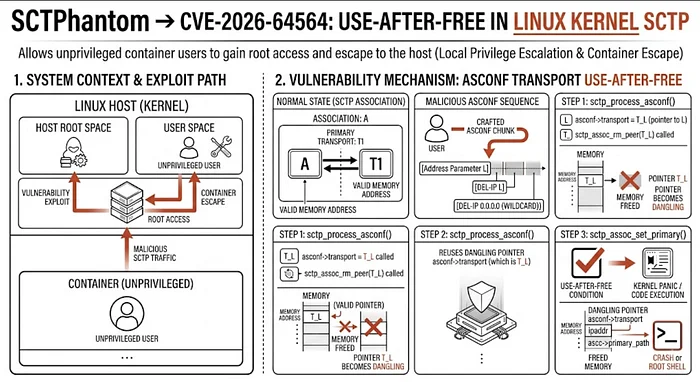
This episode of the Attack and Security Series looks at a Linux kernel vulnerability in the SCTP implementation, tracked as CVE-2026-64564 and given the name SCTPhantom. The bug is a use-after-free in SCTP's Dynamic Address Reconfiguration, specifically around ASCONF processing. ASCONF lets SCTP endpoints modify address information for an association, with operations such as ADD-IP, DEL-IP and SET-PRIMARY.
The reason a kernel bug matters here is the layering. A container looks like its own small computer, but it still runs on the host's Linux kernel:
Application
 │
 ▼
Container
 │
 ▼
Container Runtime
 │
 ▼
Linux Kernel
 │
 ▼
Hardware
So a serious kernel vulnerability sits underneath every container on the host, and the boundary between container and host becomes the interesting one.
SCTP itself is a transport protocol alongside TCP and UDP. One of its features is multihoming: a single SCTP association can keep several network paths, and Linux tracks those paths internally with structures representing SCTP transports.
               SCTP Association
                       │
          ┌────────────┼────────────┐
          │            │            │
          ▼            ▼            ▼
       Path A        Path B       Path C
       IP 1          IP 2         IP 3
Setup
The bug was found by Tencent's researchers. The report does not describe the specific test machines, kernel builds or tooling versions used beyond the fixed upstream versions listed later. Tencent reported successful container-to-host escape in six of eight tested attempts.
Finding it
The starting point is a lifetime problem in SCTP's Dynamic Address Reconfiguration. The vulnerable sequence involved a mismatch between the address used for validation and the transport object selected for later processing. In effect, Linux validated one address as acceptable, then later operated on a transport that the code expected to still be alive but that could already have been removed.
That is the shape of a use-after-free. An object is freed, a pointer to it survives, and later code follows that pointer:
Object exists
 │
 ▼
Object is freed
 │
 ▼
Pointer still exists
 │
 ▼
Program uses pointer
 │
 ▼
💥 Use-After-Free
The dangerous part is that the freed memory can be reused for something else. The program believes it is looking at its old object, while the memory now belongs to a different allocation.
Here is the simplified version the report gives, where every pointer refers to an object that still exists:
SCTP Association
 │
 ▼
 Transport A
 │
 ▼
 Transport B
 │
 ▼
 Transport C
The report's simplified diagram of the vulnerable case shows a DEL-IP removing a transport, its memory being freed, and another pointer still referring to it:
SCTP Association
 │
 ▼
 Transport A
 │
 ▼
 Transport B
 │
 ▼
 Transport C
 │
 │ DEL-IP
 ▼

Transport B gets removed
 │
 ▼
Memory is freed
 │
 ▼
But another pointer
still refers to B
 │
 ▼
Dangling Pointer 👻
Exploitation
Finding a use-after-free does not automatically mean root. Turning the bug into a reliable exploit is a separate, multi-stage effort, and the Tencent research describes a chain:
SCTP Use-After-Free
 │
 ▼
Memory Reuse
 │
 ▼
Information Disclosure
 │
 ▼
Kernel Address Recovery
 │
 ▼
Controlled Kernel Objects
 │
 ▼
Privilege Escalation
 │
 ▼
ROOT
Step 1: Reuse the freed memory
The attacker arranges for another object to occupy the memory region that held the freed SCTP object. The stale pointer still points at that location, so the kernel believes it is looking at its SCTP object while the memory may now hold another object's data.
Before

Memory
┌──────────────┐
│ SCTP Object  │
└──────────────┘
        ↓ FREE
Memory
┌──────────────┐
│              │
└──────────────┘
        ↓ REUSE
Memory
┌──────────────┐
│ New Object   │
└──────────────┘
This reuse is the foundation of the rest of the chain.
Step 2: Leak kernel memory
Modern kernels use KASLR, Kernel Address Space Layout Randomization, so important kernel code is not placed at predictable addresses. An information disclosure is therefore valuable: it leaks information about kernel memory and reduces the attacker's uncertainty about where things are.
Memory Bug
 │
 ▼
Unexpected Data
 │
 ▼
Kernel Address Leak
 │
 ▼
Reduce KASLR Uncertainty
Tencent's published chain describes a kernel memory disclosure followed by recovery of the KASLR slide.
Step 3: Turn corruption into control
The chain used memory reclamation to create controlled kernel object relationships. The aim is not to write random bytes but to influence how the kernel interprets memory as legitimate kernel structures:
Dangling Pointer
 │
 ▼
Freed Memory Reused
 │
 ▼
Attacker Influences Object Contents
 │
 ▼
Kernel Follows Unexpected References
 │
 ▼
Controlled Behavior
Step 4: Escalate to root
The chain ultimately reached a state where kernel credential handling resulted in global root privileges on the tested systems:
Local User
 │
 ▼
SCTP Vulnerability
 │
 ▼
Kernel Memory Corruption
 │
 ▼
Kernel Control
 │
 ▼
Credential Manipulation
 │
 ▼
ROOT 👑
Step 5: Escape the container
Because the container shares the host kernel, kernel-level control crosses the container boundary:
Container
 │
 ▼
Kernel Vulnerability
 │
 ▼
Kernel-Level Control
 │
 ▼
Host Context
The full chain from the attacker's starting point looks like this:
ATTACKER
 │
 ▼
 Container Process
 │
 ▼
 SCTP Interface
 │
 ▼
 Linux SCTP Code
 │
 ▼
 ASCONF Processing
 │
 ▼
 Use-After-Free 👻
 │
 ▼
 Memory Reuse
 │
 ▼
 Information Disclosure
 │
 ▼
 Kernel Address Info
 │
 ▼
 Controlled Kernel Objects
 │
 ▼
 Credential Abuse
 │
 ▼
 ROOT
 │
 ▼
 Container Escape
 │
 ▼
 HOST KERNEL
 │
 ▼
 HOST COMPROMISE
Root cause
The vulnerable sequence traces back to development around Linux 2.6.25, around 2007, and the vulnerability was disclosed in 2026, roughly 18 years later. The upstream fix identifies the relevant historical sequence and adds a check preventing deletion of the transport that is still being retained for the ASCONF operation. In other words, the lifetime assumption that a transport selected for later ASCONF processing would still be alive was not enforced when a DEL-IP could remove it.
Impact
An attacker who can reach the SCTP interface from a container process can follow the chain to kernel memory corruption, credential manipulation and root on the tested systems, and from there escape to the host. Exposure depends on factors such as SCTP availability, socket access, namespaces, capabilities, seccomp and LSM policy. The six-of-eight result is an evaluation figure, not a guarantee.
Fix
Patch the kernel. Tencent lists the first fixed upstream versions as:
| Branch | First fixed version |
|---|---|
| 6.6.y | 6.6.148 |
| 6.12.y | 6.12.101 |
| 6.18.y | 6.18.42 |
| 7.1.y | 7.1.6 |
| 7.2 | 7.2-rc5 |
Vendor kernels may backport the fix while keeping an older-looking version number, so check the distribution's security advisory rather than comparing only the base kernel version.
If SCTP is not required in the environment, disabling the SCTP module can reduce exposure, but first understand whether anything depends on it. First establish whether anything depends on it:
Is SCTP actually used?
 │
 ├── YES ──→ Patch / vendor mitigation
 │
 └── NO ───→ Consider disabling module
The report notes that exposure depends on container controls such as seccomp, LSM, capabilities and namespaces:
                 CONTAINER
                      │
              ┌───────┴───────┐
              ▼               ▼
          Seccomp           LSM
              │               │
              └───────┬───────┘
                      ▼
                Capabilities
                      │
                      ▼
                 Namespaces
                      │
                      ▼
                 Linux Kernel
Least privilege applies directly: if the application does not need CAP_SYS_ADMIN or CAP_NET_ADMIN, do not grant it. The report suggests looking for kernel crashes and warnings, unexpected SCTP activity, unusual container behaviour, privilege changes, unexpected namespace activity and suspicious process creation.
Variants to test
- SCTP reachability from a container. Check whether a container can create SCTP sockets and reach the ASCONF path. A positive result is a container that can open an SCTP socket and send ASCONF messages despite not needing SCTP.
- DEL-IP followed by ASCONF processing. Exercise the sequence where a transport is deleted while still retained for an ASCONF operation. A positive result is a kernel warning, crash or memory anomaly on an unpatched kernel.
- Module availability. Check whether the SCTP module is loaded or loadable on hosts that do not use SCTP. A positive result is a loaded module with no legitimate consumer.
- Capability and seccomp posture. Inspect container capabilities and seccomp profiles for anything that widens kernel interface access. A positive result is a container holding capabilities or syscall access it does not need.
- Patch level versus vendor advisory. Compare the running kernel version with the distribution's advisory rather than the base version alone. A positive result is a kernel that looks old but is backported, or looks new but is not.
- Detection coverage. Confirm that kernel warnings, crashes and unexpected SCTP activity reach monitoring. A positive result is a test event that produces an alert and an investigation path.
What happened, in plain words
Researchers at Tencent, a large technology company, found a serious flaw in Linux. Linux is the core software that runs underneath a huge share of the world's servers, including most of the machines that run containers in the cloud. The flaw was given the name SCTPhantom and the tracking number CVE-2026-64564. A CVE is a public catalogue entry: when someone finds a security bug, it gets a number so everyone can refer to the same thing.
The bug lives in a part of Linux that speaks a network protocol called SCTP. The flaw is a use-after-free, a kind of memory mistake. Where the vulnerable path is reachable, it can let a normal user, or a process inside a container, gain root and then escape to the host.
The researcher also described using an AI system called Corvus as part of the research process. The bug's origin traces back roughly 18 years, to code written around 2007, and it was disclosed in 2026.
This article walks through the whole story from zero. You only need to know how to use a computer and a browser. Every technical word is explained the first time it appears, and there is a glossary at the end.
Context
What a kernel is, and why it sits under everything
When you open a program on your computer, that program does not talk to the hardware directly. It asks the operating system to do things: read a file, send data over the network, draw a window. The part of the operating system that does this asking on behalf of programs is the kernel. Think of a large office building: the applications are the tenants, and the kernel is the building management that controls the lifts, the electricity and the front door. If building management is compromised, every tenant is affected, no matter how careful each tenant is.
Linux is one such kernel, and it is the one used by most servers, by Android phones, and by the machines that run containers.
What a container is
A container is a way to run a program in its own little bubble on a shared machine. It has its own files, its own network view, its own set of processes, so it feels like a small separate computer. Tools like Docker and Kubernetes are ways of creating and managing containers.
But here is the crucial point: a container is not a separate computer. It is a set of restrictions placed on a normal program running on the same machine, using the same kernel. The technical write-up draws the layers like this:
Application
 │
 ▼
Container
 │
 ▼
Container Runtime
 │
 ▼
Linux Kernel
 │
 ▼
Hardware
Read it from the bottom up. The hardware is the physical machine: processor, memory, disks. The Linux kernel is the software that manages that hardware. The container runtime is the software (Docker, containerd and similar) that sets up the bubble. The container is the bubble itself. The application is your program running inside it.
Why does this matter? Because every container on a machine shares the same kernel. If the kernel has a hole, the wall between one container and the host is only as strong as the kernel. That is why a kernel bug is so much more serious than a bug in one application.
What SCTP is
Computers talk to each other over networks using protocols, which are agreed sets of rules for sending data. The two you have probably heard of are TCP (used for web pages, reliable and ordered) and UDP (used for video calls and games, fast but not guaranteed).
SCTP, the Stream Control Transmission Protocol, is a third one. It is less common than TCP and UDP. One of its special features is multihoming: a single conversation (an association, SCTP's word for a connection) can keep several network paths open at once, so if one path fails another can take over. Linux keeps track of each of those paths internally with a small data structure called a transport.
               SCTP Association
                       │
          ┌────────────┼────────────┐
          │            │            │
          ▼            ▼            ▼
       Path A        Path B       Path C
       IP 1          IP 2         IP 3
In this diagram, one association has three paths, each with its own IP address. Each path is represented inside Linux by a transport object. If you think of the association as a group chat, each transport is one phone number a member can be reached on.
Setup
The research was carried out by Tencent's researchers. The report does not describe the specific test machines, kernel builds or tooling versions used, beyond the fixed upstream versions listed later. The exploitation was evaluated against container environments, and the results are reported as six successful container-to-host escapes out of eight tested attempts.
Finding it
The feature involved: Dynamic Address Reconfiguration
SCTP has a feature called Dynamic Address Reconfiguration, which lets one end of an association change the addresses used while the conversation is still running. It does this with messages called ASCONF. There are three operations mentioned in the report:
- ADD-IP: add a new address (a new path) to the association.
- DEL-IP: remove an address (and therefore its transport) from the association.
- SET-PRIMARY: choose which address is the main one.
Think of a delivery company that can add or remove a depot while deliveries are ongoing. ADD-IP opens a new depot, DEL-IP closes one, SET-PRIMARY says which depot is now the main one.
The mistake: a lifetime problem
The vulnerable sequence involved a mismatch between the address used for validation and the transport object selected for later processing. In plain words: Linux checked one address and decided it was fine, then later went to work on a transport that the code assumed was still there, but which could already have been removed.
That is the shape of a use-after-free. Let us define it carefully, because it is the heart of the whole story.
When a program needs memory, it asks the operating system for a chunk, uses it, and then gives it back. Giving it back is called freeing. A pointer is a small piece of data that records where in memory something lives, like a note saying "the parcel is in locker 217". A use-after-free happens when the program frees the memory but keeps the pointer, and then later follows the pointer as if the memory still belonged to it.
Object exists
 │
 ▼
Object is freed
 │
 ▼
Pointer still exists
 │
 ▼
Program uses pointer
 │
 ▼
💥 Use-After-Free
Line by line: an object (a chunk of memory holding data) exists. Then it is freed, meaning the program told the operating system it no longer needs it. But a pointer to it still exists, like a note that was never thrown away. Then the program uses that pointer, reading or writing memory it no longer owns. The result is a use-after-free, marked here with a bang.
The dangerous part is that the freed memory can be handed out again for something else. The program believes it is looking at its old object, while the memory now belongs to a different allocation. This is like keeping a key to a hotel room after checkout: the room is still there, but a new guest may now be inside, and you would be walking into their room believing it is yours.
The normal state and the broken state
In a healthy SCTP association, every pointer refers to an object that still exists:
SCTP Association
 │
 ▼
 Transport A
 │
 ▼
 Transport B
 │
 ▼
 Transport C
This is a chain: the association points to transport A, which points to transport B, which points to transport C. Each arrow is a pointer, and each target is alive. Nothing is dangling.
In the vulnerable sequence, a DEL-IP removes a transport, its memory is freed, and another pointer still refers to it:
SCTP Association
 │
 ▼
 Transport A
 │
 ▼
 Transport B
 │
 ▼
 Transport C
 │
 │ DEL-IP
 ▼

Transport B gets removed
 │
 ▼
Memory is freed
 │
 ▼
But another pointer
still refers to B
 │
 ▼
Dangling Pointer 👻
Follow the arrows. The association still points to A, A still points to B, and B still points to C. Then a DEL-IP message arrives and removes transport B. B's memory is freed. But the pointer from A to B was not cleared, so it now points at memory that is no longer B's. That leftover pointer is called a dangling pointer, and the ghost emoji is there because it points at something that is no longer really there.
Exploitation
Why finding a bug is not the same as taking over a machine
Finding a use-after-free does not automatically mean root. Root is the name of the all-powerful administrator account on Linux; a process running as root can do anything on the machine. Turning a memory bug into a reliable way to become root is a separate, multi-stage effort. The Tencent research describes a chain:
SCTP Use-After-Free
 │
 ▼
Memory Reuse
 │
 ▼
Information Disclosure
 │
 ▼
Kernel Address Recovery
 │
 ▼
Controlled Kernel Objects
 │
 ▼
Privilege Escalation
 │
 ▼
ROOT
Read it as a staircase. First the bug gives a use-after-free. Then the attacker arranges for the freed memory to be reused. Then they make the kernel leak some information. Then they use that leak to learn where things are in memory. Then they place controlled objects in the kernel. Then they use all of that to gain higher privileges. Finally they reach root. Each step depends on the one above it; if any step fails, the chain stops.
Step 1: Reuse the freed memory
The attacker arranges for another object to occupy the memory region that held the freed SCTP object. The stale pointer still points at that location, so the kernel believes it is looking at its SCTP object while the memory may now hold another object's data.
Before

Memory
┌──────────────┐
│ SCTP Object  │
└──────────────┘
        ↓ FREE
Memory
┌──────────────┐
│              │
└──────────────┘
        ↓ REUSE
Memory
┌──────────────┐
│ New Object   │
└──────────────┘
Line by line: at first the memory box holds the SCTP object. Then it is freed, so the box is empty. Then it is reused, so the box now holds a new object chosen by the attacker. The dangling pointer from the previous section still points at this box, so the kernel reads the new object's bytes and interprets them as if they were the old SCTP object. This reuse is the foundation of the rest of the chain: without it, the dangling pointer would point at empty memory and the bug would be much harder to turn into anything useful.
Step 2: Leak kernel memory
Modern kernels use KASLR, Kernel Address Space Layout Randomization. To understand it, imagine a library where every book has a fixed shelf position. If a burglar knows the layout, they can go straight to the safe. KASLR shuffles the layout every time the machine boots, so an attacker cannot know in advance where important kernel code and data sit in memory. The KASLR slide is the random offset by which everything was shifted at boot.
An information disclosure is a bug that leaks information the attacker should not see. In this context it leaks something about kernel memory, which reduces the attacker's uncertainty about where things are.
Memory Bug
 │
 ▼
Unexpected Data
 │
 ▼
Kernel Address Leak
 │
 ▼
Reduce KASLR Uncertainty
Line by line: a memory bug causes the kernel to hand back data it did not mean to. That unexpected data contains a kernel address, a number that reveals where something lives in memory. That leak reduces the uncertainty created by KASLR. Tencent's published chain describes a kernel memory disclosure followed by recovery of the KASLR slide, meaning the attacker worked out the random offset and could then calculate real addresses.
Step 3: Turn corruption into control
The chain used memory reclamation to create controlled kernel object relationships. The aim is not to write random bytes but to influence how the kernel interprets memory as legitimate kernel structures:
Dangling Pointer
 │
 ▼
Freed Memory Reused
 │
 ▼
Attacker Influences Object Contents
 │
 ▼
Kernel Follows Unexpected References
 │
 ▼
Controlled Behavior
Line by line: start with the dangling pointer. The freed memory has been reused. The attacker now influences what is written into that memory. The kernel then follows references (pointers) inside that memory, believing them to be its own. The result is behaviour the attacker chose. The key idea is that the attacker is not spraying random garbage; they are crafting bytes that the kernel will mistake for its own internal bookkeeping, like forging a form so that a clerk files it in the wrong drawer.
Step 4: Escalate to root
The chain ultimately reached a state where kernel credential handling resulted in global root privileges on the tested systems:
Local User
 │
 ▼
SCTP Vulnerability
 │
 ▼
Kernel Memory Corruption
 │
 ▼
Kernel Control
 │
 ▼
Credential Manipulation
 │
 ▼
ROOT 👑
Line by line: a local user is someone with an ordinary account on the machine, not an administrator. They trigger the SCTP vulnerability. That causes kernel memory corruption, meaning the kernel's own memory is now in a state the attacker influenced. That gives kernel control. The attacker then manipulates credentials, the kernel's record of which user a process belongs to, so that their process is recorded as root. The crown marks the end of the climb. Privilege escalation is the general name for going from a lower privilege level to a higher one.
Step 5: Escape the container
Because the container shares the host kernel, kernel-level control crosses the container boundary:
Container
 │
 ▼
Kernel Vulnerability
 │
 ▼
Kernel-Level Control
 │
 ▼
Host Context
Line by line: the attacker starts inside a container. They use the kernel vulnerability. They gain control at the kernel level. Because the kernel is shared, that control is now in the host context, meaning the real machine underneath all the containers. This jump from inside a container to the host is called a container escape.
Tencent reported successful container-to-host escape in six of eight tested attempts. The full chain from the attacker's starting point looks like this:
ATTACKER
 │
 ▼
 Container Process
 │
 ▼
 SCTP Interface
 │
 ▼
 Linux SCTP Code
 │
 ▼
 ASCONF Processing
 │
 ▼
 Use-After-Free 👻
 │
 ▼
 Memory Reuse
 │
 ▼
 Information Disclosure
 │
 ▼
 Kernel Address Info
 │
 ▼
 Controlled Kernel Objects
 │
 ▼
 Credential Abuse
 │
 ▼
 ROOT
 │
 ▼
 Container Escape
 │
 ▼
 HOST KERNEL
 │
 ▼
 HOST COMPROMISE
This is the whole journey in one picture. The attacker runs a process inside a container. That process reaches the SCTP interface, the part of the kernel that handles SCTP traffic. The traffic reaches Linux's SCTP code, and specifically the ASCONF processing. That triggers the use-after-free. The freed memory is reused. Information is disclosed. Kernel addresses are learned. Controlled kernel objects are placed. Credentials are abused. Root is reached. The container is escaped. The host kernel is now under the attacker's influence, and the host is compromised. Each arrow is one step that must succeed for the next to be possible, which is exactly why defenders try to break the chain at any point.
Root cause
The vulnerable sequence traces back to development around Linux 2.6.25, around 2007, and the vulnerability was disclosed in 2026, roughly 18 years later. The upstream fix identifies the relevant historical sequence and adds a check preventing deletion of the transport that is still being retained for the ASCONF operation. In other words, the lifetime assumption that a transport selected for later ASCONF processing would still be alive was not enforced when a DEL-IP could remove it.
To unpack that: the old code assumed that once a transport had been picked for an ASCONF operation, it would still be there when the operation ran. But a DEL-IP could remove it in between. The fix adds a check that refuses to delete a transport that is still being held for an ASCONF operation. It is like a rule saying you cannot close a depot while a delivery is still being routed through it.
Impact
An attacker who can reach the SCTP interface from a container process can follow the chain to kernel memory corruption, credential manipulation and root on the tested systems, and from there escape to the host. The report is explicit that this is not automatic for every container: exposure depends on factors such as SCTP availability, socket access, namespaces, capabilities, seccomp and LSM policy. The six-of-eight result is an evaluation figure, not a guarantee.
Those factors deserve a plain explanation, because they are the difference between a scary headline and your actual risk:
- SCTP availability: is the SCTP code even present and usable on the machine? Is the SCTP code even present and usable on the machine?
- Socket access: a socket is the program's handle for network communication. If a container cannot create an SCTP socket, it cannot send ASCONF messages.
- Namespaces: Linux features that give a container its own view of processes, network and files. They limit what a process can see and touch.
- Capabilities: fine-grained permissions that can be given to a process instead of full root. For example,
CAP_NET_ADMINallows network administration. If a container has few capabilities, it can do less damage. - seccomp: a Linux feature that filters which system calls a process may make. A system call is a program asking the kernel to do something. seccomp can refuse system calls a process does not need.
- LSM policy: Linux Security Modules, such as SELinux or AppArmor, are extra rule systems that restrict what processes may do even if they have the permission bits.
Fix
Patch the kernel
The primary fix is to update the kernel to a version that contains the correction. Tencent lists the first fixed upstream versions as:
| Branch | First fixed version |
|---|---|
| 6.6.y | 6.6.148 |
| 6.12.y | 6.12.101 |
| 6.18.y | 6.18.42 |
| 7.1.y | 7.1.6 |
| 7.2 | 7.2-rc5 |
A branch here is a line of kernel releases that receive fixes, such as the 6.6 series. The table says: if you are on the 6.6 line, the first release with the fix is 6.6.148, and so on. The -rc5 suffix means release candidate 5, a pre-release build.
Vendor kernels may backport the fix while keeping an older-looking version number, so check the distribution's security advisory rather than comparing only the base kernel version. A distribution is the packaged form of Linux you install, such as Debian, Ubuntu or Red Hat. A backport is taking a fix from a newer kernel and applying it to an older one. A security advisory is the vendor's official notice saying which versions are fixed. So a kernel that looks old may already be patched, and one that looks new may not be; the advisory is the source of truth.
If you cannot patch immediately
If SCTP is not required in the environment, disabling the SCTP module can reduce exposure, but the report warns against blindly running rmmod sctp on production. rmmod is the command that unloads a kernel module, a piece of kernel code that can be loaded and unloaded at runtime. First establish whether anything depends on it:
Is SCTP actually used?
 │
 ├── YES ──→ Patch / vendor mitigation
 │
 └── NO ───→ Consider disabling module
Line by line: ask whether SCTP is actually used. If yes, patch or apply the vendor's mitigation. If no, consider disabling the module. The word "consider" matters: if some legitimate service depends on SCTP, unloading the module will break it, and a mitigation that breaks production is not a good mitigation.
Container controls
Beyond patching, the report points to container controls: seccomp, LSM, capabilities and namespaces, arranged so that each layer limits what the next can do:
                 CONTAINER
                      │
              ┌───────┴───────┐
              ▼               ▼
          Seccomp           LSM
              │               │
              └───────┬───────┘
                      ▼
                Capabilities
                      │
                      ▼
                 Namespaces
                      │
                      ▼
                 Linux Kernel
Read it top down. The container is the starting point. Two controls sit side by side: seccomp filters which system calls are allowed, and LSM policy adds its own rules. Below them, capabilities limit which privileged operations are possible. Below that, namespaces limit what the process can see. Finally the kernel itself. The point of stacking them is defence in depth: if one layer fails or is misconfigured, the next still stands between the attacker and the kernel.
Least privilege
Least privilege applies directly: if the application does not need CAP_SYS_ADMIN or CAP_NET_ADMIN, do not grant it, and do not expose kernel interfaces it does not need. CAP_SYS_ADMIN is a very broad capability, often described as close to root; CAP_NET_ADMIN covers network configuration. The principle is simple: give each program the minimum it needs to do its job, and nothing more, because every extra permission is another door an attacker can try.
Monitoring
Monitoring should cover kernel crashes and warnings, unexpected SCTP activity, unusual container behaviour, privilege changes, unexpected namespace activity and suspicious process creation. A kernel crash is the kernel hitting a fatal error; a kernel warning is a logged complaint that something looks wrong. Both are valuable signals. If you see SCTP activity on a machine that has no reason to use SCTP, that is worth investigating. If a process suddenly gains privileges or a new namespace appears, that is worth investigating too. Monitoring turns a silent compromise into an alert.
Variants to test
These are checks a defender can run to see whether their own environment is exposed. Each one has a clear positive result, meaning the answer that should worry you.
- SCTP reachability from a container. Check whether a container can create SCTP sockets and reach the ASCONF path. A positive result is a container that can open an SCTP socket and send ASCONF messages despite not needing SCTP. In other words, if a container that has no business speaking SCTP can still do so, that is unnecessary exposure.
- DEL-IP followed by ASCONF processing. Exercise the sequence where a transport is deleted while still retained for an ASCONF operation. A positive result is a kernel warning, crash or memory anomaly on an unpatched kernel. This is the direct test of the bug itself.
- Module availability. Check whether the SCTP module is loaded or loadable on hosts that do not use SCTP. A positive result is a loaded module with no legitimate consumer. If nothing needs SCTP, the module being present is pure risk.
- Capability and seccomp posture. Inspect container capabilities and seccomp profiles for anything that widens kernel interface access. A positive result is a container holding capabilities or syscall access it does not need. This is the least-privilege check in practice.
- Patch level versus vendor advisory. Compare the running kernel version with the distribution's advisory rather than the base version alone. A positive result is a kernel that looks old but is backported, or looks new but is not. Either way, the version number alone misled you, and the advisory is what counts.
- Detection coverage. Confirm that kernel warnings, crashes and unexpected SCTP activity reach monitoring. A positive result is a test event that produces an alert and an investigation path. A control you cannot see working is a control you cannot trust.
Glossary
- Application: a program you run, such as a web server or a database.
- ASCONF: SCTP messages that change an association's addresses while it is running.
- Association: SCTP's word for a connection between two endpoints.
- Backport: applying a fix from a newer software version to an older one.
- Branch: a line of software releases that receive fixes, such as the 6.6 series.
- Capabilities: fine-grained Linux permissions that can be granted to a process instead of full root.
CAP_NET_ADMIN: a capability allowing network configuration.CAP_SYS_ADMIN: a very broad capability, often close to root in power.- Container: an isolated bubble for running a program on a shared machine, using the host kernel.
- Container escape: getting from inside a container out to the host machine.
- Container runtime: software such as Docker that creates and manages containers.
- Credential: the kernel's record of which user a process belongs to.
- CVE: a public catalogue number for a security vulnerability.
- Dangling pointer: a pointer that still refers to memory that has already been freed.
- DEL-IP: an ASCONF operation that removes an address from an association.
- ADD-IP: an ASCONF operation that adds an address to an association.
- SET-PRIMARY: an ASCONF operation that chooses the main address of an association.
- Defence in depth: stacking several independent security controls so that one failure does not mean total failure.
- Distribution: a packaged form of Linux, such as Debian or Ubuntu.
- Dynamic Address Reconfiguration: the SCTP feature that lets addresses change during an association.
- Free: to tell the operating system that a chunk of memory is no longer needed.
- Host: the real machine that containers run on.
- Information disclosure: a bug that leaks data the attacker should not see.
- KASLR: Kernel Address Space Layout Randomization, which shuffles kernel memory locations at boot.
- KASLR slide: the random offset by which kernel memory was shifted at boot.
- Kernel: the core of the operating system that manages hardware on behalf of programs.
- Kernel crash: a fatal error in the kernel.
- Kernel warning: a logged complaint from the kernel that something looks wrong.
- Least privilege: giving each program only the minimum permissions it needs.
- Local user: someone with an ordinary, non-administrator account on a machine.
- LSM: Linux Security Modules, extra rule systems such as SELinux or AppArmor.
- Module: a piece of kernel code that can be loaded and unloaded at runtime.
- Multihoming: an SCTP feature that keeps several network paths open for one association.
- Namespace: a Linux feature that gives a process its own view of processes, network or files.
- Pointer: a piece of data recording where something lives in memory.
- Privilege escalation: going from a lower privilege level to a higher one.
- Protocol: an agreed set of rules for communication between computers.
- Release candidate (
-rc): a pre-release build of software. - Root: the all-powerful administrator account on Linux.
rmmod: the command that unloads a kernel module.- SCTP: Stream Control Transmission Protocol, a transport protocol alongside TCP and UDP.
- Security advisory: a vendor's official notice about which versions fix a vulnerability.
- Socket: a program's handle for network communication.
- System call: a program asking the kernel to perform an operation.
- TCP: a reliable, ordered transport protocol used for most web traffic.
- Transport: Linux's internal structure representing one SCTP path.
- UDP: a fast, unreliable transport protocol used for real-time traffic.
- Upstream: the original project that produces the software, before distributions package it.
- Use-after-free (UAF): using memory after it has been freed, through a pointer that was never cleared.

