Breaking the Competition (Bug Bounty Write-up)
The report describes five bugs on a private CTF hosting platform, including a race condition in flag submission that allowed a user to score multiple times for the same challenge, and a logic error in CTF date settings that could make accounts unusable. An attacker could exploit these to gain extra points or cause denial of service to users who joined a broken CTF.

In this post, I’ll be describing how I found 5 bugs on a private HackerOne program. The website that I attacked was a new CTF hosting provider, and I had actually participated in a CTF using this provider prior to being invited to their private program.
The full write-up lives on its author's site
It belongs to its author, so we link to it rather than copy it. The other two tabs are our own rewrites, checked against it.
Context
This write-up covers five bugs I found on a private HackerOne program. The target was a new CTF hosting provider, and I had actually taken part in a CTF run on this platform before being invited to its private program. Because the program is private, I cannot show the exact pages I exploited or the exact code I used against them, so the payloads below are described rather than reproduced.
The features involved are the ones a CTF platform normally exposes: creating a CTF with a name, a set of challenges, a maximum number of participants and start/end dates; joining a CTF; submitting flags for challenges and scoring points on a leaderboard; team-based CTFs with a creator-chosen maximum team size; and account management with email address changes, password resets and sessions.
Setup
No special tooling was needed beyond a browser and an intercepting proxy. For the race condition I used race-the-web, a tool by Aaron Hnatiw written in Go, which makes the requests efficient and allows a proxy to be configured for all requests so they can be debugged in Burp Suite. The site was built on React, which is relevant later when I looked for XSS.
Finding it
Race condition in flag submission
Of all the bugs I submitted, I believe this had the highest severity: if a CTF task was worth 100 points, the race condition let me obtain up to 1000 points for it.
Race conditions occur when multithreaded applications do not synchronise properly. The server-side code, as I imagined it, looked something like this:
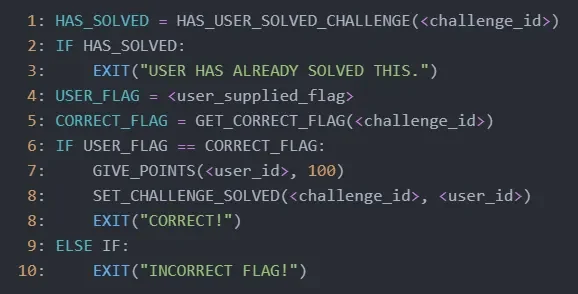
Pseudo-code of back-end flag checker
In a single-threaded application this pseudo-code would work perfectly: the program checks whether the challenge has already been solved and, if not, checks whether the flag is correct or incorrect. The problem appears when an attacker submits two requests at the same time. In a multi-threaded application, as most web servers are, the code runs twice at the same time, or at least very close to each other.
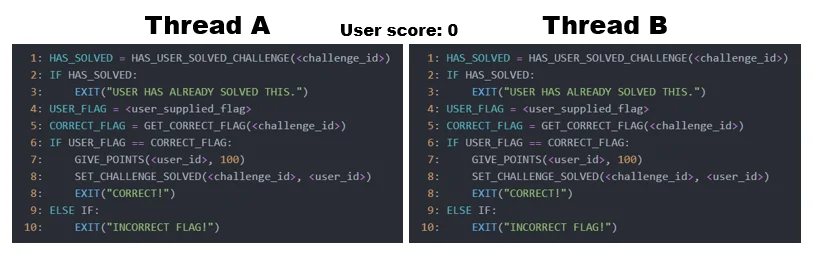
Thread A and Thread B running through the pseudo-code
In the animation, Thread B is triggered slightly after Thread A but still scores the user an extra 100 points. Thread A does not set the CHALLENGE_SOLVED attribute on the user until line 8, which is not reached until after Thread B has already passed the challenge-solve check. This is common in web applications because of the delay in retrieving data from a database: during that delay other threads can catch up with the original one and cause a race condition.
Denial of service against any user
This bug was not as useful to attackers as the previous one, but it was fun. The denial of service was not caused by a security misconfiguration but by a logic error.
Creating a CTF requires some details: the CTF name, the challenges, the maximum number of participants and the CTF start and end dates. I first tried exploiting the CTF name and challenges for XSS but found nothing, since the site was built on React and XSS is almost impossible there.
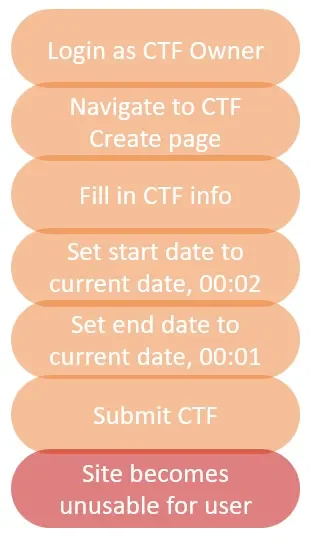
Steps for Self-DOS
I then tried setting the CTF end date to the previous day. This was blocked, which makes sense because the start and end dates should both be in the present or the future. The developers had thought of this and blocked it on both the front end and the back end. It could still be bypassed through the CTF start/end time setting: it was possible to create a CTF set to start, for example, today at 10am but finish today at 8am.
At first I created such a CTF by accident and discovered that my entire account was just Error 500s. The site had become completely unusable for my user, likely because of a lack of error catching in the back end.
Forgot password link valid after email change
This bug is far less severe than the other two but was still validated and triaged. An attacker who once had access to a victim's account can keep persistence through the forgot password link.
Session tokens valid despite password change
This one is more severe than the previous bug because the steps for an attacker to retain persistence are far simpler. It still does not allow initial exploitation, so it is not all that interesting. Once an attacker gains access to an account, there is no way to revoke that access: on the site the only way to invalidate session tokens was to log out of that session, and a victim cannot log an attacker out of theirs. Even if the user changes or resets their password, or their email address, all sessions remain valid.
Race condition in team CTFs
CTFs on the site can be done in teams, and the maximum team size is chosen by the CTF creator to keep competition fair. Through an exploit similar to the flag submission race condition, that limit can be bypassed. In my limited testing I managed to get a team with a maximum of 2 players to have over 5 users in it. This bug was marked as informative, so I will not go into more detail.
Exploitation
Step 1: demonstrate the flag submission race
To demonstrate the race condition to HackerOne I did the following:
- Created my own CTF on the platform.
- Joined the CTF as a user.
- Used race-the-web to send 100 requests to the site's flag submission API endpoint.
- Verified the results on the leaderboard.
My race-the-web configuration looked as follows:
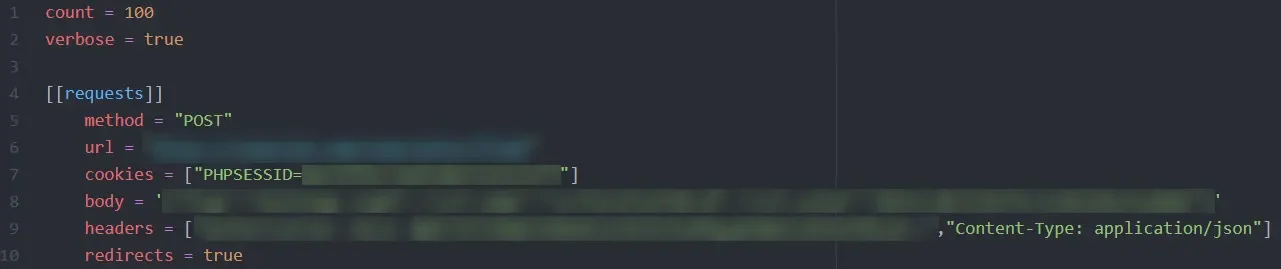
My race-the-web config.toml
The proxy option lets me watch each request in Burp Suite. HackerOne came back with the following feedback:
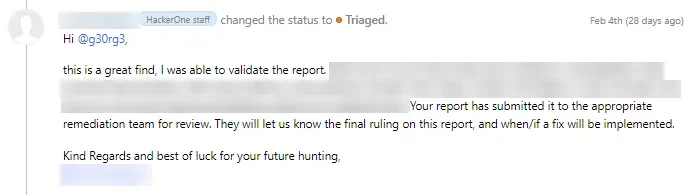
HackerOne response to the bug.
Step 2: create a broken CTF against yourself
At first I created such a CTF by accident: the start and end dates were valid but the end time was earlier than the start time on the same day. The result was a CTF whose end preceded its start, and my account returned Error 500 for everything afterwards.
I raised this on HackerOne, detailing how an attacker with access to a victim's account could cause a complete denial of service to them:
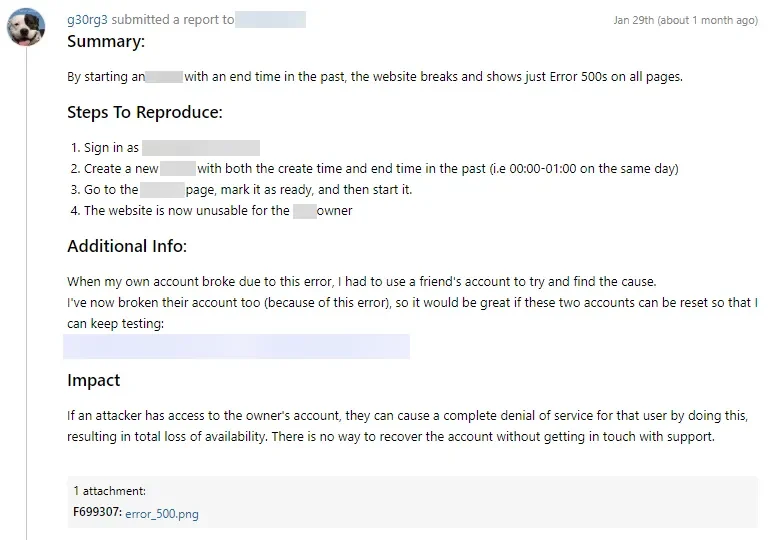
Initial HackerOne DOS report
Because this was only a self-DoS, the HackerOne team asked me to explain how it was exploitable, so I had to increase the impact.
Step 3: extend the impact to staff and other users
During further testing I found that all linked staff accounts also become unusable after such a CTF is created. I judged that impact still too low to re-report on its own.
Creating a broken CTF is good for a self-DoS, but affecting all other users needs a way to make them join it. Most users on the site do not have permission to create CTFs and can only join them, so I needed a way to let users join a broken CTF.
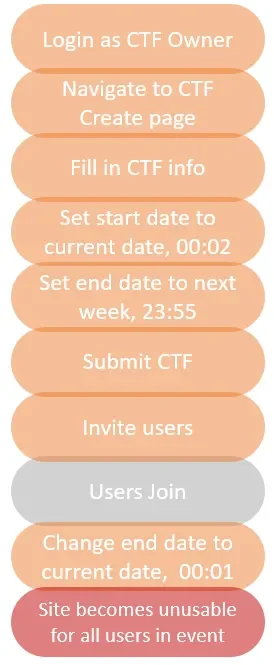
Steps to DOS all users
I first experimented with forcing users to join the CTF through CSRF, but there was no way to obtain the broken CTF's ID. Instead I realised the CTF can be broken after it has been created: between creating the CTF and officially starting it, some basic information such as the rules and maximum players can be edited, and the start/end time is included in that.
As an attacker this is very useful. Create a CTF, send invites to users, and after they have joined, change the end time to sometime in the past. That breaks the accounts of every user who joined. Since this could affect anyone on the site, I felt comfortable re-submitting the bug:
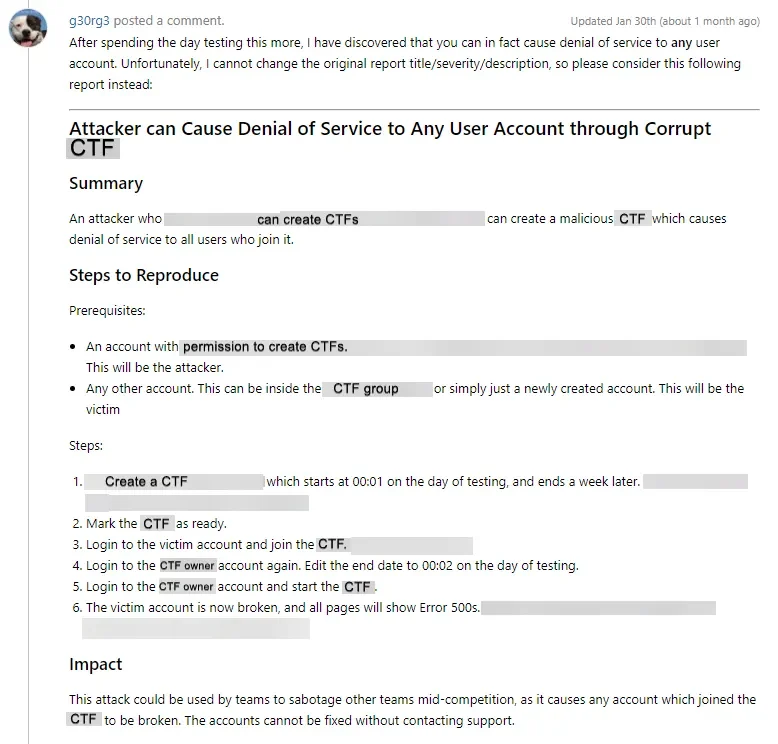
Second HackerOne DOS report.
This bug was accepted, triaged and patched.
Step 4: keep a password reset link alive across an email change
The scenario runs as follows:
- An attacker gains access to a victim's inbox.
- The attacker issues a password reset on the CTF site to the compromised email address.
- The attacker copies the password reset link and deletes the original email.
The user would then assume only their inbox was compromised and that their other accounts are, at least likely, safe. But consider the rest:
- The victim changes their email password, thinking the attacker can no longer reach their accounts, and sets up a new email address to distance themselves from the attack.
- The victim changes their email address on the CTF site, so the attacker can no longer log in.
- The attacker still holds the password reset link from earlier and can use it to log in to the victim's account again, without even knowing the new email address.
This attack does not allow initial exploitation, but it does allow an attacker to persist in an account. The bug was marked as low but was accepted:
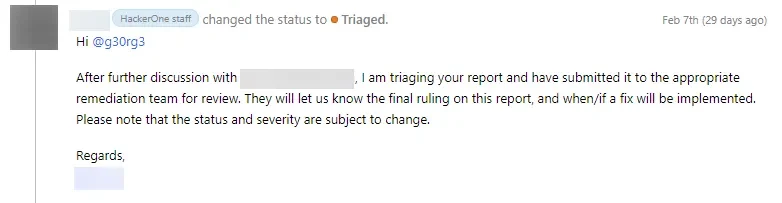
HackerOne response to my bug report.
Step 5: show that sessions survive a password change
Once an attacker has a session on an account, changing or resetting the password, or changing the email address, leaves every session valid. The only way to invalidate a session token is to log out of that session, which the victim cannot do on the attacker's behalf. OWASP's session management guidance covers this in detail:
[## Session Management Cheat Sheet
Web Authentication, Session Management, and Access Control: A web session is a sequence of network HTTP request and…
This bug was accepted without discussion and is currently being fixed:
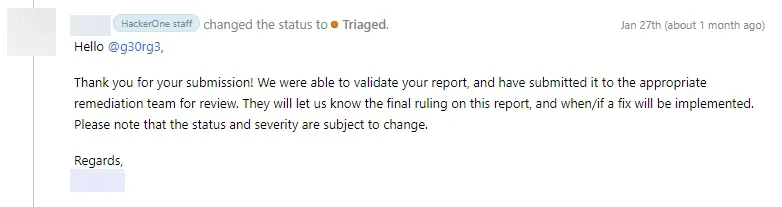
HackerOne response to the bug submission.
Root cause
The flag submission bug is a classic time-of-check to time-of-use problem. The check for whether the challenge is already solved and the write of the CHALLENGE_SOLVED attribute are separate steps, and the database round trip between them leaves a window in which a second thread passes the same check. Nothing in the pseudo-code serialises the two requests for the same user and challenge.
The denial of service is a validation gap. The developers blocked past dates on both the front end and the back end, but the start and end time fields were not compared with each other, so a CTF could be created whose end precedes its start. The back end then failed to handle the resulting inconsistent state and returned Error 500 for the affected account, likely because errors were not caught. The same edit path that allows rules and maximum players to be changed before the CTF starts also accepts the start/end time, so the inconsistency can be introduced after users have already joined.
The password reset bug lets a reset link stay valid after the account's email address changes. The session bug is the absence of session invalidation on credential or identity change; OWASP's guidance is to renew the session ID after any privilege level change, and here changing the password or email revoked no sessions.
Impact
- Flag submission race: an attacker can score a challenge repeatedly, up to ten times its value, which undermines the integrity of the leaderboard.
- Broken CTF: an attacker who can create a CTF can make their own account, and the accounts of linked staff, unusable with Error 500. By inviting users, letting them join, and then moving the end time into the past, the attacker can break the accounts of everyone who joined, so the bug affects any user on the site. It was accepted, triaged and patched.
- Password reset link: an attacker who once had access to a victim's account, and to their inbox, can regain access after the victim changes both their email password and their CTF site email address. It does not allow initial exploitation, only persistence. It was marked low and accepted.
- Session tokens: an attacker with a session keeps it after the victim changes or resets their password or email address, and the victim has no way to revoke it. It does not allow initial exploitation. It was accepted without discussion and was being fixed.
- Team size race: the creator-chosen maximum team size can be exceeded; in limited testing a team capped at 2 players ended up with over 5 users. It was marked informative.
Fix
The denial of service was patched after being accepted and triaged. The session bug was accepted without discussion and was being fixed at the time of writing. The report does not describe the code changes made for either. For the remaining issues the report gives no fix; the measures they imply are validating that the end time is after the start time on every create and edit path, making the solve check and the score write atomic for a given user and challenge, binding password reset links to the email address they were issued for, and invalidating all sessions when the password or email address changes.
Variants to test
- Concurrent submissions on any scoring or redemption endpoint. Send many simultaneous requests for the same flag, coupon, invite or one-time action and check whether the effect is applied more than once. A positive result is a leaderboard, balance or counter that moves by more than one unit.
- Concurrent joins against a capacity limit. Fire simultaneous join requests at a team or event with a maximum size. A positive result is a member count above the configured maximum, as in the team CTF bug.
- Date and time fields validated separately. On any create or edit form with start and end dates plus times, submit a valid date pair with an end time earlier than the start time, and try the same through the edit path after the object exists. A positive result is an object that saves and then produces server errors or an unusable account.
- Edit-after-join on shared objects. Create an object others can join, have a second account join, then edit its timing or configuration. A positive result is the joiner's account or view breaking.
- Password reset links after an email change. Request a reset, change the account's email address, then use the old link. A positive result is a successful reset or login without knowing the new address.
- Session survival after credential change. Keep a session cookie from before a password change or reset and replay it afterwards. A positive result is the old session still being authenticated.
What happened, in plain words
A security researcher spent time testing a website that hosts Capture The Flag (CTF) competitions. A CTF is a game where people solve small security puzzles, called challenges, and earn points for each one they solve. The website was run by a company that had invited the researcher to test it privately, so the pages and code involved cannot be shown here.
Over the course of the testing, the researcher found five separate problems. One let a player earn far more points than a challenge was worth. One let a person break their own account, and later break the accounts of everyone who joined a competition they had created. One let an old password reset link keep working after the account's email address had been changed. One let an attacker stay logged in even after the victim changed their password. The last one let a team grow past the size limit the competition organiser had set.
This article walks through each of them in the order the researcher found them, explaining every idea from scratch along the way. You only need to know how to use a browser to follow it.
Background you need first
Before the bugs make sense, a few everyday ideas need explaining.
A web server and threads. When you open a page, your browser sends a request to a computer called a web server, which does some work and sends a response back. Big sites handle many requests at once, and they do this by splitting the work into small parallel tasks called threads. Think of a supermarket with several tills open: several customers can be served at the same moment. Most of the time that is good. Sometimes two tills serve the same customer twice by mistake, and that is the seed of the first bug.
An API. An API is a way for one piece of software to talk to another. In a website, the pages you see in the browser often call a hidden address on the server to fetch or send data, for example to submit a flag or load a leaderboard. You never see these addresses in the address bar, but the browser uses them constantly. The researcher sent requests directly to one of these hidden addresses.
A flag. In a CTF, each challenge hides a short secret string called a flag. You find it by solving the puzzle, then paste it into the site. If it is correct, you score points.
A leaderboard. A public table ranking players by points. If points can be earned dishonestly, the leaderboard stops meaning anything.
A race condition. This is the name for the situation where two actions happen at almost the same time and the program was only designed for them to happen one after the other. The everyday comparison is two people booking the last seat on a plane at the same instant: each checks that the seat is free, each sees it free, and both book it. The check and the booking were separate steps, and the gap between them is the problem.
A denial of service (DoS). Making a service unusable, either for yourself or for someone else. A self-DoS means you break your own access. A DoS against others means you break theirs.
XSS (cross-site scripting). A bug where an attacker gets their own code to run inside another person's browser on a website. It is one of the classic web bugs, and the researcher looked for it early on.
React. A popular toolkit for building websites. It builds pages in a way that makes XSS very hard to pull off, which is why the researcher's XSS attempts went nowhere.
A session and a session token. When you log in, the server gives your browser a small piece of data, usually stored in a cookie, called a session token. Your browser sends it back with every request so the server knows who you are, without asking for your password each time. Think of it as a wristband at a festival: show it at the gate and you get in. If someone copies your wristband, they get in too, until the wristband is cancelled.
A password reset link. When you click "forgot password", the site emails you a special link. Opening it lets you set a new password. The link is meant to be temporary and tied to your account.
CSRF (cross-site request forgery). A trick where an attacker makes a logged-in victim's browser send a request the victim did not intend, for example joining a competition without realising.
Burp Suite. A tool that sits between your browser and a website and lets you watch and edit every request. It is the standard workbench for this kind of testing.
HackerOne. A platform where companies invite researchers to report bugs. A private program means only invited researchers can see it, which is why the exact pages and code are not shown here.
The setup
The researcher needed only a browser and an intercepting proxy (Burp Suite). For the race condition, they used a tool called race-the-web, written by Aaron Hnatiw. It is written in the Go programming language, which makes it fast at firing many requests at once, and it can send all its traffic through a proxy so each request can be inspected in Burp Suite. The site itself was built on React, which matters later when XSS was attempted.
Bug 1: earning the same points many times over
The idea
Of all the bugs submitted, the researcher judged this one the most serious. If a challenge was worth 100 points, the race condition let them collect up to 1000 points for it, ten times the intended reward.
How the server was probably written
The researcher could not see the real code, so they imagined what the server-side logic probably looked like:
Pseudo-code of back-end flag checker
Pseudo-code means simplified code written to show the logic rather than to run. In plain words, the imagined logic is:
- Check whether this user has already solved this challenge.
- If they have, stop.
- If they have not, check whether the submitted flag is correct.
- If it is correct, add the points.
- Mark the challenge as solved for this user.
In a program that handles one request at a time, this works perfectly. The check happens, then the points are added, then the challenge is marked solved, and any later request sees it is already solved and stops.
Where it breaks
Now imagine two requests arriving at the same moment:
Thread A and Thread B running through the pseudo-code
The animation shows two threads, A and B, walking through the same logic. Thread B starts slightly after Thread A, but it still scores the user an extra 100 points. The reason is that Thread A does not mark the challenge as solved until its last step, and by the time it gets there, Thread B has already passed the "has this been solved?" check. Both threads saw the challenge as unsolved, so both added points.
This happens in real sites because reading data from a database takes a moment. During that moment, another thread can catch up and slip through the same gap. The technical name for this pattern is time-of-check to time-of-use: the check and the use of the result are separate steps, and something can change in between.
Proving it
To demonstrate the bug to HackerOne, the researcher did the following:
- Created their own CTF on the platform.
- Joined that CTF as a normal user.
- Used race-the-web to send 100 requests to the site's flag submission API endpoint at the same time.
- Checked the leaderboard to see the result.
The point of each step: creating and joining their own CTF gave a controlled environment where they could see the score. Sending 100 simultaneous requests gave the best chance of several of them passing the check before any of them marked the challenge solved. The leaderboard was where the result was checked.
The race-the-web configuration looked like this:
My race-the-web config.toml
A .toml file is a plain text settings file. This one tells race-the-web which address to send requests to, how many to send, and how to send them. The proxy setting is the useful part: it routes every request through Burp Suite so the researcher could watch each one.
HackerOne replied with the following feedback:
HackerOne response to the bug.
Bug 2: breaking accounts with a badly timed competition
The idea
This bug was less useful to an attacker than the first, but it was fun. It was not caused by a misconfigured server but by a logic error: the site accepted a combination of settings that made no sense, and then could not cope with the result.
What creating a CTF involves
To create a CTF, the organiser supplies a name, a set of challenges, a maximum number of participants, and start and end dates. The researcher first tried putting malicious content into the CTF name and challenges to see if it would run as XSS in other people's browsers, but found nothing. The site was built on React, and XSS is almost impossible there.
Steps for Self-DOS
The date check and the time gap
The researcher then tried setting the CTF end date to the previous day. The site blocked this, which is sensible: a competition should not end before it starts, and both dates should be in the present or the future. The developers had clearly thought about it and blocked it on both the front end (the form in your browser) and the back end (the server).
But the dates were not the whole story. The form also had start and end times, and the check could be bypassed through them. It was possible to create a CTF set to start, for example, today at 10am but finish today at 8am. The date check passed because both dates were today, and the times were never checked against one another.
At first the researcher created such a CTF by accident, and discovered that their entire account was just Error 500s. Error 500 is the server's way of saying "something went wrong on my side". The site had become completely unusable for that user, likely because the back end did not catch the error caused by the impossible timing.
The researcher reported this on HackerOne, explaining how an attacker with access to a victim's account could cause a complete denial of service to them:
Initial HackerOne DOS report
Because this was only a self-DoS, the HackerOne team asked the researcher to explain how it could be used against someone else. So the impact had to be increased.
Making it affect other people
During further testing, the researcher found that all linked staff accounts also became unusable after such a CTF was created. That was still judged too small an impact to report on its own.
A broken CTF is fine for breaking your own account, but to affect everyone else you need them to join it. Most users on the site cannot create CTFs, only join them, so the researcher needed a way to get users to join a broken CTF.
Steps to DOS all users
The first idea was to force users to join through CSRF, but there was no way to obtain the broken CTF's ID, which such a trick would need. Then came the realisation: the CTF can be broken after it has been created. Between creating the CTF and officially starting it, some basic information such as the rules and maximum players can be edited, and the start and end time is included in that editable set.
That changes everything for an attacker. Create a CTF, send invites to users, and after they have joined, change the end time to sometime in the past. That breaks the accounts of every user who joined. Since this could affect anyone on the site, the researcher felt comfortable re-submitting the bug:
Second HackerOne DOS report.
This bug was accepted, triaged and patched. Triaged means the security team confirmed it was real and assigned it for fixing.
Bug 3: a password reset link that outlives an email change
This bug is far less severe than the other two, but it was still validated and triaged. The idea is that an attacker who once had access to a victim's account can keep that access through the forgot password link.
The scenario
- An attacker gains access to a victim's inbox.
- The attacker issues a password reset on the CTF site to the compromised email address.
- The attacker copies the password reset link and deletes the original email.
At this point the user would assume only their inbox was compromised, and that their other accounts are, at least likely, safe. But consider the rest:
- The victim changes their email password, thinking the attacker can no longer reach their accounts, and sets up a new email address to distance themselves from the attack.
- The victim changes their email address on the CTF site, so the attacker can no longer log in.
- The attacker still holds the password reset link from earlier and can use it to log in to the victim's account again, without even knowing the new email address.
The reset link stays valid after the address changes. This attack does not allow an attacker to get in for the first time, but it does allow them to stay in. The bug was marked as low but was accepted:
HackerOne response to my bug report.
Bug 4: staying logged in after a password change
This one is more severe than the previous bug because the steps for an attacker to keep access are far simpler. It still does not allow an attacker to get in for the first time, so it is not all that interesting.
Once an attacker has a session on an account, there is no way to revoke it. On the site, the only way to invalidate a session token was to log out of that session, and a victim cannot log an attacker out of theirs. Even if the user changes or resets their password, or changes their email address, all sessions remain valid.
Think back to the festival wristband: changing your password is like changing the password on your front door, but the attacker's wristband still works because nobody cancelled it.
OWASP, a well-known security organisation, publishes guidance on how sessions should be managed, and this case is covered there:
[## Session Management Cheat Sheet
Web Authentication, Session Management, and Access Control: A web session is a sequence of network HTTP request and…
The guidance says the session ID should be renewed after any change in privilege level. Here, changing the password or email revoked no sessions. This bug was accepted without discussion and was being fixed:
HackerOne response to the bug submission.
Bug 5: teams bigger than the limit
CTFs on the site can be done in teams, and the maximum team size is chosen by the CTF creator to keep the competition fair. Through an exploit similar to the flag submission race condition, that limit can be bypassed. In limited testing, the researcher managed to get a team with a maximum of 2 players to have over 5 users in it.
The report describes it only as a similar exploit to the flag submission race condition. This bug was marked as informative, so the researcher did not go into more detail.
Why these bugs exist
Looking at all five together, the causes fall into a few patterns.
- The flag submission bug is a time-of-check to time-of-use problem. The check for whether the challenge is already solved and the write that marks it solved are separate steps, and the database round trip between them leaves a window in which a second thread passes the same check. Nothing in the logic serialises the two requests for the same user and challenge.
- The denial of service is a validation gap. The developers blocked past dates on both the front end and the back end, but the start and end time fields were not compared with each other, so a CTF could be created whose end precedes its start. The back end then failed to handle the resulting inconsistent state and returned Error 500 for the affected account, likely because errors were not caught. The same edit path that allows rules and maximum players to be changed before the CTF starts also accepts the start and end time, so the inconsistency can be introduced after users have already joined.
- The password reset bug is a lifecycle problem: the reset link is not tied to the email address it was issued for, so it stays valid after the address changes.
- The session bug is the absence of session invalidation on a credential or identity change. OWASP's guidance is to renew the session ID after any privilege level change, and here no session was revoked at all.
- The team size bug is the same race condition pattern as the flag submission bug, applied to a capacity limit instead of a score.
What each bug could be used for
- Flag submission race: an attacker can score a challenge repeatedly, up to ten times its value, which undermines the integrity of the leaderboard.
- Broken CTF: an attacker who can create a CTF can make their own account, and the accounts of linked staff, unusable with Error 500. By inviting users, letting them join, and then moving the end time into the past, the attacker can break the accounts of everyone who joined, so the bug affects any user on the site. It was accepted, triaged and patched.
- Password reset link: an attacker who once had access to a victim's account, and to their inbox, can regain access after the victim changes both their email password and their CTF site email address. It does not allow initial exploitation, only persistence. It was marked low and accepted.
- Session tokens: an attacker with a session keeps it after the victim changes or resets their password or email address, and the victim has no way to revoke it. It does not allow initial exploitation. It was accepted without discussion and was being fixed.
- Team size race: the creator-chosen maximum team size can be exceeded; in limited testing a team capped at 2 players ended up with over 5 users. It was marked informative.
How they were fixed
The denial of service was patched after being accepted and triaged. The session bug was accepted without discussion and was being fixed at the time of writing. The report does not describe the code changes made for either. For the remaining issues the report gives no fix; the measures they imply are validating that the end time is after the start time on every create and edit path, making the solve check and the score write atomic for a given user and challenge, binding password reset links to the email address they were issued for, and invalidating all sessions when the password or email address changes.
Similar things to try on other sites
If you are learning, these are the same ideas in a form you can look for elsewhere. Only ever test sites you own or that have invited you to test them.
- Concurrent submissions on any scoring or redemption endpoint. Send many simultaneous requests for the same flag, coupon, invite or one-time action and check whether the effect is applied more than once. A positive result is a leaderboard, balance or counter that moves by more than one unit.
- Concurrent joins against a capacity limit. Fire simultaneous join requests at a team or event with a maximum size. A positive result is a member count above the configured maximum, as in the team CTF bug.
- Date and time fields validated separately. On any create or edit form with start and end dates plus times, submit a valid date pair with an end time earlier than the start time, and try the same through the edit path after the object exists. A positive result is an object that saves and then produces server errors or an unusable account.
- Edit-after-join on shared objects. Create an object others can join, have a second account join, then edit its timing or configuration. A positive result is the joiner's account or view breaking.
- Password reset links after an email change. Request a reset, change the account's email address, then use the old link. A positive result is a successful reset or login without knowing the new address.
- Session survival after credential change. Keep a session cookie from before a password change or reset and replay it afterwards. A positive result is the old session still being authenticated.
Closing thoughts
The programme was fun, and the researcher appreciated the team validating the reports, even though the resolution time was generally over a month. Competing against friends who were also looking at the same site helped with motivation. No monetary reward was given, but some merchandise was shipped out.
Glossary
- API: a way for one piece of software to talk to another, often a hidden address a web page calls to fetch or send data.
- Back end: the part of a website that runs on the server, out of sight of the browser.
- Burp Suite: a tool that sits between a browser and a website so requests can be watched and edited.
- Cookie: a small piece of data a website stores in your browser, often used to remember who you are.
- CSRF (cross-site request forgery): a trick that makes a logged-in victim's browser send a request they did not intend.
- CTF (Capture The Flag): a game where people solve security puzzles and earn points for finding hidden secret strings called flags.
- Denial of service (DoS): making a service unusable, either for yourself or for someone else.
- Error 500: the server's response meaning something went wrong on its side.
- Flag: the secret string you find by solving a CTF challenge and submit to score points.
- Front end: the part of a website that runs in your browser, the pages and forms you see.
- Go: a programming language, used here because it makes fast, efficient web requests.
- HackerOne: a platform where companies invite researchers to report security bugs.
- Informative: a status meaning the platform did not treat a report as a security issue worth fixing.
- Leaderboard: a public table ranking players by points.
- Logic error: a bug caused by the program's rules being wrong or incomplete, rather than by a misconfigured setting.
- OWASP: a well-known security organisation that publishes guidance on web security topics.
- Pseudo-code: simplified code written to show logic rather than to run.
- Race condition: a bug where two actions happen at almost the same time and the program was only designed for them to happen one after the other.
- React: a popular toolkit for building websites, which makes XSS very hard to pull off.
- Session: the period during which a website remembers you are logged in, tracked by a session token.
- Session token: a small piece of data, usually in a cookie, that your browser sends to prove who you are, like a festival wristband.
- Thread: a small parallel task inside a program, letting a server handle several requests at once.
- Time-of-check to time-of-use: a bug pattern where a check and the action that depends on it are separate steps, and something can change in between.
- Triaged: confirmed as a real issue and assigned for fixing.



