Breaking the Vault: Bypassing Chatbot Limits via Race Conditions & Response Manipulation
The chatbot enforced a five-conversation limit only through a non-atomic database count check and a client-side button lock. An attacker could fire concurrent requests to create extra conversations, then manipulate the frontend responses to unlock the UI and reuse a harvested conversation ID, allowing unlimited chat sessions.
 Published on medium.com
Bug Bounty
The full write-up lives on its author's site
It belongs to its author, so we link to it rather than copy it. The other two tabs are our own rewrites, checked against it.
Context
The target is a fintech and wallet platform with an AI-powered chatbot that uses Retrieval-Augmented Generation (RAG) and Large Language Models (LLMs). Every prompt the backend processes burns API tokens and compute, so the product caps each user at a maximum of 5 active chatbot conversations. The write-up is about breaking that cap and turning it into a Denial of Wallet vector.
The author describes the limit as being enforced in two places:
- Frontend state. The UI counts conversations through a
GET /conversationsendpoint and disables the "New Conversation" button once the returned array reaches a length of 5. - Backend validation. The
/initendpoint checks the database count before allowing a new conversation and answers withHTTP 429 Too Many Requestswhen the user is over the limit.
The chain combines a race condition with two separate pieces of client-side trust: manipulating the conversation list response, and manipulating the error response from /init.
Setup
The write-up does not describe account creation, user roles, or any specific tool versions. The preconditions it does state are:
- A normal user account on the chatbot feature.
- The ability to intercept and modify HTTP traffic, using Burp Suite.
- Turbo Intruder, or Burp Repeater's "Send group in parallel" feature, for firing concurrent requests.
- Four conversations already created, so the next creation attempt is the one that crosses the limit of 5.
Finding it
The frontend decides whether to lock the button purely from the length of the array returned by GET /conversations, and the backend decides whether to allow creation from a database count. The backend count check is described as lacking proper database locking or atomic operations. That combination is what the chain exploits: concurrency defeats the count check, and response manipulation defeats the UI check.
Exploitation
Step 1: Create four conversations normally
The attacker creates 4 chats through the normal UI. At this point sequential requests to create a 5th are safely blocked, so the next step is to race the check.
Step 2: Intercept the creation request
The request to create the 5th conversation is captured in Burp Suite:
The request is a JSON POST to the /init endpoint, authenticated with a bearer token, and carries a single body field, platform, set to website.
Step 3: Fire concurrent requests
Using Turbo Intruder or Burp Repeater's "Send group in parallel", the attacker sends multiple concurrent requests (3 to 5 simultaneously) right before hitting the hard limit.
Step 4: Harvest the extra conversation IDs
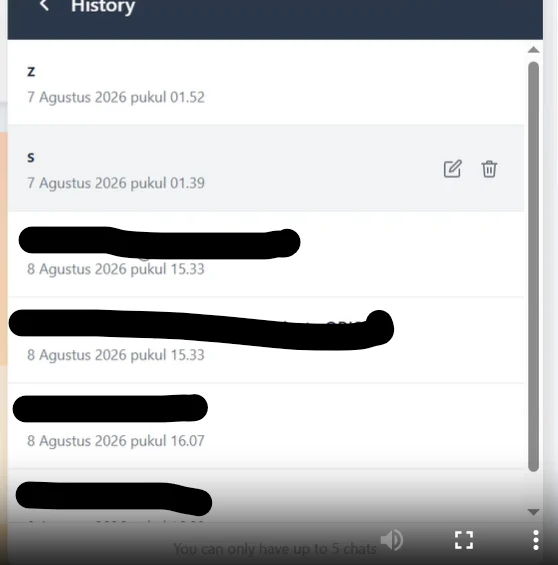
Because the count check is not protected by proper database locking or atomic operations, the server races past it and returns 200 OK for several of the concurrent requests. Each success creates a valid conversation_id in the database, so the account now holds more conversations than the limit allows. The attacker saves one of these hidden IDs for later.
Step 5: Load the dashboard and capture the conversation list
With the database over the limit, the frontend locks the UI because its state reflects reality. The attacker navigates back to the chat dashboard, which triggers:
The server responds with the true list of 5 active chats:
{ “conversations”: [ {“id”:”97f242…”}, {“id”:”74ec92…”}, {“id”:”bd5887…”}, {“id”:”943598…”}, {“id”:”cc278a…”} ]}
Step 6: Response manipulation 1, shrink the array
The attacker intercepts that response in Burp Suite and deletes one JSON object from the array before forwarding it. The frontend now believes only 4 chats exist and instantly re-enables the "New Conversation" button.

Step 7: Attempt creation and capture the rejection
Clicking "New Conversation" sends a standard POST /init request. The backend knows the user actually has 5 or more chats, so it rejects the attempt:
HTTP/2 429 Too Many RequestsContent-Type: application/json{"detail":"You have reached the limit of active conversations. Please delete one of your previous conversations to start a new one."}
Step 8: Response manipulation 2, rewrite the error into a success
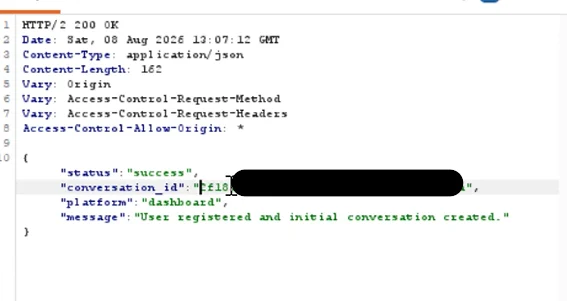
Instead of accepting the rejection, the attacker intercepts the error response, changes the status code from 429 Too Many Requests to 200 OK, and replaces the body with a success message that injects the conversation_id harvested in step 4:
{ “status”: “success”, “conversation_id”: “[INSERT_RACE_CONDITION_ID_HERE]”, “platform”: “dashboard”, “message”: “User registered and initial conversation created.”}
The frontend accepts the payload, and the attacker can chat in the new session. All subsequent message requests using that ID are processed normally by the backend, so the limit is bypassed end to end.
Root cause
The chain depends on three weaknesses working together:
- Non-atomic count check. The
/initendpoint checks the database count before creating a conversation, but the check and the insert are not atomic and not protected by proper locking. Concurrent requests all pass the check before any of them is committed, so several conversations are created where only one should be allowed. - Client-side enforcement of the limit. The UI decides whether the user may start a conversation from the array returned by
GET /conversations. Editing that response in the browser's proxy re-enables the button without any server-side change. - Trusting the response body and status. The frontend accepts the rewritten
200 OKand the injectedconversation_id, and subsequent messages using that ID are processed normally.
Impact
The author describes three consequences:
- Financial exhaustion (Denial of Wallet). RAG systems lean heavily on expensive LLM tokens (the write-up names OpenAI and Anthropic APIs as examples) per query. An attacker can script the bypass to spin up thousands of parallel conversations, flooding the backend with prompts and driving up cloud and API bills.
- Degradation of critical banking services. As a fintech and wallet application, uptime and fast customer support matter. Flooding the RAG infrastructure with unauthorised queries drains database and retrieval resources, slowing down or crashing support bots for legitimate customers who need help with transactions.
- Subversion of business tiering. AI capabilities are often tiered, for example restricted to premium users or rate-limited to control overhead. The flaw lets any basic or malicious user abuse unlimited enterprise-grade resources for free.
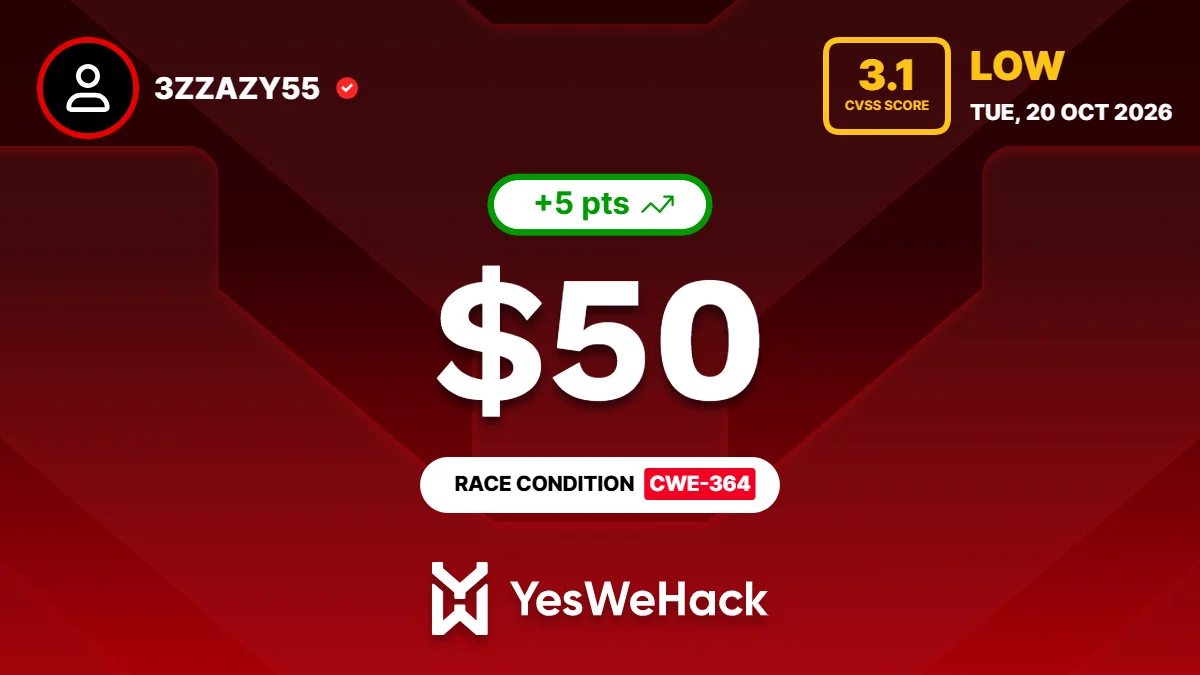
The report was triaged and accepted as Low Severity (CVSS 3.1) with a $50 bounty, acknowledging the valid logic flaw and concurrency issue in backend validation.
Fix
The write-up does not describe the code change that resolved the issue. Based on the root cause it identifies, the fixes that would close each link in the chain are:
- Make the count check and the conversation insert atomic, for example with a transaction and row-level locking or a unique constraint that enforces the per-user limit at the database level, so concurrent requests cannot all pass the check.
- Treat the frontend purely as presentation: the server must remain the authority on whether a new conversation is allowed, regardless of what the UI believes about the current count.
- Do not let the client supply the
conversation_idfor a newly created conversation. The server should generate it and return it, and the frontend should only accept IDs the server issued.
Variants to test
- Race any per-user quota. Find endpoints that check a count before inserting (conversations, API keys, invites, exports) and send 3 to 5 parallel requests just below the limit. A positive result is more
200 OKresponses, and more created objects, than the quota allows. - Shrink list responses that drive UI locks. Wherever a button is disabled based on the length of an array in a
GETresponse, delete an element in the proxy and reload. A positive result is the control re-enabling while the server still holds the full set. - Rewrite
429responses into200 OKwith a plausible body. Do this on any endpoint that returns a quota error, injecting an identifier you obtained elsewhere. A positive result is the client proceeding to use that identifier and the backend accepting subsequent requests with it. - Replay harvested IDs across sessions. Take an ID created during a race and use it after the quota is exhausted. A positive result is normal processing of messages on that ID while new creations are still rejected.
- Script the whole chain. Automate the parallel creation and the ID harvesting to measure how far past the limit an account can go. A positive result is a growing number of live conversations per account, which is the Denial of Wallet precondition.
What happened, in plain words
A fintech and wallet platform offers an AI chatbot. You type a question, the chatbot answers. Behind the scenes, every answer costs the company real money, because the chatbot uses large language models (LLMs) and a technique called Retrieval-Augmented Generation (RAG), and each question burns paid API tokens and computing power.
To keep those costs under control, the platform allows each user a maximum of 5 active chatbot conversations. Once you have five, the "New Conversation" button should stop working.
The researcher found a way to get around that cap and create conversations beyond the limit. The trick chains three separate weaknesses together: a race condition, a frontend logic bypass, and a backend logic bypass. The author describes the result as bypassed tier limitations and a Denial of Wallet (DoW) vector: the attacker does not steal data, but can make the company pay for AI usage.
You only need to know how to use a browser and a computer to follow along.
Background: what the product does and why the limit exists
Before the attack makes sense, a few ideas need unpacking.
What is an API? An API (Application Programming Interface) is the set of addresses a website's frontend uses to talk to its backend. Think of a restaurant: the menu and the waiter are the API. You do not walk into the kitchen yourself; you tell the waiter what you want, and the waiter brings it back. In web terms, the frontend (what you see in the browser) sends requests to the backend (the servers and databases), and the backend sends responses back.
What is an HTTP request? Every time your browser loads a page or a button sends data, it makes an HTTP request. A request has a method (like GET to fetch something or POST to send something), a URL (the address), headers (extra information, such as who you are), and sometimes a body (the data you are sending).
What is a bearer token? When you log in, the server gives your browser a token, a long string of characters. Your browser sends it with every request in an Authorization header, and the server uses it to know who you are. Think of it as a wristband at an event: show it and you get in without showing your ID again. If someone steals it, they can pretend to be you, which is why tokens are secrets.
What is a conversation ID? Each chat conversation has a unique identifier, a string like 97f242…. The backend uses that ID to know which conversation a message belongs to. It is like a ticket number at a repair shop: quote the number and the staff know exactly which item is yours.
What is a race condition? Imagine two people reaching for the last seat on a train at the same moment. Each one checks "is the seat free?" and both see "yes", so both sit down. The check and the action were not done as one indivisible step. In software, if a server checks "does this user have fewer than 5 conversations?" and then creates a new one, and two requests arrive at almost the same instant, both can pass the check before either one is saved. That is a race condition.
What is a frontend and a backend? The frontend is the part running in your browser: buttons, pages, what you see. The backend is the part running on the company's servers: databases, business rules, the real source of truth. A common mistake is to let the frontend enforce a rule that the backend should enforce.
What is Burp Suite? It is a tool that sits between your browser and the website, letting you see every request and response, pause them, change them, and send them again. Think of it as a mail interception service: you can read the letter, rewrite it, and put it back in the envelope before it reaches the recipient.
What is Turbo Intruder / "Send group in parallel"? These are features of Burp Suite that send many requests at the same instant, rather than one after another. That is exactly what you need to trigger a race condition.
What is a 429 response? HTTP status codes are three-digit numbers the server uses to say what happened. 200 OK means success. 429 Too Many Requests means "you have hit a rate limit or quota".
How the limit was supposed to work
The author describes the limit as being enforced in two places:
- Frontend state. The UI counts conversations through a
GET /conversationsendpoint and disables the "New Conversation" button once the returned array reaches a length of 5. - Backend validation. The
/initendpoint checks the database count before allowing a new conversation and answers withHTTP 429 Too Many Requestswhen the user is over the limit.
In plain words: the browser asks the server "how many conversations do I have?", gets a list back, counts the items, and if there are five, greys out the button. Separately, when you try to start a new conversation, the server checks its database and refuses if you are at the limit. Two locks, one in the browser and one on the server.
The chain combines a race condition with two separate pieces of client-side trust: manipulating the conversation list response, and manipulating the error response from /init.
Setup: what you need before starting
The preconditions it does state are:
Why four? Because the limit is five. If you already have four, the next successful creation is the one that should be blocked. That is the moment the race condition has to win.
Finding it: why the two locks do not protect each other
The researcher frames the limit as a cost control rather than a security boundary, and observes that the two enforcement pillars trust different things. The frontend decides whether to lock the button purely from the length of the array returned by GET /conversations, and the backend decides whether to allow creation from a database count. Neither layer is described as validating the other, and the backend count check is described as lacking proper database locking or atomic operations. That combination is what the chain exploits: concurrency defeats the count check, and response manipulation defeats the UI check.
In everyday terms: the browser lock trusts whatever list the server sends, and the server lock trusts its own count but does not perform the check and the creation as one indivisible step. So you can attack each lock separately, with a different technique, and neither one notices what the other is doing.
Exploitation, step by step
Step 1: Create four conversations normally
The attacker creates 4 chats through the normal UI. At this point sequential requests to create a 5th are safely blocked, so the next step is to race the check.
Why do this normally? Because the attack needs the account to be right at the edge of the limit. If you start from zero, the race would just create a few conversations that you are allowed to have anyway. Starting from four means any extra creation is a violation.
Step 2: Intercept the creation request
The request to create the 5th conversation is captured in Burp Suite:
Line by line:
POST /redacted/api/v1/chatbot/conversations/init HTTP/2is the request line.POSTmeans "I am sending data to create something". The path points at the chatbot conversationsinitendpoint, which is the address that starts a new conversation.HTTP/2is the version of the protocol being used.Host: redacted.comtells the server which website the request is for. One server can host many sites, so this header picks the right one.Authorization: Bearer eyJhbGci…[TRUNCATED]is the login token. The wordBearermeans "the holder of this token is authorised". The long string after it is the token itself, which identifies the user. It is truncated in the write-up, and in a real report it would be a secret.Content-Type: application/jsonsays the body is formatted as JSON, a common text format for structured data.{"platform":"website"}is the body: a single field namedplatformwith the valuewebsite. It tells the backend where the request is coming from.
The request is a JSON POST to the /init endpoint, authenticated with a bearer token, and carries a single body field, platform, set to website.
Why intercept it? Because the attack needs to send this exact request many times at once, and Burp lets you capture it once and replay it in a controlled way.
Step 3: Fire concurrent requests
Using Turbo Intruder or Burp Repeater's "Send group in parallel", the attacker sends multiple concurrent requests (3 to 5 simultaneously) right before hitting the hard limit.
Why several at once? Because the backend checks the count and then creates the conversation. If the requests arrive one after another, the first one is blocked and the rest are blocked too. If they arrive together, several can pass the check before any of them has been saved. That is the race.
Step 4: Harvest the extra conversation IDs
Because the count check is not protected by proper database locking or atomic operations, the server races past it and returns 200 OK for several of the concurrent requests. Each success creates a valid conversation_id in the database, so the account now holds more conversations than the limit allows. The attacker saves one of these hidden IDs for later.
In plain words: the server said "yes" to more than one request at the same time, and each "yes" produced a real conversation with its own ID. The account is now over the limit, and the attacker keeps one of those IDs in a notepad for the next stage.
Step 5: Load the dashboard and capture the conversation list
With the database over the limit, the frontend locks the UI because its state reflects reality. The attacker navigates back to the chat dashboard, which triggers:
Line by line:
GET /redacted/api/v1/chatbot/conversations HTTP/2is a request to read the list of conversations.GETmeans "give me data", as opposed toPOSTwhich sends data.Host: redacted.comagain identifies the website.Authorization: Bearer eyJhbGci…[TRUNCATED]is the same login token, proving who is asking.
The server responds with the true list of 5 active chats:
{ “conversations”: [ {“id”:”97f242…”}, {“id”:”74ec92…”}, {“id”:”bd5887…”}, {“id”:”943598…”}, {“id”:”cc278a…”} ]}
Line by line:
- The outer braces
{ }hold a JSON object, a collection of named values. "conversations"is the name of the field, and its value is an array (a list) written with square brackets[ ].- Inside the array are five objects, each with an
idfield. Eachidis a conversation identifier, shortened here with…. - The frontend counts these five items and locks the "New Conversation" button.
Why capture this response? Because the frontend trusts it completely. If the attacker can change what the frontend sees, the frontend will change its behaviour.
Step 6: Response manipulation 1, shrink the array
The attacker intercepts that response in Burp Suite and deletes one JSON object from the array before forwarding it. The frontend now believes only 4 chats exist and instantly re-enables the "New Conversation" button.
Why does this work? Because the button's state is decided in the browser, from the length of the list. The server still has five conversations, but the browser has been told there are four. The lock is in the wrong place: it is enforced by the client, and the client can be edited.
Step 7: Attempt creation and capture the rejection
Clicking "New Conversation" sends a standard POST /init request. The backend knows the user actually has 5 or more chats, so it rejects the attempt:
HTTP/2 429 Too Many RequestsContent-Type: application/json{"detail":"You have reached the limit of active conversations. Please delete one of your previous conversations to start a new one."}
Line by line:
HTTP/2 429 Too Many Requestsis the status line.429is the code for "too many requests", and the text after it is a human-readable label.Content-Type: application/jsonsays the body is JSON.{"detail":"You have reached the limit of active conversations. Please delete one of your previous conversations to start a new one."}is the body: a JSON object with adetailfield containing the error message.
Why is this step useful? Because it confirms the backend lock is working. The frontend was fooled, but the server was not. The attacker now knows exactly what the rejection looks like, and can plan to rewrite it.
Step 8: Response manipulation 2, rewrite the error into a success
Instead of accepting the rejection, the attacker intercepts the error response, changes the status code from 429 Too Many Requests to 200 OK, and replaces the body with a success message that injects the conversation_id harvested in step 4:
{ “status”: “success”, “conversation_id”: “[INSERT_RACE_CONDITION_ID_HERE]”, “platform”: “dashboard”, “message”: “User registered and initial conversation created.”}
Line by line:
"status": "success"tells the frontend the operation worked."conversation_id": "[INSERT_RACE_CONDITION_ID_HERE]"is the placeholder where the attacker pastes the real ID saved in step 4. The frontend will treat this as the ID of the newly created conversation."platform": "dashboard"says where the conversation was started."message": "User registered and initial conversation created."is a human-readable confirmation.
Why does this work? Because the frontend trusts the status code and the body it receives. It does not independently ask the server "did you really create this conversation for me?". It just believes the 200 OK and the success-shaped JSON. All subsequent message requests using that ID are processed normally by the backend.
Root cause: why the chain works
The chain depends on three weaknesses working together:
- Non-atomic count check. The
/initendpoint checks the database count before creating a conversation, but the check and the insert are not atomic and not protected by proper locking. Concurrent requests all pass the check before any of them is committed, so several conversations are created where only one should be allowed. - Client-side enforcement of the limit. The UI decides whether the user may start a conversation from the array returned by
GET /conversations. Editing that response in the browser's proxy re-enables the button without any server-side change. - Trusting the response body and status. The frontend treats a
200 OKwith a success-shaped body as proof that a conversation was created, and accepts aconversation_idsupplied by the client. The backend never confirms that this ID belongs to a conversation it created for that user in that request.
The existing defences, the UI lock and the 429 from /init, each stop only the straightforward sequential path. Neither is designed to survive concurrency or a client that rewrites its own responses.
In everyday terms: the browser lock can be edited because it lives in the browser, and the server lock can be raced because it checks and then acts in two separate moments. Each lock is fine on its own against a normal user clicking buttons, but neither is designed for someone who can send many requests at once and rewrite what comes back.
Impact: what an attacker could do with this
The author describes three consequences:
- Financial exhaustion (Denial of Wallet). RAG systems lean heavily on expensive LLM tokens (the write-up names OpenAI and Anthropic APIs as examples) per query. An attacker can script the bypass to spin up thousands of parallel conversations, flooding the backend with prompts and driving up cloud and API bills.
- Degradation of critical banking services. As a fintech and wallet application, uptime and fast customer support matter. Flooding the RAG infrastructure with unauthorised queries drains database and retrieval resources, slowing down or crashing support bots for legitimate customers who need help with transactions.
- Subversion of business tiering. AI capabilities are often tiered, for example restricted to premium users or rate-limited to control overhead. The flaw lets any basic or malicious user abuse unlimited enterprise-grade resources for free.
In plain words: the author argues the attacker does not need to steal anything, but can make the company pay for AI usage it never intended to provide and slow down or crash support bots for real customers. That is why the author calls it a Denial of Wallet: the damage is to the company's bank account and to service quality, not to data.
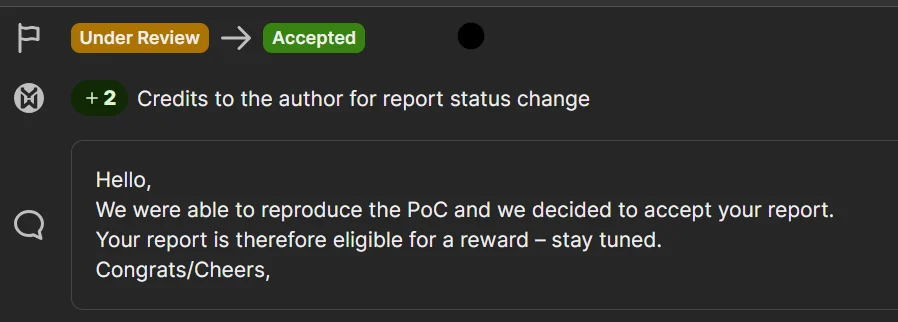
The report was triaged and accepted as Low Severity (CVSS 3.1) with a $50 bounty, acknowledging the valid logic flaw and concurrency issue in backend validation. The final status is Accepted and Resolved.
Fix: how to close the chain
The write-up does not describe the code change that resolved the issue. Based on the root cause it identifies, the fixes that would close each link in the chain are:
- Make the count check and the conversation insert atomic, for example with a transaction and row-level locking or a unique constraint that enforces the per-user limit at the database level, so concurrent requests cannot all pass the check.
- Treat the frontend purely as presentation: the server must remain the authority on whether a new conversation is allowed, regardless of what the UI believes about the current count.
- Do not let the client supply the
conversation_idfor a newly created conversation. The server should generate it and return it, and the frontend should only accept IDs the server issued.
In everyday terms: do the check and the creation as one indivisible step so two requests cannot both slip through, keep the real decision on the server rather than in the browser, and never let the browser tell the server what ID a new conversation should have.
Variants to test: where else to look
- Race any per-user quota. Find endpoints that check a count before inserting (conversations, API keys, invites, exports) and send 3 to 5 parallel requests just below the limit. A positive result is more
200 OKresponses, and more created objects, than the quota allows. - Shrink list responses that drive UI locks. Wherever a button is disabled based on the length of an array in a
GETresponse, delete an element in the proxy and reload. A positive result is the control re-enabling while the server still holds the full set. - Rewrite
429responses into200 OKwith a plausible body. Do this on any endpoint that returns a quota error, injecting an identifier you obtained elsewhere. A positive result is the client proceeding to use that identifier and the backend accepting subsequent requests with it. - Replay harvested IDs across sessions. Take an ID created during a race and use it after the quota is exhausted. A positive result is normal processing of messages on that ID while new creations are still rejected.
- Script the whole chain. Automate the parallel creation and the ID harvesting to measure how far past the limit an account can go. A positive result is a growing number of live conversations per account, which is the Denial of Wallet precondition.
Glossary
- API: the set of addresses and rules a frontend uses to talk to a backend, like a waiter taking orders to a kitchen.
- HTTP request: a message from a browser (or tool) to a server, with a method, a URL, headers and sometimes a body.
- HTTP response: the server's reply, with a status code, headers and sometimes a body.
- Method (GET, POST): the verb of a request.
GETasks for data,POSTsends data to create or change something. - Header: extra information attached to a request or response, such as who you are or what format the body uses.
- Body: the data part of a request or response, often formatted as JSON.
- JSON: a text format for structured data, using braces, square brackets, names and values.
- Bearer token: a secret string sent in the
Authorizationheader that proves who you are, like a wristband at an event. - Endpoint: a specific address on a server that performs a specific action, such as
/initor/conversations. - Frontend: the part of an application running in your browser: pages, buttons, what you see.
- Backend: the part running on the company's servers: databases, business rules, the real source of truth.
- Client-side: happening in the browser, under the user's control.
- Server-side: happening on the server, not under the user's control.
- Race condition: a bug where two actions happen at almost the same moment and both pass a check that only one should pass, because the check and the action are not one indivisible step.
- Atomic operation: an action that happens as one indivisible step, so nothing can slip in between its parts.
- Database locking: a mechanism that stops two operations from changing the same data at the same time.
- Conversation ID: a unique string identifying one chat conversation, used by the backend to know which conversation a message belongs to.
- Status code: a three-digit number in an HTTP response saying what happened, such as
200 OKfor success or429 Too Many Requestsfor a quota error. - 429 Too Many Requests: the status code meaning the user has hit a rate limit or quota.
- Burp Suite: a tool that sits between your browser and a website, letting you see, pause, edit and resend requests and responses.
- Turbo Intruder: a Burp Suite feature for sending many requests at the same instant.
- Send group in parallel: a Burp Repeater feature that sends several requests simultaneously.
- Response manipulation: editing a server's response before the browser sees it, so the frontend behaves differently from what the server intended.
- Logic flaw: a bug in the rules of an application, rather than in its code syntax, that lets someone do something the rules should forbid.
- Business logic: the rules an application follows to serve its purpose, such as "a user may have at most five conversations".
- LLM (Large Language Model): an AI model that generates text, used by chatbots to answer questions.
- RAG (Retrieval-Augmented Generation): a technique where an AI model looks up relevant information before answering, which costs extra computing and API usage.
- API token: a unit of paid usage charged by an AI provider each time a prompt is processed.
- Denial of Wallet (DoW): an attack that does not steal data but makes the victim pay for resources it never intended to provide.
- CVSS: a scoring system for the severity of a security issue; 3.1 is the version of the scoring standard used here.
- Bounty: a payment made to a researcher who reports a valid security issue.
- Triage: the process of reviewing a reported issue and deciding whether it is valid and how severe it is.
- Quota: a limit on how much of something a user may consume, such as five conversations.
- Rate limit: a limit on how often something may be done in a period of time.
- Proxy: a tool or service that sits between your browser and a website, letting you inspect and modify traffic.



