CVE-2026-17070: Crossing the Liman Vault credential boundary
A low-privilege user could change a server-wide shared-key flag through the personal Vault key-creation endpoint, which lacked the access check enforced by the normal sharing route. After deleting their own temporary key, the credential resolver fell back to another user's key, so an already-permitted extension function ran under that user's managed-server identity, including root in the lab.

medium.com
Published on medium.com
Security Research
The full write-up lives on its author's site
It belongs to its author, so we link to it rather than copy it. The other two tabs are our own rewrites, checked against it.
Context
Liman MYS is a server management product from HAVELSAN. Among its features is a Vault that stores credentials used to reach managed servers, and an extension mechanism that lets an authorised function run against a server object. The credential boundary is the part that matters here: when an extension function runs against a server, the product has to decide whose stored credential is used to reach that server.
The finding is recorded as CVE-2026-17070, classified as CWE-862, with a CVSS v3.1 score of 8.8 High (AV:N/AC:L/PR:L/UI:N/S:U/C:H/I:H/A:H). The official affected range is 2.2.3 through versions before 2.3.1.
The core question the research asks is not whether a user can invoke an operation, but whose credential that already-permitted operation uses. A low-privilege actor who legitimately holds a server object and is allowed to call one ordinary extension function could change server-wide credential-sharing state through a personal-key workflow, and then have that same function run under another user's managed-server identity.
Setup
The source lock identifies Core commit [redacted] and Fiber commit [redacted]. Tests ran in a local Docker lab with synthetic users and a disposable SSH target.
The actor was given one server object and one extension object, and zero add_server, update_server or server_details permissions. A marker-only remoteIdentity extension function was installed as a lab fixture and explicitly granted to the actor. The product API, the credential resolver and the normal extension-render route were used. The separate raw /engine/command path was not invoked.
This setup deliberately isolates the credential question: the caller is already allowed to invoke the function, so any difference in outcome comes from which credential the resolver selects, not from whether the caller can reach the function at all.
The preserved strengthened test ran against Core release.master.1110 and Fiber release.72.
Finding it
Two paths handled the same server-level sharing state with different levels of authorisation. The normal server-management route enforced a boundary on who may change sharing for a server object. The personal Vault key-creation path, VaultController::createKey(), also updated servers.shared_key, taking the value from request-controlled shared state, without that same boundary. Access to an object and authority to share credentials for that object are different permissions, and only one of them was being checked.
A second observation made the first one durable: deleting the temporary personal key did not reverse the global sharing flag. The actor could therefore leave no personal key behind while the server still advertised shared-key availability.
A third observation was in the captured Fiber resolver. It first searched for a key belonging to the caller and the server. If none was present and SharedKey == 1, it selected a key for the server and changed encrypterUser to that key's owner. The plaintext secret never needed to be returned to the actor: selecting and using the other identity was enough to cross the boundary.
Exploitation
Step 1: confirm the controls reject the obvious paths
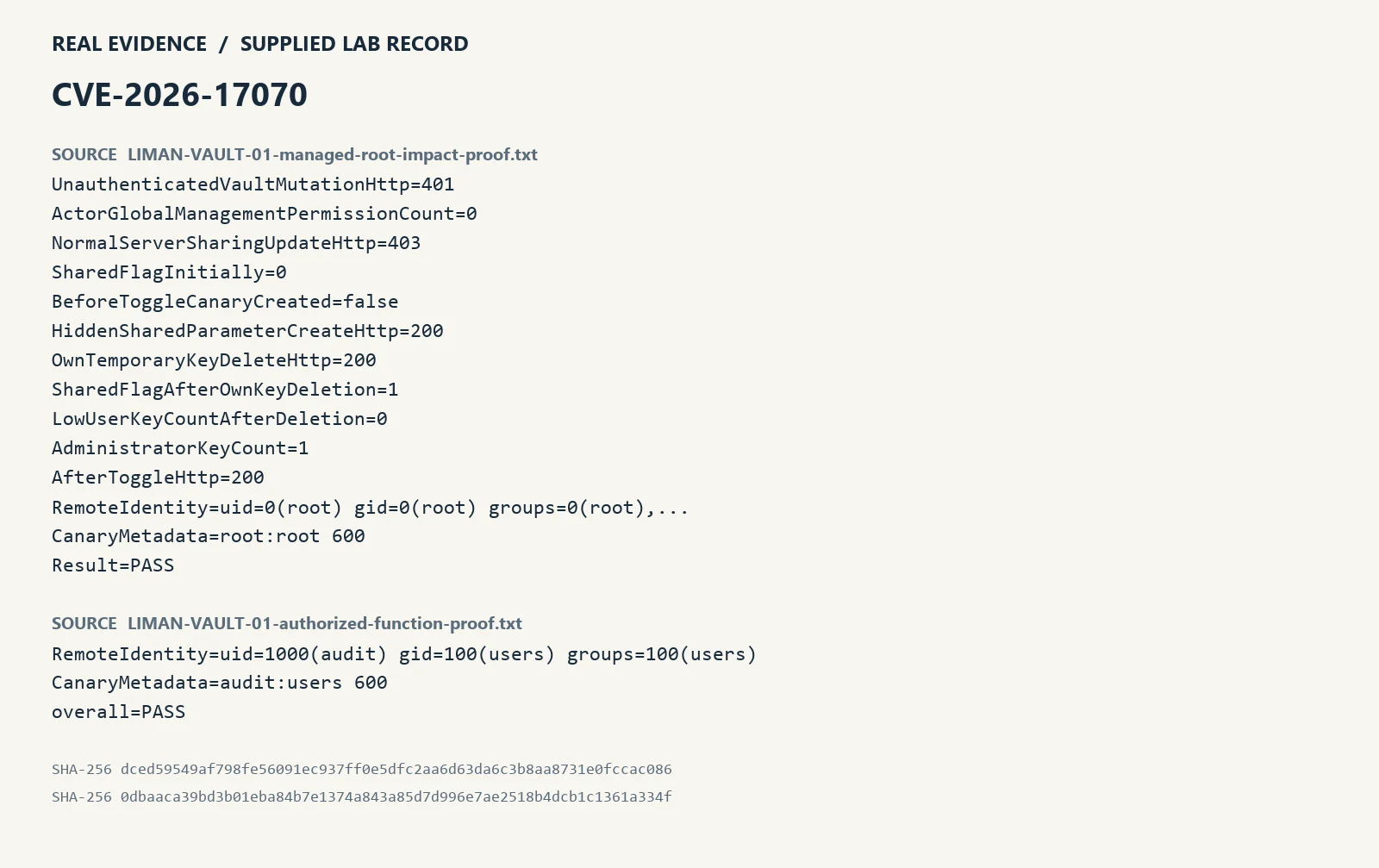
Before touching state, the researcher recorded the baseline rejections. An unauthenticated Vault mutation returned HTTP 401. The actor's normal server-sharing update returned HTTP 403. The actor's global management permission count was 0.
Step 2: confirm the permitted function cannot yet reach the target
Before the state change, the permitted function could not connect, and no canary existed. The before-state response needs careful reading: the outer HTTP status was 201, while its body contained status: 403 and cannot connect to server. It is not accurate to describe that particular response as an HTTP 403; the separate HTTP 403 control is the normal sharing-management request from step 1.
Step 3: create a personal Vault key carrying the hidden sharing value
Vault key creation with the hidden sharing value returned HTTP 200. This is the request that changes servers.shared_key through the personal-key workflow, bypassing the boundary that the normal sharing route enforces.
Step 4: delete the actor's own temporary key
Deletion of the actor's own temporary key returned HTTP 200. After deletion the sharing flag was 1, the actor key count was 0, and the administrator key count was 1. The actor now holds no key of its own, but the server still advertises shared-key availability.
Step 5: invoke the same permitted function again
The same permitted function then returned HTTP 200 and the administrator credential's remote identity. The resolver found no key for the caller and server, saw SharedKey == 1, selected the administrator's remaining key, and set encrypterUser to that key's owner.
With the original non-root victim configuration, the function returned:
RemoteIdentity=uid=1000(audit) gid=100(users) groups=100(users)CanaryMetadata=audit:users 600overall=PASS
For the managed-root variant, the synthetic administrator had a root credential for a separate disposable SSH container. Both recorded iterations produced a root identity and CanaryMetadata=root:root 600. The root credential and SSH policy were temporary lab fixtures, and the password was not printed.
Step 6: restore the lab
The restoration record reports removal of temporary permissions, keys, helpers and canaries and restoration of the extension and SSH state. A post-restoration non-root run again returned the audit identity. The recorded original sharing flag was 1; each attack baseline deliberately set it to 0. Restoration must be evaluated against the original fixture state, not confused with the per-test baseline.
Root cause
Three decisions combined into one boundary crossing.
VaultController::createKey()used the caller's personal-key workflow to updateservers.shared_keyfrom request-controlledsharedstate. The normal server-management route enforced a boundary that this path did not.- Deleting the temporary personal key did not reverse the global sharing flag, so the actor could leave no personal key while the server still advertised shared-key availability.
- The captured Fiber resolver first searched for a key belonging to the caller and server.
The normal server-management route enforced a boundary on who may change sharing for a server object, while the personal-key route did not. The resolver fell back to another owner's key whenever no caller key existed and SharedKey was 1.
Impact
An actor with access to a server object and permission to invoke one ordinary extension function, but with no global server-management permissions, could cause that function to run under another user's managed-server identity. The preserved tests demonstrate both a non-root identity and a root identity in separate controlled configurations.
The paired results support credential confusion as the mechanism. They do not imply that all installed extensions expose arbitrary shell execution. The specific permitted marker function ran under the selected victim identity. Root impact depends on a root-capable credential and the capabilities of the permitted operation.
The evidence concerns isolated synthetic lab identities. It does not demonstrate plaintext credential disclosure, unauthenticated exploitation, a production compromise or a fresh 2.3.1 retest.
Fix
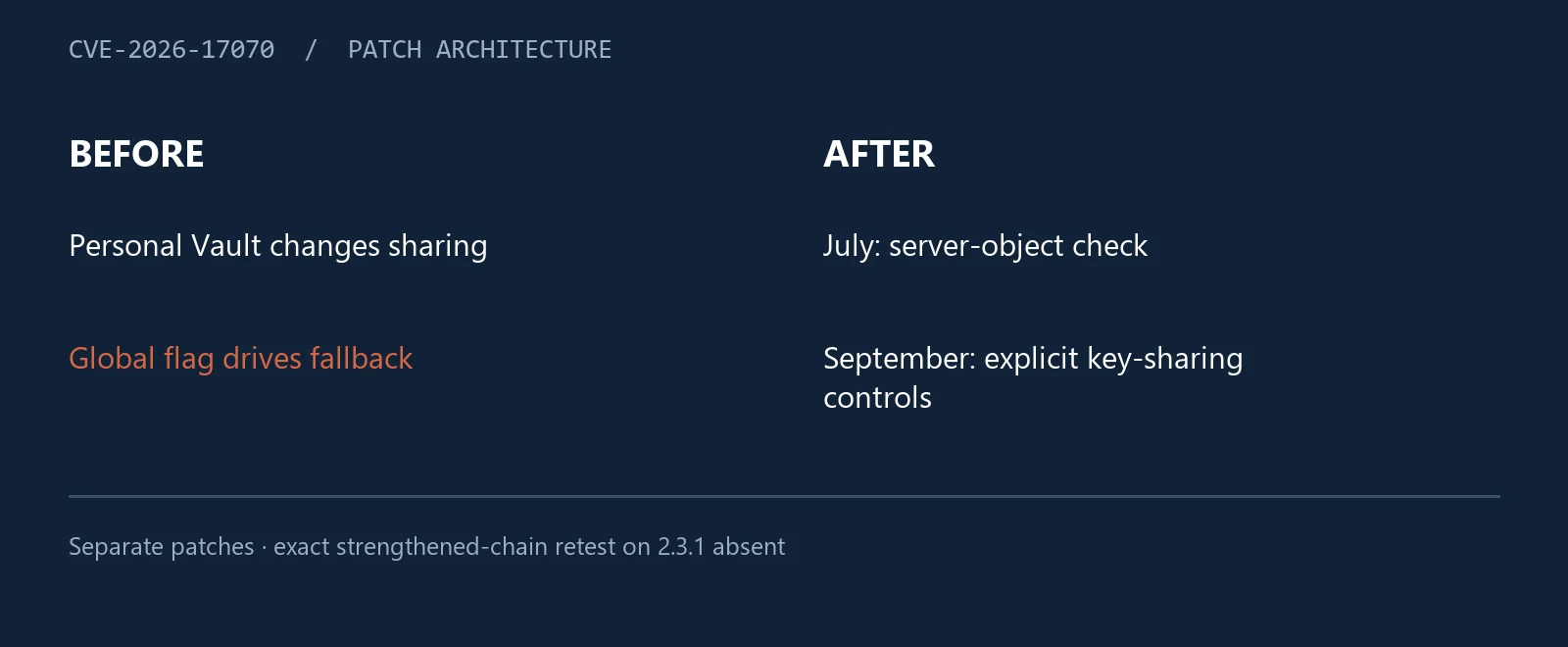
The 27 July 2026 fix added server-object access checks to create() and createKey(), and changed the recorded version to 2.3.1. The release and the CVE record establish that fixed-version declaration.
The strengthened test actor, however, already possessed server-object access. Source inspection of a newly added object-access check does not substitute for running this exact credential-sharing chain against the fixed version. The article neither declares 2.3.1 vulnerable to that chain nor claims the chain was dynamically closed there.
Commit e8873b27, dated 2 September 2026, separately introduced shared-key security changes. The inspected diff includes a dedicated share_server_key permission, key-level sharing state, an explicit sharing route, transaction and row locking, state maintenance and audit-related changes. These changes are relevant to the underlying ownership boundary, but they are later work and should not be described as the July 2.3.1 patch. Inspection of the Core diff also does not establish end-to-end enforcement by every deployed credential consumer.
The defensive lessons follow from the mechanism: treat credential sharing as its own authorised operation, bind a grant to a particular key and owner, make revocation atomic with deletion, and ensure the resolver consumes that explicit grant. Auditing should preserve both the calling application identity and the identity selected for the managed target. The key question is not only whether a user can access a server, but whether that user can cause another person's credential to be selected.
Variants to test
- Personal-key routes that write server-level state. Look for any create, update or delete handler on a user-owned object that also mutates a field on a shared object. A positive result is a request that succeeds with the caller's own object permissions while changing state that the normal management route would reject with 403.
- Deletion that does not reverse a flag. Create a temporary object that sets a sharing or visibility flag, delete the object, and check whether the flag persists. A positive result is the flag still set with the caller's object count at zero.
- Resolver fallback on a server-wide flag. Inspect how the credential resolver chooses a key when no caller-owned key exists. A positive result is a fallback that selects another owner's key and changes the effective identity without an explicit per-key grant.
- Identity in the response. Use a marker function that returns the remote identity and a canary file's metadata. A positive result is a remote identity and canary metadata belonging to a different user than the caller.
- Root-capable credentials. Repeat the chain where the other owner holds a root credential on a disposable target. A positive result is a root identity and root-owned canary metadata, which shows the impact scales with the selected credential.
- Fixed-version retest. Run the exact chain, including the already-authorised-server precondition, against the fixed release rather than relying on source inspection of the new check. A positive result would be the same cross-user identity appearing after the fix.
What happened, in plain words
Imagine a shared office building. Each tenant has a key to their own office, and the building manager keeps a master key in a locked cabinet. The cabinet is supposed to be opened only by people with the right paperwork. One day a tenant finds a side door to the cabinet that only asks "do you rent an office here?" and not "are you allowed to touch other people's keys?". The tenant slips a note into the cabinet saying "master keys may be shared", then throws away their own key. The cabinet, seeing the note and finding no tenant key, starts opening doors with the manager's key instead. The tenant never sees the key itself, but the next time they open a door, it opens with the manager's authority.
That is the shape of CVE-2026-17070 in HAVELSAN Liman MYS. Liman MYS is a server management product: it lets an organisation look after many servers from one place. Two of its features matter here. The first is the Vault, a store of credentials (usernames, passwords, SSH keys) that Liman uses to reach the servers it manages. The second is the extension mechanism, which lets small add-on functions run against a server. When such a function runs, Liman has to decide whose stored credential is used to reach that server. That decision is the credential boundary, and it is what this research crossed.
The finding is recorded as CVE-2026-17070. A CVE is a public catalogue number for a known security flaw, so that everyone can refer to the same issue. It is classified as CWE-862, which is the catalogue's label for "missing authorisation check": the software forgot to ask whether the person is allowed to do the thing. Its CVSS v3.1 score is 8.8 High. CVSS is a standard way of scoring how serious a flaw is, from 0 to 10, and the string AV:N/AC:L/PR:L/UI:N/S:U/C:H/I:H/A:H is the breakdown of that score. The official affected range is 2.2.3 through versions before 2.3.1.
The question the research asks is not "can this user run the function?". The user was already allowed to run it. The question is "whose credential does that already-allowed function use?". A low-privilege actor, meaning someone with only small permissions, who legitimately holds one server object and may call one ordinary extension function, could change server-wide credential-sharing state through a personal-key workflow. Then the same function ran under another user's managed-server identity.
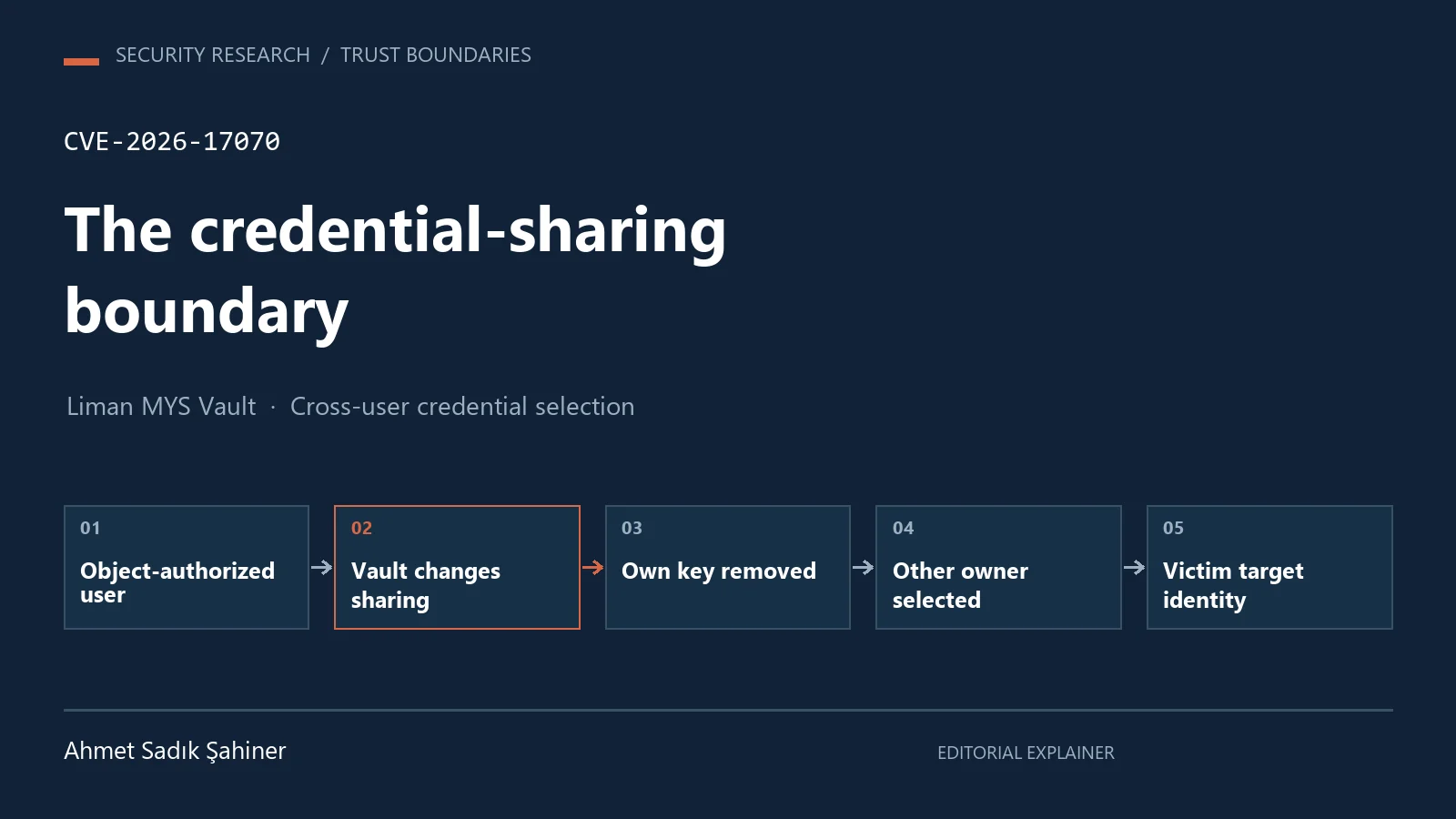
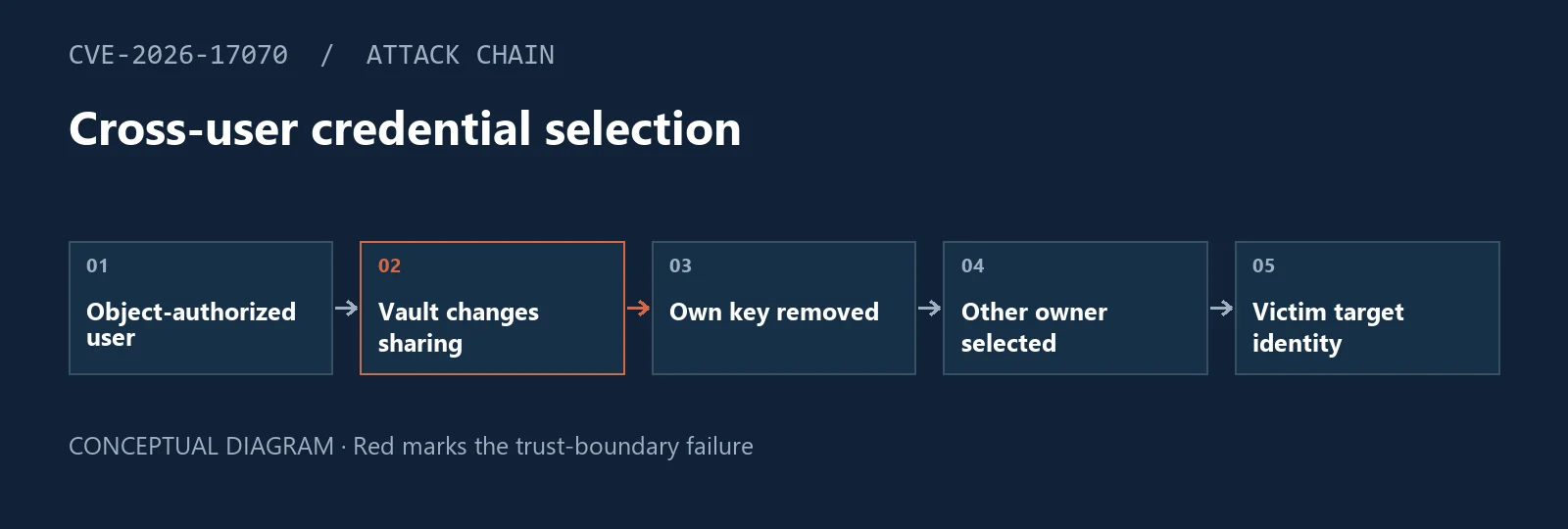
The diagram shows the flow in one picture: an object-authorised user goes through shared credential state and ends up acting as another owner's managed-server identity.
The setup
To study this safely, the researcher built a lab. A lab here means a self-contained test environment, not a real customer system. It ran in Docker, a tool for running software in isolated containers, with synthetic (made-up) users and a disposable SSH target. SSH is the standard way to log in to a Linux server remotely; a disposable target is a throwaway machine that can be deleted afterwards.
The source lock identifies Core commit [redacted] and Fiber commit [redacted]. A commit is a saved snapshot of source code in a version-control system such as Git, and its long hexadecimal name identifies exactly which snapshot was used. Core and Fiber are the two code components named in the report. The preserved strengthened test ran against Core release.master.1110 and Fiber release.72.
The actor, meaning the test user playing the attacker, was given one server object and one extension object. An object in this context is a record in the product, such as "this server" or "this extension". The actor had zero add_server, update_server or server_details permissions. Permissions are the individual yes/no rights a user account holds; these three are the rights to add servers, change servers and view server details. The actor had none of them.
A marker-only remoteIdentity extension function was installed as a lab fixture and explicitly granted to the actor. A fixture is something set up in advance so a test has something stable to work with. This function was a marker-only fixture, explicitly granted to the actor. That is the marker.
The product API, the credential resolver and the normal extension-render route were used. An API is the set of addresses a program offers so other programs (or a browser, or a tool like curl) can ask it to do things; think of it as the service counter of a shop, with a fixed list of requests it accepts. The credential resolver is the internal piece of code that decides which stored credential to use for a connection. The extension-render route is the normal web address through which an extension function is invoked. The separate raw /engine/command path was not invoked: that is a different, lower-level way of sending commands, and the researcher deliberately left it out of the test.
This setup isolates the credential question. Because the caller is already allowed to invoke the function, any difference in the outcome must come from which credential the resolver picks, not from whether the caller can reach the function at all. It is like testing a door: we are not asking whether the person can walk up to it, only which key it ends up using.
Finding it
The researcher noticed that two paths handled the same server-level sharing state with different levels of authorisation. A path here means one particular request the product accepts, one route through its code. The normal server-management route enforced a boundary on who may change sharing for a server object. The personal Vault key-creation path, VaultController::createKey(), also updated servers.shared_key, taking the value from request-controlled shared state, without that same boundary.
Unpacking that: VaultController::createKey() is the function that runs when a user creates a key in their own personal Vault. servers.shared_key is a field on the server record, a flag that says whether shared keys may be used for that server. Request-controlled shared state means the value comes straight from what the caller sent in the request, so the caller can choose it. Access to an object and authority to share credentials for that object are different permissions, and only one of them was being checked. In office terms: being allowed into the building is not the same as being allowed to change who holds the master key.
A second observation made the first one durable. Deleting the temporary personal key did not reverse the global sharing flag. The actor could therefore leave no personal key behind while the server still advertised shared-key availability. The note in the cabinet stayed after the tenant's own key was thrown away.
A third observation was in the captured Fiber resolver. It first searched for a key belonging to the caller and the server. If none was present and SharedKey == 1, it selected a key for the server and changed encrypterUser to that key's owner. encrypterUser is the internal name of the field that records whose credential is being used for the connection. The plaintext secret never needed to be returned to the actor: selecting and using the other identity was enough to cross the boundary. The plaintext secret did not need to be returned to the actor; selecting and using the other identity was enough.
Exploitation
Step 1: confirm the controls reject the obvious paths
Before touching state, the researcher recorded the baseline rejections. A baseline is the "before" measurement, taken so that later changes can be attributed to the right cause. An unauthenticated Vault mutation returned HTTP 401. Unauthenticated means the request carried no valid login at all. HTTP 401 is the web's standard answer for "you are not logged in". A mutation is a request that changes something rather than just reading it.
The actor's normal server-sharing update returned HTTP 403. HTTP 403 means "I know who you are, and you are not allowed". The actor's global management permission count was 0, confirming the account really was low-privilege.
Why this step: it proves the ordinary, intended route is properly guarded. Without it, a later success could be explained by "the product never checks anything", which would be a much less interesting finding.
Step 2: confirm the permitted function cannot yet reach the target
Before the state change, the permitted function could not connect, and no canary existed. A canary is a small file planted on the target machine purely as evidence: if the function can read it, we know the function really reached that machine under that identity. The before-state response needs careful reading. The outer HTTP status was 201, while its body contained status: 403 and cannot connect to server. HTTP 201 normally means "created", so the outer status alone would be misleading. It is not accurate to describe that particular response as an HTTP 403; the separate HTTP 403 control is the normal sharing-management request from step 1.
Why this step: it establishes that the function is genuinely blocked at this point. If it could already connect, the later success would prove nothing about credentials.
Step 3: create a personal Vault key carrying the hidden sharing value
Vault key creation with the hidden sharing value returned HTTP 200. HTTP 200 means "OK, done". This is the request that changes servers.shared_key through the personal-key workflow, bypassing the boundary that the normal sharing route enforces.
Why this step: this is the actual flaw. The request looks like an ordinary personal action, creating a key for yourself, but it carries a hidden extra value that flips a server-wide switch. The actor's normal server-sharing update returned 403; the personal-key creation returned 200.
Step 4: delete the actor's own temporary key
Deletion of the actor's own temporary key returned HTTP 200. After deletion the sharing flag was 1, the actor key count was 0, and the administrator key count was 1. The actor now holds no key of its own, but the server still advertises shared-key availability.
Why this step: it removes the actor's own key so that the resolver cannot find a caller-owned key. That is the condition the fallback logic waits for. It also shows the flag surviving the deletion, which is the second half of the flaw.
Step 5: invoke the same permitted function again
The same permitted function then returned HTTP 200 and the administrator credential's remote identity. The resolver found no key for the caller and server, saw SharedKey == 1, selected the administrator's remaining key, and set encrypterUser to that key's owner.
With the original non-root victim configuration, the function returned:
RemoteIdentity=uid=1000(audit) gid=100(users) groups=100(users)CanaryMetadata=audit:users 600overall=PASS
Line by line, in plain words:
RemoteIdentity=uid=1000(audit) gid=100(users) groups=100(users)is what the target machine reported about the incoming connection.uid=1000(audit)means the connection arrived as the user namedaudit, whose numeric user ID is 1000.gid=100(users)is that user's main group, andgroups=100(users)lists the groups it belongs to. In short: the target saw theauditaccount, not the actor's account.CanaryMetadata=audit:users 600describes the planted canary file: it is owned by userauditand groupusers, and its permission bits are600, meaning only its owner may read or write it. The function could see it, so the function really was running asaudit.overall=PASSis the test's own verdict: the expected identity was observed.
For the managed-root variant, the synthetic administrator had a root credential for a separate disposable SSH container. Root is the all-powerful administrator account on a Linux machine. Both recorded iterations produced a root identity and CanaryMetadata=root:root 600. The root credential and SSH policy were temporary lab fixtures, and the password was not printed.
Why this step: it is the payoff. The same function, called by the same low-privilege actor, now acts as somebody else. The two variants, non-root and root, show that root impact depends on a root-capable credential and the capabilities of the permitted operation.
The first figure is the real evidence panel: the rejected unauthenticated and normal-management requests, the changed sharing state, and the non-root and root identities from the controlled tests. The second is a conceptual drawing of the chain: a personal Vault key operation changes sharing, and deleting the caller's key exposes another owner's credential selection.
Step 6: restore the lab
The restoration record reports removal of temporary permissions, keys, helpers and canaries and restoration of the extension and SSH state. A post-restoration non-root run again returned the audit identity. The recorded original sharing flag was 1; each attack baseline deliberately set it to 0. Restoration must be evaluated against the original fixture state, not confused with the per-test baseline.
Why this matters: cleaning up properly is part of doing a test honestly. The note about the flag is a warning against a common mistake. The lab originally had the flag at 1, each test deliberately set it to 0 before starting, so "restored" means back to the original 1, not back to the test's starting 0.
Root cause
Three decisions combined into one boundary crossing.
VaultController::createKey()used the caller's personal-key workflow to updateservers.shared_keyfrom request-controlledsharedstate. The normal server-management route enforced a boundary that this path did not.- Deleting the temporary personal key did not reverse the global sharing flag, so the actor could leave no personal key while the server still advertised shared-key availability.
- The captured Fiber resolver first searched for a key belonging to the caller and server.
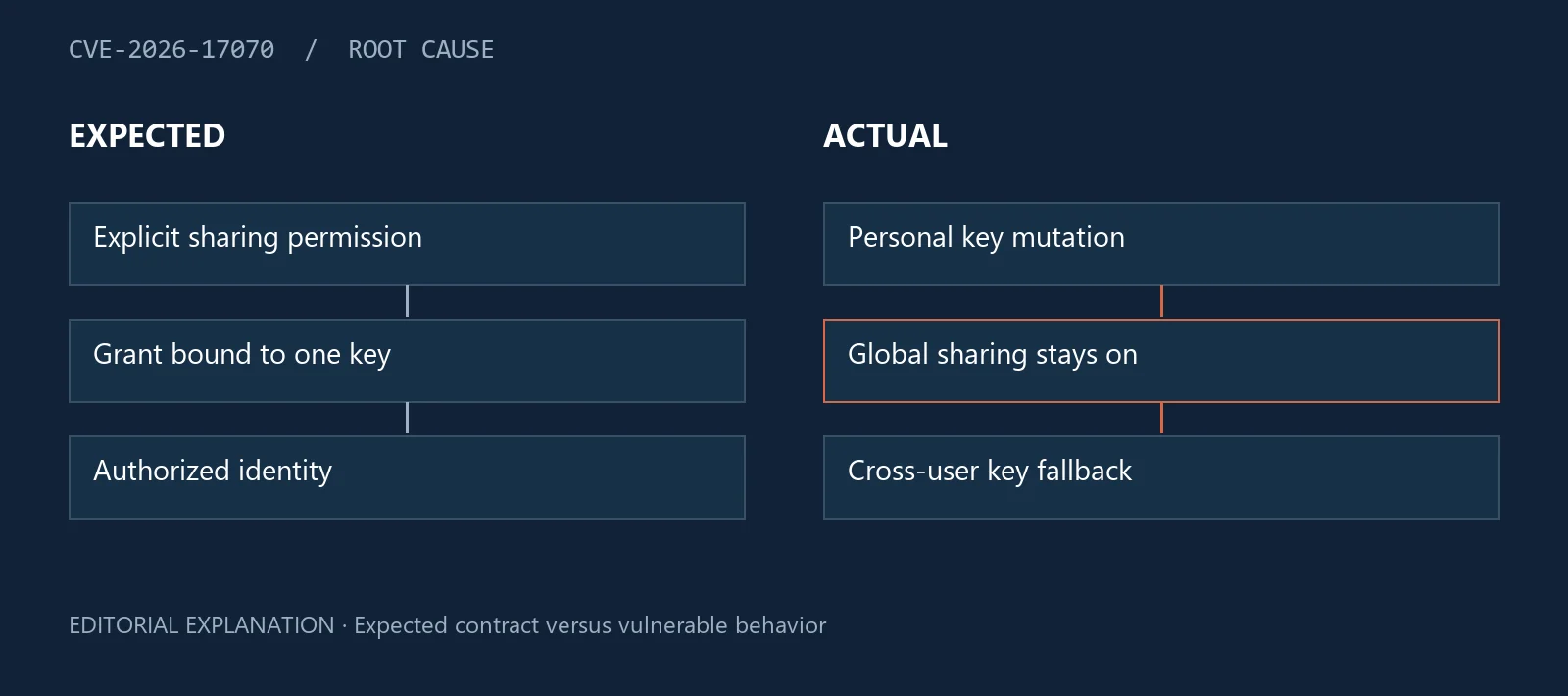
The figure illustrates this root cause: a personal key mutation and a server-wide sharing flag together produce cross-user credential fallback.
The normal server-management route enforced a boundary on who may change sharing for a server object, while the personal-key route did not. The resolver fell back to another owner's key whenever no caller key existed and SharedKey was 1. In everyday terms: the building asked "do you rent here?" and treated a yes as also meaning "you may change the master key list".
Impact
An actor with access to a server object and permission to invoke one ordinary extension function, but with no global server-management permissions, could cause that function to run under another user's managed-server identity. The preserved tests demonstrate both a non-root identity and a root identity in separate controlled configurations.
The paired results support credential confusion as the mechanism. Credential confusion means the system uses the wrong person's credential for an action. They do not imply that all installed extensions expose arbitrary shell execution. The specific permitted marker function ran under the selected victim identity. Root impact depends on a root-capable credential and the capabilities of the permitted operation. In other words, the flaw decides whose badge you wear; what you can do while wearing it depends on what that badge opens and what the function you are allowed to run is capable of.
The evidence concerns isolated synthetic lab identities. It does not demonstrate plaintext credential disclosure, unauthenticated exploitation, a production compromise or a fresh 2.3.1 retest. Plaintext credential disclosure would mean the attacker actually reads the password or key; that did not happen here. Unauthenticated exploitation would mean an attacker with no account at all; that did not happen either. A production compromise would mean a real customer system was broken into; this was a lab.
Fix
The 27 July 2026 fix added server-object access checks to create() and createKey(), and changed the recorded version to 2.3.1. The release and the CVE record establish that fixed-version declaration. In plain terms, the side door now asks whether you have access to this server object, the same check the front door applies.
The strengthened test actor, however, already possessed server-object access. Source inspection of a newly added object-access check does not substitute for running this exact credential-sharing chain against the fixed version. Source inspection means reading the changed code and reasoning about it, rather than executing it. The article neither declares 2.3.1 vulnerable to that chain nor claims the chain was dynamically closed there. The fix added server-object access checks, but the exact chain was not re-run against the fixed release.
Commit e8873b27, dated 2 September 2026, separately introduced shared-key security changes. The inspected diff includes a dedicated share_server_key permission, key-level sharing state, an explicit sharing route, transaction and row locking, state maintenance and audit-related changes. A diff is the side-by-side view of what changed between two versions of the code. A dedicated permission means sharing now has its own yes/no right, separate from merely having access to the server. Key-level sharing state means the sharing decision is attached to a particular key rather than to the whole server. An explicit sharing route means there is now a proper request whose only job is to share, instead of sharing being a side effect of something else. Transaction and row locking are database techniques that stop two operations from interfering with each other halfway through. Audit-related changes add record-keeping of who did what.
These changes are relevant to the underlying ownership boundary, but they are later work and should not be described as the July 2.3.1 patch. Inspection of the Core diff also does not establish end-to-end enforcement by every deployed credential consumer. End-to-end enforcement would mean every part of the product that uses a credential actually respects the new rule; reading one component's diff cannot prove that.
The figure compares the two patch stages: the July server-object checks and the September explicit key-sharing controls are separate changes, and an exact-chain retest on 2.3.1 remains absent.
The defensive lessons follow from the mechanism. Treat credential sharing as its own authorised operation, bind a grant to a particular key and owner, make revocation atomic with deletion, and ensure the resolver consumes that explicit grant. Atomic here means the two things happen together or not at all, so you cannot end up with a deleted key whose sharing permission lingers. Auditing should preserve both the calling application identity and the identity selected for the managed target. The key question is not only whether a user can access a server, but whether that user can cause another person's credential to be selected.
Variants to test
These are the generalised checks the researcher suggests, so the same class of mistake can be hunted elsewhere.
- Personal-key routes that write server-level state. Look for any create, update or delete handler on a user-owned object that also mutates a field on a shared object. A positive result is a request that succeeds with the caller's own object permissions while changing state that the normal management route would reject with 403.
- Deletion that does not reverse a flag. Create a temporary object that sets a sharing or visibility flag, delete the object, and check whether the flag persists. A positive result is the flag still set with the caller's object count at zero.
- Resolver fallback on a server-wide flag. Inspect how the credential resolver chooses a key when no caller-owned key exists. A positive result is a fallback that selects another owner's key and changes the effective identity without an explicit per-key grant.
- Identity in the response. Use a marker function that returns the remote identity and a canary file's metadata. A positive result is a remote identity and canary metadata belonging to a different user than the caller.
- Root-capable credentials. Repeat the chain where the other owner holds a root credential on a disposable target. A positive result is a root identity and root-owned canary metadata, which shows the impact scales with the selected credential.
- Fixed-version retest. Run the exact chain, including the already-authorised-server precondition, against the fixed release rather than relying on source inspection of the new check. A positive result would be the same cross-user identity appearing after the fix.
Glossary
- API: the fixed set of requests a program offers so other software can ask it to do things.
- Atomic: done as a single all-or-nothing step, so a half-finished state cannot be left behind.
- Audit: record-keeping of who did what and when.
- Baseline: the "before" measurement in a test, used to attribute later changes correctly.
- Canary: a small planted file used as evidence that a connection really reached a machine under a given identity.
- Commit: a saved snapshot of source code, identified by a long hexadecimal name.
- Core: one of the two code components named in the report.
- Credential: the username, password or key used to prove identity to a server.
- Credential boundary: the rule that decides whose credential is used for a given action.
- Credential confusion: a flaw where the system uses the wrong person's credential for an action.
- Credential resolver: the internal code that chooses which stored credential to use for a connection.
- CVE: a public catalogue number for a known security flaw.
- CVSS: a standard 0 to 10 score for how serious a flaw is, with a breakdown string explaining the score.
- CWE-862: the catalogue label for a missing authorisation check.
- Diff: the side-by-side view of what changed between two versions of code.
- Docker: a tool for running software in isolated containers.
- encrypterUser: the internal field recording whose credential is used for a connection.
- End-to-end enforcement: every part of the product actually respecting a rule, not just one component.
- Extension: an add-on function that can run against a server in Liman MYS.
- Extension-render route: the normal web address through which an extension function is invoked.
- Fiber: one of the two code components named in the report.
- Fixture: something set up in advance so a test has something stable to work with.
- HTTP 200 / 201 / 401 / 403: standard web answers meaning OK, created, not logged in, and not allowed.
- Identity: the account a remote machine sees on an incoming connection.
- Lab: a self-contained test environment, not a real customer system.
- Liman MYS: a server management product from HAVELSAN.
- Marker function: a function whose only job is to report which identity the remote server sees.
- Mutation: a request that changes something rather than only reading it.
- Object: a record in the product, such as a server or an extension.
- Path: one particular request the product accepts, one route through its code.
- Permission: an individual yes/no right held by a user account.
- Plaintext credential disclosure: the attacker actually reading a password or key.
- Production compromise: a real customer system being broken into.
- Request-controlled: a value that comes straight from what the caller sent, so the caller can choose it.
- Root: the all-powerful administrator account on a Linux machine.
- servers.shared_key: the field on a server record that says whether shared keys may be used for that server.
- Source inspection: reading changed code and reasoning about it, rather than executing it.
- SSH: the standard way to log in to a Linux server remotely.
- Synthetic: made up for the test, not real user data.
- Transaction and row locking: database techniques that stop two operations interfering halfway through.
- Unauthenticated: a request carrying no valid login at all.
- Vault: Liman's store of credentials used to reach managed servers.
- VaultController::createKey(): the function that runs when a user creates a key in their own personal Vault.


