CVE-2026–98432: Linux Kernel TCP Use-After-Free RCE
A race condition in the Linux kernel's IPv4 TCP handshake can free IP options memory while another CPU still reads it, causing a use-after-free. An unauthenticated remote attacker could send crafted TCP packets to trigger kernel memory disclosure, corruption, or a crash, and a demonstrated exploit against an MPTCP listener achieved root command execution.

medium.com
Published on medium.com
Cybersecurity
The full write-up lives on its author's site
It belongs to its author, so we link to it rather than copy it. The other two tabs are our own rewrites, checked against it.
Context
CVE-2026-98432 is a use-after-free (UAF) vulnerability in the Linux kernel's IPv4 TCP handshake path. It affects kernel versions 4.4 and later. The flaw is a race condition that can lead to kernel memory corruption and potentially remote code execution.

Anthropic's Frontier Red Team reported that an unreleased internal Claude research model discovered the vulnerability and developed a working exploit. That exploit executes arbitrary commands as root on a Linux server with an accessible Multipath TCP (MPTCP) listener, without authentication or user interaction. Anthropic reported that its proof of concept took approximately 53 minutes to progress from a remote kernel address leak to command execution.
AWS independently acknowledged the vulnerability and confirmed that remote code execution is possible under specific conditions. As of the latest AWS advisory reviewed on 3 November 2026, AWS reported no known exploitation in the wild.
Setup
No accounts, roles or tooling are described beyond the exploit itself. The preconditions that matter are on the target side:
- A Linux kernel version 4.4 or later that has not been patched against this flaw.
- A listening service reachable over the network that accepts IPv4 TCP connections carrying IP options.
- For the demonstrated remote code execution path specifically, an accessible MPTCP listener.
No authentication or user interaction is required on the attacker's side.
Finding it
The report does not describe how the vulnerability was discovered. It states that an unreleased internal Claude research model discovered it and produced the exploit.
Exploitation
The demonstrated attack used two stages. First, it exploited the race to disclose kernel memory and obtain a kernel pointer, helping defeat Kernel Address Space Layout Randomization (KASLR). Second, it exploited the memory-corruption condition to overwrite a callback pointer and redirect execution through existing kernel functionality, ultimately executing an attacker-controlled command with root privileges.
Step 1: Trigger the race with crafted IPv4 TCP packets
An unauthenticated remote attacker can potentially trigger the vulnerable code by sending crafted IPv4 TCP packets containing IP options to an affected listening service. Exploitation depends on specific timing conditions and on successfully winning the race between connection processing and memory deallocation.
Step 2: Disclose kernel memory and defeat KASLR
The first stage uses the race to disclose kernel memory and obtain a kernel pointer. The report does not include the packets or tooling used for this stage.
Step 3: Overwrite a callback pointer and redirect execution
The second stage uses the memory-corruption condition to overwrite a callback pointer and redirect execution through existing kernel functionality, executing an attacker-controlled command with root privileges.
Step 4: Command execution as root
The demonstrated exploit achieved arbitrary command execution as root on a Linux server with an accessible MPTCP listener. The demonstrated exploit required no authentication or user interaction.
Root cause
When a TCP connection begins, the client sends a SYN packet to the server. If the packet contains IPv4 options, the Linux kernel stores those options alongside the pending connection request so they can be used while processing the handshake and constructing the SYN-ACK response.
The problem arises when the connection progresses while the kernel is simultaneously processing a retransmitted SYN for the same request. During successful connection establishment, tcp_v4_syn_recv_sock() transfers ownership of the IP options buffer from the request socket to the newly created child socket without copying the underlying memory. Meanwhile, another CPU can still be processing the retransmitted SYN and reading those options through the TCP response path. Because these operations can occur concurrently, the child socket may be destroyed and its IP options memory freed while another execution path still holds a reference to that memory.
The underlying issue is a mismatch between how the kernel accesses shared memory and how it releases that memory. The relevant code paths use Read-Copy-Update (RCU) read-side protection when accessing the IP options. RCU allows readers to access shared data concurrently, but memory must not be reclaimed until existing readers have finished using it. In the vulnerable implementation, inet_sock_destruct() releases the options buffer using kfree(), which does not wait for an RCU grace period. Consequently, another CPU can continue accessing the buffer after it has been freed. Subsequent operations in ip_options_build() may then read memory that is no longer valid.
A related race can occur when TCP request-socket migration is enabled, including configurations that use net.ipv4.tcp_migrate_req or a BPF SO_REUSEPORT migration program. In this case, request sockets can share the same options buffer, creating another opportunity for one execution path to free memory that another path is still accessing.
The immediate consequences can include kernel memory disclosure, memory corruption, and a system crash. More seriously, the demonstrated proof of concept progressed from a remote kernel memory disclosure to control-flow manipulation and arbitrary command execution as root.
Importantly, the MPTCP listener is a requirement of the demonstrated remote code execution exploit, not necessarily of the underlying vulnerability. The underlying use-after-free exists in the IPv4 TCP handshake code and can have security consequences even where the specific demonstrated exploit path is unavailable.
Impact
Exploitation depends on specific timing conditions and on winning the race between connection processing and memory deallocation.
The demonstrated exploit achieved arbitrary command execution as root on a Linux server with an accessible MPTCP listener, without authentication or user interaction.
Severity assessments differ between the Linux kernel maintainers and major vendors, with scores ranging from 5.9 to 9.8:
| Assessor | Score | Rating | Notes |
|---|---|---|---|
| Linux Kernel CVE Team | 9.8 | Critical | Remotely exploitable over the network, no privileges or user interaction, low attack complexity |
| Ubuntu | 8.3 | High | Emphasises significant impact on system availability, with lower confidentiality and integrity impacts |
| Oracle and SUSE | 8.1 | High | Similar assessment but considers exploitation more complex |
| Amazon (AWS) | 7.0 | High | Lower numerical score, classified as Important |
| Red Hat | 5.9 | Moderate | Considers successful exploitation more difficult and a kernel crash more likely than remote code execution |
The variation reflects differences in how vendors assess race-condition reliability, exploitation complexity, and potential impact.
Fix
The upstream fix addresses the unsafe memory deallocation rather than changing the TCP handshake itself. The kernel patch replaces the relevant kfree() calls with kfree_rcu() in inet_sock_destruct() and tcp_v4_reqsk_destructor(). Unlike a direct kfree(), kfree_rcu() defers reclamation until an RCU grace period has elapsed, allowing existing readers to finish accessing the memory before it is released. This resolves the lifetime-management issue responsible for the use-after-free condition. The fix has been incorporated into patched upstream kernel releases and backported to maintained stable branches.
Administrators should upgrade to the corresponding patched release or a newer supported kernel version.
The recommended remediation is to install a patched Linux kernel and reboot the affected system. According to AWS, applying the kernel update is the only complete remediation, although supported livepatch solutions can also address the vulnerability without requiring an immediate reboot.
Affected software and versions
CVE-2026-98432 affects Linux kernel versions 4.4 and later, including the stable kernel branches listed in the advisory. Kernel versions from 4.4 onward on older or unsupported branches may also be vulnerable.
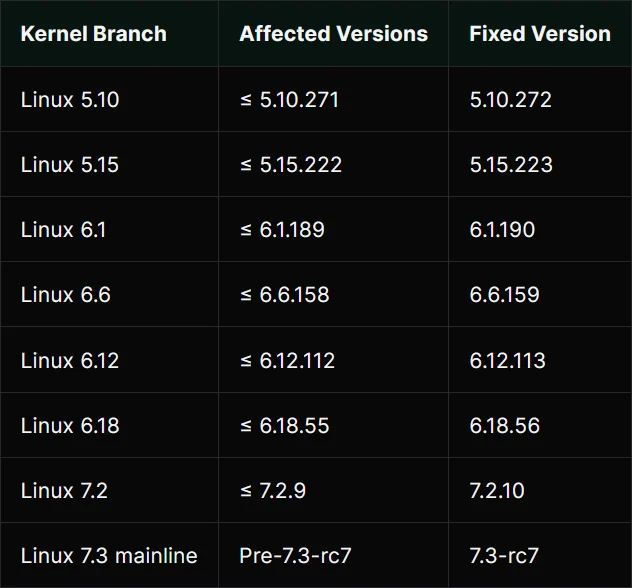
Potentially affected Linux distributions include Ubuntu, Debian, Red Hat Enterprise Linux (RHEL), SUSE Linux Enterprise, Oracle Linux, and Amazon Linux. Actual exposure and remediation status depend on the distribution, kernel package, and vendor-specific backported patches. Distribution-provided kernel versions may contain fixes without matching the upstream version numbers, so check the relevant vendor security advisory before determining whether a system is vulnerable.
Vendor-specific remediation
- Amazon Linux: AWS has released patched kernel packages for Amazon Linux 2 and Amazon Linux 2023, covering multiple kernel branches. Administrators should update affected instances to the latest available security-patched kernel.
- Kubernetes and AWS-managed environments: Organisations running workloads on Amazon EKS, ECS, Fargate, or Bottlerocket should ensure that their underlying worker nodes and compute environments are running patched kernel versions. This includes managed and self-managed node groups, EC2 instances, and existing workloads that may continue running on vulnerable infrastructure.
- Distribution-specific updates: consult each distribution's official security advisories. The Ubuntu Security Tracker lists affected releases and tracks fixes, the Red Hat CVE advisory provides affected product details and available security errata, and additional guidance is available from the Debian Security Tracker and SUSE Security. Since patch status varies by distribution and release, verify the system's status with the relevant vendor and install the applicable security update.
Organisations should prioritise identifying all affected systems, including cloud instances, container hosts, and Kubernetes worker nodes, to ensure that vulnerable kernel versions are not left running.
Temporary mitigations if you cannot patch immediately
These measures do not replace installing a patched kernel and rebooting.
- Disable Multipath TCP (MPTCP). If MPTCP is not required, disable it by setting the kernel parameter
net.mptcp.enabled=0. This reduces exposure to the demonstrated exploitation path, which relies on an accessible MPTCP listener. - Disable MPTCP in Go applications. Go 1.24 and later enable MPTCP by default for listening sockets on Linux where supported. For Go applications, setting
GODEBUG=multipathtcp=0disables this default behaviour at runtime. Applications that explicitly enable MPTCP may override this setting, so it should not be treated as a system-wide mitigation. - Block IPv4 packets containing IP options. The vulnerability involves the handling of IP options during the IPv4 TCP handshake. As a temporary mitigation, AWS recommends dropping incoming packets with IPv4 header options using an iptables rule:
iptables -I INPUT 1 -m u32 --u32 '0>>24&0x0f=6:15' -j DROP
This rule filters incoming packets with IPv4 headers longer than the standard 20-byte header. It may interfere with legitimate traffic that relies on IPv4 options, and the rule does not automatically persist across reboots. Administrators should also account for traffic paths that bypass the host's INPUT chain, such as forwarded traffic to containers.
4. Restrict direct network exposure. Where possible, place affected systems behind a properly configured load balancer or managed service that terminates incoming connections before they reach the vulnerable host. Restrict unnecessary inbound access and ensure that the host's TCP services are not directly reachable from untrusted networks.
These mitigations reduce exposure but do not fully remediate CVE-2026-98432. Prioritise installing the vendor-provided kernel patch and rebooting affected systems as soon as possible.
Variants to test
- Request-socket migration paths. Enable
net.ipv4.tcp_migrate_reqor attach a BPFSO_REUSEPORTmigration program, then send SYNs carrying IP options while retransmitting the same SYN concurrently. - Other RCU-protected buffers freed with plain
kfree(). Audit destructors that release memory read under RCU read-side protection. A positive result is a reader still holding a reference after the grace period would have been required. - **
- **
What happened, in plain words
A security flaw was found in Linux, the operating system that runs on most servers on the internet. The flaw has the identifier CVE-2026-98432. A CVE is a public catalogue number given to a known security problem so that everyone can refer to the same thing. This particular flaw can, under specific conditions, let an attacker who can send network traffic to a server take control of that server, running commands as the most powerful user on the machine, called root. The attacker needs no password and no help from anyone sitting at the machine.
Anthropic's Frontier Red Team, a security research group, reported that an unreleased internal Claude research model discovered the vulnerability and built a working exploit. An exploit is a concrete recipe or program that abuses a flaw. Anthropic reported that its proof of concept took approximately 53 minutes to go from a remote kernel address leak to command execution. A proof of concept is a demonstration that the attack works, not a polished tool.
AWS, the cloud provider, independently acknowledged the vulnerability and confirmed that remote code execution is possible under specific conditions. As of the latest AWS advisory reviewed on 3 November 2026, AWS reported no known exploitation in the wild, meaning nobody had been observed using it against real systems at that point.
The image above carries the identifier CVE-2026-98432.
Setup
The report describes no accounts, roles or tooling beyond the exploit itself. What matters is what the target machine looks like:
- A Linux kernel version 4.4 or later that has not been patched against this flaw. The kernel is the core of the operating system, the part that talks to hardware and manages memory and network connections.
- A listening service reachable over the network that accepts IPv4 TCP connections carrying IP options. A listening service is a program waiting for incoming connections, like a shop assistant standing at an open counter. IPv4 is the older and still most common version of the addressing system the internet uses to route traffic. TCP is the protocol that carries a reliable, ordered conversation between two computers, the way a phone call has a beginning, a middle and an end.
- For the demonstrated remote code execution path specifically, an accessible MPTCP listener. MPTCP, Multipath TCP, is an extension of TCP that lets one connection use several network paths at once, like a delivery that can travel down two roads simultaneously. A listener is the part of a program that waits for incoming connections.
No authentication or user interaction is required on the attacker's side. Authentication means proving who you are, for example with a password. User interaction means somebody has to click, open a file or otherwise act.
Finding it
The report does not describe how the vulnerability was discovered. It states that an unreleased internal Claude research model discovered it and produced the exploit.
Exploitation
The demonstrated attack used two stages. First, it exploited the race to disclose kernel memory and obtain a kernel pointer, helping defeat Kernel Address Space Layout Randomization (KASLR). Second, it exploited the memory-corruption condition to overwrite a callback pointer and redirect execution through existing kernel functionality, ultimately executing an attacker-controlled command with root privileges.
That paragraph is dense, so let us unpack it. A race condition is a bug that appears only when two things happen at almost the same moment and the program does not expect that overlap, like two people grabbing the same document at once. Kernel memory is the working memory the operating system core uses for its own bookkeeping. Disclosing it means leaking its contents to the attacker. A kernel pointer is a memory address inside the kernel, a number that says where something lives in memory. KASLR is a defence that loads the kernel at a random address each boot so an attacker cannot guess where things are; leaking a pointer gives that address away. Memory corruption means writing into memory in a way the program did not intend. A callback pointer is a stored address the kernel jumps to when it wants to run a piece of code; overwriting it lets the attacker choose where the kernel jumps next. Root privileges means the highest level of permission on a Linux machine, able to do anything.
Step 1: Trigger the race with crafted IPv4 TCP packets
An unauthenticated remote attacker can potentially trigger the vulnerable code by sending crafted IPv4 TCP packets containing IP options to an affected listening service. Exploitation depends on specific timing conditions and on successfully winning the race between connection processing and memory deallocation.
A packet is a small chunk of data travelling over a network, like one envelope in the post. Crafted means deliberately built by hand rather than by ordinary software. IP options are an optional extra field in the header of an IPv4 packet, the header being the label on the envelope that says where it is going and how it should be handled. Deallocation means giving memory back, freeing it for reuse. Winning the race means the attacker's two overlapping actions land in the order that causes the bug.
Step 2: Disclose kernel memory and defeat KASLR
The first stage uses the race to disclose kernel memory and obtain a kernel pointer. The report does not include the packets or tooling used for this stage.
Step 3: Overwrite a callback pointer and redirect execution
The second stage uses the memory-corruption condition to overwrite a callback pointer and redirect execution through existing kernel functionality, executing an attacker-controlled command with root privileges. Redirecting execution through existing kernel functionality means the attacker does not bring their own code; they make the kernel run code that is already there, chosen by them.
Step 4: Command execution as root
The demonstrated exploit achieved arbitrary command execution as root on a Linux server with an accessible MPTCP listener. Arbitrary means the attacker can run any command they like. The demonstrated exploit required no authentication or user interaction.
Root cause
When a TCP connection begins, the client sends a SYN packet to the server. SYN is the opening message of the TCP handshake, the three-step greeting two computers exchange before they talk, much like "hello", "hello back", "ok, let's talk". If the packet contains IPv4 options, the Linux kernel stores those options alongside the pending connection request so they can be used while processing the handshake and constructing the SYN-ACK response. The SYN-ACK is the server's reply in that greeting.
The problem arises when the connection progresses while the kernel is simultaneously processing a retransmitted SYN for the same request. A retransmission is the client sending the same message again because it did not hear back in time. During successful connection establishment, tcp_v4_syn_recv_sock() transfers ownership of the IP options buffer from the request socket to the newly created child socket without copying the underlying memory. A socket is the software object that represents one network connection. A buffer is a reserved block of memory holding data. Transferring ownership without copying means both sides now refer to the same block of memory rather than each having their own.
Meanwhile, another CPU can still be processing the retransmitted SYN and reading those options through the TCP response path. A CPU is one processor core; a server has many, and they run code at the same time. Because these operations can occur concurrently, the child socket may be destroyed and its IP options memory freed while another execution path still holds a reference to that memory. An execution path is one sequence of code running on one CPU.
The underlying issue is a mismatch between how the kernel accesses shared memory and how it releases that memory. The relevant code paths use Read-Copy-Update (RCU) read-side protection when accessing the IP options. RCU is a technique that lets many readers look at shared data at the same time without locking it, on the condition that the memory is not actually reclaimed until every reader has finished. Think of a library where a book may be taken off the shelf only once the last person reading it has put it down. In the vulnerable implementation, inet_sock_destruct() releases the options buffer using kfree(), which does not wait for an RCU grace period. A grace period is the window RCU needs to be sure all readers are done. kfree() is the kernel's plain "free this memory now" call. Consequently, another CPU can continue accessing the buffer after it has been freed. Subsequent operations in ip_options_build() may then read memory that is no longer valid. That is the use-after-free: using memory after it has been handed back.
A related race can occur when TCP request-socket migration is enabled, including configurations that use net.ipv4.tcp_migrate_req or a BPF SO_REUSEPORT migration program. Migration here means moving a pending connection request from one place to another. net.ipv4.tcp_migrate_req is a kernel setting that switches this behaviour on. BPF is a way to load small programs into the kernel, and SO_REUSEPORT is a socket option that lets several programs share the same network port, with a BPF program deciding which one gets each connection. In this case, request sockets can share the same options buffer, creating another opportunity for one execution path to free memory that another path is still accessing.
The immediate consequences can include kernel memory disclosure, memory corruption, and a system crash. More seriously, the demonstrated proof of concept progressed from a remote kernel memory disclosure to control-flow manipulation and arbitrary command execution as root. Control-flow manipulation means changing the order in which the kernel executes its instructions.
Importantly, the MPTCP listener is a requirement of the demonstrated remote code execution exploit, not necessarily of the underlying vulnerability. The underlying use-after-free exists in the IPv4 TCP handshake code and can have security consequences even where the specific demonstrated exploit path is unavailable.
Impact
Exploitation depends on specific timing conditions and on winning the race between connection processing and memory deallocation.
The demonstrated exploit achieved arbitrary command execution as root on a Linux server with an accessible MPTCP listener, without authentication or user interaction.
Severity assessments differ between the Linux kernel maintainers and major vendors, with scores ranging from 5.9 to 9.8. A severity score is a number, usually on a 0 to 10 scale under a scheme called CVSS, that tries to express how bad a flaw is. Higher is worse.
| Assessor | Score | Rating | Notes |
|---|---|---|---|
| Linux Kernel CVE Team | 9.8 | Critical | Remotely exploitable over the network, no privileges or user interaction, low attack complexity |
| Ubuntu | 8.3 | High | Emphasises significant impact on system availability, with lower confidentiality and integrity impacts |
| Oracle and SUSE | 8.1 | High | Similar assessment but considers exploitation more complex |
| Amazon (AWS) | 7.0 | High | Lower numerical score, classified as Important |
| Red Hat | 5.9 | Moderate | Considers successful exploitation more difficult and a kernel crash more likely than remote code execution |
The variation reflects differences in how vendors assess race-condition reliability, exploitation complexity, and potential impact. Availability, confidentiality and integrity are the three classic things a flaw can damage: whether the system keeps working, whether secrets stay secret, and whether data stays correct.
Fix
The upstream fix addresses the unsafe memory deallocation rather than changing the TCP handshake itself. Upstream means the main Linux project, as opposed to a particular company's copy of it. The kernel patch replaces the relevant kfree() calls with kfree_rcu() in inet_sock_destruct() and tcp_v4_reqsk_destructor(). A patch is a small change to source code that fixes a problem. Unlike a direct kfree(), kfree_rcu() defers reclamation until an RCU grace period has elapsed, allowing existing readers to finish accessing the memory before it is released. In plain terms, the fix makes the kernel wait until everyone has finished reading before it takes the book away. This resolves the lifetime-management issue responsible for the use-after-free condition. The fix has been incorporated into patched upstream kernel releases and backported to maintained stable branches. Backported means the same fix is copied into older versions that are still supported.
The vulnerability has been addressed in Linux 5.10.272, 5.15.223, 6.1.190, 6.6.159, 6.12.113, and 6.18.56. Administrators should upgrade to the corresponding patched release or a newer supported kernel version.
The recommended remediation is to install a patched Linux kernel and reboot the affected system. Remediation means actually removing the risk, not just reducing it. According to AWS, applying the kernel update is the only complete remediation, although supported livepatch solutions can also address the vulnerability without requiring an immediate reboot. Livepatch is a mechanism that applies kernel fixes to a running system without restarting it.
Affected software and versions
CVE-2026-98432 affects Linux kernel versions 4.4 and later, including the stable kernel branches listed in the advisory. A branch is one line of development of a software project, kept alive with fixes for a period of time. Kernel versions from 4.4 onward on older or unsupported branches may also be vulnerable.
The image above appears where the article introduces the affected stable kernel branches.
Potentially affected Linux distributions include Ubuntu, Debian, Red Hat Enterprise Linux (RHEL), SUSE Linux Enterprise, Oracle Linux, and Amazon Linux. A distribution, or distro, is a complete packaged version of Linux assembled by an organisation, bundling the kernel with tools and settings. Actual exposure and remediation status depend on the distribution, kernel package, and vendor-specific backported patches. Distribution-provided kernel versions may contain fixes without matching the upstream version numbers, so check the relevant vendor security advisory before determining whether a system is vulnerable. A security advisory is an official notice from a vendor describing a flaw and what to do about it.
Vendor-specific remediation
- Amazon Linux: AWS has released patched kernel packages for Amazon Linux 2 and Amazon Linux 2023, covering multiple kernel branches. Administrators should update affected instances to the latest available security-patched kernel. An instance here means a running virtual server in the cloud.
- Kubernetes and AWS-managed environments: Organisations running workloads on Amazon EKS, ECS, Fargate, or Bottlerocket should ensure that their underlying worker nodes and compute environments are running patched kernel versions. Kubernetes is a system for running many containers across many machines; a container is a lightweight isolated bundle of software sharing the host's kernel. A worker node is one machine in such a cluster that actually runs the workloads. EKS, ECS, Fargate and Bottlerocket are AWS services for running containers. This includes managed and self-managed node groups, EC2 instances, and existing workloads that may continue running on vulnerable infrastructure. EC2 is AWS's virtual server product.
- Distribution-specific updates: consult each distribution's official security advisories. The Ubuntu Security Tracker lists affected releases and tracks fixes, the Red Hat CVE advisory provides affected product details and available security errata, and additional guidance is available from the Debian Security Tracker and SUSE Security. Errata are the vendor's published list of fixes. Since patch status varies by distribution and release, verify the system's status with the relevant vendor and install the applicable security update.
Organisations should prioritise identifying all affected systems, including cloud instances, container hosts, and Kubernetes worker nodes, to ensure that vulnerable kernel versions are not left running.
Temporary mitigations if you cannot patch immediately
A mitigation is a measure that reduces risk without removing the flaw. These measures do not replace installing a patched kernel and rebooting.
- Disable Multipath TCP (MPTCP). If MPTCP is not required, disable it by setting the kernel parameter
net.mptcp.enabled=0. A kernel parameter is a named setting that changes how the kernel behaves. This reduces exposure to the demonstrated exploitation path, which relies on an accessible MPTCP listener. - Disable MPTCP in Go applications. Go is a programming language often used for network services. Go 1.24 and later enable MPTCP by default for listening sockets on Linux where supported. For Go applications, setting
GODEBUG=multipathtcp=0disables this default behaviour at runtime.GODEBUGis an environment variable, a named value the operating system passes to a program when it starts, that Go reads to change its behaviour. Applications that explicitly enable MPTCP may override this setting, so it should not be treated as a system-wide mitigation. - Block IPv4 packets containing IP options. The vulnerability involves the handling of IP options during the IPv4 TCP handshake. As a temporary mitigation, AWS recommends dropping incoming packets with IPv4 header options using an iptables rule:
iptables -I INPUT 1 -m u32 --u32 '0>>24&0x0f=6:15' -j DROP
Line by line: iptables is the standard Linux tool for filtering network traffic. -I INPUT 1 inserts the rule at position 1 of the INPUT chain, the list of rules applied to traffic arriving at this machine, so it is checked first. -m u32 loads a matching module that can inspect raw 32-bit chunks of a packet. --u32 '0>>24&0x0f=6:15' is the test: it reads the first 32-bit word of the packet, shifts it right by 24 bits to bring the first byte to the front, masks with 0x0f to keep only the low four bits, which in an IPv4 header is the header length field, and matches values from 6 to 15. Since the field counts 32-bit words, 5 is the normal 20-byte header, so anything above 5 means options are present. -j DROP is the action: silently discard the packet.
This rule filters incoming packets with IPv4 headers longer than the standard 20-byte header. It may interfere with legitimate traffic that relies on IPv4 options, and the rule does not automatically persist across reboots. Administrators should also account for traffic paths that bypass the host's INPUT chain, such as forwarded traffic to containers.
4. Restrict direct network exposure. Where possible, place affected systems behind a properly configured load balancer or managed service that terminates incoming connections before they reach the vulnerable host. A load balancer is a machine that sits in front of servers and spreads incoming connections among them. Restrict unnecessary inbound access and ensure that the host's TCP services are not directly reachable from untrusted networks.
These mitigations reduce exposure but do not fully remediate CVE-2026-98432. Prioritise installing the vendor-provided kernel patch and rebooting affected systems as soon as possible.
Variants to test
- ** KASAN is a kernel debugging feature that detects invalid memory accesses and prints a report when it finds one.
- Other RCU-protected buffers freed with plain
kfree(). Audit destructors that release memory read under RCU read-side protection. A destructor is the function that cleans up an object when it is no longer needed. A positive result is a reader still holding a reference after the grace period would have been required. - **
- **
Glossary
- Authentication: proving who you are, for example with a password.
- Availability: whether a system keeps working and responding.
- Backport: copying a fix from the newest version of software into an older, still-supported version.
- BPF: a way to load small programs into the Linux kernel, often to make decisions about network traffic.
- Branch: one line of development of a software project, maintained with fixes for a period.
- Buffer: a reserved block of memory holding data.
- Callback pointer: a stored memory address the kernel jumps to in order to run a piece of code.
- Confidentiality: whether secrets stay secret.
- Container: a lightweight isolated bundle of software that shares the host machine's kernel.
- Control-flow manipulation: changing the order in which a program executes its instructions.
- CPU: one processor core; a server has several running code at the same time.
- CVE: a public catalogue number for a known security vulnerability.
- CVSS: a scoring scheme, usually 0 to 10, expressing how severe a vulnerability is.
- Deallocation: giving memory back so it can be reused.
- Destructor: the function that cleans up an object when it is no longer needed.
- Distribution (distro): a complete packaged version of Linux assembled by an organisation.
- EC2: AWS's virtual server product.
- Environment variable: a named value the operating system passes to a program when it starts.
- Errata: a vendor's published list of fixes.
- Execution path: one sequence of code running on one CPU.
- Exploit: a concrete recipe or program that abuses a vulnerability.
- Grace period (RCU): the window RCU needs to be sure all readers have finished with shared memory.
- Handshake (TCP): the three-step greeting two computers exchange before they talk.
- Integrity: whether data stays correct and unaltered.
- IP options: an optional extra field in an IPv4 packet header.
- IPv4: the older and still most common version of the internet's addressing system.
- iptables: the standard Linux tool for filtering network traffic.
- KASAN: a kernel debugging feature that detects invalid memory accesses.
- KASLR: a defence that loads the kernel at a random memory address each boot.
- Kernel: the core of the operating system, managing hardware, memory and network connections.
- Kernel parameter: a named setting that changes how the kernel behaves.
- Kernel pointer: a memory address inside the kernel.
- Kubernetes: a system for running many containers across many machines.
- Livepatch: a mechanism that applies kernel fixes to a running system without restarting it.
- Load balancer: a machine that sits in front of servers and spreads incoming connections among them.
- Listener: the part of a program that waits for incoming connections.
- Memory corruption: writing into memory in a way the program did not intend.
- Migration (request socket): moving a pending connection request from one place to another.
- Mitigation: a measure that reduces risk without removing the flaw.
- MPTCP (Multipath TCP): an extension of TCP that lets one connection use several network paths at once.
- Packet: a small chunk of data travelling over a network.
- Patch: a small change to source code that fixes a problem.
- Proof of concept: a demonstration that an attack works, not a polished tool.
- Race condition: a bug that appears only when two things happen at almost the same moment.
- RCU (Read-Copy-Update): a technique letting many readers access shared data at once, provided memory is not reclaimed until all readers finish.
- Remediation: actually removing the risk, not just reducing it.
- Retransmission: sending the same network message again because no reply arrived in time.
- Root: the highest permission level on a Linux machine, able to do anything.
- Security advisory: an official notice from a vendor describing a flaw and what to do about it.
- Severity score: a number expressing how bad a flaw is; higher is worse.
- Socket: the software object representing one network connection.
- SYN / SYN-ACK: the opening message of the TCP handshake and the server's reply.
- TCP: the protocol carrying a reliable, ordered conversation between two computers.
- Upstream: the main software project, as opposed to a particular company's copy of it.
- Use-after-free (UAF): using memory after it has been handed back for reuse.
- User interaction: a person having to click, open a file or otherwise act for an attack to work.
- Worker node: one machine in a Kubernetes cluster that actually runs the workloads.

