CVE Decoded #2: CVE-2026–23646 (OpenProject)
The logout endpoint looked up a session by an ID supplied in the request and deleted it without checking that the session belonged to the requesting user. An attacker could therefore log other users out by guessing session numbers, causing a denial of service.

medium.com
Published on medium.com
Oscp
The full write-up lives on its author's site
It belongs to its author, so we link to it rather than copy it. The other two tabs are our own rewrites, checked against it.
Context
OpenProject is an open-source project management application, positioned in the report as an open-source alternative to Jira or Asana. Companies use it to track tasks, log hours and manage large engineering projects, which means it holds sensitive company data.
Like most web applications, OpenProject issues a session when a user logs in. The report describes this as a temporary VIP pass so the user does not have to type a password on every page. The server keeps a list of active sessions, and when a user clicks "Log Out", the server finds that user's session in the list and deletes it.
The CVE covered here is CVE-2026-23646, published on 19 January 2026, rated Medium with a CVSS score of 6.5. It affects OpenProject versions before 16.6.5, is classified as an IDOR (Insecure Direct Object Reference) and its impact type is DoS (Denial of Service). In one line: a tiny missing check in the code allowed anyone to log other users out by simply guessing their session number.
The author's analogy is knowing somebody's roll number and using it to kick them out of the class. They can re-enter, but it is inconvenient and might make them angry.

Setup
The report does not describe a lab, test accounts, roles or tooling. It is an explanation of the published vulnerability and its patch, based on the vulnerable and patched server code and the linked upstream commit. The only precondition stated is the version: any self-hosted OpenProject instance below 16.6.5 is affected.
Finding it
The report frames the bug as a textbook IDOR, one of the most common bugs in web development, and stresses that the flaw was not complex: it was a single missing line of code on the server. The vulnerable logout path looked essentially like this Ruby code:
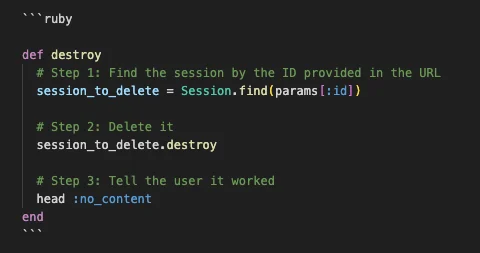
Walking through it:
Session.find(params[:id]): when the browser sends a request to log out, it includes a session ID number (like 1234). The server takes that number fromparams[:id]and searches the entire database for a session matching it.session_to_delete.destroy: the server takes the session it just found and deletes it, immediately logging that user out.head :no_content: the server sends a success message back to the browser.
What looked wrong is what is absent: the code never checks who is asking to delete the session. If I am logged in and I send a request saying "delete session number 9999", the server blindly obeys. It finds session 9999, which might belong to the CEO, and deletes it.
Exploitation
Step 1: send a logout request with someone else's session ID
An authenticated user sends a logout request whose session identifier is not their own, for example the value 9999. The report does not reproduce the raw HTTP request, only the server-side handling of params[:id].
Step 2: the server looks up the session globally
Session.find(params[:id]) searches the whole sessions table rather than the caller's own sessions, so the record belonging to another user is returned.
Step 3: the session is destroyed
session_to_delete.destroy deletes that record, and the victim is logged out immediately. The server answers with head :no_content, a success response.
Step 4: repeat
Because the only thing needed is a guessable session number, the same request can be repeated against other identifiers. The report's worst case is a script that constantly guesses session numbers and logs everyone out.
Root cause
The lookup was scoped to the entire session table instead of to the current user. Session.find returns any matching record regardless of ownership, and nothing between the lookup and destroy verifies that the session belongs to the requester. The author notes that the code shown is simplified for clarity and teaching, and that the actual code used Rails' built-in find_model_object callback. The report does not describe any other defence that would have stopped the request.
Impact
Deleting a session only logs a user out. An attacker could not steal passwords, read project data or take over the server. The worst outcome described is a script that constantly guesses session numbers and logs everyone out, causing a denial of service and a substantial headache for the company running the software. The report notes that the same vulnerability class can have very different consequences elsewhere: an IDOR that exposes medical records is Critical, while an IDOR that logs someone out is Medium, which is why the severity lands where it does.
The author also draws the distinction between IDOR and DoS directly: IDOR is the unlocked door, DoS is what the intruder does after walking through it. The same unlocked door could lead to data theft, account takeover, or in this case forced logouts.
Fix
The developers changed where the code looks for the session. The patched code looks like this:
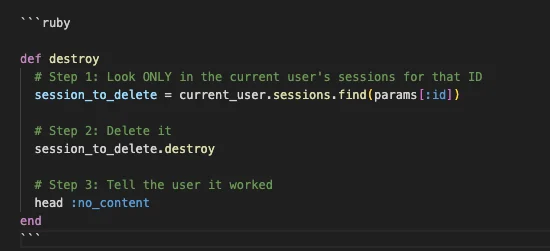
By changing Session.find (search everything) to current_user.sessions.find (search only my stuff), the bug is dead. A request to delete session 9999 now makes the server check the caller's own list of sessions, find that 9999 is not there, and block the request.
The report links the upstream commit: https://github.com/opf/openproject/commit/[redacted]
The bug was responsibly disclosed via the YesWeHack bounty program and patched by the OpenProject team. Self-hosted instances should be updated to version 16.6.5 or later; all versions prior to 16.6.5 are affected.
Variants to test
- Logout and session-revocation endpoints. Send a logout or "revoke session" request with another user's session identifier. A positive result is a
204-style success response and the victim being logged out. - Other
findcalls on user-owned records. Look for controllers that call a global find on an identifier taken fromparamsand then act on the record (delete, update, revoke). A positive result is the action succeeding on a record the caller does not own. - Session and token management pages. Test endpoints that list or terminate active sessions or API tokens for an identifier supplied by the client. A positive result is termination of a session or token belonging to a different account.
- Identifier predictability. Where session identifiers are short numbers, check whether they can be enumerated. A positive result is a sequence of successful terminations against identifiers the tester never received.
- Scoping regressions after patching. Confirm that the fixed lookup (
current_user.sessions.find) blocks foreign identifiers rather than silently succeeding, so the ownership check is genuinely enforced.
What happened, in plain words
OpenProject is a piece of software that companies use to organise work: tasks, hours spent, big engineering projects. The report describes it as an open-source alternative to Jira or Asana. "Open-source" means the code is public and anyone can read it, and "project management" means it is the shared to-do list and time tracker for a whole company. Because it holds sensitive company data, security matters.
When you log in to a website like OpenProject, the server gives your browser a temporary pass so you do not have to type your password on every page. The report calls this a session, and compares it to a temporary VIP pass. The server keeps a list of all the active sessions, and when you click "Log Out", it finds your session on that list and deletes it.
The bug in CVE-2026-23646 was that the server did not check whose session it was deleting. If you were logged in and asked it to delete session number 9999, it did so, even if 9999 belonged to someone else, for example the CEO. That person was logged out. They could log back in, but it was inconvenient and might make them angry.
The author's comparison: it is like knowing somebody's roll number and using it to kick them out of the class.
The report gives these basic details:
| Field | Value |
|---|---|
| CVE ID | CVE-2026-23646 |
| Published | 19 January 2026 |
| Severity | Medium, CVSS score 6.5 |
| Affected software | OpenProject, versions before 16.6.5 |
| Platform | Web |
| Vulnerability type | IDOR (Insecure Direct Object Reference) |
| Impact type | DoS (Denial of Service) |
A CVE is a public catalogue number for a known security flaw, so people around the world can refer to the same bug by the same name. CVSS is a scoring system that turns how bad a flaw is into a number, roughly from 0 to 10. IDOR means the program lets you reach an object (here, a session) just by naming it, without checking that it is yours. DoS, denial of service, means making a service unusable for the people who need it, without necessarily stealing anything.
Setup
The report does not describe a lab, test accounts, roles or tooling. It is an explanation of the published vulnerability and its patch, based on the vulnerable and patched server code and the linked upstream commit. The only precondition stated is the version: any self-hosted OpenProject instance below 16.6.5 is affected.
"Self-hosted" means the company runs the software on its own computers rather than using someone else's hosted service, so updating it is the company's own job.
Finding it
The report calls the bug a textbook IDOR, one of the most common bugs in web development, and stresses that the flaw was not complex: it was a single missing line of code on the server. The vulnerable logout path looked essentially like this Ruby code:
Ruby is a programming language, and the code shown is written in it. You do not need to know Ruby to follow this; each line is explained below.
Walking through it:
Session.find(params[:id]): when the browser sends a request to log out, it includes a session ID number (like 1234). The server takes that number fromparams[:id]and searches the entire database for a session matching it.paramsis simply the bundle of values the browser sent along with the request, andparams[:id]means "the value labelled id in that bundle".Session.findmeans "look up a session by its identifier".session_to_delete.destroy: the server takes the session it just found and deletes it, immediately logging that user out.destroyis the instruction that removes the record from the database.head :no_content: the server sends a success message back to the browser.headmeans "reply with only the status line, no page content", and:no_contentis the status meaning "done, and there is nothing to show you".
What looked wrong is what is absent: the code never checks who is asking to delete the session. If I am logged in and I send a request saying "delete session number 9999", the server blindly obeys. It finds session 9999, which might belong to the CEO, and deletes it.
Exploitation
Step 1: send a logout request with someone else's session ID
An authenticated user sends a logout request whose session identifier is not their own, for example the value 9999. The report does not reproduce the raw HTTP request, only the server-side handling of params[:id].
"Authenticated" means the person making the request is logged in themselves; they do not need any special rights, just an ordinary account. The point of this step is that the number in the request is chosen by the sender, and nothing stops them choosing a number that is not theirs.
Step 2: the server looks up the session globally
Session.find(params[:id]) searches the whole sessions table rather than the caller's own sessions, so the record belonging to another user is returned.
A database table is like a spreadsheet with one row per item; here, one row per active session. Searching the whole table means the server will happily hand back a row that belongs to somebody else, because the search was never limited to "rows belonging to me".
Step 3: the session is destroyed
session_to_delete.destroy deletes that record, and the victim is logged out immediately. The server answers with head :no_content, a success response, so the caller learns the deletion went through.
Step 4: repeat
Because the only thing needed is a guessable session number, the same request can be repeated against other identifiers. The report's worst case is a script that constantly guesses session numbers and logs everyone out.
A script here is a small program that sends the same request over and over with different numbers, far faster than a person could click.
Root cause
The lookup was scoped to the entire session table instead of to the current user. Session.find returns any matching record regardless of ownership, and nothing between the lookup and destroy verifies that the session belongs to the requester. The author notes that the code shown is simplified for clarity and teaching, and that the actual code used Rails' built-in find_model_object callback. The report does not describe any other defence that would have stopped the request.
Rails is a framework, a ready-made set of building blocks for building web applications in Ruby. A callback is a piece of code the framework runs automatically at a certain moment, so the real application reached the same lookup through Rails' own helper rather than through the hand-written line shown above.
Impact
Deleting a session only logs a user out. An attacker could not steal passwords, read project data or take over the server. The worst outcome described is a script that constantly guesses session numbers and logs everyone out, causing a denial of service and a substantial headache for the company running the software. The report notes that the same vulnerability class can have very different consequences elsewhere: an IDOR that exposes medical records is Critical, while an IDOR that logs someone out is Medium, which is why the severity lands where it does.
The author also draws the distinction between IDOR and DoS directly: IDOR is the unlocked door, DoS is what the intruder does after walking through it. The same unlocked door could lead to data theft, account takeover, or in this case forced logouts.
"Account takeover" means someone else ends up controlling your account. Here that did not happen: the attacker could only end sessions, not use them.
Fix
The developers changed where the code looks for the session. The patched code looks like this:
By changing Session.find (search everything) to current_user.sessions.find (search only my stuff), the bug is dead. A request to delete session 9999 now makes the server check the caller's own list of sessions, find that 9999 is not there, and block the request.
current_user means "the account that sent this request", and .sessions means "only the sessions belonging to that account". So the search is narrowed from the whole table to one person's rows, and a number that is not on that person's list simply is not found.
The report links the upstream commit: https://github.com/opf/openproject/commit/[redacted]
A commit is a saved change in a code repository, with a record of what was altered. The bug was responsibly disclosed via the YesWeHack bounty program and patched by the OpenProject team. "Responsibly disclosed" means the finder told the vendor privately and gave them time to fix it before talking about it publicly. Self-hosted instances should be updated to version 16.6.5 or later; all versions prior to 16.6.5 are affected.
Variants to test
These are the same ideas applied to other places in an application, for anyone who wants to look for similar mistakes.
- Logout and session-revocation endpoints. Send a logout or "revoke session" request with another user's session identifier. A positive result is a
204-style success response and the victim being logged out. An endpoint is a specific address on a server that does one job, such as "log out". - Other
findcalls on user-owned records. Look for controllers that call a global find on an identifier taken fromparamsand then act on the record (delete, update, revoke). A positive result is the action succeeding on a record the caller does not own. A controller is the part of the application that receives a request and decides what to do with it. - Session and token management pages. Test endpoints that list or terminate active sessions or API tokens for an identifier supplied by the client. A positive result is termination of a session or token belonging to a different account. An API is a way for programs to talk to a service directly, without a browser page in between, and an API token is a long-lived password-like string a program uses to prove who it is.
- Identifier predictability. Where session identifiers are short numbers, check whether they can be enumerated. A positive result is a sequence of successful terminations against identifiers the tester never received. Enumerating means trying 1, 2, 3 and so on in order, which only works when the numbers are short and easy to guess.
- Scoping regressions after patching. Confirm that the fixed lookup (
current_user.sessions.find) blocks foreign identifiers rather than silently succeeding, so the ownership check is genuinely enforced. A regression is an old bug coming back, for example because a later change undid the fix.
Glossary
- API: a way for one program to talk to another service directly, without a person clicking through pages.
- API token: a long string a program presents to prove which account it is acting for, like a password that does not expire with a login.
- Authenticated: logged in, with an ordinary account of your own.
- Callback: code that a framework runs automatically at a set moment, without the developer writing the call by hand.
- Commit: a saved change in a code repository, with a record of what was altered.
- Controller: the part of a web application that receives a request and decides what to do with it.
- CVE: a public catalogue number for a known security flaw, so everyone can refer to the same bug by the same name.
- CVSS: a scoring system that turns the severity of a flaw into a number, roughly from 0 to 10.
- Database table: an organised store of records, like a spreadsheet with one row per item; here, one row per active session.
- Denial of service (DoS): making a service unusable for the people who need it, without necessarily stealing anything.
- Endpoint: a specific address on a server that performs one job, such as logging out.
- Enumerate: to try identifiers in order (1, 2, 3 and so on) to find the ones that exist.
- IDOR (Insecure Direct Object Reference): a flaw where a program lets you reach an object just by naming it, without checking that the object is yours.
- Open-source: software whose code is public and can be read and reused by anyone.
params: the bundle of values a browser sends along with a request;params[:id]is the value labelled id in that bundle.- Rails: a framework, a ready-made set of building blocks for building web applications in Ruby.
- Regression: an old bug returning, for example because a later change undid the fix.
- Responsible disclosure: telling the vendor about a flaw privately and giving them time to fix it before discussing it publicly.
- Ruby: the programming language OpenProject is written in.
- Script: a small program that repeats actions automatically, far faster than a person could.
- Self-hosted: software a company runs on its own computers rather than using someone else's hosted service.
- Session: a temporary pass the server gives your browser after you log in, so you do not have to type your password on every page.
- Session ID: the number or string that identifies one particular session in the server's list.
- Status
204/no_content: a reply from the server meaning "done, and there is nothing to show you". - Account takeover: a situation where someone else ends up controlling your account.



