Deleting Any Organization’s Workflows via GraphQL IDOR
Two GraphQL operations on a B2B SaaS platform failed to check tenant ownership: a query that returned another organisation's standard details, including its workflow identifiers, and a deletion mutation that removed any workflow by identifier. An attacker could therefore read another tenant's data and permanently delete their workflows.

medium.com
Published on medium.com
Idor
The full write-up lives on its author's site
It belongs to its author, so we link to it rather than copy it. The other two tabs are our own rewrites, checked against it.
Context
The target was a prominent B2B SaaS platform, tested during a bug bounty hunt. The product lets organizations create internal policies called "Standards", and inside those Standards organizations configure "Workflows" that automate their business logic. The whole frontend is powered by GraphQL: opening a Standard sends a GetStandardVersion query carrying a Standard-id, and deleting a workflow sends a separate mutation carrying a Workflow-id.
The bug is a cross-tenant data destruction flaw: an authenticated user in one organization can read another organization's Standard and then permanently delete that organization's workflows.
Setup
The researcher used an attacker account on the platform and Burp Suite to intercept and modify the GraphQL traffic between the browser and the backend. A victim Standard-id was needed as a precondition; the report notes that these IDs often appear in public-facing URLs such as https://[REDACTED].com/standards/<ID>, so they leak into web archives or can be found through basic OSINT. No versions, roles beyond ordinary organization membership, or other tooling are described.
Finding it
While testing, the researcher watched the background API traffic in Burp Suite to see how the frontend talked to the backend. Everything was GraphQL. Opening a Standard produced a GetStandardVersion query containing the Standard-id; deleting a workflow produced a different mutation containing a specific Workflow-id.
That raised the question the whole report turns on: the platform uses IDs to fetch and delete items, but does the backend actually verify who owns those IDs? The answer was no, in two distinct places:
- Information disclosure:
GetStandardVersiondid not check whether the requesting user belonged to the organization that owned theStandard-id. - Destructive IDOR: the workflow deletion mutation did not verify whether the user attempting to delete a
Workflow-idhad the rights to do so.
Because the backend blindly trusted the IDs in the requests without enforcing tenant isolation, a user from Organization A could read and destroy data belonging to Organization B.
Exploitation
Step 1: The setup
The researcher logged into the attacker account and created a Standard with a dummy workflow, purely so there was something to interact with the platform's features and observe the deletion request.
Step 2: Finding the target
A victim Standard-id was obtained from a public-facing URL of the form https://[REDACTED].com/standards/<ID>, which the report says frequently leak into web archives or turn up through basic OSINT. A valid ID belonging to another organization was grabbed.
Step 3: Leaking the internal data
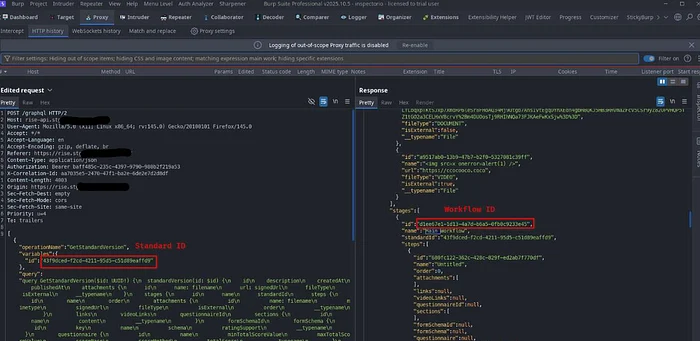
In Burp Suite, a GetStandardVersion GraphQL request was intercepted and the attacker's own Standard-id was swapped for the victim's Standard-id. The server responded with all the hidden details of the victim's standard, most importantly all of their internal Workflow-ids.
Step 4: Preparing the strike
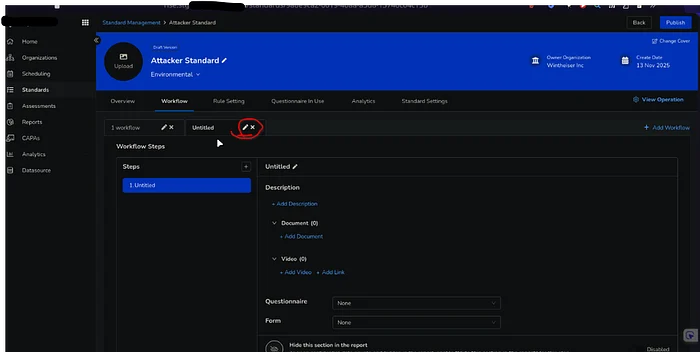
Back in the browser, the researcher went to their own standard and clicked the "X" button to delete the dummy workflow. The deletion request was intercepted before it left the machine.
Step 5: The execution
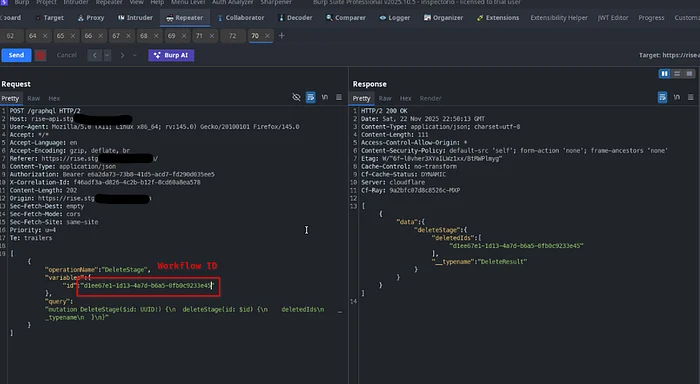
Inside the intercepted GraphQL request body, the id parameter pointed at the dummy workflow. The researcher deleted their own ID, pasted in the victim's Workflow-id leaked in step 3, and forwarded the request to the server.
Step 6: The result
The server processed the request successfully. The victim organization's workflow was instantly and permanently deleted.
Root cause
The backend trusted object identifiers supplied by the client and never tied them to the caller's tenant. Two resolvers were affected: the GetStandardVersion query, which returned a Standard to any authenticated user who knew its Standard-id, and the workflow deletion mutation, which acted on any Workflow-id presented to it. Neither enforced the ownership check that would have limited the operation to members of the owning organization. The information disclosure is what makes the destructive half practical: the victim's Workflow-id values are not guessable from outside, but the same missing check on the read path hands them over.
Impact
The consequences described are severe. An attacker could script the process to mass-delete workflows across the entire platform, permanently destroying the critical business logic and configurations that victim organizations rely on. For a SaaS provider, tenant isolation is the foundation of customer trust, and a cross-tenant attack in which one customer can reach into another's private workspace and destroy data is the most damaging scenario possible, potentially leading to massive loss of trust and legal liabilities. The deletion is described as instant and permanent, with no recovery mentioned.
Fix
The report does not describe any fix or vendor response. The change the flaw calls for is an authorization check in both resolvers: GetStandardVersion should only return a Standard when the caller belongs to the owning organization, and the deletion mutation should only act on a Workflow-id that belongs to a workflow in the caller's tenant. Enforcing tenant isolation server-side on every ID-bearing GraphQL field, rather than relying on the client to send only its own IDs, is what closes both halves of the chain.
Variants to test
- Other ID-bearing queries and mutations. Enumerate GraphQL operations that take an object ID and replay each with an ID from a second account. A positive result is a response containing the other tenant's object or a successful state change on it.
- Read-then-destroy chains. Where a read operation leaks child identifiers (as
GetStandardVersionleakedWorkflow-ids), feed those identifiers into delete or update mutations. A positive result is a mutation that succeeds against an object the caller does not own. - IDs in public URLs. Collect identifiers exposed in shareable links, archives and search results, then test them against authenticated endpoints. A positive result is any endpoint that resolves them for an unrelated account.
- Batch and aliased operations. Send several IDs in one GraphQL document, mixing the caller's own objects with foreign ones, to see whether authorization is applied per object. A positive result is a partial success in which the foreign objects are returned or modified.
What happened, in plain words
A security researcher was testing a bug bounty target: a large business-to-business (B2B) software service, the kind of cloud platform that companies use to run internal processes. While poking around, the researcher found a way for one customer of that platform to reach into another customer's private space and permanently delete their data.
The platform lets each organization create internal policies called Standards. Inside a Standard, an organization can set up Workflows, which are automated sequences that carry out business logic (for example, "when this happens, do that").
The researcher found two mistakes in the platform's API (the behind-the-scenes channel the website uses to talk to the server):
- The server would hand over the full contents of any organization's Standard to anyone who asked with the right identifier, without checking whether the asker belonged to that organization.
- The server would delete any Workflow belonging to anyone, again without checking who was asking.
By chaining the two, the researcher could read another organization's Standard, learn the identifiers of its Workflows, and then delete those Workflows. The deletion was instant and permanent.
This kind of flaw, where the server trusts an identifier supplied by the client instead of checking ownership, is called an IDOR (Insecure Direct Object Reference). Because it crosses from one customer's account into another's, it is also a cross-tenant flaw: a tenant here is one customer organization on a shared platform.

Background concepts, from zero
Before walking through the attack, here are the ideas you need. Each one is explained as if you have never seen it before.
- API: Think of a restaurant. You (the browser) do not walk into the kitchen (the server); you tell a waiter what you want, and the waiter brings it back. The API is the waiter: a defined set of requests the website can make to the server, and the answers the server sends back. Every time you click something on a modern website, the browser is usually sending an API request in the background.
- GraphQL: A specific style of API. Instead of many separate addresses (like
/get-userand/delete-post), GraphQL has one address, and each request describes exactly what it wants. A request that only reads data is called a query; a request that changes data (create, update, delete) is called a mutation. The report uses both words. - Identifier (ID): A unique label for a thing in a database, like a barcode on a product. The platform uses a
Standard-idto identify a Standard and aWorkflow-idto identify a Workflow. If you know the barcode, you can refer to the item. - Tenant: One customer organization on a shared platform. The platform hosts many organizations at once, and each should only see its own data. Keeping them apart is called tenant isolation.
- Authorization: The check that asks "are you allowed to do this?" It is different from authentication ("who are you?"). Logging in proves who you are; authorization decides what you may touch.
- IDOR (Insecure Direct Object Reference): A bug where the server accepts an identifier from the user and acts on it without checking that the user owns or may access that object. If a website lets you view your own receipt at
/receipt?id=1001and you can change it toid=1002to see someone else's, that is an IDOR. - Burp Suite: A tool used by security testers. It sits between your browser and the server, like a postal worker who can open, read, and rewrite letters before delivering them. The researcher used it to pause requests, change them, and send them on.
- Intercept: To catch a request in Burp Suite before it reaches the server, so you can inspect or modify it.
- OSINT: Open-source intelligence, meaning information gathered from publicly available sources (search engines, archives, social media).
- Web archive: A service that stores copies of web pages over time, so old URLs and their contents can still be found later.
The reconnaissance: watching the traffic
The researcher's first move was not an attack; it was observation. While using the platform normally, they watched the background API traffic in Burp Suite to see how the frontend (the part of the website running in your browser) talked to the backend (the server).
They noticed two things:
- When they opened a Standard to view it, the browser sent a GraphQL query called
GetStandardVersion, and that query contained aStandard-id. - When they deleted a workflow, the browser sent a different GraphQL mutation, and that mutation contained a specific
Workflow-id.
Why does this matter? Because it tells you the shape of the conversation. The browser is saying, in effect, "give me the Standard with this ID" and "delete the Workflow with this ID." The natural next question, the one the whole report turns on, is: does the server check that the person sending that ID actually owns the thing it points to?
The vulnerability: two missing checks
The answer was no, in two separate places:
- Information disclosure: the
GetStandardVersionquery did not check whether the requesting user belonged to the organization that owned theStandard-id. Anyone logged in who knew a Standard's ID could read that Standard. - Destructive IDOR: the workflow deletion mutation did not verify whether the user attempting to delete a
Workflow-idhad the right to do so. Anyone logged in who knew a Workflow's ID could delete it.
Because the backend blindly trusted the IDs in the requests without enforcing tenant isolation, a user from Organization A could read and destroy data belonging to Organization B.
Why does the first flaw make the second one practical? Because the read flaw hands over the Workflow IDs. But the read flaw hands them over: if you can read someone's Standard, you can see the IDs of all the Workflows inside it. The information leak is the key that unlocks the destructive step.
The exploitation, step by step
Step 1: The setup
The researcher logged into their own attacker account and created a Standard with a dummy workflow. This was not part of the attack itself; it was so they had something of their own to interact with, which let them trigger the platform's features and observe the deletion request in a safe, controlled way. Think of it as setting up a practice target before aiming at the real one.
Step 2: Finding the target
To read someone else's Standard, the researcher needed a victim's Standard-id. The report notes that these IDs often appear in public-facing URLs of the form:
In plain words: when a Standard is shared or linked, its ID can end up in the address bar, and from there it can be copied into web archives or found through basic OSINT. The researcher grabbed a valid ID belonging to another organization.
Why this works: an ID in a URL is not secret. If the platform assumes that only the owner will ever see the URL, that assumption is wrong.
Step 3: Leaking the internal data
In Burp Suite, the researcher intercepted a GetStandardVersion GraphQL request and swapped their own Standard-id for the victim's Standard-id. The server responded with all the hidden details of the victim's standard, most importantly all of their internal Workflow-ids.
Why this step was taken: the researcher needed the victim's Workflow-id values, and the read flaw was the way to get them. The server did not ask "does this user belong to the organization that owns this Standard?" It just answered.
Step 4: Preparing the strike
Back in the browser, the researcher went to their own standard and clicked the "X" button to delete their dummy workflow. They intercepted this deletion request before it left their computer.
Why this step was taken: the researcher wanted a real, valid deletion request to work from. By triggering it on their own dummy workflow, they got a request that the platform itself had built, with all the correct formatting. They could then change one value inside it rather than writing a request from scratch.
Step 5: The execution
Inside the intercepted GraphQL request body, the id parameter pointed at the dummy workflow. The researcher deleted their own ID, pasted in the victim's Workflow-id that they had just leaked, and forwarded the request to the server.
Why this step was taken: this is the moment the two flaws combine. The request is still a perfectly ordinary deletion request; only the ID inside it has changed. If the server had checked ownership, it would have refused. It did not.
Step 6: The result
The server processed the request successfully. The victim organization's workflow was instantly and permanently deleted.
Root cause
The backend trusted object identifiers supplied by the client and never tied them to the caller's tenant. Two parts of the API were affected:
- The
GetStandardVersionquery returned a Standard to any authenticated user who knew itsStandard-id. - The workflow deletion mutation acted on any
Workflow-idpresented to it.
Neither enforced the ownership check that would have limited the operation to members of the owning organization. The information disclosure is what makes the destructive half practical: the victim's Workflow-id values are not guessable from outside, but the same missing check on the read path hands them over.
In everyday terms: the server was like a hotel receptionist who hands out room keys to anyone who says a room number, without checking whether the person is a guest in that room.
Impact
The consequences described are severe.
- Permanent data loss: an attacker could script the process to mass-delete workflows across the entire platform, permanently destroying the critical business logic and configurations that victim organizations rely on.
- Severe reputational damage: for a SaaS provider, tenant isolation is the foundation of customer trust. A cross-tenant attack, in which one customer can reach into another's private workspace and destroy data, is the most damaging scenario possible, potentially leading to massive loss of trust and legal liabilities.
The deletion is described as instant and permanent, with no recovery mentioned.
Fix
The report does not describe any fix or vendor response. The change the flaw calls for is an authorization check in both places: GetStandardVersion should only return a Standard when the caller belongs to the owning organization, and the deletion mutation should only act on a Workflow-id that belongs to a workflow in the caller's tenant. Enforcing tenant isolation on the server for every GraphQL field that takes an ID, rather than relying on the client to send only its own IDs, is what closes both halves of the chain.
Variants to test
If you are learning from this, here are related things a tester would try next. Each is described with what a positive result looks like.
- Other ID-bearing queries and mutations: list the GraphQL operations that take an object ID, and replay each one with an ID taken from a second account. A positive result is a response containing the other tenant's object, or a successful change to it.
- Read-then-destroy chains: where a read operation leaks child identifiers (as
GetStandardVersionleakedWorkflow-ids), feed those identifiers into delete or update mutations. A positive result is a mutation that succeeds against an object the caller does not own. - IDs in public URLs: collect identifiers exposed in shareable links, archives and search results, then test them against authenticated endpoints. A positive result is any endpoint that resolves them for an unrelated account.
- Batch and aliased operations: send several IDs in one GraphQL document, mixing the caller's own objects with foreign ones, to see whether authorization is applied per object. A positive result is a partial success in which the foreign objects are returned or modified.
Glossary
- API: the defined set of requests a website's frontend can send to its backend, and the answers it gets back; the waiter between your browser and the server.
- Authentication: proving who you are, usually by logging in.
- Authorization: the check of whether you are allowed to do a particular thing.
- Backend: the server-side part of an application, where data is stored and decisions are made.
- B2B SaaS: business-to-business software as a service; a cloud platform sold to companies rather than individuals.
- Burp Suite: a tool that sits between a browser and a server, letting a tester intercept, inspect and modify requests.
- Cross-tenant: reaching from one customer organization's space into another's on a shared platform.
- Frontend: the part of the application that runs in your browser.
- GraphQL: an API style where each request describes exactly what data it wants; reads are queries, changes are mutations.
- IDOR (Insecure Direct Object Reference): a flaw where the server acts on an identifier supplied by the user without checking that the user owns or may access that object.
- Identifier (ID): a unique label for an object in a database, like a barcode.
- Information disclosure: a flaw that reveals data to someone who should not see it.
- Intercept: to catch a request before it reaches the server so it can be inspected or changed.
- Mutation: in GraphQL, a request that changes data (create, update, delete).
- OSINT: open-source intelligence; information gathered from publicly available sources.
- Query: in GraphQL, a request that only reads data.
- Standard: in this product, an internal policy an organization creates, which can contain Workflows.
- Tenant isolation: keeping each tenant's data separate and inaccessible to other tenants.
- Web archive: a service that stores copies of web pages over time, so old URLs and contents can still be found.
- Workflow: in this product, an automated sequence inside a Standard that carries out business logic.



