Why as a Bug Bounty hunter you should care about DoS ?
 Published on medium.com
Greetings, this is my first writeup and I will discuss a very common vulnerability that is so underrated everybody seems to ignore it during their testing “DoS”, in this writeup I will also share about my 4 valid reports on HackerOne program and also how I was able to create an impact on a very old report which was…
The full write-up lives on its author's site
It belongs to its author, so we link to it rather than copy it. The other two tabs are our own rewrites, checked against it.
DoS is one of the most underrated bug classes in web testing. Most programmes list it as out of scope, but a quick search shows plenty that do accept it and pay for it. This write-up covers four valid reports I filed on HackerOne, including how I turned an old report that had been closed as informative into a paid finding for both the original reporter and me.
Context
The target in the first two reports is ctf.hacker101.com, the HackerOne capture-the-flag site. It has a feature that lets users create groups and invite other hackers to join them, reachable at:
https://ctf.hacker101.com/group
The third report concerns the HackerOne platform itself, specifically the endpoint that lets programme members invite hackers to their programme, which sends mail through Amazon SES. The fourth is a general observation about GraphQL pagination rather than a single endpoint.
Setup
For the concurrent-request test I deliberately avoided Intruder and used multiple browser tabs instead, because of the risk of damaging a production target. The precondition for the second report was that the account already held a large number of groups created during the first round of testing.
Finding it
While testing the group feature on ctf.hacker101.com I made two observations:
- There was no rate limiting on creating groups.
- There was no pagination when displaying groups: every group was returned in a single response.
Together these mean a user can create a very large number of groups and then trigger a single GET request that renders all of them. That looked like a realistic way to exhaust the server, so I reported it.
My report was duplicated against an earlier report that described only the missing rate limiting, and that report was closed as informative. The original researcher had not demonstrated a realistic impact. Once I showed that the missing limit could be turned into a DoS on ctf.hacker101.com, HackerOne reopened the informative report and awarded a 50/50 split of the bounty to both of us. The issue was mitigated by limiting how many groups a user can create and by adding pagination to the response.
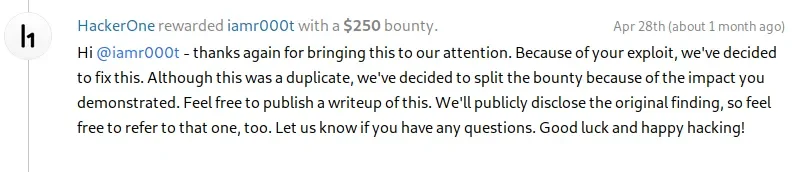
The screenshot shows the impact demonstrated on the rate limiting issue.
Exploitation
Step 1: create many groups
With no limit on group creation, I built up a large number of groups on the account. This is the resource that the later request has to render.
Step 2: request the group listing
A single GET to the group page returns every group in one response. With enough groups created in step 1, the response time rises sharply.
Step 3: bypass the fix
After the limit and pagination were applied, I went back to the endpoint. I already had a large number of groups on the account, so I expected a bypass to be possible. The response time was higher, but I could not get the server to return a 502. I then tried to get around the pagination by changing the accept encoding the browser sent:
Accept-Encoding: gzip, gzip,deflate,br
The response time was significantly higher. I also tried sending multiple requests concurrently, and that worked: with concurrent requests the server started responding with 502. To test this safely I did not use Intruder; I simply used multiple browser tabs, and it was enough. I filed a new report, which was awarded a 500 USD bounty.

The screenshot shows the earlier created groups being used to recreate the same impact.
Step 4: AWS SES bounce DoS
Amazon SES suspends an account when the bounce rate of mail sent from it exceeds 10%. If a target sends mail through SES to addresses that do not exist, Amazon can suspend the SES account and the target can no longer send any email to its users. On HackerOne I found the endpoint that lets programme members invite hackers to their programme, and observed:
- No rate limiting on inviting hackers.
- No RFC 5322 verification when sending invites.
I used a payload of the form anyemail$[redacted] and sent an invitation. The email was accepted and the invitation was sent, even though an address like that cannot exist under RFC 5322.
My report was first marked not applicable and duplicated against email spamming. Through misunderstandings and miscommunication I did some damage while demonstrating the impact, and the report was marked ineligible for bounty. The issue itself was valid and was fixed, closed as resolved.
Step 5: GraphQL pagination
Reading the GraphQL best practices page, the pagination section caught my attention: the type system allows fields to return lists of values but leaves pagination of longer lists to the API designer. GraphQL does not implement any pagination by default, so a query can be built that returns a very long response and may time out the target server.
Root cause
In the group feature, the design allowed unbounded creation of groups and returned all of them in one response, so a single request could be made arbitrarily expensive. The fix addressed both halves: a cap on how many groups a user can create, and pagination on the listing. The bypass attempt involved changing the client's Accept-Encoding header, which raised the response time, and sending concurrent requests, which produced 502 responses. In the SES case, the root cause was the absence of rate limiting and of RFC 5322 validation on invite addresses, which let non-existent addresses into the sending pipeline and drive the bounce rate up. For GraphQL, the root cause is the absence of default pagination in the specification, which leaves the cost of a list query to the API designer.
Impact
On ctf.hacker101.com, an authenticated user could create enough groups that a single listing request, or a handful of concurrent ones, made the server return 502. The second report was paid at 500 USD. On HackerOne, invitations to non-existent addresses were accepted and sent, which is the kind of behaviour that can drive a SES bounce rate up. That report was closed as resolved but was not paid. The GraphQL observation is a general risk: a query that returns a long list can time out the server.
Fix
For the group feature, the applied fix was a limit on how many groups a user can create plus pagination in the response. For the SES issue, the report was closed as resolved; the original observations were the missing rate limiting and missing RFC 5322 validation. For GraphQL, the guidance is to design pagination into list fields rather than relying on defaults.
Variants to test
- Unbounded creation plus unpaginated listing. Look for any feature where a user can create objects without a limit and where the listing returns everything at once. A positive result is a response time that grows with the number of objects you created, up to a 502.
- Pagination bypass via headers. Try altering
Accept-Encodingon a paginated endpoint, as above. A positive result is a response that is significantly slower than the paginated baseline. - Concurrent requests against a paginated listing. Send several requests at once from separate tabs. A positive result is 502 responses appearing under concurrency but not with a single request.
- Invite flows without address validation. Submit addresses that cannot exist under RFC 5322, such as
anyemail$[redacted], to invitation endpoints. A positive result is the invitation being accepted and sent. - Mail-sending features backed by SES. Check whether the target sends through SES and whether you can drive bounces. A positive result is accepted mail to non-existent addresses at a rate that could push the bounce rate past 10%.
- GraphQL list fields. Query list fields without pagination arguments. A positive result is a very long response or a timeout.
Lessons learned
- Check the programme's scope before testing for DoS, to confirm it is not out of scope.
- Follow "bend, but not break": build a minimal proof of concept and avoid damage.
- Keep automated tools to a minimum, ideally none, when testing for DoS.
- Communicate with the team throughout; it reduces the risk of damage.
- Be patient. Validating a DoS vulnerability is slow and difficult, both when writing the report and while it is being validated.
My third report being marked ineligible was frustrating, and I did some damage while demonstrating impact. I misbehaved with HackerOne's team and I apologise for that. The support and guidance I received from Ben Willis throughout was genuinely helpful, and I thank him and the HackerOne team.
What happened, in plain words
This is a story about a type of security weakness called a denial of service, usually shortened to DoS. A DoS is when someone makes a website or service so busy or so overloaded that it stops working properly for everyone else. It is a bit like standing in a shop doorway and refusing to move: you are not stealing anything, but nobody else can get in. The author of this write-up found several of these weaknesses on HackerOne, the platform where companies pay people to find security problems in their websites. Four of the reports were accepted as valid, and one of them earned a 500 USD bounty.
The most interesting part is the first story. Another researcher had already reported a related problem, but their report had been closed as "informative", which means the company looked at it and decided it was not a real security issue worth paying for. The author of this write-up came along later, found the same weak spot, and showed what real harm it could cause. Because of that demonstration, HackerOne reopened the old report and paid both researchers, splitting the bounty 50/50. So the lesson is that a finding is not just about spotting a missing limit; it is about showing what that missing limit actually lets an attacker do.
Before we go further, a few words about the words. A bug bounty programme is a deal a company offers: if you find a security problem in our product and tell us privately, we will pay you. A report is the message you send describing the problem. A bounty is the money paid. Scope is the list of things the company says you are allowed to test; anything outside that list is out of scope, and testing it can get you into trouble. Production means the real, live website that real users are using, as opposed to a test copy. That distinction matters a lot here, because breaking a test copy is annoying, but breaking the live site is serious.
Why you should care about DoS
Most bug bounty programmes list DoS as out of scope. The reasoning is practical: a DoS test can accidentally take down a live service, and companies do not want strangers knocking their shop over while practising. But the author points out that plenty of programmes do accept DoS reports and do pay for them. To find them, he suggests a simple web search using a search engine's special query syntax, sometimes called a dork. The idea is to search the public HackerOne report archive for the word "dos" together with "Bounty", which surfaces reports where a DoS was paid:
site:hackerone.com/reports/ "dos" "Bounty"
Line by line: site:hackerone.com/reports/ tells the search engine to only look inside HackerOne's public reports section. The quoted "dos" means the page must contain that exact word. The quoted "Bounty" means it must also contain that word. So the query returns public reports that mention both, which is a quick way to see that paid DoS findings exist. It is not a guarantee that any particular programme accepts them, but it shows the category is not dead.
The challenges of testing for DoS
Testing for DoS on a live website is genuinely tricky, and the author is honest about why. It is very easy, while testing, to actually break something or cause real damage. A test that is supposed to be a gentle probe can turn into an outage. So he recommends an approach he calls "Bend, but not break". The idea is to push the system just far enough to prove the weakness exists, using the smallest possible proof of concept (a POC, meaning a minimal demonstration), and never to push it so far that it falls over. Think of testing the strength of a bridge: you might drive a heavy lorry across it to see if it holds, but you do not saw through the cables to find out.
There is a positive side to this difficulty. Because DoS testing is hard and risky, fewer people do it, which means DoS weaknesses can be common and relatively easy to find. The very thing that makes them awkward to test is what makes them worth looking for.
Types of DoS worth reading about
The author does not try to cover every kind of DoS, because that would be impossible. Instead he lists a few he finds particularly interesting, with references:
- ReDoS, or Regular expression Denial of Service. A regular expression is a pattern used to match text. Some patterns are extremely slow on certain inputs, so a single crafted string can tie up a server's processor for a very long time. Reference:
https://owasp.org/www-community/attacks/Regular_expression_Denial_of_Service_-_ReDoS - CpDoS, or Cache Poisoned Denial of Service. This abuses the caching layer that sits in front of many websites. A cache is a copy of a page kept close to users so it loads faster. If an attacker can trick the cache into storing an error page, every user gets the error. Reference:
https://cpdos.org/ - Zalgo Text DoS. Zalgo text is text covered in so many stacked accent marks that it becomes a tall, glitchy mess. Some apps handle it so badly that they crash or freeze. Reference:
http://www.iphonehacks.com/2013/03/imessage-denial-of-service-attack.html - AWS SES DoS. This one is covered in detail below. Reference:
https://medium.com/@keshavaarav22/an-unexpected-bounty-email-bounce-issues-b9f24a35eb68
1. Creating an impact on an old informative report
While testing ctf.hacker101.com, the HackerOne capture-the-flag site, the author came across a feature that lets users create groups and invite other hackers to join them. A capture-the-flag site is a practice site where people solve security puzzles; groups are simply collections of users. The feature lives at this address:
https://ctf.hacker101.com/group
That is a URL, the address you would type into a browser's address bar. https:// means the connection is encrypted. ctf.hacker101.com is the site. /group is the particular page for the group feature.
While poking at this page, he noticed two things:
- No rate limiting on creating groups. Rate limiting is a rule that says "you may do this action only so many times per minute". Without it, a user can create groups as fast as they can click, or faster if they automate it.
- No pagination when displaying groups. Pagination is the practice of splitting a long list into pages, like a book with numbered pages instead of one endless scroll. Without it, the server sends back every single group in one giant response.
Put those two together and you have a recipe. Create a huge number of groups, then ask the site to show them all at once. The server has to gather and send an enormous amount of data in a single request, which can slow it down or knock it over. That is a DoS.
When he reported it, his report was marked as a duplicate of an earlier report that had described only the missing rate limiting. That earlier report had been closed as informative, meaning the company had decided it was not a real security issue. The original researcher had not shown any realistic harm. But once the author demonstrated that the missing limit could actually be turned into a DoS on the live site, HackerOne changed its mind. It reopened the old report and paid both researchers, splitting the bounty 50/50. The fix was twofold: a limit on how many groups a user can create, and pagination added to the response.
The screenshot shows the impact being demonstrated on the rate limiting issue, which is what convinced HackerOne to reopen the earlier report.
2. Bypassing the fix
After the fix went in, the author went back to the same page. He suspected a bypass would be possible, partly because his account already had a large number of groups created during the first round of testing. A bypass means getting around a security control without technically breaking it, like finding a window left open after the front door has been locked.
At first the response time was higher, but he could not get the server to return a 502. A 502 is an HTTP status code meaning "Bad Gateway": the server that sits in front of the application tried to talk to the application and got no usable answer. In practice, seeing a 502 under load is a strong sign that you have pushed the server past what it can handle.
So he tried to get around the new pagination by changing the Accept-Encoding header the browser sent. A header is a small piece of information the browser attaches to every request, like the label on a parcel. Accept-Encoding tells the server which compression formats the browser can understand, so the server can send the page squashed down to save bandwidth. Compression is like vacuum-packing clothes for a suitcase: same contents, less space. The value he used was:
Accept-Encoding: gzip, gzip,deflate,br
Line by line: Accept-Encoding is the header name. gzip, deflate and br are three compression formats (br stands for Brotli). The odd part is that gzip appears twice. The author does not explain why the duplicate matters, only that he tried this value to bypass the pagination and the response time was significantly higher. The point for a beginner is that headers are inputs the server reads, and inputs can sometimes change behaviour in unexpected ways.
He also tried sending multiple requests at the same time, which is called sending them concurrently. With concurrent requests, the server started responding with 502. To test this safely, he deliberately did not use Intruder. Intruder is a tool in Burp Suite, a popular security testing program, that fires many requests automatically. Automated tools can easily send far more traffic than intended and cause real damage. Instead he simply opened multiple browser tabs and loaded the page in each, and that was enough. He filed a new report, and it was awarded a 500 USD bounty.
The screenshot shows the earlier created groups being used to recreate the same impact, which is the basis of the second, paid report.
3. AWS SES DoS on HackerOne
Amazon SES is Amazon's Simple Email Service, a product companies use to send email from their applications. The author points out a quirk: Amazon suspends your SES account if the bounce rate of mail sent from it goes above 10%. A bounce is an email that could not be delivered, usually because the address does not exist. The bounce rate is the proportion of sent emails that bounced. So if more than one in ten of your emails bounce, Amazon suspends your SES account.
That creates an opening. If an attacker can make a target that uses SES send mail to addresses that do not exist, the bounce rate climbs, Amazon suspends the SES account, and the target can no longer send any email to its real users. The target can no longer send any email to its users. That is a DoS delivered through a third party.
While testing on HackerOne itself, the author found the endpoint that lets programme members invite hackers to their programme. An endpoint is a specific address on a server that accepts a particular kind of request, like a service window at a bank. He made two observations:
- No rate limiting on inviting hackers.
- No RFC 5322 verification when sending invites. RFC 5322 is the technical standard that defines what a valid email address looks like. Verification means checking the address against that standard before accepting it.
He used a payload of the form anyemail$[redacted] and sent an invitation. A payload here just means the input he submitted. To his surprise, the email was accepted and the invitation was sent, even though an address like that cannot exist under RFC 5322. An address like that cannot exist under RFC 5322, so a correct validator would have rejected it.
His report was first marked not applicable and duplicated against email spamming. Then, through misunderstandings and miscommunication, he did some damage while demonstrating the impact, and the report was marked ineligible for bounty. The issue itself was valid and was fixed, closed as resolved. So the finding was real, but the payout was lost.
4. GraphQL DoS
While reading the GraphQL best practices page, the author's attention was caught by the section on pagination. GraphQL is a way for a client to ask a server for exactly the data it wants, using a query language, rather than receiving a fixed response from a fixed address. The quoted passage says that the GraphQL type system allows fields to return lists of values, but leaves the pagination of longer lists up to the API designer. An API is the interface a program uses to talk to another program, like a waiter taking your order to the kitchen. The API designer is the person who decides how that interface behaves.
In plain terms: GraphQL does not build in any pagination by default. If a field returns a list, the designer has to decide whether to split it into pages. If they do not, a single query can ask for a very long list and get a very long response, which may time out the target server. A timeout is when a request takes so long that the server gives up waiting. That is a DoS risk, and it is a general one rather than a single endpoint.
Lessons learned while testing for DoS
- Before testing for DoS, check the programme's scope to confirm it is not listed as out of scope. Testing something you were told not to touch can get you banned.
- Follow "Bend, but not break": build a minimal proof of concept and avoid damage.
- Keep automated tools to a minimum, ideally none, when testing for DoS. A tool can send far more traffic than you intended.
- Communicate with the team throughout. Talking to the people who run the programme reduces the risk of damage and helps them understand what you are doing.
- Be patient. Validating a DoS vulnerability is slow and difficult, both when writing the report and while it is being validated.
My personal experience
After his third report, the AWS SES one, was marked ineligible for bounty, the author was frustrated. It had first been marked not applicable, and while demonstrating the impact he had unintentionally done some damage. He felt his time was wasted, and he admits he misbehaved with HackerOne's team, for which he apologises. After some rational thinking, he decided to use the experience to learn: to improve his methodology, his report writing, and to share what he learned with others. He thanks Ben Willis for the support and guidance throughout, and credits Ben Willis and the HackerOne team.
Glossary
- Bug bounty programme: a deal where a company pays people to privately report security problems in its products.
- Report: the message a researcher sends to a company describing a security problem.
- Bounty: the money paid for a valid report.
- Scope: the list of things a programme says you are allowed to test.
- Out of scope: anything not on that list, which you should not test.
- Production: the real, live version of a website that actual users use.
- DoS (Denial of Service): making a service so busy or overloaded that it stops working for legitimate users.
- POC (proof of concept): a minimal demonstration that a weakness is real.
- "Bend, but not break": the principle of pushing a system just far enough to prove a weakness without causing damage.
- Rate limiting: a rule that limits how many times an action can be performed in a given period.
- Pagination: splitting a long list into pages instead of returning everything at once.
- Duplicate: a report that describes the same issue as an earlier report.
- Informative: a report status meaning the company decided it was not a real security issue worth paying for.
- Bypass: getting around a security control without technically breaking it.
- HTTP status code: a number a server returns to say how a request went, such as 502.
- 502 (Bad Gateway): a status meaning a front-end server could not get a usable answer from the application behind it, often a sign of overload.
- Header: a small piece of information attached to an HTTP request or response.
- Accept-Encoding: a request header listing the compression formats the browser can understand.
- Compression: squashing data down to use less bandwidth, then expanding it at the other end.
- Concurrent requests: several requests sent at the same time rather than one after another.
- Intruder: an automated request-sending tool in Burp Suite, a security testing program.
- AWS SES (Amazon Simple Email Service): Amazon's product for sending email from applications.
- Bounce: an email that could not be delivered, usually because the address does not exist.
- Bounce rate: the proportion of sent emails that bounced.
- Endpoint: a specific address on a server that accepts a particular kind of request.
- RFC 5322: the technical standard defining what a valid email address looks like.
- Payload: the input a tester submits to a target.
- GraphQL: a query language that lets a client ask a server for exactly the data it wants.
- API (Application Programming Interface): the interface one program uses to talk to another.
- API designer: the person who decides how an API behaves, including whether lists are paginated.
- Timeout: when a request takes so long that the server gives up waiting.
- ReDoS: a DoS caused by a slow regular expression pattern being fed a crafted input.
- Regular expression: a pattern used to match text.
- CpDoS: a DoS that abuses a caching layer to serve error pages to users.
- Cache: a stored copy of a page kept close to users so it loads faster.
- Zalgo text: text covered in many stacked accent marks, which some apps handle badly.
- URL: the address of a page or resource on the web.
- Capture-the-flag site: a practice site where people solve security puzzles.


