GraphQL Authorization Flaws: How One Missing Check in a Resolver Exposes Private Data
GraphQL resolvers sometimes lack authorization checks, allowing authenticated users to access private data outside their scope. The article cites disclosed HackerOne reports where private programme details, list memberships, and namespaces were exposed via GraphQL while equivalent REST endpoints enforced access.
 Published on masimshahzad.medium.com
Bug Bounty
The full write-up lives on its author's site
It belongs to its author, so we link to it rather than copy it. The other two tabs are our own rewrites, checked against it.
Context
This is a write-up about a bug class rather than a single target: GraphQL authorization flaws, where a resolver returns data it was never meant to return. The author's framing is that GraphQL feels safe because every request is authenticated and every query is shaped by a schema, but a schema only describes what data exists. It does not decide who may see it. That decision lives in every resolver, and the cases discussed come from resolvers where nobody made it.
The article is built around publicly disclosed HackerOne reports cited in a public GraphQL security review at https://dev.to/rxkov/graphql-security-introspection-injection-and-authorization-59dl. Three cases are named:
| Report | What was exposed |
|---|---|
| 489146 | Confidential information about private programmes on the HackerOne platform itself, through a GraphQL path, to users with no access to those programmes |
| 885539 | Private list membership, through a GraphQL field that did not verify access, although the equivalent REST path had the check |
| 614355 | A private namespace, readable through a GraphQL resolver by any authenticated user, while the REST route for the same data enforced permissions correctly |
The recurring signature is the same data reached by two paths with two different answers: REST refuses, GraphQL allows. The author's opening line captures it: the REST endpoint said no, the GraphQL resolver never asked the question at all.
The cover illustration, made in Canva with AI, sets up that contrast between the REST endpoint and the GraphQL resolver.
Setup
The method described needs no special tooling beyond the application itself and two accounts you control:
- Two accounts you own, with different access levels.
- Clearly seeded private objects, so that any leak is unambiguous and belongs to you.
- The normal application interface, used as each account, to note the queries and mutations each role is meant to use.
- Introspection, where it is available in an authorised test, to list fields not visible in the interface, especially admin, export and relationship fields.
No versions, endpoints, headers or payloads are given in the article; the cases it cites are described only at the level of what was exposed.
Finding it
The reasoning starts from how the two architectures differ. In a REST API, each route can carry its own access check, and a missing check produces a classic broken access control bug on that route. In GraphQL there is usually one endpoint and many resolvers behind it, and each field you can query is resolved by its own piece of code. If authorization is expected inside resolvers, every resolver is a place where the check can be forgotten.
What makes the disclosed cases convincing is the comparison. In report 885539 the REST path had the check and the GraphQL field did not. In report 614355 the REST route enforced permissions correctly while the GraphQL resolver let any authenticated user read a private namespace. In report 489146 the users were legitimate and the query was valid; the resolver simply returned data outside their scope.
Introspection is placed firmly in the recon column. If a schema is exposed it helps a hunter map fields and relationships quickly, but introspection alone is rarely the paid finding. The paid finding is private data or a private action reached through a resolver that never checked access.
Exploitation
The article describes a repeatable testing method rather than a single exploit chain. Each step below is one of its stages.
Step 1: map the graph
Use the normal application as each account and note the queries and mutations each role is meant to use. Where introspection is available in an authorised test, use it to list fields you have not seen in the interface, especially admin, export and relationship fields.
Step 2: replay queries across accounts
Take a query that returns a private object for Account A and send the same query as Account B, changing only the object identifier. A correct system refuses or returns nothing. A flawed resolver returns Account A data to Account B.
Step 3: test fields, not only whole objects
A top level query may check access while a nested field does not. A public profile may expose a private email through a relationship field. A list you own may let you traverse into members, payment details or private notes of others because the nested resolver assumed the parent had already checked.
Step 4: compare GraphQL with REST
When both exist, send the same request to both. If the REST route refuses your second account and the GraphQL query allows it, you have clean comparative proof that the flaw is a missing resolver check rather than intended behaviour.
Step 5: test mutations with the same care
Use only objects your test accounts created. Reading private data is serious; changing or deleting another account's object through a mutation is more serious still, and it must only ever be proved on your own seeded data.
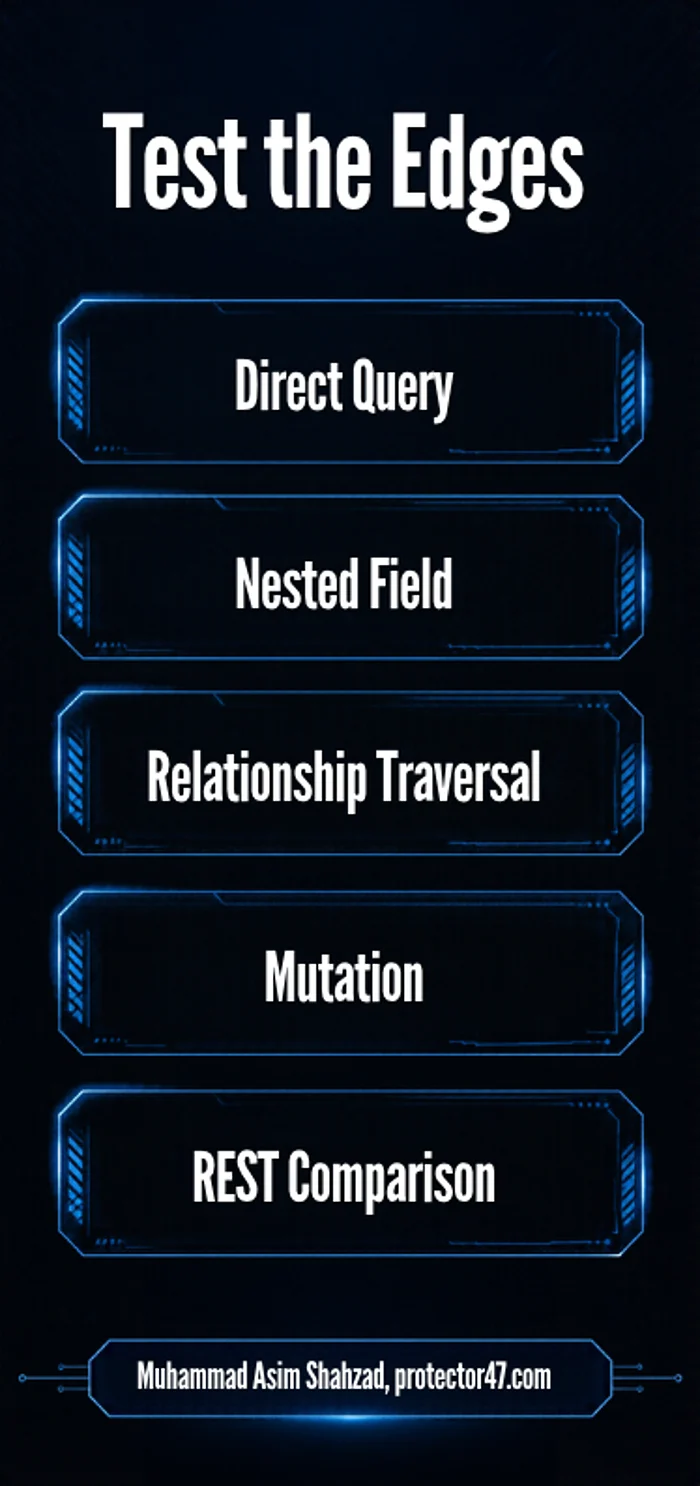
The illustration summarises the five edges to test: the direct query, the nested field, relationship traversal, the mutation and the REST comparison, on the basis that checks fail at the edges of the graph first.
Root cause
The mistake is structural. Authorization is expected inside each resolver, so it is implemented per resolver, by habit, and forgotten wherever nobody remembered. A schema describes what data exists but does not decide who may see it, and authentication of the request says nothing about whether this caller may see this object or this field. In report 489146 the users were legitimate and the query was valid, and the resolver returned data outside their scope. In reports 885539 and 614355 the REST path had the check and the GraphQL path did not.
Impact
Impact follows the field. A resolver that leaks private programme details, private list members or private project namespaces breaks confidentiality for data that owners deliberately kept closed. Relationship traversal can scale the leak, because one owned object can become a bridge to many objects you do not own. Mutations raise the stakes further, since changing or deleting another account's object is worse than reading it.
The author's reporting advice is to write around the data, not the technology: name the private object, name the account that should never see it, show the two account proof, and state the business harm in plain words. Triage teams understand exposed private projects immediately and should not need to decode GraphQL jargon to feel the impact.
Fix
No fix is described as having been applied to any of the cited reports. The article sets out what developers should do: move authorization out of individual resolver habits and into a shared business logic layer.
- Check access for the specific object and field on every resolver, including nested and relationship fields.
- Derive the caller identity from the authenticated session and pass it into the data layer, never from query arguments alone.
- Apply field level rules for sensitive fields such as email, tokens, payment details and private membership.
- Deny by default when a resolver has no explicit rule, and add two account tests for every new query, mutation and field.
- Treat introspection settings as a hardening choice, not as the authorization fix. A hidden schema with a missing check is still a missing check.
- Log cross account access denials and review them, because repeated probing of object identifiers often signals active testing or attack.
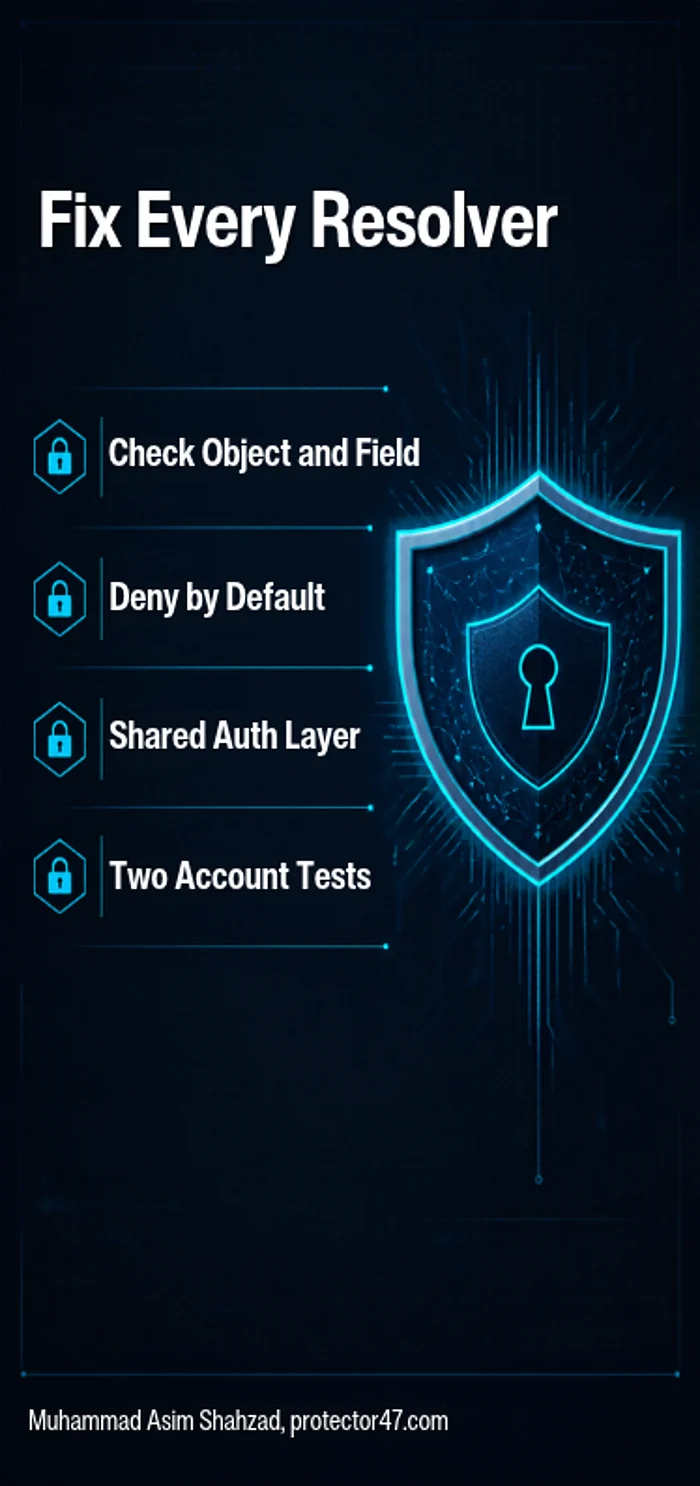
The illustration lists the same fix in short form: check object and field, deny by default, use a shared auth layer, and run two account tests for every new field.
Verification is by replaying the exact two account cases from the report. The owning account should still succeed. The second account should receive a refusal or an empty result on the direct query, on the nested field path and on the mutation.
Variants to test
Each of these follows from the method above.
- Direct object query with a swapped identifier. Take a query that returns a private object for your first account and replay it as your second account, changing only the identifier. A positive result is the first account's data coming back to the second.
- Nested field on a public object. Query a public profile and ask for a sensitive field such as email through a relationship. A positive result is the private value appearing where the top level object was legitimately public.
- Relationship traversal from an owned object. Start from a list or object you own and traverse into members, payment details or private notes of others. A positive result is data belonging to accounts you do not control.
- REST versus GraphQL comparison. Send the equivalent request to both paths as the second account. A positive result is REST refusing while GraphQL returns the data, which is the cleanest proof of a missing resolver check.
- Mutations against your own seeded objects. Attempt to change or delete an object created by your other test account. A positive result is the mutation succeeding across accounts; keep this strictly to your own seeded data.
- Introspection for unseen fields. Where introspection is available in an authorised test, list fields absent from the interface, especially admin, export and relationship fields, then test each one with the two account method. A positive result is any of those fields returning data outside the caller's scope.
For hunters, the article recommends keeping a matrix: rows are objects and fields, columns are test roles, and each cell is filled with allowed or denied from real tests. Gaps in the matrix are the findings, and the matrix itself becomes strong report evidence.
What happened, in plain words
Imagine a building with two doors into the same records room. The front door has a guard who checks your badge and turns you away. The side door has no guard at all, so you walk straight in. Nothing was broken, no lock was picked, and your badge was genuine. The guard was simply only ever posted at one door.
That is the shape of the bug class in this article. A website can offer two ways to reach the same data: an older style called REST and a newer style called GraphQL. The REST way checked whether you were allowed to see the data. The GraphQL way did not. The author's opening line says it exactly: the REST endpoint said no, the GraphQL resolver never asked the question at all.
The cover illustration, made in Canva with AI, sets up that contrast between the REST endpoint and the GraphQL resolver.
Before going further, a few words need unpacking, because the rest of the article leans on them.
- A server is the computer somewhere else that holds a website's data and answers requests from your browser.
- An API (Application Programming Interface) is the set of doorways a program offers so other programs can ask it for data. Think of a restaurant menu: you do not walk into the kitchen, you order from a fixed list and food comes back. An API is that menu, but for data.
- REST is one long-established style of building such a menu. Each item on the menu has its own address, and the kitchen can apply its own rule to each address. One dish can be public, another can be for staff only.
- GraphQL is a newer style. Instead of many addresses, there is usually one address, and you send a written request describing exactly which pieces of data you want. The server has a small piece of code, called a resolver, for each piece, and each resolver fetches that piece.
- Authentication means proving who you are, like showing a badge at reception. Authorization means deciding what you are allowed to do once you are inside, like which floors your badge opens. These are two different questions, and this whole article is about the second one being skipped.
- A schema is GraphQL's map of everything that can be asked for: every object and every field. It is a catalogue, not a rulebook. It says what exists, not who may see it.
GraphQL feels modern and safe because every request is authenticated and every query is shaped by a schema. None of that guarantees authorization. A schema describes what data exists. It does not decide who may see it. That decision lives in every single resolver, and the findings in this article come from resolvers where nobody made it.
A quick note on how the article was produced: it states that it was researched and written with AI assistance, and checked for accuracy and originality before publishing.
By the end you will know why GraphQL authorization fails in a structurally different way from REST, how disclosed HackerOne cases prove the pattern, how to test with two accounts you own, and how to build authorization so a new field cannot quietly leak private data. HackerOne, for context, is a well-known platform where security researchers report bugs to companies and are sometimes paid for them; a disclosed report is one the company has agreed to make public.
The bug class, explained simply
In a REST API, each route can carry its own access check, and a missing check creates a classic broken access control bug on that route. In GraphQL there is usually one endpoint and many resolvers behind it. Each field you can query is resolved by its own piece of code. If authorization is expected inside resolvers, then every resolver is a place where the check can be forgotten.
Put in everyday terms: a REST API is a corridor of separate doors, each with its own lock. A GraphQL API is one big hall with hundreds of drawers, and each drawer is supposed to have its own tiny lock fitted by whoever built that drawer. If the rule is "everyone fits their own lock", then every drawer is a chance for someone to forget.
A public technical review of GraphQL security collects the key disclosed cases in one place and makes exactly this point. You can read it at https://dev.to/rxkov/graphql-security-introspection-injection-and-authorization-59dl
That review cites HackerOne report 489146, where the HackerOne platform itself exposed confidential information about private programmes through a GraphQL path to users who had no access to those programmes. The users were legitimate. The query was valid. The resolver simply returned data outside their scope.
A programme on HackerOne is a company's bug bounty scheme: the set of rules and scope a company publishes for researchers. Report 489146 involved the HackerOne platform itself, not a customer.
It cites HackerOne report 885539, where private list membership was exposed through a GraphQL field that did not verify access, even though the equivalent REST path had the check. It also cites HackerOne report 614355, where a private namespace could be read through a GraphQL resolver by any authenticated user while the REST route for the same data enforced permissions correctly. Same data, two paths, two different answers. That contrast is the signature of this bug class.
A namespace here means a private area holding a group of related items, like a folder that belongs to one team. "Any authenticated user" means anyone with a valid login, even the most ordinary account with no special rights.
Introspection belongs in this picture as recon only. If a schema is exposed, it helps a hunter map fields and relationships quickly. Introspection alone is rarely the paid finding. The paid finding is private data or a private action reached through a resolver that never checked access.
Introspection is a built-in GraphQL feature that lets a client ask the server to describe its own schema, in effect handing over the catalogue. Recon, short for reconnaissance, is the mapping-out phase of a test: learning the layout before trying anything. The point being made is that knowing the layout is not the same as getting in. A burglar with a floor plan has not yet stolen anything.
How the bug was found
The reliable method uses two accounts you own, with different access levels and clearly seeded private objects.
"Seeded" means you deliberately create the test data yourself, so that anything you later see clearly belongs to you and no real person's information is involved. Two accounts with different access levels means, for example, one ordinary user account and one account with more rights, so you can compare what each is allowed to see.
First, map the graph. Use the normal application as each account and note the queries and mutations each role is meant to use. Where introspection is available in an authorised test, use it to list fields you have not seen in the interface, especially admin, export and relationship fields.
A query in GraphQL means a request to read data. A mutation means a request to change data, such as creating, editing or deleting something. A field is one named piece of data inside an object, for example a name or an email address. A relationship field is a field that points from one object to another, such as a team pointing to its members. "Authorised test" means you have permission from the owner to test, which is the line between research and intrusion.
Second, replay queries across accounts. Take a query that returns a private object for Account A and send the same query as Account B, changing only the object identifier. A correct system refuses or returns nothing. A flawed resolver returns Account A data to Account B.
An object identifier is the unique label a system uses for one record, often a number or a long random string. Swapping it is like changing the seat number on a ticket: if the usher only checks that you hold a ticket and never checks the seat, you sit anywhere.
Third, test fields, not only whole objects. A top level query may check access while a nested field does not. A public profile may expose a private email through a relationship field. A list you own may let you traverse into members, payment details or private notes of others because the nested resolver assumed the parent had already checked. Test the edges of the graph, because that is where checks are most often missing.
"Nested" means a field asked for inside another object's answer, like asking for a public profile and then, within it, for the email address. "Traverse" means walking from one object to another through relationships. The everyday comparison: a hotel may check your key at the main entrance and then assume every internal door is fine, so a guest who is allowed into the lobby can wander into any corridor.
Fourth, compare GraphQL with REST when both exist. If the REST route refuses your second account and the GraphQL query allows it, you have clean comparative proof that the flaw is a missing resolver check, not intended behaviour.
This gives clean comparative proof, because the same data is refused at one door and handed over at another. If the same data, asked for by the same account, is refused at one door and handed over at another, the difference is a mistake.
Fifth, test mutations with the same care, using only objects your test accounts created. Reading private data is serious. Changing or deleting another account object through a mutation is more serious still, and it must only ever be proved on your own seeded data.
The illustration summarises the five edges to test: the direct query, the nested field, relationship traversal, the mutation and the REST comparison, on the basis that checks fail at the edges of the graph first.
Impact, in plain words
Impact follows the field. A resolver that leaks private programme details, private list members or private project namespaces breaks confidentiality for data that owners deliberately kept closed. Relationship traversal can scale that leak, because one owned object can become a bridge to many objects you do not own.
"Confidentiality" is simply the promise that data stays with the people it was meant for. "Scale" here means the leak grows: if one object you legitimately own links to many objects you do not own, a single missing check can expose far more than one record.
Write the report around the data, not the technology. Name the private object, name the account that should never see it, show the two account proof, and state the business harm in plain words. Triage teams understand exposed private projects immediately. They should not need to decode GraphQL jargon to feel the impact.
A triage team is the group at a company that reads incoming bug reports and decides which ones matter and how urgently. Writing for them means leading with what was exposed and to whom, not with the mechanics of how you found it.
How to find it and how to fix it
For hunters, keep a simple matrix. Rows are objects and fields. Columns are your test roles. Fill each cell with allowed or denied from real tests. Gaps in the matrix are your findings, and the matrix itself becomes strong report evidence.
A matrix here is just a grid. Down the side you list the things that can be asked for, across the top you list the accounts you are testing with, and in each cell you write what actually happened when you tried. A gap in the grid is a finding. The grid also makes the report easy to read at a glance.
The illustration lists the fix in short form: check object and field, deny by default, use a shared auth layer, and run two account tests for every new field.
For developers, move authorization out of individual resolver habits and into a shared business logic layer.
A business logic layer is the part of the code where the application's rules live, kept in one place so that every doorway passes through it. The idea is to stop relying on each developer remembering to add a check, and instead make the check happen centrally.
- Check access for the specific object and field on every resolver, including nested and relationship fields.
- Derive the caller identity from the authenticated session and pass it into the data layer, never from query arguments alone.
- Apply field level rules for sensitive fields such as email, tokens, payment details and private membership.
- Deny by default when a resolver has no explicit rule, and add two account tests for every new query, mutation and field.
- Treat introspection settings as a hardening choice, not as the authorization fix. A hidden schema with a missing check is still a missing check.
- Log cross account access denials and review them, because repeated probing of object identifiers often signals active testing or attack.
A few of those terms deserve a plain explanation.
- A session is the server's memory of you being logged in, usually carried by a cookie, which is a small piece of data your browser stores and sends back with each request, or by a token, which is a string that proves your login. Deriving identity from the session means asking "who is actually logged in?" rather than trusting a name the requester typed into the request.
- Query arguments are the values you put into a request, such as an identifier. If the server trusts an identity supplied in those values, anyone can claim to be anyone.
- Deny by default means that if no rule says yes, the answer is no. It is the difference between a club with a guest list and a club with an open door and a bouncer who only sometimes shows up.
- Hardening means tightening a system's defences in general. The point about introspection is that hiding the catalogue is not the same as locking the drawers.
- Logging means keeping a record of events. Watching for repeated attempts to access other people's objects helps spot someone testing the system.
Verify the fix by replaying the exact two account cases from the report. The owning account should still succeed. The second account should receive a refusal or an empty result on the direct query, on the nested field path and on the mutation.
Closing takeaways
GraphQL does not remove authorization work. It multiplies the places where that work must happen, one resolver and one field at a time.
The disclosed pattern is consistent. REST checks, GraphQL forgets. Whenever an application offers both, compare them with two accounts.
Introspection is a map, not the treasure. The finding is private data or a private action reached without a check, proved with your own accounts and reported with minimum exposure.
"Minimum exposure" means proving the leak with as little data as possible, ideally only your own test data, rather than pulling out real users' information to make the point.
Sources credited in the article are the public GraphQL security review linked above, which cites HackerOne reports 489146, 885539 and 614355, and the public GraphQL guidance on authorization in the business logic layer. All research is based on publicly disclosed material only.
Glossary
- API: the set of doorways a program offers so other programs can ask it for data, like a restaurant menu for data.
- Authentication: proving who you are, such as logging in.
- Authorization: deciding what a proven user is allowed to see or do.
- Broken access control: a bug where the system fails to enforce who may access what.
- Business logic layer: the central part of an application where its rules live, shared by all entry points.
- Confidentiality: the promise that data stays with the people it was meant for.
- Cookie: a small piece of data a browser stores for a site and sends back with requests, often used to keep you logged in.
- Deny by default: the rule that if nothing explicitly allows an action, it is refused.
- Field: one named piece of data inside an object, such as an email address.
- GraphQL: a style of API with usually one address, where the client writes a request describing exactly which fields it wants.
- Hardening: tightening a system's general defences.
- HackerOne: a platform where researchers report security bugs to companies, sometimes for a reward.
- Introspection: a GraphQL feature that lets a client ask the server to describe its own schema.
- Logging: keeping a record of events for later review.
- Matrix: a grid used in testing, with objects and fields down the side and test accounts across the top.
- Mutation: a GraphQL request that changes data, such as creating, editing or deleting.
- Namespace: a private area holding a group of related items, like a team's folder.
- Nested field: a field requested inside another object's answer.
- Object: one record in a system, such as a profile, a list or a project.
- Object identifier: the unique label a system uses for one record.
- Programme: a company's published bug bounty scheme, which may be public or private.
- Query: a GraphQL request to read data.
- Query arguments: the values supplied inside a request, such as an identifier.
- Recon: short for reconnaissance, the mapping-out phase of a test.
- Relationship field: a field that points from one object to another, such as a team pointing to its members.
- Resolver: the small piece of server code that fetches one particular field.
- REST: a long-established style of API where each item has its own address and can carry its own access check.
- Schema: GraphQL's catalogue of every object and field that can be asked for.
- Seeded data: test data you create yourself, so any leak clearly belongs to you.
- Session: the server's memory of you being logged in.
- Token: a string that proves your login, often sent with requests.
- Traverse: to walk from one object to another through relationships.
- Triage team: the group at a company that reads incoming bug reports and decides which matter.


