How a Login Token for a Forum Became a Login Token for OpenAI’s Internal Code
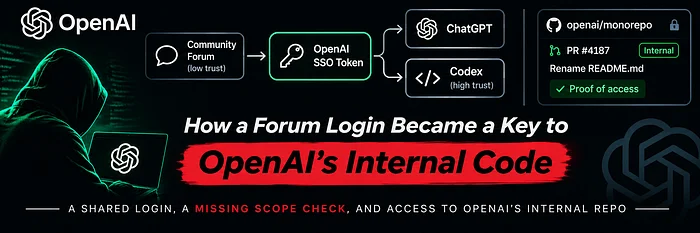
A session token issued by OpenAI's public Discourse forum was accepted as a valid login by ChatGPT and Codex, which did not check that the token was scoped for them. An attacker with a forum session could therefore take over employees' ChatGPT and Codex sessions and reach internal source control.

Bug Bounty
The full write-up lives on its author's site
It belongs to its author, so we link to it rather than copy it. The other two tabs are our own rewrites, checked against it.
Context
OpenAI runs its public community forum, community.openai.com, on Discourse, and lets people sign in to that forum with "Sign in with OpenAI" through a shared identity system. A token issued by that forum was also honoured by higher-trust products such as ChatGPT and Codex. The team's insight was that a shared login system connecting a low-stakes public forum to high-stakes internal tools is exactly the kind of boundary worth testing.
The write-up is by L4ZZ3RJ0D, published on Medium on 11 November 2026, and describes work by Harsh Jaiswal, Mohan Pedhapati and Rahul Maini at Hacktron AI in July 2026. The report was made responsibly, and the issue was fixed in roughly 14 hours and paid a $6,500 bounty. The team's own technical writeup is at Hacking OpenAI.
Setup
The team did not start with a scanner pointed at OpenAI's infrastructure. They started with a hypothesis formed from how OpenAI's services fit together: a shared login system connecting a public forum to internal tools is exactly the kind of boundary worth testing.
Proving the hypothesis required a session inside the forum first. That is where the memory-corruption work comes in, and it is worth being clear about its role. The report leans on a heap buffer overflow in an image-decoding library, discovered and weaponised largely by directing Claude through the process rather than hand-writing the exploit. That part is a story about where AI-assisted security research stands, but it is not what the bounty was paid for. The access-control flaw underneath it is.
Discourse was routing a specific image format through a chain ending in a library called libheif. A security fix had gone out upstream quietly, without being flagged as a security fix and without a CVE attached, and it had never made it into the Debian packages that Discourse's own Docker image was built on. A fix existing upstream does not help if the build you are running never received it, and nobody downstream had reason to check, because the original commit did not advertise itself as something worth backporting urgently.
Finding it
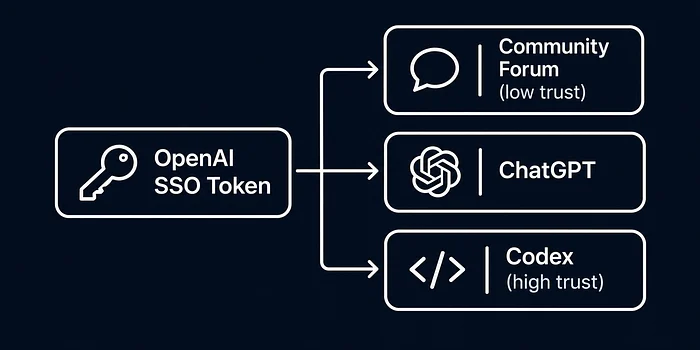
The insight, before touching a single exploit, was structural. A shared login system connecting a low-stakes public forum to high-stakes internal tools like ChatGPT and Codex is a boundary worth testing, because shared identity infrastructure only works safely if every service on the other end checks not just that a token is valid, but that it is valid for the specific thing being asked of it.
Exploitation
Step 1: get code execution on the forum
The memory-corruption chain, reached through Discourse's image handling and ending in libheif, gave the team working code execution on the forum. This was a means to an end: it produced a session on the forum from which the identity question could be tested.
Step 2: present the forum session token to ChatGPT and Codex
With a session token issued by the forum, meant for nothing more than reading and posting on a help board, the team tested whether ChatGPT and Codex would honour it. They did. It was honoured as a fully valid login, with no re-check at the boundary of either application asking whether the token was meant for it or only for the forum that issued it.
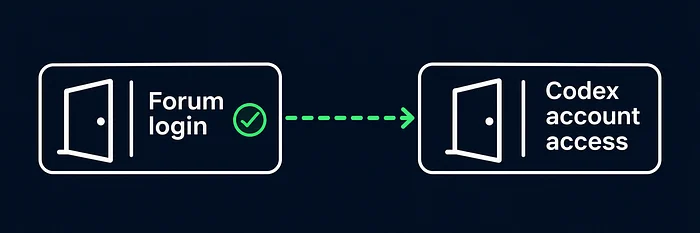
The consequence is conditional on who else had logged in through the same path. Depending on which OpenAI employees happened to have logged in that way, the forum session could be used to step straight into their live ChatGPT and Codex sessions, with no further interaction needed from them at all.
Step 3: prove reach without reading source
To demonstrate real-world severity without crossing a line into reading anything they should not, the team took over one employee's account whose Codex environment was connected to OpenAI's own internal GitHub organisation. Using that compromised Codex session, they opened a single, deliberately harmless pull request inside OpenAI's internal monorepo: nothing more than a renamed README file. That proved the access chain reached all the way to production source control without touching proprietary code. Then they stopped, reported, and waited.
Root cause
The root failure was a single sentence's worth of missing logic somewhere in OpenAI's identity infrastructure: a check that should have asked whether a token is scoped for the service receiving it, and never did. A check that should have asked whether a token is scoped for the service receiving it never did.
Shared single sign-on is supposed to make identity management across many services easier and more consistent, but every service trusting the same identity provider has to independently enforce that a token issued for purpose A does not quietly unlock purpose B just because both trust the same login screen. The forum, the image library and AI-assisted exploit development are incidental. The boundary between low-stakes and high-stakes surfaces was not as separate as the org chart implied.
Impact
An attacker who obtains a forum session token, in this case via code execution on the forum, could, depending on which OpenAI employees had logged in through the same path, step into their live ChatGPT and Codex sessions without any further action from them. In the demonstrated case, that reached an employee's Codex environment connected to OpenAI's internal GitHub organisation, enough to open a pull request in the internal monorepo. The team limited themselves to a renamed README and did not read OpenAI's source code. The report notes that OpenAI explicitly excluded part of what the team did from the bounty's scope, and the team said so plainly rather than inflating the story.
Fix
The report states that the issue was fixed in roughly 14 hours and paid a $6,500 bounty. It does not describe the change itself. The fix the report argues for is scope enforcement at every service that accepts a token from the shared identity provider: each service must verify that the token was issued for it, not merely that it is validly signed.
Variants to test
- Forum plus main application on one identity provider. Sign in to the low-stakes surface, capture the session token, and present it to the high-stakes surface. A positive result is a full authenticated session on the second service without a fresh login.
- Support portal plus billing dashboard. Mint a token on the support portal and replay it against billing endpoints. A positive result is access to billing data or actions that the support token was never meant to authorise.
- Marketing site plus admin panel. Obtain a session from the public site's login and send it to the admin panel. A positive result is an admin session or any admin-only response.
- Any multi-surface target sharing a login. Before running any exploit tooling, map which surfaces share the identity provider and ask by hand whether a token from the unimportant side is checked for scope before the important side accepts it. A positive result is any important-side surface that trusts the signature alone.
Happy hunting, see you in the next scope.
What happened, in plain words
OpenAI runs a public discussion website, a forum, at community.openai.com. Anyone can read it and, if they have an OpenAI account, sign in to it using a button labelled "Sign in with OpenAI". That button is not a separate password kept by the forum: it hands the login job to a shared OpenAI identity system.
A group of security researchers at Hacktron AI, Harsh Jaiswal, Mohan Pedhapati and Rahul Maini, asked a simple question in July 2026: if you get a login token from the forum, a place where the worst thing you can do is post a message, will the serious products, ChatGPT and Codex, also accept that same token as a valid login? The answer was yes. That is the bug OpenAI paid a $6,500 bounty to fix, and the report says it was fixed in roughly 14 hours.
Getting a token from the forum in the first place required breaking into the forum, which they did through a flaw in an image-processing library. That part is a separate, more technical story. The part that matters here is the missing check: the serious services never asked whether a token was meant for them.
This piece is by L4ZZ3RJ0D, published on Medium on 11 November 2026. The team's own technical writeup is at Hacking OpenAI. The report was made responsibly, and the team was upfront that OpenAI explicitly excluded part of what they did from the bounty's scope, and said so plainly rather than inflating the story.
The words you need first
Before the steps, a handful of everyday ideas. None of them require any security background.
- A website login is like a cloakroom ticket. You show your ID once at the desk, and the attendant gives you a ticket. For the rest of the evening you show the ticket, not your ID, and you get your coat back. The ticket is only supposed to work at that one cloakroom.
- A token is that ticket in software form: a long string of characters that a server gives your browser after you log in. Your browser sends it back with every request so the server knows who you are without asking for your password again.
- A cookie is simply the little box your browser keeps tokens in. When people say "the session cookie", they mean the token stored in the browser for one site.
- Single sign-on (SSO) is the arrangement where one login works across many different websites. Think of a building pass that opens the front door, the lift and your own office. Convenient, but only safe if each door checks that your pass is allowed through that particular door.
- An identity provider is the company or system that issues the pass. Here it is OpenAI's shared login system.
- A service is any website or application that accepts that pass: the forum, ChatGPT, Codex.
- Scope is the list of places a pass is meant to work. A forum token's scope is "read and post on the help board". It should not include "open ChatGPT" or "open Codex".
- An API is the way one piece of software talks to another over the internet, without a human clicking. If a website is a waiter taking your order, the API is the kitchen door where orders are passed through. When the report says a service "accepts a token", it means the API behind that service accepted it.
- Discourse is the software OpenAI uses to run its forum. It is a ready-made product that many companies install to host their own discussion boards.
- Docker is a way of packaging software, with all the pieces it depends on, into a single box called an image, so it runs the same everywhere. If a piece inside the box is out of date, the whole box is out of date.
- Debian is one of the long-running families of Linux, the operating system most servers run on. Discourse's Docker image is built on Debian packages, which are pre-packaged bundles of software.
libheifis a small piece of software that reads a particular image format (HEIF, the format used by many phone cameras). Discourse uses it when someone uploads such an image.- A CVE is a public catalogue number given to a known security flaw, so everyone can refer to the same bug by the same name. A fix without a CVE is easy to miss.
- A heap buffer overflow is a classic programming mistake where a program writes more data into a memory area than that area can hold, spilling into neighbouring memory. In the wrong hands it can let an attacker run their own instructions on the server. Think of pouring a litre of water into a half-litre glass: the excess goes somewhere it was never meant to go.
- Code execution means an attacker has managed to make the server run instructions of their choosing. It is the difference between reading a locked door and holding the key.
- Access control is the set of rules about who is allowed to do what. An access-control flaw is when those rules are missing or too loose.
- A pull request is a proposed change to a shared code repository. You suggest an edit, and someone else reviews and merges it. Opening one is a visible, harmless way of proving you can write to a codebase.
- A monorepo is a single code repository holding many projects together, rather than one repository per project.
- GitHub is the website where code repositories live and where pull requests are opened.
The setup: why they looked here at all
The team did not start by pointing an automated scanner at OpenAI's servers. They started by thinking about how the pieces fit together. A public forum and internal tools sharing one login system is exactly the kind of seam worth testing, because shared login only works safely if every service on the other end checks not just that a token is valid, but that it is valid for the specific thing being asked of it.
That is the whole idea in one sentence. A cloakroom ticket proves the attendant gave you something. It does not prove you are entitled to a coat from a different cloakroom.
Getting into the forum first
To test the idea, they needed a real session on the forum. That is where the image library comes in, and it is worth being clear about its role: it was a means to an end, not the point of the exercise.
Discourse was routing a specific image format through a chain of software ending in libheif. A security fix for that library had gone out upstream, quietly, without being flagged as a security fix and without a CVE attached. That fix had never made it into the Debian packages that Discourse's own Docker image was built on.
Sit with that for a moment. A fix existing somewhere upstream does not help you if the build you are actually running never received it. And nobody downstream had reason to go and check, because the original change did not advertise itself as something worth urgently copying across. It is like a recall notice for a part in your car being published in a trade journal nobody at your garage reads.
The team used that gap to get working code execution on the forum. The report notes that this part was discovered and weaponised largely by directing Claude through the process rather than hand-writing the exploit. That is a fascinating story about where AI-assisted security research stands, but it is not what the bounty was paid for. The access-control flaw underneath it is.
The test: does the forum token open ChatGPT and Codex?
With a session token issued by the forum, meant for nothing more than reading and posting on a help board, the team presented it to ChatGPT and Codex. It was accepted as a fully valid login. There was no re-check at the boundary of either application asking whether the token was meant for it, or only for the forum that issued it.
The consequence depends on who else had logged in through the same path. Depending on which OpenAI employees happened to have logged in that way, the forum session could be used to step straight into their live ChatGPT and Codex sessions, with no further interaction needed from them at all. The employee does not have to click or approve anything. Their session is reachable because it was created through the same shared login.
Proving it reached real source code, without reading any
Demonstrating that you can reach someone's session is one thing. Demonstrating that the reach matters in the real world is another, and doing it without crossing a line into reading things you should not is a third.
The team took over one employee's account whose Codex environment was connected to OpenAI's own internal GitHub organisation. Using that compromised Codex session, they opened a single, deliberately harmless pull request inside OpenAI's internal monorepo: nothing more than a renamed README file. That proved the access chain reached all the way to production source control without touching proprietary code. Then they stopped, reported, and waited.
Why a renamed README? Because it is visible and undeniable, and it changes nothing of value. It is the equivalent of proving you can get into a building by moving a chair in the lobby, rather than by reading the files in the safe.
The root cause, in one sentence
The root failure was a single sentence's worth of missing logic somewhere in OpenAI's identity infrastructure: a check that should have asked whether a token is scoped for the service receiving it, and never did. A check that should have asked whether a token is scoped for the service receiving it never did.
Shared single sign-on is supposed to make managing identity across many services easier and more consistent. But every service that trusts the same identity provider has to independently enforce that a token issued for purpose A does not quietly unlock purpose B just because both trust the same login screen. The forum, the image library and the AI-assisted exploit development are incidental. The boundary between low-stakes and high-stakes surfaces was not as separate as the org chart implied.
What the impact was
An attacker who obtains a forum session token, in this case via code execution on the forum, could, depending on which OpenAI employees had logged in through the same path, step into their live ChatGPT and Codex sessions without any further action from them. In the demonstrated case, that reached an employee's Codex environment connected to OpenAI's internal GitHub organisation, enough to open a pull request in the internal monorepo. The team limited themselves to a renamed README and did not read OpenAI's source code.
The fix
The report states that the issue was fixed in roughly 14 hours and paid a $6,500 bounty. It does not describe the change itself. The fix the report argues for is scope enforcement at every service that accepts a token from the shared identity provider: each service must verify that the token was issued for it, not merely that it is validly signed.
In cloakroom terms: every attendant checks the ticket number against the cloakroom they are standing in, not just that the ticket is genuine.
Variants worth testing on your own targets
These are the same ideas applied to other setups. The pattern is always the same: a token from the unimportant side, presented to the important side.
- Forum plus main application on one identity provider. Sign in to the low-stakes surface, capture the session token, and present it to the high-stakes surface. A positive result is a full authenticated session on the second service without a fresh login.
- Support portal plus billing dashboard. Mint a token on the support portal and replay it against billing endpoints. A positive result is access to billing data or actions that the support token was never meant to authorise.
- Marketing site plus admin panel. Obtain a session from the public site's login and send it to the admin panel. A positive result is an admin session or any admin-only response.
- Any multi-surface target sharing a login. Before running any exploit tooling, map which surfaces share the identity provider and ask by hand whether a token from the unimportant side is checked for scope before the important side accepts it. A positive result is any important-side surface that trusts the signature alone.
The lesson to carry into your own work: any time you are testing a target that has more than one surface sharing a login system, a forum and a main app, a support portal and a billing dashboard, a marketing site and an admin panel, the one question worth asking by hand before touching any exploit tooling at all is whether a token minted on the unimportant side is actually checked for scope before the important side accepts it, or whether every surface is just trusting the same signature and calling it a day.
That is not a bug you find by fuzzing an endpoint. It is a bug you find by actually mapping out how a company's services connect to each other and asking, deliberately, whether the boundaries between low stakes and high stakes are as separate as the org chart implies.
Happy hunting, see you in the next scope.
Glossary
- Access control: the rules about who is allowed to do what on a system.
- API: the channel through which one piece of software talks to another over the internet, without a human clicking.
- Bounty: a reward a company pays a researcher for reporting a security flaw responsibly.
- Code execution: a situation where an attacker can make a server run instructions of their choosing.
- Cookie: the small store in your browser where a site keeps your session token.
- CVE: a public catalogue number given to a known security flaw so everyone can refer to the same bug.
- Debian: a long-running family of Linux, the operating system most servers run on.
- Discourse: the ready-made forum software OpenAI uses for
community.openai.com. - Docker: a way of packaging software and its dependencies into one box, called an image, so it runs the same everywhere.
- Heap buffer overflow: a programming mistake where a program writes more data into a memory area than it can hold, spilling into neighbouring memory, which can let an attacker run their own instructions.
- Identity provider: the system that issues login tokens and vouches for who you are.
libheif: a small library that reads a particular image format (HEIF), used by Discourse when someone uploads such an image.- Monorepo: a single code repository holding many projects together.
- Pull request: a proposed change to a shared code repository, which someone else reviews before it is merged.
- Scope: the list of services and actions a token is meant to be used for.
- Service: any website or application that accepts a token from the identity provider.
- Session: the period during which a server remembers you as logged in, identified by your token.
- Single sign-on (SSO): one login that works across many different websites.
- Token: a string of characters a server gives your browser after login, which your browser sends back so the server knows who you are.


