How a Predictable Activity ID Bypassed an Unguessable Invite Link and Earned Me a $1,000 Bounty
A private activity-planning application used long, unguessable invitation links to protect private activities, but the backend also exposed each activity through a short, sequential numeric ID. An attacker with an ordinary account could change the HTTP method from DELETE to GET and supply a numeric ID to retrieve private activity details and the invitation link, and could enumerate other private activities by incrementing the ID.
 Published on medium.com
Hacking
The full write-up lives on its author's site
It belongs to its author, so we link to it rather than copy it. The other two tabs are our own rewrites, checked against it.
Context
The target was an activity-planning application. Users create activities, choose a destination, optionally add a route, and set the activity's visibility. A private activity is not meant to be discoverable by other users: the organizer receives a long, unguessable invitation link that has to be shared directly with the people who are allowed to participate.
The expected access model was:
- The organizer creates a private activity.
- The application generates an unguessable invitation link.
- The organizer sends the link to selected participants.
- Only users who receive the link can access the private activity.
Guessing the complete invitation link would have been extremely difficult, so on the surface the design looked sound. The problem was that the same activity was also represented internally by a much shorter, predictable numeric ID. The affected API was primarily associated with the company's mobile application, although it was also reachable through a web interface. The company, application, hostname, API paths, usernames and identifying values are redacted in this write-up.
Setup
The researcher used two ordinary accounts on the same application:
- A first account, which acted as the organizer and created the private activity.
- A second account, which had not created the activity, had not been invited to it and did not possess the invitation link.
Traffic was inspected and modified with Burp Suite. No special role, privilege or precondition beyond a normal account was needed. The researcher also notes that the enumeration step could be automated with a tool such as Burp Intruder.
Finding it
After creating the private activity, the researcher opened it and selected the delete option while monitoring the application's network traffic. The delete action produced a request that referenced the activity by a short numeric identifier rather than by the long invitation token:
The exact hostname and API path were removed from the write-up. The important part is ACTIVITY_ID: the backend identified the object with a short number, while the user-facing protection relied on the unguessable invitation link. That mismatch is what made the design look wrong. If the same object can be addressed by a predictable number, the secrecy of the long link protects nothing unless the server checks authorisation on every request.
Exploitation
Step 1: Create a private activity
Signed in with the first account, the researcher started a new activity and completed the creation process by:
- Selecting themselves as the activity organizer.
- Choosing a destination.
- Continuing without adding a route.
- Entering the required activity information.
- Changing the visibility from public to private.
- Finishing the creation process.
The application created the private activity and generated an unguessable invitation link for it. At that point another user should not have been able to access the activity unless the link was deliberately shared.
Step 2: Discover the internal activity ID
The researcher opened the private activity and selected the option to delete it while monitoring traffic through Burp Suite. The application generated the DELETE /[REDACTED]/[ACTIVITY_ID] request shown above. The identifier was recorded and the delete request was dropped so the activity stayed active.
Step 3: Test the identifier from a second account
The researcher signed out of the organizer account and signed in with the second account. That account had not created the private activity, had not been invited to it, did not possess the unguessable invitation link and should not have been permitted to view it.
Using the second account, the researcher took the endpoint discovered through the delete request and changed the HTTP method from DELETE to GET:
The server returned:
HTTP/2 200 OK
The response contained the private activity's information, including its invitation link. An unauthorised user could therefore bypass the long, unguessable invitation link entirely, needing only the much shorter internal numeric identifier.
Step 4: Test for enumeration
The researcher then changed the numeric activity ID to nearby values. Because the identifiers were sequential, requesting different numbers returned information about other private activities. For example, if one valid activity used an identifier such as:
52796
an attacker could test nearby values by incrementing or decrementing the number. The process could be automated with a tool such as Burp Intruder, and requests returning 200 OK indicated valid activities.
The attacker did not need to guess the unguessable invitation links: the vulnerable API returned those links after the attacker supplied a valid numeric activity ID.
Root cause
The application relied on the secrecy of the invitation link to protect private activities, but the backend API did not enforce the same access restrictions. When it received an activity ID, the server should have checked whether the requesting user was:
- The activity creator.
- An invited participant.
- An authorised member of the activity.
- Otherwise permitted to access the requested object.
Instead, the server returned the object solely because the supplied numeric ID existed. This is a classic IDOR caused by missing object-level authorisation. The long invitation link was a separate, stronger identifier for the same resource, but it was not the identifier the API actually used for access control, so its unguessability provided no protection against a request that used the numeric ID.
Impact
An attacker with an ordinary account could potentially:
- Access private activities without receiving an invitation.
- View information belonging to private activities.
- Retrieve supposedly unguessable invitation links.
- Share those invitation links with additional unauthorised users.
- Enumerate other private activities using sequential IDs.
- Automate the collection of private activity information.
The unguessable invitation link provided little protection because a separate API endpoint exposed the same resource through a predictable identifier.
Fix
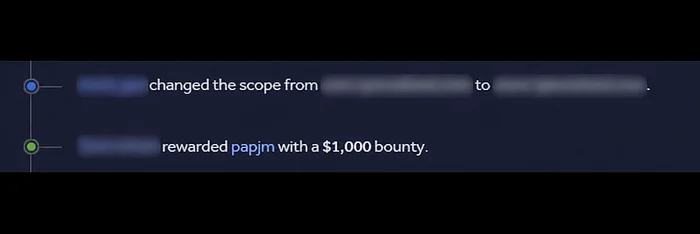
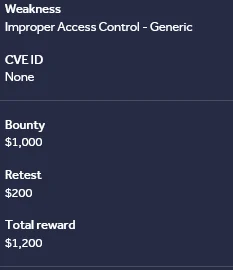
The report does not describe the code change itself. What it documents is the operational response. The vulnerability was reported in October 2023; the company accepted the report and awarded a $1,000 bounty. In June 2025 the researcher was invited to retest, repeated the original process and confirmed the issue was still reproducible, receiving an additional $50 retest reward.
In June 2026 the company contacted the researcher for another retest after attempting to block access to the vulnerable endpoint. The initial test showed the vulnerability still worked. The company then found that the affected infrastructure existed in multiple regions and that each region needed to be reconfigured. After the remaining infrastructure was updated, the researcher tested the endpoint again and unauthorised requests returned:
HTTP/2 403 Forbidden
The private activity details and invitation link were no longer accessible. The company resolved the report and awarded another $150 retest reward, bringing the total including retests to $1,200.
The lesson the researcher draws is that a long, unguessable link does not protect a resource if the same resource is available through another endpoint using a predictable identifier. Identifiers are references, not authorisation controls: every request for a private object must be protected by a server-side permission check.
Variants to test
- Method switching on a discovered endpoint. Take any object-scoped request you can generate (delete, update, archive) and replay it with
GETfrom a second account. A positive result is200 OKwith the object's data instead of403or404. - Numeric IDs in place of opaque tokens. Where the UI uses a long token or UUID, look for a parallel request that uses a short number. A positive result is the same object returned through the numeric reference.
- Sequential enumeration. Increment and decrement a known valid ID and look for
200 OKresponses on objects belonging to other users. Automate with Burp Intruder or an equivalent. - Private versus public objects. Create the same object type as private and as public, then request both from an uninvited account. A positive result is the private object returning the same data as the public one.
- Ownership and membership checks. Test objects where you are neither creator nor member, and objects where you are a member but not the creator. A positive result is access in either case where the application's model says you should be denied.
- Multi-region deployments. After a fix is announced, retest against every region or hostname that serves the API. A positive result is the vulnerable behaviour persisting on an infrastructure segment that was not reconfigured.
What happened, in plain words
Imagine you organise a private party. Instead of telling people the address, you give each guest a very long, random password that they must type to get in. Nobody could ever guess that password, so the party feels safe. But the venue also has a simple door number, like 52796, painted on the wall. If anyone can walk up to that door number and be let in without the password, the long password was never really protecting anything.
That is essentially what happened in this report. An activity-planning application let people create activities (think of a trip, a meetup or an outing) and mark them as private. Private activities were protected by a long, unguessable invitation link. But the same activity could also be reached through a short, predictable number, and the server did not check whether the person asking was allowed to see it. The researcher used a second, ordinary account to fetch a private activity it had never been invited to, and the server handed over the activity's details plus its secret invitation link. Because the numbers ran in sequence, an attacker could walk through them one by one and collect many private activities.
The researcher reported the issue in October 2023 and received a $1,000 bounty. Two retests followed, in June 2025 and June 2026, adding $50 and $150, for $1,200 in total. The company, application, hostname, API paths, usernames and identifying values are redacted in the write-up.
The product and the feature
The target was an activity-planning application. Users create activities, choose a destination, optionally add a route, and set the activity's visibility. A private activity is not meant to be discoverable by other users: the organiser receives a long, unguessable invitation link that has to be shared directly with the people who are allowed to participate.
The expected access model was:
- The organiser creates a private activity.
- The application generates an unguessable invitation link.
- The organiser sends the link to selected participants.
- Only users who receive the link can access the private activity.
Guessing the complete invitation link would have been extremely difficult, so on the surface the design looked sound. The problem was that the same activity was also represented internally by a much shorter, predictable numeric ID. The affected API was primarily associated with the company's mobile application, although it was also reachable through a web interface.
A few words you will meet constantly
- An API (Application Programming Interface) is the part of a website or app that the browser or phone app talks to behind the scenes. When you click a button, your browser does not usually load a whole new page; it sends a small request to the API, and the API answers with data. Think of a restaurant: the menu and the waiter are the interface, the kitchen is the API, and your order is the request.
- A request is a message your browser sends to a server, asking it to do something: show a page, save a change, delete an item. A response is the server's answer, including a status code such as
200 OK(it worked) or403 Forbidden(you are not allowed). - An endpoint is one specific address inside the API that handles one kind of request, for example the address that handles deleting an activity.
- An HTTP method is the verb at the start of a request.
GETmeans "give me this",DELETEmeans "remove this". The same address can behave differently depending on the verb. - An ID (identifier) is a label the system uses to tell one object from another, like a customer number. A numeric ID is simply an ID made of digits, such as
52796. - A token or invitation link here is a long random string that is very hard to guess. It works like a password embedded in a link: if you have it, you are in.
- Authorisation means checking whether the person making a request is allowed to do what they are asking. Authentication is the earlier step of proving who you are (logging in).
- An IDOR (Insecure Direct Object Reference) is a vulnerability where the application lets you reach an object just by naming its ID, without checking that the object belongs to you or that you are allowed to see it. It is like a hotel where any room key opens any door as long as you know the room number.
Setup
The researcher used two ordinary accounts on the same application:
- A first account, which acted as the organiser and created the private activity.
- A second account, which had not created the activity, had not been invited to it and did not possess the invitation link.
Traffic was inspected and modified with Burp Suite. Burp Suite is a tool that sits between your browser and the server and lets you read every request and response, and change a request before it is sent. Think of it as a recording device plus an editing desk for the conversation between browser and server. No special role, privilege or precondition beyond a normal account was needed. The researcher also notes that the enumeration step could be automated with a tool such as Burp Intruder, which sends the same request many times with one part changed each time (for example, a different number).
Finding it
After creating the private activity, the researcher opened it and selected the delete option while monitoring the application's network traffic. The delete action produced a request that referenced the activity by a short numeric identifier rather than by the long invitation token:
Line by line:
DELETEis the HTTP method: the browser is asking the server to remove something./[REDACTED]/[ACTIVITY_ID]is the path, the part of the address that says which object is meant. The first segment has been removed from the write-up, and[ACTIVITY_ID]is a placeholder for the short number the application actually used.
The exact hostname and API path were removed from the write-up. The important part is ACTIVITY_ID: the backend identified the object with a short number, while the user-facing protection relied on the unguessable invitation link. That mismatch is what made the design look wrong. If the same object can be addressed by a predictable number, the secrecy of the long link protects nothing unless the server checks authorisation on every request.
Why this step mattered: the delete request is a convenient place to see the internal ID because the app has to tell the server exactly which activity to delete. The delete request is a convenient place to see the internal ID because the app has to tell the server exactly which activity to delete. That revealed the number the app uses behind the scenes.
Exploitation
Step 1: Create a private activity
Signed in with the first account, the researcher started a new activity and completed the creation process by:
- Selecting themselves as the activity organiser.
- Choosing a destination.
- Continuing without adding a route.
- Entering the required activity information.
- Changing the visibility from public to private.
- Finishing the creation process.
The application created the private activity and generated an unguessable invitation link for it. At that point another user should not have been able to access the activity unless the link was deliberately shared.
Why this step mattered: you need a real private object to test against. Creating it yourself means you know exactly what it contains and who should be allowed to see it, so any access from the second account is clearly wrong.
Step 2: Discover the internal activity ID
The researcher opened the private activity and selected the option to delete it while monitoring traffic through Burp Suite. The application generated the DELETE /[REDACTED]/[ACTIVITY_ID] request shown above. The identifier was recorded and the delete request was dropped so the activity stayed active.
Why this step mattered: the delete request is a reliable way to see the internal ID. Dropping the request (not letting it reach the server) is important: if it went through, the activity would be gone and there would be nothing left to test.
Step 3: Test the identifier from a second account
The researcher signed out of the organiser account and signed in with the second account. That account had not created the private activity, had not been invited to it, did not possess the unguessable invitation link and should not have been permitted to view it.
Using the second account, the researcher took the endpoint discovered through the delete request and changed the HTTP method from DELETE to GET:
Line by line:
GETis the HTTP method: "give me this object".- The path is the same as before, with the same redacted segment and the same
[ACTIVITY_ID]placeholder. Only the verb changed.
The server returned:
HTTP/2 200 OK
Line by line:
HTTP/2is the version of the protocol used for the conversation.200 OKis the status code meaning the request succeeded and the server is sending the data back.
The response contained the private activity's information, including its invitation link. An unauthorised user could therefore bypass the long, unguessable invitation link entirely, needing only the much shorter internal numeric identifier.
Why this step mattered: changing the verb is a classic test. An endpoint built for deleting an object may also answer other verbs, so a GET can return the object. Using the second account is what makes the result meaningful: the same request from the organiser would prove nothing.
Step 4: Test for enumeration
The researcher then changed the numeric activity ID to nearby values. Because the identifiers were sequential, requesting different numbers returned information about other private activities. For example, if one valid activity used an identifier such as:
52796
an attacker could test nearby values by incrementing or decrementing the number. The process could be automated with a tool such as Burp Intruder, and requests returning 200 OK indicated valid activities.
Why this step mattered: a single leaked activity is bad, but a predictable sequence turns it into a mass problem. If 52796 works, then 52795 and 52797 probably belong to other people. A tool can try many numbers and keep the ones that answer 200 OK.
The attacker did not need to guess the unguessable invitation links: the vulnerable API returned those links after the attacker supplied a valid numeric activity ID.
Root cause
The application relied on the secrecy of the invitation link to protect private activities, but the backend API did not enforce the same access restrictions. When it received an activity ID, the server should have checked whether the requesting user was:
- The activity creator.
- An invited participant.
- An authorised member of the activity.
- Otherwise permitted to access the requested object.
Instead, the server returned the object solely because the supplied numeric ID existed. This is a classic IDOR caused by missing object-level authorisation. The long invitation link was a separate, stronger identifier for the same resource, but it was not the identifier the API actually used for access control, so its unguessability provided no protection against a request that used the numeric ID.
In everyday terms: the bouncer checked the password at the front door, but there was a side door with a number on it and nobody standing there.
Impact
An attacker with an ordinary account could potentially:
- Access private activities without receiving an invitation.
- View information belonging to private activities.
- Retrieve supposedly unguessable invitation links.
- Share those invitation links with additional unauthorised users.
- Enumerate other private activities using sequential IDs.
- Automate the collection of private activity information.
The unguessable invitation link provided little protection because a separate API endpoint exposed the same resource through a predictable identifier.
Fix
The report does not describe the code change itself. What it documents is the operational response. The vulnerability was reported in October 2023; the company accepted the report and awarded a $1,000 bounty. In June 2025 the researcher was invited to retest, repeated the original process and confirmed the issue was still reproducible, receiving an additional $50 retest reward.
In June 2026 the company contacted the researcher for another retest after attempting to block access to the vulnerable endpoint. The initial test showed the vulnerability still worked. The company then found that the affected infrastructure existed in multiple regions and that each region needed to be reconfigured. After the remaining infrastructure was updated, the researcher tested the endpoint again and unauthorised requests returned:
HTTP/2 403 Forbidden
Line by line:
HTTP/2is again the protocol version.403 Forbiddenis the status code meaning the server understood the request but refuses to allow it. This is the answer you want for a request from someone who is not allowed to see the object.
The private activity details and invitation link were no longer accessible. The company resolved the report and awarded another $150 retest reward, bringing the total including retests to $1,200.
The lesson the researcher draws is that a long, unguessable link does not protect a resource if the same resource is available through another endpoint using a predictable identifier. Identifiers are references, not authorisation controls: every request for a private object must be protected by a server-side permission check.
Variants to test
- Method switching on a discovered endpoint. Take any object-scoped request you can generate (delete, update, archive) and replay it with
GETfrom a second account. A positive result is200 OKwith the object's data instead of403or404. - Numeric IDs in place of opaque tokens. Where the UI uses a long token or UUID, look for a parallel request that uses a short number. A positive result is the same object returned through the numeric reference.
- Sequential enumeration. Increment and decrement a known valid ID and look for
200 OKresponses on objects belonging to other users. Automate with Burp Intruder or an equivalent. - Private versus public objects. Create the same object type as private and as public, then request both from an uninvited account. A positive result is the private object returning the same data as the public one.
- Ownership and membership checks. Test objects where you are neither creator nor member, and objects where you are a member but not the creator. A positive result is access in either case where the application's model says you should be denied.
- Multi-region deployments. After a fix is announced, retest against every region or hostname that serves the API. A positive result is the vulnerable behaviour persisting on an infrastructure segment that was not reconfigured.
Glossary
- API: the part of a website or app that the browser or phone app talks to behind the scenes to fetch or change data.
- Request: a message your browser sends to a server asking it to do something.
- Response: the server's answer to a request, including a status code and usually some data.
- Endpoint: one specific address inside an API that handles one kind of request.
- HTTP method: the verb at the start of a request, such as
GET(fetch) orDELETE(remove). - Status code: a three-digit number in a response saying how it went, for example
200 OK(success) or403 Forbidden(not allowed). - ID: a label the system uses to tell one object from another.
- Numeric ID: an ID made of digits, such as
52796. - Token: a long random string that is very hard to guess and acts like a password.
- Invitation link: a link containing a long random token that grants access to a private activity.
- Authentication: proving who you are, usually by logging in.
- Authorisation: checking whether the person making a request is allowed to do what they are asking.
- Object-level authorisation: an authorisation check on one specific object, such as one activity, rather than on the whole application.
- IDOR (Insecure Direct Object Reference): a vulnerability where naming an object's ID is enough to reach it, because the server does not check that you are allowed to see that object.
- Enumeration: trying many values one after another (for example, nearby numbers) to find the ones that exist or are accessible.
- Sequential ID: an ID that increases by one for each new object, so neighbouring numbers belong to other objects.
- Burp Suite: a tool that sits between your browser and the server so you can read and change requests and responses.
- Burp Intruder: a part of Burp Suite that sends the same request many times with one part changed each time, used for enumeration.
- Redacted: removed or hidden from a published write-up, usually to protect the company and its users.
- Bounty: a reward paid by a company to a researcher who reports a security problem.
- Retest: repeating the original test after a fix to check whether the problem is really gone.
- Multi-region deployment: running the same application on several separate sets of servers in different places, so a fix must be applied to each one.



