How I Got My NASA Hall of Fame: A Unique Twist on Google Dorking
A 13-year-old NASA article contained a social media link with a typo in the domain path, pointing to an unregistered page. An attacker could register that page and impersonate NASA to phish users who clicked the official link.

medium.com
Published on medium.com
Bug Bounty
The full write-up lives on its author's site
It belongs to its author, so we link to it rather than copy it. The other two tabs are our own rewrites, checked against it.
Context
NASA runs a vulnerability disclosure programme (VDP) on Bugcrowd, and the scope is described in the report as massive. The target in this case was a news article hosted on a *.*.nasa.gov subdomain, which the author describes as the highly trusted Laboratory domain. The feature involved is mundane: a social media section at the bottom of an old article, headed "Find Solar System Exploration at…", containing an outbound link to a social media page.
Normally such a link takes a reader from the NASA article to an official NASA or JPL social media presence. Here the link was broken, and the domain it pointed at was unregistered, which turns a dead link into an asset an attacker can claim.
Setup
The researcher worked against the NASA VDP on Bugcrowd. No specific tooling versions are given. The approach was deliberately manual: Google search operators (dorks) run against the NASA domains, followed by reading the pages returned. The report notes that before this finding the author had submitted four reports to the programme, with the following outcomes:
| Result | Count |
|---|---|
| Informative (Info) | 2 |
| Duplicate | 1 |
| Accepted P4 | 1 (this one) |
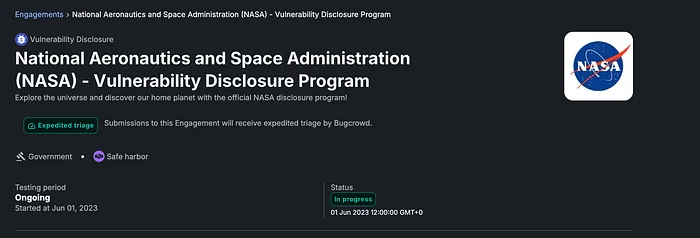
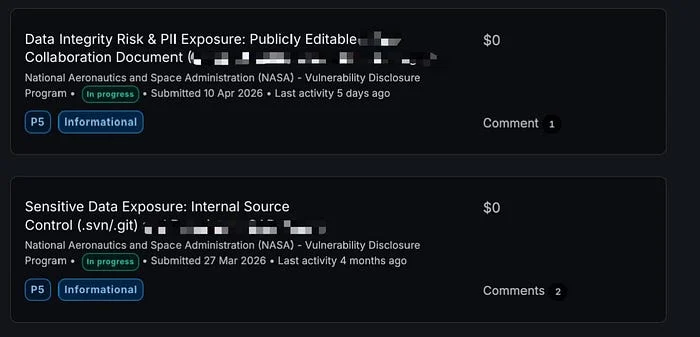
The two Informative reports came from dorking for exposed directories, hidden admin panels and log files, which the author cites as the reason for changing approach. The precondition for the finding is that the misspelled domain was unregistered, which the report states the link led to.
Finding it
The reasoning started from a shift away from automated enumeration. Enumerating subdomains, checking for alive hosts and fuzzing parameters across an infrastructure of NASA's size produced too much noise, so the author moved to targeted dorking instead.
The dorking strategy was to search for pages on NASA domains that link out to social media platforms, which surfaces old articles with social media sections. The operators used were:
site:example.com ("facebook.com" OR "instagram.com" OR "twitter.com" OR "youtube.com")site:*.example.com ("facebook.com" OR "instagram.com" OR "twitter.com" OR "youtube.com")site:*.*.example.com ("facebook.com" OR "instagram.com" OR "twitter.com" OR "youtube.com")
Each line narrows the host pattern further: the bare domain, then any subdomain, then a two-level subdomain, while requiring one of the four social platform strings to appear on the page. In the article the placeholder example.com stands in for the NASA domain.
This led to a 13-year-old news article on the *.*.nasa.gov Laboratory domain. Scrolling to the bottom, the researcher found the social media section and read the link target. The URL contained a typographical error:
- Incorrect:
https://social-media-page.com/oursolarssytem - Expected:
https://social-media-page.com/oursolarsystem
The letters y and t are transposed in system. Because of the typo the link pointed at a page that did not exist and whose domain was unregistered, so the destination was entirely abandoned.
Exploitation
Step 1: Confirm the destination is unclaimed
The researcher checked the misspelled URL and found it led to a completely unregistered page. This is the condition that makes the bug exploitable: a broken link alone is only a quality issue, but a broken link whose destination can be bought is a hijacking opportunity.
Step 2: Register the page to demonstrate control
To prove impact for responsible disclosure without causing harm, the author registered the misspelled page. The report does not name the registrar, the domain or the hosting used.
Step 3: Publish a defanged disclaimer
The registered page was set up with a defanged disclaimer stating that it existed purely for VDP security research. This demonstrates that whoever controls the destination controls what a visitor arriving from the NASA article sees, while making clear that no phishing content was served. The report does not include the page's HTML or wording.
Step 4: Report and triage
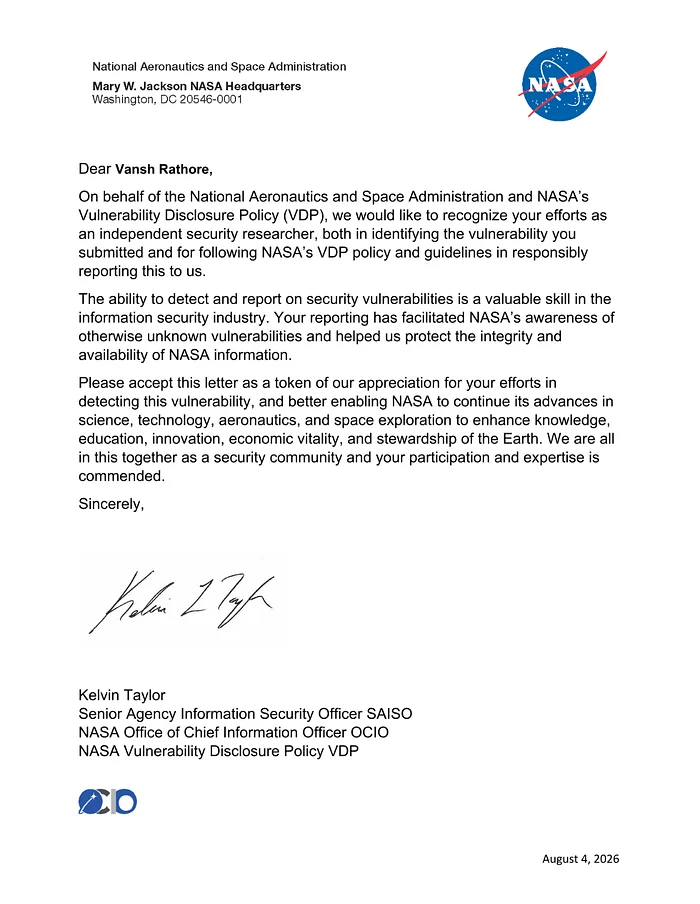
The report was submitted to the NASA VDP on Bugcrowd. The Bugcrowd team triaged it, NASA fixed the article, and a few days later the author received the official VDP Letter of Recognition.
Root cause
The mistake is a typographical error in a hard-coded outbound URL inside the article's social media section. The link sat in the article's social media section, so a reader had no signal that anything was wrong. Because the misspelled domain was never registered, the link resolved to nothing, and nothing in the publishing workflow caught either the typo or the dead destination. The report does not describe any link checking or review process for this article.
The weakness class given in the report is CWE-601, URL redirection to an untrusted site, framed here as brand impersonation: the trusted .gov origin lends its credibility to whatever the destination later becomes.
Impact
A broken link on a highly trusted .gov domain can be claimed by anyone. An attacker could register the misspelled page, place official-looking NASA or JPL logos on it, and run phishing campaigns. Users who click the link from the official NASA article would have no reason to suspect they had landed on an attacker-controlled page, because the link came from the agency's own site.
The impact depends on the misspelled destination remaining unregistered, and on readers following the link from the article. The author demonstrated the risk by registering the page and serving only a research disclaimer, not by running any campaign.
Fix
NASA fixed the article after triage.
Variants to test
- Run the same social-platform dorks against other large government or enterprise domains, varying the host depth (
site:,site:*.,site:*.*.). A positive result is an old page whose social links point at a misspelled or otherwise unregistered destination. - Check every outbound link on old news and press pages for typos in the domain or path, especially where the link text hides the URL. A positive result is a link whose target domain does not resolve or is available for registration.
- Look for links to platforms that have since been renamed or shut down, where the old domain may have lapsed. A positive result is a lapsed domain still referenced from a trusted page.
- Confirm registration status of any suspicious destination before reporting, and if you register it, serve only a clearly labelled research disclaimer. A positive result is a page you control being reachable from the trusted site's link.
What happened, in plain words
A security researcher found a small mistake on an old NASA web page: a link at the bottom of a news article pointed to a web address with a typo in it. Because of the typo, that address did not belong to anyone. Anyone in the world could buy it and put their own page there. The researcher registered it, put up a defanged disclaimer stating it was for VDP security research, and reported the problem. NASA fixed the article, and the researcher received an official letter of recognition from NASA's bug bounty programme.
That is the whole story. No clever hacking tools, no breaking into servers. Just a typo, a search engine, and the patience to look at old pages that everyone else ignores.
This article walks through it from the beginning, assuming you have never done anything in security before. Every term is explained the first time it appears.
Some background first: what is a bug bounty programme?
Companies and government agencies know that their websites may contain mistakes that could be abused. Rather than wait for criminals to find them, many organisations invite outside people to look for these mistakes and report them. This invitation is called a vulnerability disclosure programme, or VDP. A VDP is usually run without payment: you report the problem, the organisation fixes it, and you get recognition, such as your name on a public list (often called a hall of fame) or a letter thanking you.
A bug bounty programme is similar, but it pays money for valid reports. The amount depends on how serious the problem is, and programmes often use severity ratings such as P1 (most serious) down to P4 (least serious but still valid).
Bugcrowd is a company that runs these programmes on behalf of organisations. Researchers submit their reports through Bugcrowd's website, and Bugcrowd's staff (called triagers) read each report, check whether it is valid, and pass it on to the organisation.
NASA runs a VDP on Bugcrowd. The researcher in this story had submitted four reports to it before the one that worked:
| Result | Count |
|---|---|
| Informative (Info) | 2 |
| Duplicate | 1 |
| Accepted P4 | 1 (this one) |
What those results mean:
- Informative (Info): the report described something real, but it was not considered a security problem worth acting on. It was noted, then closed.
- Duplicate: someone else had already reported the same issue.
- Accepted P4: the report was valid and accepted, at the lowest severity level. This is the one that earned the recognition.
The two Informative results came from searching for things like exposed folders, hidden admin pages and log files. Those searches turned up material that looked interesting but was not actually a vulnerability. That experience is what pushed the researcher to change approach, as described below.
The problem with doing too much
NASA's web presence is enormous. It includes many different websites, and each website can have many subdomains. A subdomain is a prefix added to a main domain name: if the main domain is nasa.gov, then something.nasa.gov is a subdomain of it, and a.b.nasa.gov is a subdomain of a subdomain. Large organisations can have thousands of them.
A common approach in security testing is to automate the search: use software to list every subdomain, check which ones respond, and try many different inputs on each one to see if anything breaks. This is called enumeration (listing things) and fuzzing (throwing lots of varied inputs at a system to see how it reacts).
The researcher's conclusion was that on an infrastructure this large, that approach produces too much noise. "Noise" here means a flood of results that mostly do not matter, which makes it hard to spot the one thing that does. So the plan changed: stop relying on automated scanners, and instead be precise. Search for something specific, then read what you find with your own eyes.
What a Google dork is
A Google dork is simply a search query that uses special operators to narrow results in a way ordinary typing does not. You have probably used Google with quotation marks to search for an exact phrase. Dorks go further: they can restrict results to a particular website, or require that certain words appear on the page.
The two operators used here:
site:restricts results to a given domain.site:nasa.govreturns only pages on that domain.OR(in capitals) means "either of these".("a" OR "b")matches pages containingaor containingb.
Security researchers use dorks to find pages that search engines have indexed but that nobody is paying attention to any more: old articles, forgotten sections, pages that were published years ago and never updated.
The researcher's idea was to combine dorking with a very simple class of bug called broken link hijacking. A broken link is a link on a website that no longer leads anywhere useful. Hijacking means taking control of where it leads. If a link points to a web address that nobody owns, anyone can buy that address and decide what appears when someone clicks the link. The trusted website is then, without meaning to, sending its visitors to a page controlled by a stranger.
The search that found it
The goal was to find NASA pages that link out to social media platforms. Old news articles often end with a section listing the organisation's Facebook, Instagram, Twitter and YouTube pages, so searching for those platform names on NASA domains should surface exactly those articles.
The queries used were:
site:example.com ("facebook.com" OR "instagram.com" OR "twitter.com" OR "youtube.com")site:*.example.com ("facebook.com" OR "instagram.com" OR "twitter.com" OR "youtube.com")site:*.*.example.com ("facebook.com" OR "instagram.com" OR "twitter.com" OR "youtube.com")
Line by line, in plain words:
site:example.com (...)asks Google for pages on the main domain that contain at least one of the four social media addresses.example.comis a placeholder standing in for the NASA domain in the published write-up.site:*.example.com (...)does the same, but the*.means "any subdomain". So this coversanything.example.com.site:*.*.example.com (...)goes one level deeper: it covers subdomains of subdomains, such asa.b.example.com. This is the pattern that matters here, because the article that turned up sat on a two-level subdomain.
Why three separate lines instead of one? Because each one covers a different depth of the domain tree. Running all three makes sure nothing is missed at any level. The * is a wildcard, a symbol meaning "anything can go here".
The page that turned up
The search led to a news article that was 13 years old, sitting on a *.*.nasa.gov subdomain. The researcher describes this as the highly trusted Laboratory domain. "Highly trusted" is the key phrase: a .gov address is a United States government address, and visitors treat it as authoritative.
Scrolling to the bottom of the article, there was a social media section headed "Find Solar System Exploration at…". This is the ordinary block of links you see at the end of many articles, pointing readers to the organisation's social media accounts.
The link was there, but the web address it pointed to contained a typographical error:
- Incorrect:
https://social-media-page.com/oursolarssytem - Expected:
https://social-media-page.com/oursolarsystem
Look closely at the last part of the address, the part after the final slash. The correct spelling is oursolarsystem. The link said oursolarssytem: the letters y and t are swapped. It is the kind of mistake anyone makes when typing quickly, and it is almost invisible when you are reading a page rather than reading the address.
Because of that swap, the link did not point to the intended page. It pointed to an address that did not exist. And crucially, the domain behind it was not registered by anyone.
Why an unregistered address is the whole problem
Every website address has two parts that matter here: the domain, which is the part you buy (like social-media-page.com), and the path, which is everything after the slash (like /oursolarsystem). You cannot create a page at a path unless you control the domain it sits on.
When a domain is unregistered, it is available for anyone to buy, usually for a small yearly fee from a company called a registrar. Once you own it, you decide what appears at every path on it.
So the situation was this: NASA's own article, on a trusted government domain, contained a link inviting readers to visit a page. That page's domain belonged to nobody. The first person to buy it would control what every reader of that article saw when they clicked.
A broken link on its own is a minor quality issue. A broken link whose destination can be bought by anyone is a security issue, because the trusted site is effectively handing its credibility to whoever gets there first.
Proving it, step by step
Step 1: Confirm the destination is unclaimed
The researcher checked the misspelled address and confirmed it led to a completely unregistered page. This step matters because it separates a real finding from a cosmetic one. If the misspelled domain had belonged to someone, the link would still be wrong, but there would be no opportunity to take it over, and the report would have been much weaker.
Step 2: Register the page to demonstrate control
To prove the impact without causing harm, the researcher registered the misspelled page. This is a standard technique in responsible disclosure: instead of describing what an attacker could do, you show that you can do the harmless version of it. Registering the domain yourself gives you concrete evidence for your report.
The write-up does not name the registrar, the domain or the hosting used.
Step 3: Publish a defanged disclaimer
On the registered page, the researcher put up a defanged disclaimer: a notice stating that the page existed purely for VDP security research. "Defanged" means made harmless: the page demonstrated control of the destination without pretending to be NASA and without collecting anything from visitors.
This is the responsible way to do it. The point being proven is that whoever controls the destination controls what a visitor arriving from the NASA article sees. The disclaimer makes clear that no phishing content was served. The write-up does not include the page's HTML or its exact wording.
Step 4: Report and triage
The report went to the NASA VDP on Bugcrowd. The Bugcrowd team triaged it, meaning they reviewed it, confirmed it was valid, and passed it to NASA. NASA fixed the article. A few days later, the researcher received the official VDP Letter of Recognition.
Why the mistake happened
The root cause is a typographical error in the web address in the article's social media section. The link sat in the article's social media section, so a reader had no signal that anything was wrong.
Because the misspelled domain was never registered, the link led nowhere, and nothing in the publishing process caught either the typo or the dead destination. The write-up does not describe any link-checking or review process for this article.
The weakness class given in the report is CWE-601, which stands for "URL redirection to an untrusted site". CWE is a public catalogue of common software weaknesses, each with a number, so that researchers and defenders can refer to the same problem by the same name. Here the problem is framed as brand impersonation: the trusted .gov origin lends its credibility to whatever the destination later becomes.
What the impact would have been
A broken link on a highly trusted .gov domain can be claimed by anyone. An attacker could register the misspelled page, place official-looking NASA or JPL logos on it, and run phishing campaigns. Phishing means building a page that looks like the real thing in order to trick visitors into handing over information or clicking further links.
Users who clicked the link from the official NASA article would have no reason to suspect they had landed on an attacker-controlled page, because the link came from the agency's own website. That is what makes this kind of bug worth reporting even though it looks trivial.
The impact depends on two things: the misspelled destination remaining unregistered, and readers actually following the link from the article. The researcher demonstrated the risk by registering the page and serving only a research disclaimer, not by running any campaign.
How it was fixed
NASA fixed the article after triage. Correcting the address to the intended spelling, or removing the dead link, would address it.
Other places to look for the same thing
- Run the same social-platform dorks against other large government or enterprise domains, varying the host depth (
site:,site:*.,site:*.*.). A positive result is an old page whose social links point at a misspelled or otherwise unregistered destination. - Check every outbound link on old news and press pages for typos in the domain or path, especially where the link text hides the address. A positive result is a link whose target domain does not resolve or is available for registration.
- Look for links to platforms that have since been renamed or shut down, where the old domain may have lapsed. A positive result is a lapsed domain still referenced from a trusted page.
- Confirm the registration status of any suspicious destination before reporting, and if you register it, serve only a clearly labelled research disclaimer. A positive result is a page you control being reachable from the trusted site's link.
Glossary
- Bug bounty programme: an invitation from an organisation to outside researchers to find security problems, usually with payment for valid reports.
- Vulnerability disclosure programme (VDP): like a bug bounty programme, but typically without payment; recognition is the reward.
- Bugcrowd: a company that runs bug bounty and disclosure programmes on behalf of organisations and triages the reports submitted to them.
- Triager: a person who reviews submitted reports, checks whether they are valid, and passes them to the organisation.
- Hall of fame: a public list of researchers who have reported valid issues to a programme.
- P1 / P4: severity ratings used by programmes, from most serious (P1) to least serious but still valid (P4).
- Informative (Info): a report outcome meaning the issue was noted but not considered a security problem worth acting on.
- Duplicate: a report outcome meaning someone else had already reported the same issue.
- Subdomain: a prefix added to a main domain name, such as
something.nasa.govundernasa.gov. - Enumeration: systematically listing things, such as every subdomain of a domain.
- Fuzzing: sending large numbers of varied inputs to a system to see how it reacts.
- Google dork: a search query that uses special operators to narrow results, for example to a single website.
site:operator: a search operator that restricts results to a given domain.ORoperator: a search operator meaning either of the listed terms may match.- Wildcard (
*): a symbol meaning "anything can go here". - Broken link: a link on a website that no longer leads anywhere useful.
- Broken link hijacking: taking control of where a broken link leads, by claiming the destination it points to.
- Domain: the part of a web address you register, such as
social-media-page.com. - Path: the part of a web address after the slash, such as
/oursolarsystem. - Unregistered domain: a domain that nobody currently owns and that anyone can buy.
- Registrar: a company that sells domain name registrations.
- Defanged disclaimer: a notice on a page making clear it is harmless and exists only for security research.
- Responsible disclosure: reporting a security problem privately to the organisation so it can be fixed, rather than exploiting it.
- CWE-601: a catalogue entry for "URL redirection to an untrusted site".
- CWE: a public catalogue of common software weaknesses, each with a number.
- Brand impersonation: presenting a page as if it belonged to a trusted organisation in order to deceive visitors.
- Phishing: building a page or message that looks official in order to trick people into handing over information or clicking further links.
.govdomain: a United States government domain, treated by visitors as authoritative.- Letter of Recognition (LOR): an official letter from a programme acknowledging a valid report.




