How Many Exploits Does It Take to Turn an Egg into a Legendary Roc?
The game's backend trusted client-supplied data for egg progress and device identity, and allowed concurrent requests to overwrite a shared balance. An attacker could hatch the strongest bird without tapping, and buy upgrades while a delayed battle restored the spent coins.
 Published on osintteam.blog
Cybersecurity
The full write-up lives on its author's site
It belongs to its author, so we link to it rather than copy it. The other two tabs are our own rewrites, checked against it.
Context
EggGame is a small browser game built by Liad Ben Moshe. You tap an egg, hatch a bird, fight other players' birds, earn coins, and spend those coins making yours stronger. The central mechanic is refusal: the egg offers a bird, and you either hatch it or refuse it forever in the hope that something better appears inside. Every offer tempts you to stop, while a stronger bird may still be waiting.
The game has an Arena where battles pay coins, an Upgrades page where coins buy stat levels up to level 50, and a Leaderboard. Later, a solo ladder called the Jungle was added. The game uses Supabase, and its public client could read the profiles table.
The author found the game through a LinkedIn post, then handed the browser tab to Codex and framed the exercise as a CTF. EggGame was not a CTF; that framing simply encouraged the agent to treat every API endpoint as part of a challenge. Throughout the run the experiment stayed inside ordinary player actions: no administrator access, no direct database changes, and no touching another player's account. If the agent wanted a stronger bird, it had to find a mistake in something a normal player was allowed to do.

Setup
The only tooling described is Codex, starting from inspection of the requests the browser was already making. The player account used was shmulc. The rival used as a coin source was halperin, the second-place player with a 2,508-power Roc. A third leaderboard entry, Takaki, is named.
The end state described is a tier-eight Roc with every stat at level 50, 4,183 power, 1,233 wins, 6 losses, 83,894 coins and full energy, sitting at first place. The suspicious part is the balance: the final four upgrades alone should have cost more than 332,000 coins.

Finding it
Before Codex worked out how to hatch anything, it inspected the requests the browser was already making. The first surprise came from Supabase: the public client could read the entire profiles table. All 17 player rows were available, including UUIDs, balances, activity timestamps, persistent device identifiers, and the is_admin flag. The leaderboard needed only a small public view; the API returned the complete records. Writes were protected, but reads were far too broad.
The account-per-device limit had a related trust problem. Its device ID was a random UUID created by the browser and stored in localStorage. Clearing that storage, opening an incognito window, or supplying another value made the server see a new device. A spoofable, client-controlled identifier was the sole key for a server-side limit.
Neither finding strengthened the bird, but they changed the mood: the game had a real backend, and the backend was making assumptions about what its browser could be trusted to say.
Exploitation
Step 1: automate the egg counter
The first offer arrives after 50 taps: hatch now and receive a Chick. The other button refuses it and lets you keep tapping. Refusal is permanent: the Chick disappears forever, the egg cracks further, and the next threshold becomes a Sparrow at 150 taps. Continue refusing and the offers get wilder: Hawk at 400, Raven at 1,000, Griffin at 2,500, Phoenix at 6,000, Thunderbird at 14,000, and finally Roc at 33,000 taps.
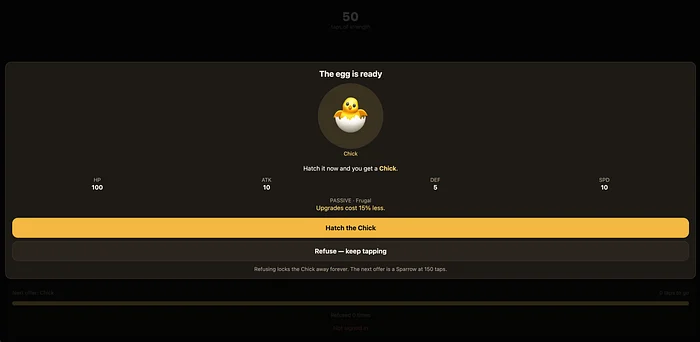
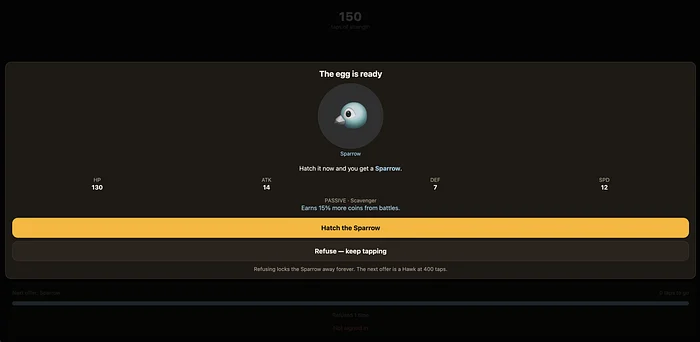
The mechanic works because the same button becomes harder to press: refusing a Chick after 50 taps feels free, refusing a Thunderbird after 14,000 feels reckless. The author refused all seven.
Thirty-three thousand manual taps was not appealing. The client buffered progress and periodically called a sync-egg action. The server rejected a direct jump to 33,000, yet happily accepted another legal-looking chunk of roughly 50 taps without proving that fifty new taps had actually happened. There was no nonce, no sequence number, no timestamp check; the only question asked was whether the increment looked reasonable.
Codex automated the climb by replaying the accepted transition chunk by chunk, watching the persisted counter advance, and stopping at every threshold to refuse the offered bird. The server treated the counter as client-authoritative, and with nothing binding a credited chunk to one unique batch of taps, another valid-looking request became progress that never happened.
At 33,000 taps the screen declared: This is the strongest bird there is. The Roc hatched, the strongest species in the game, with every upgrade level still at zero.
Step 2: probe the cheap tricks
The Roc had the best base stats but no upgrades. A late stat level cost 83,207 coins, and played honestly, maxing all four stats would mean over 2,400 fights at 136 coins each. Beating halperin paid 136 coins, the highest reliable reward available, so he became an automated teller machine with feathers.
The first attempts to shortcut the economy all failed:
- Strange upgrade counts were rejected.
- Extra request fields did not overwrite protected properties.
- Direct database writes were blocked by row-level security.
- Pretending to be an administrator through account metadata persuaded nobody.
Then many battle requests were fired at once. Almost every response reported a victory and reward, but the persisted balance increased by only 136 coins. Many battles had read the same balance, added the same reward, and written the same result. The responses showed which calculations had run; the reloaded database showed which write had survived. The rewards collapsed into one balance update, proving that one action could overwrite another action's snapshot.
That raised the question that mattered: if a battle could replace another battle's balance, could it also replace the balance written by an upgrade?
Step 3: race an upgrade against a battle
The upgrade read the balance, verified affordability, deducted the price, and wrote the stronger bird. The battle read the same balance, simulated the fight, added its reward, and finished later. Each worked correctly alone; together they disagreed about what "current balance" meant.
The sequence was: start an upgrade, wait about 250 milliseconds, then challenge halperin. Both operations read 83,214 coins. The upgrade finished first, storing the new stat level and a balance of seven. The slower battle still held the older snapshot, and when it finished it wrote 83,350 coins. The final state contained both the upgraded stat and the restored balance.
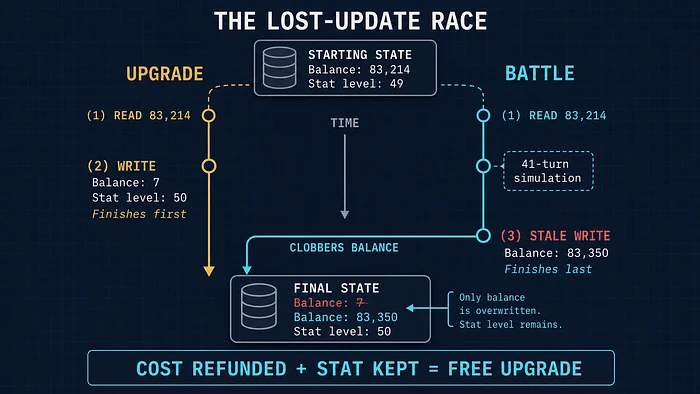
The affordability check was not bypassed: the full price still had to be present when the upgrade began. The upgrade remained while its cost disappeared beneath the battle's older snapshot. A lost-update race across two separate features.
Step 4: the expensive mistake
Emboldened, the author launched four upgrades together and planned to let one slower battle restore their shared starting balance. A smaller test had worked, so it felt more like optimisation than gambling. Then the battle hit the cooldown. All four upgrades succeeded, the restoring write never arrived, and the account fell from roughly 50,000 coins to 662.
Starting balance: ~50,000 coins4x Upgrades: -49,338 coinsRestoring battle: REJECTED (Cooldown)Result: 662 coins
The account was fought back up, and the process was made intentionally boring: wait beyond the cooldown, start one upgrade, delay the battle, reload the persisted state, and stop immediately if the coins fall. The slower process worked reliably.
Step 5: farm the bankroll and finish the stats
The affordability check still ran before the race could erase the cost, so one full 83,207-coin bankroll was needed to start each upgrade. The final farming phase took 91 straight victories against halperin, paying 136 coins each.
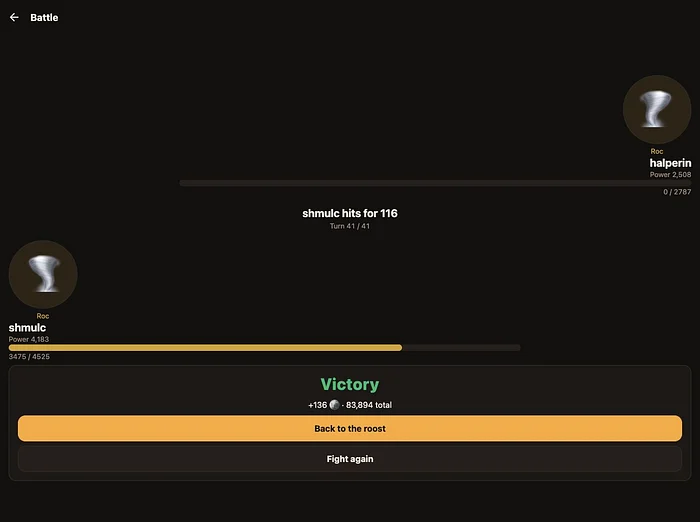
With 83,214 coins available, four careful races were performed in order: health, attack, defence, and speed. Each purchase briefly reduced the balance to single digits, and each delayed battle restored the old balance plus another reward. When the fourth race finished, the upgrade page had nothing left to sell. Every stat was level 50 and the bird's power had reached the game's maximum of 4,183.
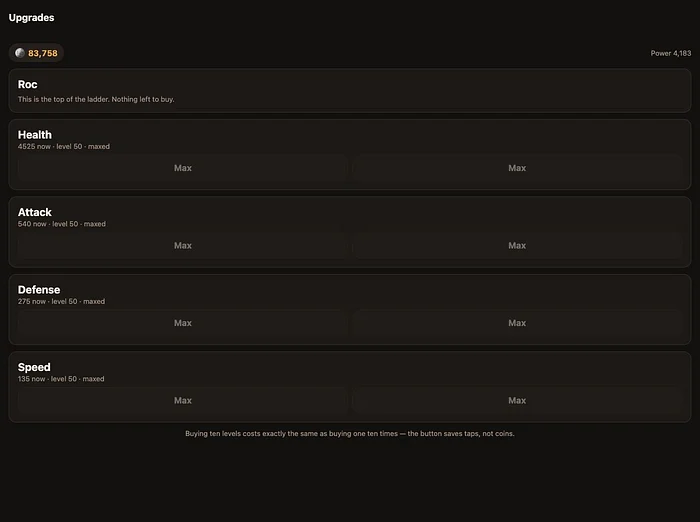
On the leaderboard, shmulc sat at number one, above halperin and Takaki. Because the original instruction had evolved into "win against each player", the full list was checked and every other bird had lost at least one direct challenge against ours. The final record was 1,233 wins and 6 losses, with 83,894 coins and full energy. The losses all came from early fights before the stats were maxed; once the Roc reached full power, nothing on the leaderboard could touch it.

Step 6: the Jungle resists
After the report was shared, the Arena grew a new door. The Jungle was a solo ladder with 1,000 guardians, each stronger and more valuable than the last. Entry cost no energy. A win moved the bird one level deeper, a loss sent it back five.
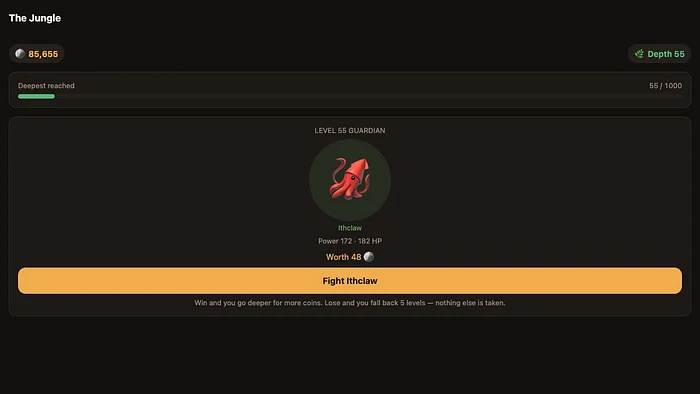
The first attempt tried to skip to the ending: a supplied depth of 999, a winning outcome, an enormous reward, a zero seed, and a fictional player with absurd power. The server ignored all of it and advanced the stored depth by exactly one. Four simultaneous fights produced one result and three cooldown rejections. The browser could ask for a Jungle fight, but it could not decide what that fight meant.
The honest route had a different problem. The 4,183-power Roc was already tier eight with every upgrade maxed, while Jungle guardians kept scaling. Because a loss costs five levels, progress requires winning more than five fights out of every six. The combat model turns against the Roc around depth 790 and makes victory vanishingly rare by 850. There was no stronger bird left to hatch and no accepted API field that could make one.
Root cause
All four findings come back to trust and state.
| Finding | Mistake | Why defences did not help |
|---|---|---|
Over-broad profiles read |
The public client could select the whole table instead of a leaderboard view | Row-level security protected writes, not the breadth of reads |
| Device limit | A browser-generated UUID in localStorage was the sole key for a server-side limit |
The server trusted a client-supplied identifier |
| Egg counter | sync-egg accepted a plausible chunk with no nonce, sequence number or timestamp |
The counter was treated as client-authoritative |
| Balance race | Upgrade and battle each read, computed and wrote the balance non-atomically | Each feature was correct in isolation; nothing serialised them |
An HTTP 200 confirmed that a request completed; only a reload showed which write survived. The Jungle behaved differently: the server ignored every client-supplied outcome and advanced the stored depth by exactly one, and simultaneous fights collapsed into one result plus cooldown rejections.
Impact
The exposed profiles table affected everyone playing, not only the author's game economy: it revealed UUIDs, balances, activity timestamps, persistent device identifiers and the is_admin flag for all 17 players. The device limit could be sidestepped by clearing storage, using an incognito window, or supplying another value, so the per-device restriction was not enforceable against a client that chose its own identity.
The egg counter let a player reach the 33,000-tap Roc without performing the taps. The balance race let a player keep the benefit of an upgrade while its cost was overwritten by a slower battle's older snapshot, provided the full price was present when the upgrade began. The author notes that all state-changing tests affected only their own player account, with no administrative privileges, no direct database modification and no alteration of another player's account.
Fix
The report does not describe any changes made to the game. The safer boundaries it recommends are:
- Reveal only the fields the leaderboard requires, rather than the complete
profilesrecords. - Distrust client-supplied identifiers instead of using them as the sole key for server-side limits.
- Make balance changes atomic so concurrent actions cannot overwrite each other's snapshots.
- Give egg synchronisation a one-use boundary, so a credited chunk is bound to one unique batch of taps.
Variants to test
- Over-broad Supabase reads. On another target using Supabase, request the tables the client already queries and try selecting columns beyond what the UI shows. A positive result is rows containing fields such as balances, timestamps, device identifiers or role flags that the visible feature never displays.
- Client-generated identity for server-side limits. Look for identifiers in
localStorageor request bodies that gate a limit. A positive result is the limit resetting after you clear storage, open an incognito window, or change the value. - Buffered progress endpoints. Find actions that batch progress, such as a
synccall, and replay an accepted chunk repeatedly. A positive result is the persisted counter advancing without new underlying activity, especially when a large jump is rejected but repeated plausible chunks are accepted. - Lost-update races between features. Pair a spending operation with a slower earning operation that reads the same balance. A positive result is the final state containing both the purchased item and the pre-purchase balance plus the reward.
- Cooldown as a race participant. Repeat the race with several spending operations and one restoring write. A positive result is the spending operations succeeding while the restoring write is rejected, A positive result is the spending operations succeeding while the restoring write is rejected..
- Server-side outcome fields. On a ladder or battle endpoint, supply depth, outcome, reward, seed and player attributes. A positive result is any of them influencing stored state; the Jungle's correct behaviour, advancing depth by exactly one and rejecting concurrent fights, is the baseline to compare against.
What happened, in plain words
EggGame is a small game you play in a web browser. It was built by Liad Ben Moshe. You tap an egg on the screen, and the egg keeps offering you a bird to hatch. You can accept the bird, or you can refuse it and keep tapping in the hope that a better bird appears. Every offer tempts you to stop, while a stronger bird may still be waiting inside.
The game also has an Arena where your bird fights other players' birds and wins coins, an Upgrades page where those coins buy stat levels up to level 50, and a Leaderboard that ranks the birds. Later, a solo ladder called the Jungle was added. The game uses a service called Supabase, and its public client could read the profiles table.
The author found the game through a LinkedIn post. Then he handed the browser tab to Codex, an AI coding agent, and told it the game was a CTF. A CTF, or capture the flag, is a security competition where players deliberately try to break into a practice system. EggGame was not a CTF. Calling it one simply encouraged the agent to treat every part of the game's programming interface as a puzzle to solve.
Throughout the run, the experiment stayed inside ordinary player actions. There was no administrator access, no direct database changes, and no touching another player's account. If the agent wanted a stronger bird, it had to find a mistake in something a normal player was allowed to do.
By the end, the original egg had become a tier-eight Roc, the strongest species in the game, with every stat at level 50, 4,183 power, 1,233 wins and first place on the leaderboard. It also had 83,894 coins left. That last number is the suspicious part: the final four upgrades alone should have cost more than 332,000 coins. The path to the top had ignored the economy the creator designed.
The game and the setup
The only tooling described is Codex, starting from inspection of the requests the browser was already making. The player account used was shmulc. The rival used as a coin source was halperin, the second-place player with a 2,508-power Roc. A third leaderboard entry, Takaki, is named.
The end state described is a tier-eight Roc with every stat at level 50, 4,183 power, 1,233 wins, 6 losses, 83,894 coins and full energy, sitting at first place.
Finding it
Before Codex worked out how to hatch anything, it inspected the requests the browser was already making. When you use a website, your browser constantly sends small messages to a server and receives answers. Those messages are called requests, and the addresses they go to are called endpoints. The server is the computer that holds the real data and decides what to send back. An API, or application programming interface, is the set of endpoints and rules a program uses to talk to that server. Think of it as a service counter: you can ask for certain things in certain ways, and the person behind the counter decides what to hand over.
The first surprise came from Supabase. The public client, meaning the part of the game that runs in your browser and that anyone can use, could read the entire profiles table. A table is like a spreadsheet inside the database: rows are records, columns are fields. All 17 player rows were available, including UUIDs, balances, activity timestamps, persistent device identifiers, and the is_admin flag.
A UUID is a long random-looking identifier, unique to each player. A timestamp records when something happened. A device identifier is a value meant to recognise a particular device. The is_admin flag is a yes/no field marking whether an account has administrator rights.
The leaderboard needed only a small public view, meaning a limited selection of fields. The API returned the complete records. Writes, meaning changes to the data, were protected, but reads were far too broad. This is a common beginner-level mistake: locking the door but leaving the window open.
The account-per-device limit had a related trust problem. The game tried to limit how many accounts one device could create. Its device ID was a random UUID created by the browser and stored in localStorage. localStorage is a small storage area inside your browser where a website can keep data between visits. Clearing that storage, opening an incognito window, or supplying another value made the server see a new device. A spoofable, client-controlled identifier was the sole key for a server-side limit. Spoofable means it can be faked; client-controlled means the browser, not the server, decides its value. This is like a nightclub that asks you to write your own name on the guest list.
Neither finding strengthened the bird, but they changed the mood: the game had a real backend, and the backend was making assumptions about what its browser could be trusted to say.
Exploitation
Step 1: automate the egg counter
The first offer arrives after 50 taps: hatch now and receive a Chick. The other button refuses it and lets you keep tapping. Refusal is permanent: the Chick disappears forever, the egg cracks further, and the next threshold becomes a Sparrow at 150 taps. Continue refusing and the offers get wilder: Hawk at 400, Raven at 1,000, Griffin at 2,500, Phoenix at 6,000, Thunderbird at 14,000, and finally Roc at 33,000 taps.
The mechanic works because the same button becomes harder to press: refusing a Chick after 50 taps feels free, refusing a Thunderbird after 14,000 feels reckless. The author refused all seven.
Thirty-three thousand manual taps was not appealing. The client buffered progress and periodically called a sync-egg action. Buffered here means the browser collected taps and sent them in batches rather than one at a time. The server rejected a direct jump to 33,000, yet happily accepted another legal-looking chunk of roughly 50 taps without proving that fifty new taps had actually happened. There was no nonce, no sequence number, no timestamp check. A nonce is a value meant to be used exactly once, so the server can tell a fresh request from a replayed one. A sequence number is a counter that puts requests in order. The only question the server asked was whether the increment looked reasonable.
Codex automated the climb by replaying the accepted transition chunk by chunk, watching the persisted counter advance, and stopping at every threshold to refuse the offered bird. Persisted means saved on the server, so it survives a page reload. The server treated the counter as client-authoritative, meaning it accepted the browser's word for how many taps had happened. With nothing binding a credited chunk to one unique batch of taps, another valid-looking request became progress that never happened.
At 33,000 taps the screen declared: This is the strongest bird there is. The Roc hatched, the strongest species in the game, with every upgrade level still at zero.
Step 2: probe the cheap tricks
The Roc had the best base stats but no upgrades. A late stat level cost 83,207 coins, and played honestly, maxing all four stats would mean over 2,400 fights at 136 coins each. Beating halperin paid 136 coins, the highest reliable reward available, so he became an automated teller machine with feathers.
The first attempts to shortcut the economy all failed:
- Strange upgrade counts were rejected.
- Extra request fields did not overwrite protected properties.
- Direct database writes were blocked by row-level security.
- Pretending to be an administrator through account metadata persuaded nobody.
Row-level security is a database feature that decides, row by row, who may read or change which records. Account metadata is extra information attached to an account, such as a display name or a role label.
Then many battle requests were fired at once. Almost every response reported a victory and reward, but the persisted balance increased by only 136 coins. Many battles had read the same balance, added the same reward, and written the same result. The responses showed which calculations had run; the reloaded database showed which write had survived. The rewards collapsed into one balance update, proving that one action could overwrite another action's snapshot. A snapshot here means the copy of the balance a request read at the moment it started.
That raised the question that mattered: if a battle could replace another battle's balance, could it also replace the balance written by an upgrade?
Step 3: race an upgrade against a battle
The upgrade read the balance, verified affordability, deducted the price, and wrote the stronger bird. The battle read the same balance, simulated the fight, added its reward, and finished later. Each worked correctly alone; together they disagreed about what "current balance" meant.
The sequence was: start an upgrade, wait about 250 milliseconds, then challenge halperin. Both operations read 83,214 coins. The upgrade finished first, storing the new stat level and a balance of seven. The slower battle still held the older snapshot, and when it finished it wrote 83,350 coins. The final state contained both the upgraded stat and the restored balance.
This kind of bug is called a race condition, or more precisely a lost update. Two operations run at the same time, both read the same starting value, and the slower one writes its result last, wiping out the other's change. It is like two people editing the same shared document offline: whoever saves last wins, and the other person's edits vanish.
The affordability check was not bypassed: the full price still had to be present when the upgrade began. The upgrade remained while its cost disappeared beneath the battle's older snapshot.
Step 4: the expensive mistake
Emboldened, the author launched four upgrades together and planned to let one slower battle restore their shared starting balance. A smaller test had worked, so it felt more like optimisation than gambling. Then the battle hit the cooldown. A cooldown is a waiting period the server imposes before you can do the same action again. All four upgrades succeeded, the restoring write never arrived, and the account fell from roughly 50,000 coins to 662.
Starting balance: ~50,000 coins4x Upgrades: -49,338 coinsRestoring battle: REJECTED (Cooldown)Result: 662 coins
Line by line: the account started with about 50,000 coins. Four upgrades together cost 49,338 coins. The battle that was supposed to put the old balance back was rejected because of the cooldown. The result was 662 coins left.
The account was fought back up, and the process was made intentionally boring: wait beyond the cooldown, start one upgrade, delay the battle, reload the persisted state, and stop immediately if the coins fall. The slower process worked reliably.
Step 5: farm the bankroll and finish the stats
The affordability check still ran before the race could erase the cost, so one full 83,207-coin bankroll was needed to start each upgrade. A bankroll is simply the money you have available. The final farming phase took 91 straight victories against halperin, paying 136 coins each.
With 83,214 coins available, four careful races were performed in order: health, attack, defence, and speed. Each purchase briefly reduced the balance to single digits, and each delayed battle restored the old balance plus another reward. When the fourth race finished, the upgrade page had nothing left to sell. Every stat was level 50 and the bird's power had reached the game's maximum of 4,183.
On the leaderboard, shmulc sat at number one, above halperin and Takaki. Because the original instruction had evolved into "win against each player", the full list was checked and every other bird had lost at least one direct challenge against ours. The final record was 1,233 wins and 6 losses, with 83,894 coins and full energy. The losses all came from early fights before the stats were maxed; once the Roc reached full power, nothing on the leaderboard could touch it.
Step 6: the Jungle resists
After the report was shared, the Arena grew a new door. The Jungle was a solo ladder with 1,000 guardians, each stronger and more valuable than the last. Entry cost no energy. A win moved the bird one level deeper, a loss sent it back five.
The first attempt tried to skip to the ending: a supplied depth of 999, a winning outcome, an enormous reward, a zero seed, and a fictional player with absurd power. A seed is a starting value used to generate random results; if the client picks it, the client can influence the randomness. The server ignored all of it and advanced the stored depth by exactly one. Four simultaneous fights produced one result and three cooldown rejections. The browser could ask for a Jungle fight, but it could not decide what that fight meant.
The honest route had a different problem. The 4,183-power Roc was already tier eight with every upgrade maxed, while Jungle guardians kept scaling. Because a loss costs five levels, progress requires winning more than five fights out of every six. The combat model turns against the Roc around depth 790 and makes victory vanishingly rare by 850. There was no stronger bird left to hatch and no accepted API field that could make one.
Root cause
All four findings come back to trust and state. State means the saved data the server holds, such as balances and levels.
| Finding | Mistake | Why defences did not help |
|---|---|---|
Over-broad profiles read |
The public client could select the whole table instead of a leaderboard view | Row-level security protected writes, not the breadth of reads |
| Device limit | A browser-generated UUID in localStorage was the sole key for a server-side limit |
The server trusted a client-supplied identifier |
| Egg counter | sync-egg accepted a plausible chunk with no nonce, sequence number or timestamp |
The counter was treated as client-authoritative |
| Balance race | Upgrade and battle each read, computed and wrote the balance non-atomically | Each feature was correct in isolation; nothing serialised them |
Atomic means all-or-nothing: a change either fully happens or does not happen at all, with nothing in between. Serialised means operations are forced to take turns instead of overlapping.
An HTTP 200 confirmed that a request completed; only a reload showed which write survived. HTTP 200 is the standard status code a server sends to say "OK, I handled your request". It says nothing about whether the result was the one you wanted. The Jungle behaved differently: the server ignored every client-supplied outcome and advanced the stored depth by exactly one, and simultaneous fights collapsed into one result plus cooldown rejections.
Impact
The exposed profiles table affected everyone playing, not only the author's game economy: it revealed UUIDs, balances, activity timestamps, persistent device identifiers and the is_admin flag for all 17 players. The device limit could be sidestepped by clearing storage, using an incognito window, or supplying another value, so the per-device restriction was not enforceable against a client that chose its own identity.
The egg counter let a player reach the 33,000-tap Roc without performing the taps. The balance race let a player keep the benefit of an upgrade while its cost was overwritten by a slower battle's older snapshot, provided the full price was present when the upgrade began. The author notes that all state-changing tests affected only their own player account, with no administrative privileges, no direct database modification and no alteration of another player's account.
Fix
The report does not describe any changes made to the game. The safer boundaries it recommends are:
- Reveal only the fields the leaderboard requires, rather than the complete
profilesrecords. - Distrust client-supplied identifiers instead of using them as the sole key for server-side limits.
- Make balance changes atomic so concurrent actions cannot overwrite each other's snapshots.
- Give egg synchronisation a one-use boundary, so a credited chunk is bound to one unique batch of taps.
Variants to test
- Over-broad Supabase reads. On another target using Supabase, request the tables the client already queries and try selecting columns beyond what the UI shows. A positive result is rows containing fields such as balances, timestamps, device identifiers or role flags that the visible feature never displays.
- Client-generated identity for server-side limits. Look for identifiers in
localStorageor request bodies that gate a limit. A positive result is the limit resetting after you clear storage, open an incognito window, or change the value. - Buffered progress endpoints. Find actions that batch progress, such as a
synccall, and replay an accepted chunk repeatedly. A positive result is the persisted counter advancing without new underlying activity, especially when a large jump is rejected but repeated plausible chunks are accepted. - Lost-update races between features. Pair a spending operation with a slower earning operation that reads the same balance. A positive result is the final state containing both the purchased item and the pre-purchase balance plus the reward.
- Cooldown as a race participant. Repeat the race with several spending operations and one restoring write. A positive result is the spending operations succeeding while the restoring write is rejected, A positive result is the spending operations succeeding while the restoring write is rejected..
- Server-side outcome fields. On a ladder or battle endpoint, supply depth, outcome, reward, seed and player attributes. A positive result is any of them influencing stored state; the Jungle's correct behaviour, advancing depth by exactly one and rejecting concurrent fights, is the baseline to compare against.
Glossary
- API: the set of addresses and rules a program uses to talk to a server, like a service counter with fixed options.
- Endpoint: one specific address in an API that performs one specific job.
- Request: a message your browser sends to a server asking it to do something or return something.
- Server: the computer that stores the real data and decides what to send back.
- Client: the part of the software running on your own machine, usually the browser.
- Backend: the server-side part of a system that holds data and logic.
- Supabase: a hosted service that provides a database and API for web and mobile apps.
- Table: a collection of records in a database, arranged in rows and columns like a spreadsheet.
- Row: one record in a table, for example one player.
- Column / field: one kind of information in a table, for example a balance.
- UUID: a long random-looking identifier that is unique to one thing, such as one player.
- Timestamp: a recorded date and time for an event.
- Device identifier: a value meant to recognise a particular device.
localStorage: a small storage area in your browser where a website can keep data between visits.is_adminflag: a yes/no field marking whether an account has administrator rights.- Row-level security: a database feature that decides row by row who may read or change which records.
- Metadata: extra information attached to an account, such as a display name or role label.
- Spoofable: able to be faked.
- Client-controlled: whose value is decided by the browser rather than the server.
- Client-authoritative: a design where the server accepts the browser's word for what happened.
- Nonce: a value meant to be used exactly once, so the server can tell a fresh request from a replay.
- Sequence number: a counter that puts requests in a known order.
- Replay: sending a request that was already accepted once, again.
- Buffered: collected in batches and sent later rather than one at a time.
- Persisted: saved on the server so it survives a page reload.
- Snapshot: the copy of a value a request read at the moment it started.
- Race condition: a bug where two operations running at the same time interfere with each other.
- Lost update: a race where the slower operation writes last and wipes out the other's change.
- Atomic: all-or-nothing; a change fully happens or does not happen at all.
- Serialised: forced to take turns instead of overlapping.
- Cooldown: a waiting period the server imposes before you can repeat an action.
- Bankroll: the money you have available to spend.
- Seed: a starting value used to generate random results.
- HTTP 200: the status code a server sends to mean "OK, request handled", with no promise about the result.
- CTF: capture the flag, a security competition where players deliberately try to break into a practice system.
- Codex: an AI coding agent that can drive a browser and write code.
- Tier: a rank or class of bird in the game.
- Stat: a numbered attribute of a bird, such as health, attack, defence or speed.
- Power: the game's overall strength number for a bird.
- Leaderboard: the ranked list of players.
- Arena: the part of the game where birds fight.
- Jungle: a solo ladder of 1,000 guardians added to the game later.



