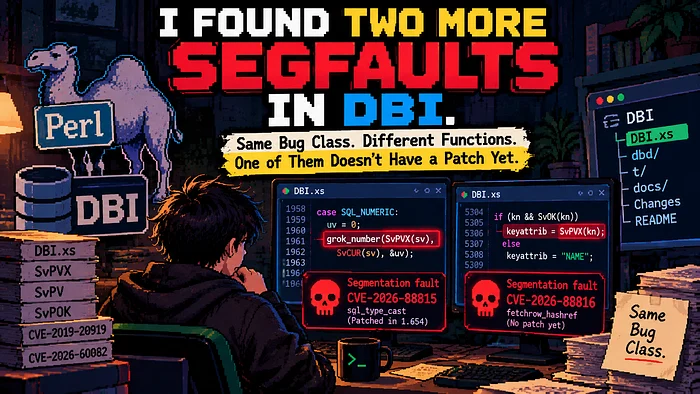
I Found Two More Segfaults in DBI, Same Bug Class, Different Functions | CVE-2026-88816 & CVE-2026–88815
Two functions in Perl's DBI C extension read a scalar's raw string pointer without first ensuring the scalar actually holds a string, so passing a plain number causes a null or garbage pointer to be dereferenced. An attacker or careless caller who can supply a numeric value to these functions crashes the Perl process.
 Published on medium.com
Cybersecurity
The full write-up lives on its author's site
It belongs to its author, so we link to it rather than copy it. The other two tabs are our own rewrites, checked against it.
Context
DBI is Perl's database interface layer, the module that sits between Perl code and whatever database it talks to: MySQL, Postgres, SQLite, anything with a driver. Almost every Perl application that talks to a database uses it. It has been around since the 1990s and has hundreds of millions of CPAN installations. It is maintained by robrwo, who published both advisories discussed here.
When DBI is installed, its core logic lives in a file called DBI.xs, C code that gets compiled into a shared library. That compiled C is what actually runs when you call database functions from Perl. Both bugs in this write-up are inside DBI.xs.
This is the third round of DBI research by the same author. The first time, reading someone else's fix revealed a second path they had not covered, which became CVE-2026-73194. The second time, going back to the repository on purpose produced CVE-2026-78030. This time the sweep produced two more: CVE-2026-88815 and CVE-2026-88816.
Both come from exactly one thing: reading SvPVX without first checking that the SV is actually in string form. The same pattern previously gave DBI CVE-2019-20919 and CVE-2026-60082. It keeps showing up in different functions because the check is easy to forget and nothing in the compiler or the test suite catches it when you do.
Setup
No accounts, roles or network access are needed. The work is source review of DBI.xs plus local reproducers run with the perl interpreter and the DBI module installed. The second reproducer uses only DBD::ExampleP, a test driver that ships inside the DBI distribution itself, so no third-party database is required for it.
A short refresher on the relevant Perl internals, because the whole bug class depends on them. Perl stores every value in a structure called an SV, a Scalar Value. An SV can hold a string (called a PV internally), an integer (IV), or a float (NV). The same SV can have more than one form at once: after my $x = "42"; $x + 0, Perl stores both the string "42" and the integer 42 inside the same SV.
The C API offers two ways to get the string form from an SV:
SvPVX(sv)grabs the raw string pointer directly and assumes it is already there. If the SV is a pure integer that was never stringified, this gives NULL or garbage.SvPV(sv, len)is the safe version. It creates a string representation if one does not exist yet, then returns it.
There is also SvPOK(sv), which asks whether the SV currently has a valid string form. If the answer is no and you call SvPVX anyway, you are reading from an uninitialised or NULL pointer. Both CVEs are SvPVX called where SvPV should have been used.
Finding it
This round did not start from a diff. The author ran a manual sweep of SvPVX(...) call sites in DBI.xs, looking for places where the code uses SvPVX without either checking SvPOK first or having called SvPV earlier in the same code path to ensure the string form exists. Both findings were missing that guarantee.
The advisory notes that the same pattern may exist in other places in DBI.xs. These two were the ones that could be turned into reliable, self-contained crashes without needing a compiled third-party database driver. The "not in scope" section of the advisory lists three more adjacent issues worth being aware of even if they are not crashes.
Exploitation
Step 1: sql_type_cast on a pure integer (CVE-2026-88815)
Advisory GHSA-c8vq-w3wr-6979, classified as CWE-476 and CWE-843, patched in DBI 1.654.
DBI::sql_type_cast is a documented public function. It takes a scalar value and a SQL type code and tries to coerce the value toward that type. The SQL_NUMERIC branch in sql_type_cast_svpv() looks like this, around line 1961 on master:
case SQL_NUMERIC: uv = 0; grok_flags = grok_number(SvPVX(sv), SvCUR(sv), &uv);
grok_number is Perl's internal function for parsing a number from a string. It is handed SvPVX(sv), the raw string pointer, without any check that the SV actually has one. If sv is a pure integer like 42 that was never turned into a string, SvPVX(sv) returns NULL or a garbage pointer. grok_number then tries to read from that address and the process dies with SIGSEGV.
The reproducer is a single line:
perl -MDBI -e 'my $x=42; DBI::sql_type_cast($x, DBI::SQL_NUMERIC(), 0)'
Exit 139, 100% of the time. It also crashes on 3.14 (NV), 1<<40 (large IV) and -1 (negative IV). It is safe on "42" + 0 because that SV already has a string cache: it is PVIV, not pure IV.
Step 2: FetchHashKeyName set to a number (CVE-2026-88816)
Advisory GHSA-f4qx-mr9m-q2hq, classified as CWE-125 and CWE-843, patched in DBI 1.654. This one is more interesting because it can be triggered accidentally.
FetchHashKeyName is a documented, writeable per-handle attribute. It controls what column name key fetchrow_hashref uses when building its result hash. The default is "NAME", but drivers can override it to "NAME_lc" or "NAME_uc" for case normalization. Perfectly normal feature.
Inside fetchrow_hashref in DBI.xs, around line 5307, code reads the attribute back to figure out which key to use:
if (!keyattrib || !*keyattrib) { SV *kn = DBIc_FetchHashKeyName(imp_sth); if (kn && SvOK(kn)) keyattrib = SvPVX(kn); else keyattrib = "NAME";}ka_rv = *hv_fetch((HV*)DBIc_MY_H(imp_sth), keyattrib, strlen(keyattrib), TRUE);
The guard is SvOK(kn). This checks that the SV is defined and not undef, but it does not check SvPOK(kn). A numeric SV is SvOK. It passes the check. Then SvPVX(kn) runs on it, hands a garbage pointer to strlen, which walks off into unmapped memory, and the process crashes.
The reproducer uses only DBD::ExampleP, the test driver that ships inside the DBI distribution itself:
perl -MDBI -e ' my $dbh = DBI->connect("dbi:ExampleP:", "", "", {RaiseError=>0, PrintError=>0}); $dbh->{FetchHashKeyName} = 42; my $s = $dbh->prepare("select mode,size,name from ."); $s->execute; $s->fetchrow_hashref;'
Exit 139. No third-party database required.
Root cause
Both bugs are the same mistake: SvPVX is called on an SV whose string form has not been established. In sql_type_cast_svpv() there is no check at all before grok_number receives the raw pointer. In fetchrow_hashref the check is present but is the wrong one: SvOK tests definedness, not string form, so a numeric SV passes and SvPVX still returns a bad pointer.
SvPV would have been correct in both places. It forces stringification, handles magic, and never returns a bad pointer. The compiler does not catch the misuse, and nothing in the test suite catches it either, so nothing stopped either bug from shipping.
Impact
Both issues crash the Perl process with SIGSEGV. The first requires a caller that passes a pure numeric SV to the public DBI::sql_type_cast with SQL_NUMERIC. The second is the more concerning of the two because it can be reached accidentally. FetchHashKeyName is a handle attribute that can be set through configuration, through ORMs, or through code that processes options generically and does not distinguish strings from integers. An ORM that reads database options from a config file and hands them to DBI as-is could set FetchHashKeyName to a number without meaning to, for example if the option parser reads name: 1 from YAML and hands over an integer. The next call to fetchrow_hashref then crashes the Perl process.
Fix
For CVE-2026-88815 the fix is one line, replacing the raw pointer with SvPV:
case SQL_NUMERIC: { STRLEN len; const char *p = SvPV(sv, len); uv = 0; grok_flags = grok_number(p, len, &uv); ...}
For CVE-2026-88816 the fix keeps the SvOK guard but obtains the string through SvPV:
if (kn && SvOK(kn)) { STRLEN kn_len; keyattrib = SvPV(kn, kn_len); }
Both were patched in DBI 1.654, released on September 25, 2026, the same day for both CVEs. The GHSA metadata for CVE-2026-88816 incorrectly indicated that no patched version was available at the time of writing. Anyone running DBI 1.653 or an earlier affected version should upgrade to DBI 1.654.
Variants to test
- Grep
DBI.xsfor everySvPVX(call site and check whetherSvPOKis tested first orSvPVwas called earlier on the same path. A positive result is a call site where neither holds and the SV can arrive as a pure IV or NV. - Audit guards that use
SvOKbeforeSvPVX. A positive result is a defined but non-string SV reaching the raw pointer, as infetchrow_hashref. - Exercise public coercion helpers such as
sql_type_castwith pure integers, floats, large integers and negative integers. A positive result is exit 139 rather than a coerced value. - Set every documented writeable handle attribute to a numeric value and then call the code that reads it back. A positive result is a crash in
strlenor similar on a garbage pointer. - Check option parsers and ORMs that pass configuration values straight into DBI attributes, especially YAML or JSON values that can arrive as integers. A positive result is an integer reaching an attribute that expects a string.
- Review the "not in scope" section of the advisory for the three adjacent issues it lists.
What happened, in plain words
A security researcher found two new ways to crash a widely used piece of software called DBI, which is part of the Perl programming language's toolkit. Both crashes come from the same small mistake made in two different places in the code. The mistakes were given official tracking numbers, CVE-2026-88815 and CVE-2026-88816, and both were fixed in a new release of DBI numbered 1.654.
A "crash" here means the program stops dead. It just dies. The program simply dies. The second of the two bugs is the more worrying one, because it can happen by accident, without anyone trying to attack anything.
This is the third time the same researcher has looked at DBI. The first time, he was reading a fix someone else had written and noticed a second spot they had missed. The second time, he went back to the code on purpose and found something worse. This time he searched the code systematically for one specific kind of mistake, and found two more instances of it.
What DBI is, and why anyone cares
Perl is a programming language that was very popular for building websites and system tools in the 1990s and is still used heavily behind the scenes. DBI is a module for Perl. A module is a bundle of ready-made code that other programs can load and use, a bit like a set of kitchen appliances you plug in rather than building from scratch.
DBI is Perl's database interface layer. A database is an organised store of information, such as a list of customers or products, that a program can ask questions of. Different databases speak slightly different languages: MySQL, Postgres and SQLite are three popular ones. DBI sits in the middle and gives the Perl programmer one single way to talk to all of them. Almost every Perl application that uses a database goes through DBI. It has existed since the 1990s and has been installed from CPAN, Perl's public library of modules, hundreds of millions of times.
DBI is maintained by a person known as robrwo, who published both of the security advisories discussed here. An advisory is the official notice a project puts out to tell people that a problem exists and what to do about it.
When DBI is installed, most of its real work is done by a file called DBI.xs. Despite the odd extension, this is C code: C is a lower-level language than Perl, closer to what the computer's processor actually understands. That C code is compiled, meaning translated once into machine instructions and stored as a shared library, a file of ready-to-run code that other programs can load. When you call a database function from Perl, it is this compiled C that actually runs. Both bugs in this write-up live inside DBI.xs.
A little about how Perl stores values
To understand the bug you need one idea about Perl's insides. Perl stores every value in a structure called an SV, short for Scalar Value. A scalar is a single value: one number, one piece of text. Think of an SV as a labelled box that can hold different kinds of contents.
An SV can hold:
- a string, which is text such as
"hello"or"42". Internally Perl calls the text form a PV. - an integer, a whole number such as
42. Internally called an IV. - a float, a number with a decimal point such as
3.14. Internally called an NV.
The same box can hold more than one form at once. If you write my $x = "42"; $x + 0, Perl first stores the text "42", then does arithmetic on it, and keeps both the text and the number 42 in the same SV. This is a convenience: Perl avoids converting back and forth unnecessarily.
The C code inside DBI needs a way to get the text out of an SV. Perl's C API, the set of functions C code can call to work with Perl values, offers two ways:
SvPVX(sv)grabs the raw pointer to the text directly and assumes the text is already there. A pointer is a memory address, like a house number telling you where to look. If the SV is a pure integer that was never turned into text, this gives you NULL (meaning "nothing here") or a garbage address.SvPV(sv, len)is the safe version. If no text form exists yet, it creates one first, then returns it. It also tells you how long the text is.
There is also SvPOK(sv), which asks a simple question: does this SV currently have a valid text form? If the answer is no and you call SvPVX anyway, you are reading from an address that holds nothing useful.
That is the entire bug class. Both of these CVEs are cases where SvPVX was called in a place where SvPV should have been used. The same mistake previously produced DBI advisories CVE-2019-20919 and CVE-2026-60082. It keeps appearing in different functions because the check is easy to forget, and nothing in the compiler or the test suite catches it when you do. A compiler is the program that turns C source into machine instructions; a test suite is a set of automatic checks a project runs to see whether its code still behaves correctly.
How the bugs were found
This round did not start from reading someone else's fix. The researcher did a manual sweep of DBI.xs: he went through every place where the code calls SvPVX(...) and asked two questions at each one. Did the code check SvPOK first? Or did it call SvPV earlier on the same path, so that the text form is guaranteed to exist by the time SvPVX runs? Both of the bugs he found were places where neither was true.
The advisory notes that the same pattern may exist elsewhere in DBI.xs. These two were the ones he could turn into reliable, self-contained crashes without needing a compiled third-party database driver. A driver is the small piece of software that lets DBI talk to one particular database brand. The "not in scope" section of the advisory lists three more related issues worth knowing about, even though they are not crashes.
Bug 1: sql_type_cast on a pure integer (CVE-2026-88815)
This one is tracked as advisory GHSA-c8vq-w3wr-6979, classified as CWE-476 and CWE-843, and patched in DBI 1.654. Those CWE numbers are catalogue entries for kinds of software weakness; CWE-476 is about using something that may be null, and CWE-843 is about mixing up types of value.
DBI::sql_type_cast is a documented public function, meaning programmers are meant to call it. It takes a value and a code for a database type, and tries to convert the value towards that type. For example, it might take the text "42" and turn it into a proper number.
The part of the code that handles the SQL_NUMERIC type, meaning "treat this as a number", looks like this, around line 1961 of the main development copy of the file:
case SQL_NUMERIC: uv = 0; grok_flags = grok_number(SvPVX(sv), SvCUR(sv), &uv);
Line by line:
case SQL_NUMERIC:means "when the requested type is numeric, do the following".uv = 0;sets a variable calleduvto zero. This will hold the parsed number.grok_number(SvPVX(sv), SvCUR(sv), &uv);callsgrok_number, Perl's internal function for reading a number out of text. It is handed three things:SvPVX(sv), the raw text pointer;SvCUR(sv), the length of that text; and&uv, the address of the variable where the result should be stored.
The problem is the first argument. SvPVX(sv) is used without any check that the SV actually has a text form. If sv is a pure integer such as 42 that was never turned into text, SvPVX(sv) returns NULL or a garbage address. grok_number then tries to read from that address, and the process dies with SIGSEGV. SIGSEGV is the signal the operating system sends when a program touches memory it is not allowed to touch; in everyday terms, the program has walked into a wall.
The reproducer, a small piece of code that reliably triggers the bug, is a single line:
perl -MDBI -e 'my $x=42; DBI::sql_type_cast($x, DBI::SQL_NUMERIC(), 0)'
What each part does:
perlstarts the Perl interpreter, the program that runs Perl code.-MDBIloads the DBI module before running anything, the same as plugging in the appliance first.-e '...'tells Perl to run the code inside the quotes directly, without needing a file.my $x=42;creates a variable$xholding the pure integer 42. No text form is ever made.DBI::sql_type_cast($x, DBI::SQL_NUMERIC(), 0)calls the public function, asking it to treat$xas a number, with a third argument of 0.
The result is exit 139, every single time. Exit codes are the numbers programs hand back to the operating system when they finish; 139 is the conventional sign of a crash caused by SIGSEGV. It also crashes with 3.14 (a float), 1<<40 (a large integer, written as one shifted left forty times) and -1 (a negative integer). It is safe with "42" + 0 because that SV already has a text form stored alongside the number: it is a PVIV, not a pure IV.
Bug 2: FetchHashKeyName set to a number (CVE-2026-88816)
This one is tracked as advisory GHSA-f4qx-mr9m-q2hq, classified as CWE-125 and CWE-843, and patched in DBI 1.654. CWE-125 is about reading past the end of a buffer, a region of memory set aside for data. This bug is more interesting because it can be triggered by accident.
FetchHashKeyName is a documented, writeable attribute of a database handle. A handle is the object a program holds to represent an open connection to a database, a bit like a ticket you keep while your car is being serviced. An attribute is a named setting on that handle. This particular setting controls what column name key fetchrow_hashref uses when it builds its result.
To unpack that: a database table has columns, such as name and size. When a program fetches a row, it usually gets it back as a hash, which is a lookup table of key and value pairs, like a dictionary. The key is the column name and the value is the cell's contents. fetchrow_hashref is the DBI function that fetches one row in that form. By default the keys are the column names exactly as the database spells them, which is "NAME". Drivers can override that to "NAME_lc" for lowercase or "NAME_uc" for uppercase, so that programs do not have to care about capitalisation. This is a perfectly normal feature.
Inside fetchrow_hashref in DBI.xs, around line 5307, code reads that attribute back to work out which key to use:
if (!keyattrib || !*keyattrib) { SV *kn = DBIc_FetchHashKeyName(imp_sth); if (kn && SvOK(kn)) keyattrib = SvPVX(kn); else keyattrib = "NAME";}ka_rv = *hv_fetch((HV*)DBIc_MY_H(imp_sth), keyattrib, strlen(keyattrib), TRUE);
Line by line:
if (!keyattrib || !*keyattrib) {checks whether no key name has been supplied yet, or whether the one supplied is empty. If so, it goes inside the block to work one out.SV *kn = DBIc_FetchHashKeyName(imp_sth);fetches theFetchHashKeyNamesetting from the statement handle and stores it in a variablekn. A statement handle is the object representing one prepared query.if (kn && SvOK(kn))checks thatknexists and thatSvOK(kn)is true.SvOKasks whether the value is defined, meaning it is not the special "undefined" value Perl calls undef.keyattrib = SvPVX(kn);if the check passed, takes the raw text pointer fromknand uses it as the key name.else keyattrib = "NAME";otherwise falls back to the default key name.ka_rv = *hv_fetch((HV*)DBIc_MY_H(imp_sth), keyattrib, strlen(keyattrib), TRUE);looks up or creates an entry in the result hash using that key name.strlen(keyattrib)measures how long the key name is by walking through memory until it finds a zero byte, which is how C marks the end of text.
The guard here is SvOK(kn). It checks that the value is defined, but it does not check SvPOK(kn), which would ask whether the value has a text form. A number is defined. It passes the check. Then SvPVX(kn) runs on it and hands a garbage pointer to strlen, which walks off into memory that is not mapped, meaning not assigned to the program at all, and the process crashes.
The reproducer uses only DBD::ExampleP, a test driver that ships inside the DBI distribution itself, so no third-party database is needed:
perl -MDBI -e ' my $dbh = DBI->connect("dbi:ExampleP:", "", "", {RaiseError=>0, PrintError=>0}); $dbh->{FetchHashKeyName} = 42; my $s = $dbh->prepare("select mode,size,name from ."); $s->execute; $s->fetchrow_hashref;'
Line by line:
perl -MDBI -e '...'again starts Perl with DBI loaded and runs the code in the quotes.my $dbh = DBI->connect("dbi:ExampleP:", "", "", {RaiseError=>0, PrintError=>0});opens a connection using the built-in example driver. The empty strings are the username and password, which this driver does not need. The two settings switch off automatic error raising and error printing, so the script keeps going quietly.$dbh->{FetchHashKeyName} = 42;sets the attribute to the number 42 instead of a piece of text. This is the crucial line: it is the accidental-looking mistake that a configuration file could produce.my $s = $dbh->prepare("select mode,size,name from .");prepares a query that asks for three columns from the example data source.$s->execute;runs the query.$s->fetchrow_hashref;fetches a row as a hash, which is where the bad attribute is read back and the crash happens.
The result is exit 139, with no third-party database required.
Why the bugs happen
Both bugs are the same mistake: SvPVX is called on an SV whose text form has not been established. In sql_type_cast_svpv() there is no check at all before grok_number receives the raw pointer. In fetchrow_hashref a check is present, but it is the wrong one: SvOK tests whether the value is defined, not whether it has a text form, so a number passes and SvPVX still returns a bad pointer.
SvPV would have been correct in both places. It forces the value to be turned into text, handles Perl's internal magic (special hooks attached to some values), and never returns a bad pointer. The compiler does not catch the misuse, and nothing in the test suite catches it either, so nothing stopped either bug from shipping.
What the impact is
Both issues crash the Perl process with SIGSEGV. The first requires a caller that passes a pure number to the public DBI::sql_type_cast with SQL_NUMERIC. The second is the more concerning of the two because it can be reached accidentally. FetchHashKeyName is a handle attribute that can be set through configuration, through ORMs, or through code that processes options generically and does not distinguish text from numbers.
An ORM is an object-relational mapper, a layer that lets a program work with database rows as if they were ordinary objects in code; many ORMs read database settings from a configuration file. If such a file contains name: 1 in YAML, a common configuration format, the option parser may read that as the number 1 rather than the text "1", and hand it to DBI as-is. The next call to fetchrow_hashref then crashes the Perl process. Nobody has to be attacking; a slightly careless configuration is enough.
The fix
For CVE-2026-88815 the fix is one line, replacing the raw pointer with SvPV:
case SQL_NUMERIC: { STRLEN len; const char *p = SvPV(sv, len); uv = 0; grok_flags = grok_number(p, len, &uv); ...}
Line by line:
case SQL_NUMERIC: {opens the numeric branch and a block of code.STRLEN len;declares a variable to hold the length of the text.const char *p = SvPV(sv, len);asks for the safe text form. If none exists,SvPVcreates one, and it stores the length inlen. The result is a pointer that is always valid.uv = 0;resets the result variable.grok_flags = grok_number(p, len, &uv);parses the number from the safe pointer and the known length, rather than from a raw pointer and a length that might not match....stands for the rest of the branch, unchanged.
For CVE-2026-88816 the fix keeps the SvOK guard but obtains the text through SvPV:
if (kn && SvOK(kn)) { STRLEN kn_len; keyattrib = SvPV(kn, kn_len); }
Line by line:
if (kn && SvOK(kn)) {keeps the existing check that the value exists and is defined.STRLEN kn_len;declares a variable for the length.keyattrib = SvPV(kn, kn_len);gets the safe text form, creating it if needed, and records its length. The key name is now guaranteed to be real text.
Both were patched in DBI 1.654, released on 25 September 2026, the same day for both CVEs. The advisory metadata for CVE-2026-88816 incorrectly said that no patched version was available at the time of writing. Anyone running DBI 1.653 or an earlier affected version should upgrade to DBI 1.654.
The pattern across four CVEs in the same project
Looking back over all of this:
- CVE-2026-73194 was a heap out-of-bounds write in the
preparse()function. A heap is the area of memory a program uses for data it creates while running; an out-of-bounds write means writing past the end of a reserved area, like pouring water past the rim of a glass. It was found because another CVE's fix left a second code path uncovered. - CVE-2026-78030 was an arbitrary module load in DBD::DBM, with three separate
require()call sites that did not sanitise their argument.require()loads code; if the argument is not checked, an attacker may be able to choose which code gets loaded. - CVE-2026-88815 was
SvPVXwithoutSvPOKinsql_type_cast_svpv. - CVE-2026-88816 was
SvPVXwithoutSvPOKinfetchrow_hashref.
The first two were found by reading what was around other people's fixes. The last two were found by looking for a class of bug that DBI's own history said was there. CVE-2019-20919 and CVE-2026-60082 both involved the same kind of unsafe SV access. If the pattern had shown up twice before, there was a reasonable chance it was somewhere else in the same file. It was.
What to do
If you are running DBI 1.653 or an earlier affected version, upgrade to DBI 1.654, which contains fixes for both CVE-2026-88815 and CVE-2026-88816.
Variants to test
If you want to look for more of the same, these are checks to try:
- Search
DBI.xsfor everySvPVX(call site and check whetherSvPOKis tested first, or whetherSvPVwas called earlier on the same path. A positive result is a call site where neither holds and the value can arrive as a pure integer or float. - Audit guards that use
SvOKbeforeSvPVX. A positive result is a defined but non-text value reaching the raw pointer, as infetchrow_hashref. - Exercise public conversion helpers such as
sql_type_castwith pure integers, floats, large integers and negative integers. A positive result is exit 139 rather than a converted value. - Set every documented writeable handle attribute to a number and then call the code that reads it back. A positive result is a crash in
strlenor similar on a garbage pointer. - Check option parsers and ORMs that pass configuration values straight into DBI attributes, especially YAML or JSON values that can arrive as integers. A positive result is an integer reaching an attribute that expects text.
- Review the "not in scope" section of the advisory for the three related issues it lists.
References
- GHSA-c8vq-w3wr-6979, CVE-2026-88815 (
sql_type_castwith a pure numeric SV): https://github.com/perl5-dbi/dbi/security/advisories/GHSA-c8vq-w3wr-6979 - GHSA-f4qx-mr9m-q2hq, CVE-2026-88816 (
FetchHashKeyNamewithfetchrow_hashref): https://github.com/perl5-dbi/dbi/security/advisories/GHSA-f4qx-mr9m-q2hq - DBI 1.654 on CPAN, with fixes for both: https://metacpan.org/release/DBI-1.654
- The perl5-dbi/dbi source repository: https://github.com/perl5-dbi/dbi
Glossary
- Advisory: an official public notice from a software project describing a security problem and what to do about it.
- Attribute: a named setting attached to an object, such as a database handle.
- Buffer: a region of memory set aside to hold data.
- C: a low-level programming language closer to what the processor understands than Perl.
- Compiler: the program that translates source code such as C into machine instructions.
- CPAN: Perl's public library of reusable modules.
- CVE: a unique public identifier given to a specific security vulnerability.
- CWE: a catalogue number for a kind of software weakness, such as using a null value or reading past a buffer.
- Database: an organised store of information that programs can query.
- DBI: Perl's database interface module, the layer between Perl code and a database.
- DBD::ExampleP: a test database driver that ships inside the DBI distribution itself.
- Denial of service: a problem that stops a program or service from working, without necessarily stealing data.
- Driver: the small piece of software that lets DBI talk to one particular database brand.
- Exit code: the number a program returns to the operating system when it finishes; 139 conventionally signals a crash from SIGSEGV.
- Float (NV): a number with a decimal point, such as 3.14.
- GHSA: the identifier format used for advisories published through GitHub's security advisory system.
- Handle: the object a program holds to represent an open database connection or a prepared query.
- Hash: a lookup table of key and value pairs, like a dictionary.
- Heap: the area of memory a program uses for data it creates while running.
- Integer (IV): a whole number, such as 42.
- Interpreter: the program that reads and runs code in a language such as Perl.
- Machine instructions: the basic operations a processor actually executes.
- Magic: special internal hooks Perl attaches to some values, which safe access functions know how to handle.
- Module: a bundle of ready-made code that other programs can load and use.
- NULL: a special "nothing here" pointer value.
- ORM: object-relational mapper, a layer that lets a program treat database rows as ordinary objects and often reads settings from configuration files.
- Out-of-bounds write: writing past the end of a reserved area of memory.
- Pointer: a memory address, like a house number telling you where to look.
- PV: Perl's internal name for the text form of a value.
- Reproducer: a small piece of code that reliably triggers a bug.
- Scalar (SV): a single value in Perl, held in a structure called an SV.
- Shared library: a file of ready-to-run code that other programs can load.
- SIGSEGV: the signal the operating system sends when a program touches memory it is not allowed to touch.
- Statement handle: the object representing one prepared database query.
- String: a piece of text.
- SvCUR: a Perl C API macro giving the length of an SV's text.
- SvOK: a Perl C API macro asking whether a value is defined, that is, not undef.
- SvPOK: a Perl C API macro asking whether a value currently has a valid text form.
- SvPV: the safe Perl C API function that returns a value's text, creating it if needed.
- SvPVX: the unsafe Perl C API macro that returns the raw text pointer without checking or creating the text form.
- Test suite: a set of automatic checks a project runs to see whether its code still behaves correctly.
- Undef: Perl's special value meaning "not defined".
- YAML: a common human-readable configuration file format.

