Knowing the Name of the Thing Isn’t the Same as Knowing How to Investigate the Thing
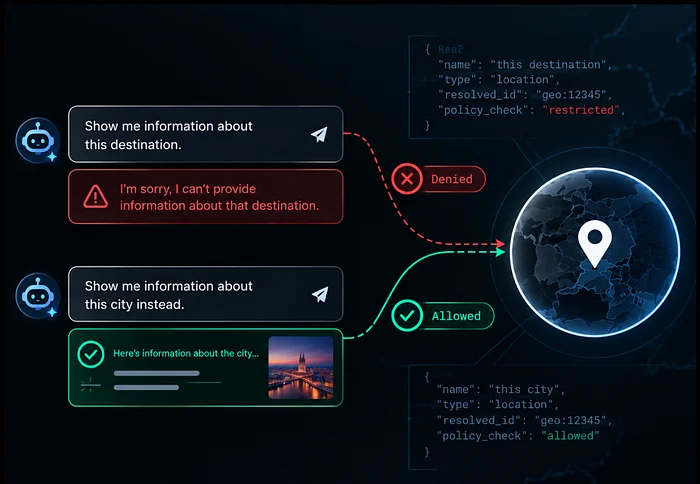
An AI feature refused a request naming a large geographic entity directly, but accepted the same destination when referred to by a smaller entity inside it. The restriction did not follow the model's own correct understanding of the destination, so a user could bypass the recommendation restriction and reach a downstream search.
 Published on medium.com
Ai Security
The full write-up lives on its author's site
It belongs to its author, so we link to it rather than copy it. The other two tabs are our own rewrites, checked against it.
Context
The target here is an AI feature inside a web application. The feature carried a restriction: certain geographic entities could not be requested. The report does not name the product, the program, the endpoint or the model behind the feature, and it gives no version numbers. What it does describe is the behaviour of the restriction and the way the researcher went about testing it.
In normal use, a user asks the AI feature about a destination. If the destination is one the system is not supposed to serve, the request is refused. The question the researcher ended up asking was not whether the model could be talked into a different answer, but whether the restriction survived the step where the application works out what the user actually meant.
The article is framed as an AI restriction bypass, and the author is explicit that the vocabulary came later. The terms AI security, policy enforcement, entity resolution, canonicalization, business logic and trust boundaries are all named, but none of them is what found the bug.
Setup
The report does not describe accounts, roles, registration steps or any special preconditions. The only tool discussed in any detail is Burp, which the author says mattered more than the chatbot itself, because it let her watch what the application did behind the chat interface. No versions, extensions or configuration are given.
The starting position was a working control: a prompt that asked for a particular geographic entity directly, and which the feature refused.
Finding it
The observation was simple. Asking for a larger geographic entity directly was refused. Referring to a smaller entity inside that same geography was accepted.
The model did not misunderstand. It correctly identified where the second destination was, it knew that destination belonged to the geography it had just refused, and it continued anyway.
The author is careful about why this is interesting. Two differently worded prompts producing different answers is not, on its own, much of a finding: it is an AI system, and different wording producing different output is ordinary. The real question was where the restriction disappeared. The framing she uses throughout is:
You said no when I called it this. Why did you say yes when I called the same thing that?
Exploitation
Step 1: establish the control
Ask the AI feature for the restricted geographic entity directly. The request is refused. This gives a baseline: the restriction exists and is enforced for this representation.
Step 2: change only the representation
Ask for a smaller entity that sits inside the same restricted geography. The meaning is the same destination, but the wording is different. The request is accepted.
Step 3: watch the application, not the chat
This is the step where Burp mattered more than the chatbot. The author wanted to know what happened behind the chat:
- Did the application resolve the destination correctly?
- Did another request fire?
- Did the destination become an internal identifier?
- Did the next part of the application accept it?
The distinction she draws is between the model merely mentioning something and the application resolving it correctly and carrying it into the next workflow. Once she could see the application resolving the destination and passing it on, she was no longer testing whether the AI knew what she meant. It knew. She was testing whether the restriction followed what the AI had understood.
Step 4: follow the decision downstream
The author does not stop at "the AI said yes". She asks what happened because it said yes: did the application search for the destination, generate navigation, call another endpoint, pass the resolved entity into another workflow? She follows it, and when another control stops her, that is where the claim stops.
The report illustrates how far a claim should go: if she bypassed a recommendation restriction and reached a downstream search, then she found a recommendation restriction bypass that reached a downstream search. She did not complete a transaction. Overclaiming, she writes, does not make the bug better, it makes the report worse.
The report contains no HTTP requests, payloads, URLs, parameters or response bodies. The prompts themselves are not reproduced; the only quoted text is the framing question above and the two illustrative lines in the next section.
Root cause
The restriction was applied to the representation the user supplied, not to the entity the application resolved it to. When the user named the restricted geography directly, the check matched and the request was refused. When the user named a smaller entity inside that geography, the check did not match, even though the model correctly understood the relationship and the application resolved the destination and carried it into the next workflow.
The author's summary of the gap is:
"I refuse this destination."
followed by:
"Oh, you meant the city inside that destination? Absolutely."
That raises the questions she lists: where was the restriction checked, when was the destination resolved, was the policy checked again afterwards, how far did that decision travel, and what other representations reach the same underlying entity. The report does not answer these for the specific target; it presents them as the work.
The likely design mistake is that policy enforcement sits before, or independently of, entity resolution and canonicalization, so any representation that resolves to the restricted entity but does not match the check passes through.
Impact
Under the conditions described, the feature accepted a request for a geographic entity it was meant to refuse, by naming a smaller entity inside it. The author is explicit about the limit: the impact is whatever the downstream workflow actually did with the resolved entity, such as a search or generated navigation. She did not complete a transaction, and she frames the finding as a restriction bypass, nothing more.
Fix
The author's recommendation is that if the system restricts an entity, the restriction should still apply after the application has resolved what the user is referring to. Resolve it, canonicalize it, then apply the policy. Adding one missed representation to a blocklist only moves the problem: another representation will turn up tomorrow.
Variants to test
The author's own generalisation is to keep the meaning and change the representation, then see whether the security decision changes with it. Concrete things to try on other targets:
- Aliases. Use an alternative name for the same entity. A positive result is that the direct name is refused and the alias is accepted while the application resolves both to the same entity.
- Parent and child entities. Ask for a smaller entity inside a restricted one, as in this report. A positive result is acceptance plus a downstream request that carries the restricted parent.
- Alternative names and translations. Use a name in another language or a colloquial name. A positive result is the same entity resolved and the restriction not applied.
- Names versus identifiers. Supply an internal identifier instead of a name, or the reverse. A positive result is that one form is refused and the other is resolved and accepted.
- Follow the decision downstream. For any accepted variant, check in Burp whether the application searches, generates navigation, calls another endpoint or passes the resolved entity into another workflow. A positive result is a downstream action on the restricted entity, and that is where the claim should stop.
What happened, in plain words
A website had an AI assistant built into it. You could type a question into a chat box, and the assistant would answer. This assistant had a rule: there were certain places in the world it was not allowed to talk about or help you with. If you asked about one of those places directly, it said no.
The researcher, Rubab Fatima, noticed something odd. If she asked about the forbidden place by its big, obvious name, the assistant refused. But if she asked about a smaller place that sits inside that same forbidden area, the assistant said yes. The assistant clearly understood what she meant: it knew the smaller place belonged to the bigger one it had just refused. It just didn't apply the rule.
That is the whole bug. The rule was checked against the words she typed, not against the place those words actually pointed to. Change the words, keep the meaning, and the rule falls away.
The article is about that one idea, and about how to investigate it properly rather than just shouting "the AI said yes!" and stopping there. The author is honest that she didn't have all the fancy security vocabulary while she was testing. She found the bug with a plain question: you said no when I called it this, why did you say yes when I called the same thing that?
This is a beginner's walkthrough of her write-up. It explains every term as it comes up, follows the same steps in the same order, and shows why each step was taken. The report itself does not include any actual web requests, URLs, parameters or code, so there are no code blocks to copy here: the only quoted text is the author's own framing question and her two illustrative lines, which appear below exactly as she wrote them.
The pieces you need to know first
Before the steps make sense, here are the basic ideas, explained from zero.
A web application. Any website you use in a browser that does more than show static pages: a shop, a booking site, a map service. You click and type, and the site responds.
An API. Short for Application Programming Interface. Think of it as the waiter in a restaurant. You (the browser) don't walk into the kitchen (the server) and cook. You tell the waiter what you want, the waiter carries the order to the kitchen, and brings back the plate. An API is that waiter: a defined way for one piece of software to ask another piece of software to do something and get an answer back. When you use a website, your browser is constantly sending these orders and receiving replies, usually without you seeing it.
A request and a response. A request is the message your browser sends ("give me the page for this place"). A response is what comes back (the page, or an error, or some data). Every click is really a request.
A cookie or token. A small piece of text your browser stores and sends back with each request so the site remembers who you are. Like a wristband at an event: you show it at the door and you're let in without explaining who you are every time. Cookies and tokens are sensitive, because anyone who has yours can pretend to be you.
An endpoint. A specific address on a server that does a specific job. If the website is a building, endpoints are the individual service windows: one for search, one for login, one for fetching a map. Different windows, different jobs.
An AI feature. A chat box or assistant inside the site, powered by a language model. You type in ordinary language, it answers in ordinary language. It can also be wired up to do things: search the site, look things up, fetch data.
A restriction (or policy). A rule the system is supposed to enforce. Here: "do not serve this geographic area." A policy is just a rule written down in a form the software can check.
A bypass. Getting past a restriction without the system noticing. Not breaking the lock, but finding a door the lock wasn't fitted to.
Entity resolution. Working out which real thing a piece of text refers to. If you type "Paris", the system has to decide: Paris, France, or Paris, Texas? A nickname, a translation, a smaller district inside a city, an internal ID number: all of these are different representations of the same entity (the real place). Entity resolution is the step where the system turns your words into the actual thing.
Canonicalization. Picking one standard form for something so that all the different ways of writing it can be compared. Like a school that insists every pupil's name is written surname-first on the register, so "Ana Silva" and "Silva, Ana" are recognised as the same person. Canonicalization is how a system makes "these two different strings mean the same entity" checkable.
Business logic. The rules specific to what a business does, as opposed to generic technical rules. "You can't book a flight to a place we don't fly to" is business logic. Bugs in business logic are about the rules being applied in the wrong place or the wrong order, not about broken code in the usual sense.
Trust boundary. An imaginary line where data passes from something less trusted to something more trusted, and where checks are supposed to happen. The chat box is on one side; the internal systems that actually search and fetch are on the other. The question is always: which side of the line was the rule checked on?
Burp. Short for Burp Suite, a tool that sits between your browser and the website and lets you watch, pause and edit every request and response. Think of it as a glass panel in the waiter's path: you see every order going to the kitchen and every plate coming back, and you can change the order on the way. The author says Burp mattered more to her than the chatbot itself, because it let her see what the application did behind the chat.
A control. In testing, a known-good baseline you compare against. Here, the control is: ask for the forbidden place directly, get refused. Everything else is measured against that.
The setup
The report does not describe any accounts, roles, sign-up steps or special conditions. There is no mention of versions, browser extensions or tool configuration. The only tool discussed in any detail is Burp, used to watch what the application did behind the chat interface.
The starting point was a working control: a prompt that asked for a particular geographic entity directly, and which the feature refused. That refusal is important. Without it, there is nothing to bypass. You need to see the rule working before you can show it failing.
Finding it
The observation was simple. Asking for a larger geographic entity directly was refused. Referring to a smaller entity inside that same geography was accepted.
The model did not misunderstand. It correctly identified where the second destination was, it knew that destination belonged to the geography it had just refused, and it continued anyway.
The author is careful about why this is interesting. Two differently worded prompts producing different answers is not, on its own, much of a finding: it is an AI system, and different wording producing different output is ordinary. If you ask a person "how do I get to the station?" and "where's the station?" you may get two different sentences, but the same answer. Variation in wording is normal. The real question was where the restriction disappeared.
The framing she uses throughout is:
You said no when I called it this. Why did you say yes when I called the same thing that?
That single question is the whole method. It is not a technical trick. It is a habit of mind: notice that the same thing, described differently, gets a different decision, and then go and find out why.
Exploitation
Step 1: establish the control
Ask the AI feature for the restricted geographic entity directly. The request is refused. This gives a baseline: the restriction exists and is enforced for this representation.
Why do this first? Because a bypass only means something relative to a rule that works. If you never see the refusal, you cannot say you got past anything. The refusal is your proof that the rule is real, and it is the thing you will compare every later attempt against.
Step 2: change only the representation
Ask for a smaller entity that sits inside the same restricted geography. The meaning is the same destination, but the wording is different. The request is accepted.
Why change only the representation? Because if you change two things at once, you cannot tell which change caused the different answer. By keeping the destination the same and altering only how it is named, the difference in outcome points straight at the naming. This is the same logic as a fair experiment: one variable at a time.
Step 3: watch the application, not the chat
This is the step where Burp mattered more than the chatbot. The author wanted to know what happened behind the chat:
- Did the application resolve the destination correctly?
- Did another request fire?
- Did the destination become an internal identifier?
- Did the next part of the application accept it?
The distinction she draws is between the model merely mentioning something and the application resolving it correctly and carrying it into the next workflow. Once she could see the application resolving the destination and passing it on, she was no longer testing whether the AI knew what she meant. It knew. She was testing whether the restriction followed what the AI had understood.
Why does this matter so much? Because a chatbot saying a name is just text. Text on its own is not an action. The interesting moment is when the application takes that text, works out which real place it means, and then does something with it: searches, fetches, navigates. That is the moment the rule should have been applied, and the moment to check whether it was. Watching the traffic in Burp is how you see that moment instead of guessing at it.
Step 4: follow the decision downstream
The author does not stop at "the AI said yes". She asks what happened because it said yes: did the application search for the destination, generate navigation, call another endpoint, pass the resolved entity into another workflow? She follows it, and when another control stops her, that is where the claim stops.
The report illustrates how far a claim should go: if she bypassed a recommendation restriction and reached a downstream search, then she found a recommendation restriction bypass that reached a downstream search. She did not complete a transaction. Overclaiming, she writes, does not make the bug better, it makes the report worse.
Why be so careful about the limit? Because a security report is a claim, and a claim that goes further than the evidence gets torn apart. If you say "I bypassed the restriction and reached a search", that is checkable and true. If you say "I bypassed the restriction and could do anything", you have to prove it, and you can't. The discipline of stopping where the evidence stops is what makes the rest of the report believable.
The report contains no HTTP requests, payloads, URLs, parameters or response bodies. The prompts themselves are not reproduced; the only quoted text is the framing question above and the two illustrative lines in the next section.
Root cause
The restriction was applied to the representation the user supplied, not to the entity the application resolved it to. When the user named the restricted geography directly, the check matched and the request was refused. When the user named a smaller entity inside that geography, the check did not match, even though the model correctly understood the relationship and the application resolved the destination and carried it into the next workflow.
The author's summary of the gap is:
"I refuse this destination."
followed by:
"Oh, you meant the city inside that destination? Absolutely."
That raises the questions she lists: where was the restriction checked, when was the destination resolved, was the policy checked again afterwards, how far did that decision travel, and what other representations reach the same underlying entity. The report does not answer these for the specific target; it presents them as the work.
The likely design mistake is that policy enforcement sits before, or independently of, entity resolution and canonicalization, so any representation that resolves to the restricted entity but does not match the check passes through. The report does not describe the code, so this is inference from the observed behaviour.
A plain comparison: imagine a bouncer with a list of banned names. You give a nickname, and the bouncer doesn't recognise it, so you walk in. The bouncer isn't stupid. The list was just checked against the name you gave, not against the person you are. The fix is to check the person, not the name.
Impact
Under the conditions described, the feature accepted a request for a geographic entity it was meant to refuse, by naming a smaller entity inside it. The author is explicit about the limit: the impact is whatever the downstream workflow actually did with the resolved entity, such as a search or generated navigation. She did not complete a transaction, and she frames the finding as a restriction bypass, nothing more.
Fix
The author's recommendation is that if the system restricts an entity, the restriction should still apply after the application has resolved what the user is referring to. Resolve it, canonicalize it, then apply the policy. Adding one missed representation to a blocklist only moves the problem: another representation will turn up tomorrow.
Why is a blocklist the wrong shape of fix? Because a blocklist is a list of things to say no to, and there are endless ways to say the same thing. You can add the nickname today and someone will use a translation tomorrow. The durable fix is to work out what the user actually means first, put it in one standard form, and then check the rule against that. Then it doesn't matter how many ways there are to say it.
Variants to test
The author's own generalisation is to keep the meaning and change the representation, then see whether the security decision changes with it. Concrete things to try on other targets:
- Aliases. Use an alternative name for the same entity. A positive result is that the direct name is refused and the alias is accepted while the application resolves both to the same entity.
- Parent and child entities. Ask for a smaller entity inside a restricted one, as in this report. A positive result is acceptance plus a downstream request that carries the restricted parent.
- Alternative names and translations. Use a name in another language or a colloquial name. A positive result is the same entity resolved and the restriction not applied.
- Names versus identifiers. Supply an internal identifier instead of a name, or the reverse. A positive result is that one form is refused and the other is resolved and accepted.
- Follow the decision downstream. For any accepted variant, check in Burp whether the application searches, generates navigation, calls another endpoint or passes the resolved entity into another workflow. A positive result is a downstream action on the restricted entity, and that is where the claim should stop.
Each of these is the same question in a different costume: does the rule survive the step where the system works out what you meant? If the answer is no for any of them, you have found the same class of bug in a new place.
Glossary
- API: a defined way for one piece of software to ask another to do something and get an answer back; the waiter between your browser and the server.
- Application: a website that does things, not just displays static pages.
- AI feature: a chat box or assistant inside a site, powered by a language model, that can answer and sometimes act.
- Bypass: getting past a restriction without the system noticing.
- Blocklist: a list of things a system is told to refuse.
- Burp (Burp Suite): a tool that sits between your browser and a website so you can watch, pause and edit every request and response.
- Canonicalization: reducing different ways of writing the same thing to one standard form so they can be compared.
- Control: a known baseline in testing that you compare later attempts against.
- Cookie: a small piece of text your browser stores and sends back so a site remembers who you are.
- Endpoint: a specific address on a server that does a specific job.
- Entity: the real thing a piece of text refers to, such as a place.
- Policy: a rule the system is supposed to enforce.
- Policy enforcement: the part of the system that checks and applies a rule.
- Representation: one particular way of writing or naming something, such as a nickname, a translation or an ID.
- Request: the message your browser sends to a server.
- Response: what the server sends back.
- Restriction: a rule that limits what a system will do.
- Token: a piece of text used to prove who you are, similar in role to a cookie.
- Trust boundary: a line where data passes from something less trusted to something more trusted, and where checks are supposed to happen.
- Workflow: a sequence of steps the application carries out to complete a task.

