One Race Condition, Nine Projects, One Shared Data
A race condition in the project creation endpoint let the tester create nine projects with the same name and identifier, all sharing one internal Project ID and underlying data. Files, modifications and invitations in one project affected the others, so projects that looked separate were not isolated.

medium.com
Published on medium.com
Bug Hunting
The full write-up lives on its author's site
It belongs to its author, so we link to it rather than copy it. The other two tabs are our own rewrites, checked against it.
Context
While testing a web application, I found a race condition in its project creation feature. The feature lets a user create a project, and the application normally prevents users from creating projects with an existing name or identifier. The target's identity has been omitted to avoid disclosing the affected service.
The interesting part was not the duplicate projects themselves. By sending concurrent requests I created nine projects with the same details, and all nine shared the same internal Project ID and underlying data. The projects appeared separate in the interface but were operating on the same underlying project state.
Setup
All testing was performed using controlled test projects and data. The report does not describe the accounts, roles, tools or versions used.
Finding it
The affected endpoint was:
POST /backend/createproject/create
Normally, the application prevents users from creating projects with an existing name or identifier. The application normally prevents users from creating projects with an existing name or identifier.
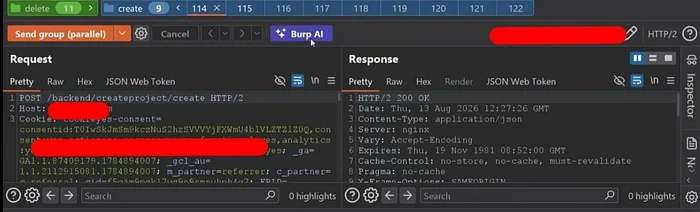
The image shows the affected endpoint, POST /backend/createproject/create, as presented in the report.
Exploitation
Step 1: Send concurrent creation requests
By sending multiple requests concurrently I bypassed the uniqueness restriction and created nine projects with the same details. The report does not include the individual requests, their bodies or the responses.
Step 2: Compare the internal identifiers
After creating the projects I checked their details and found that all of them had the same internal Project ID: 919909.
Step 3: Test whether the projects were isolated
I then tested whether the projects were isolated, with these results:
- Uploading a file to one project made it visible in the others.
- Modifying or deleting shared data affected the other projects.
- A member invitation created through one project was accepted, although its broader access implications were not fully verified.
The projects appeared separate in the interface but they were operating on the same underlying project state.
Root cause
The race condition allowed multiple project entries to be created while sharing the same internal identity and data. The report does not describe the server-side implementation, so the exact mechanism is not confirmed.
Impact
This was more than a duplicate creation issue. Depending on the application's access controls, this behaviour could lead to project isolation and data integrity issues. In the tested case, files uploaded to one project were visible in the others, changes and deletions of shared data affected the other projects, and a member invitation created through one project was accepted. The broader access implications of that invitation were not fully verified.
Fix
Uniqueness checks should be enforced atomically, and each project should maintain a consistent identity with properly isolated data and access controls.
Variants to test
- Other creation endpoints with uniqueness checks. Look for endpoints that reject duplicate names, slugs, identifiers or email addresses. A positive result is several concurrent requests all succeeding and the resulting records sharing an internal identifier.
- Invitation and membership endpoints. Send concurrent invitations or join requests for the same resource. A positive result is duplicate membership records or an invitation accepted more than once.
- File upload and quota checks. Fire concurrent uploads against a per-project or per-user limit. A positive result is more objects stored than the limit allows, or objects attached to the same underlying record.
- Cross-project isolation after duplication. Once duplicates exist, upload, modify and delete data through each copy. A positive result is a change made through one project appearing in the others, which confirms shared state rather than merely duplicated metadata.
What happened, in plain words
A security researcher was testing a web application that lets people create projects. Normally, the app stops you from creating two projects with the same name or identifier. But by sending several requests at almost the same moment, the researcher got around that rule and created nine projects with identical details. The real problem was not the duplicates: all nine projects shared the same internal Project ID and the same underlying data. In the interface they looked separate, but behind the scenes they were the same project. This is a race condition, a bug that appears when a program handles simultaneous actions badly.
Background: the product and the feature
The application is a web app with a project creation feature. A project is a container for work: files, settings, members and other data. Each project normally has a name, an identifier and an internal Project ID. The application tries to keep names and identifiers unique, so two projects cannot have the same one. The report does not name the service, its owner or its version; the target's identity was omitted to avoid disclosing the affected service.
What an API endpoint is
When you click a button in a web app, your browser often sends a request to the server behind the scenes. That request goes to an address called an endpoint. The endpoint is like a counter in a shop: you hand over a form (the request) and the counter does something with it (creates a project, for example). The endpoint in this report is:
POST /backend/createproject/create
Line by line:
POSTis the method. It tells the server that this request is meant to create or change something, not just read it. Think of it as handing in a form rather than asking to see one./backend/createproject/createis the path. It points to the part of the server that handles project creation.backendsuggests it is server-side code, not a page you see.
Finding the race condition
The application normally prevents users from creating projects with an existing name or identifier. If the check and the creation are not done as one indivisible step, two requests arriving at the same time can both pass the check before either one has saved its project. It is like two people asking a receptionist whether a meeting room is free at the same instant: both are told yes, and both book it.
The image shows the affected endpoint, POST /backend/createproject/create, as presented in the report.
Exploitation
Step 1: Send concurrent creation requests
The researcher sent multiple requests at the same time (concurrently) to create projects with the same details. By sending multiple requests concurrently, the researcher bypassed the uniqueness restriction and nine projects were created. The report does not include the individual requests, their bodies or the responses, so we cannot see the exact payloads.
Step 2: Compare the internal identifiers
After creating the projects, the researcher looked at their details. All nine had the same internal Project ID: 919909. An internal ID is the hidden number the system uses to tell records apart. If nine projects share one ID, the system may be treating them as one record.
Step 3: Test whether the projects were isolated
Isolation means that what happens in one project stays in that project. The researcher tested this and found:
- Uploading a file to one project made it visible in the others.
- Modifying or deleting shared data affected the other projects.
- A member invitation created through one project was accepted, although its broader access implications were not fully verified.
The projects appeared separate in the interface, but they were operating on the same underlying project state. In other words, the nine entries were like nine doors into the same room.
Root cause
The race condition allowed multiple project entries to be created while sharing the same internal identity and data. The report does not describe the server-side implementation, so the exact mechanism is not confirmed.
Impact
This was more than a duplicate creation issue. Depending on the application's access controls, this behaviour could lead to project isolation and data integrity issues. In the tested case, files uploaded to one project were visible in the others, changes and deletions of shared data affected the other projects, and a member invitation created through one project was accepted. The broader access implications of that invitation were not fully verified.
Fix
Uniqueness checks should be enforced atomically, and each project should maintain a consistent identity with properly isolated data and access controls.
Variants to test
- Other creation endpoints with uniqueness checks. Look for endpoints that reject duplicate names, slugs, identifiers or email addresses. A positive result is several concurrent requests all succeeding and the resulting records sharing an internal identifier.
- Invitation and membership endpoints. Send concurrent invitations or join requests for the same resource. A positive result is duplicate membership records or an invitation accepted more than once.
- File upload and quota checks. Fire concurrent uploads against a per-project or per-user limit. A positive result is more objects stored than the limit allows, or objects attached to the same underlying record.
- Cross-project isolation after duplication. Once duplicates exist, upload, modify and delete data through each copy. A positive result is a change made through one project appearing in the others, which confirms shared state rather than merely duplicated metadata.
Glossary
- API: a set of rules that lets one program talk to another. In a web app, the browser sends requests to the server's API.
- Endpoint: a specific address on a server that accepts requests, like a counter in a shop.
- POST: an HTTP method used when a request is meant to create or change something.
- Request: a message sent from a browser (or tool) to a server asking it to do something.
- Response: the server's reply to a request.
- Race condition: a bug where the result depends on the timing of simultaneous actions, so two requests can interfere with each other.
- Concurrent: happening at the same time.
- Atomic: done as a single indivisible step, so nothing else can happen in the middle.
- Uniqueness check: a rule that prevents two records from having the same name or identifier.
- Identifier: a value used to refer to a record, such as a name or a code.
- Internal Project ID: a hidden number the system uses to identify a project behind the scenes.
- Isolation: keeping one project's data separate from another's.
- Data integrity: keeping data correct and consistent, not mixed up or corrupted.
- Access controls: rules that decide who can see or change what.
- Member invitation: an offer for a person to join a project.
- Slug: a short, URL-friendly name for a record, often used in web addresses.
- Quota: a limit on how much of something (such as files or storage) a user or project can have.
- Metadata: data about data, such as a project's name or creation date, rather than its contents.



