Redis Under Threat: Understanding CVE-2026–81934, From Use-After-Free to Remote Code Execution
A use-after-free flaw in Redis's TLS pending-data handling could let a remote, unauthenticated attacker execute arbitrary code when TLS is enabled. The text describes the memory lifecycle and potential impact but gives no technical detail on triggering the bug.

About Redis
The full write-up lives on its author's site
It belongs to its author, so we link to it rather than copy it. The other two tabs are our own rewrites, checked against it.
Context
Redis is an open-source, in-memory data store that keeps data primarily in RAM for fast access. It supports several data structures, including strings, lists, sets and hashes, and is commonly used for caching, session storage, message processing and real-time applications. Because it sits in front of so many performance-critical paths, a memory-management flaw in Redis is not a local bug: it is a bug in shared infrastructure.
This write-up looks at CVE-2026-81934, a vulnerability discussed in the September 2026 God Access weekly session. The material describes it as a Use-After-Free (UAF) vulnerability that could potentially lead to Remote Code Execution (RCE). The affected code is the tlsProcessPendingData() function, which handles pending TLS data.
Setup
The material states two preconditions for exploitation: the attacker needs network access to the service, and TLS must be enabled on the Redis deployment. The issue is described as potentially allowing a remote, unauthenticated attacker to execute arbitrary code under certain conditions.
The material lists a CVSS score of 9.8. It identifies versions below 8.2.0 as vulnerable and recommends upgrading to 8.2.0 or later.
The practical part of the session uses a proof-of-concept repository. The setup steps are:
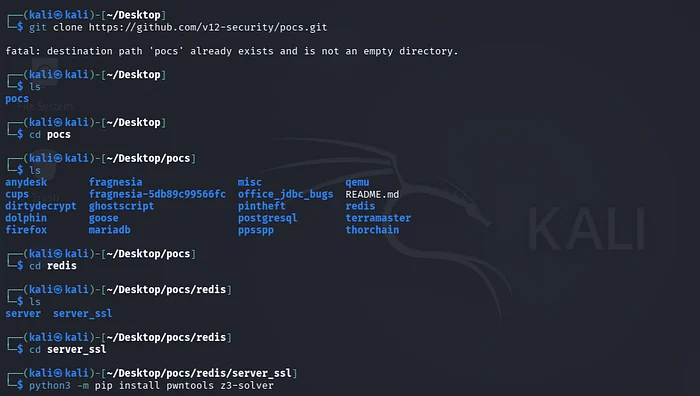
- Clone the repository into the
pocsdirectory, then navigate topocs/redis/server_sslwith thecdcommand. - Install
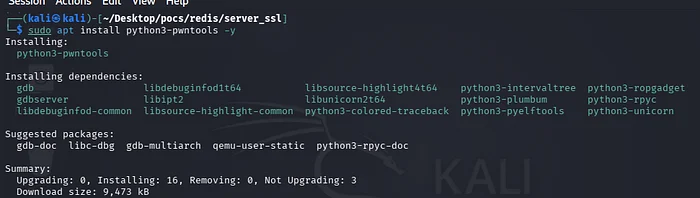
pwntoolsusingpython3. - Install z3.
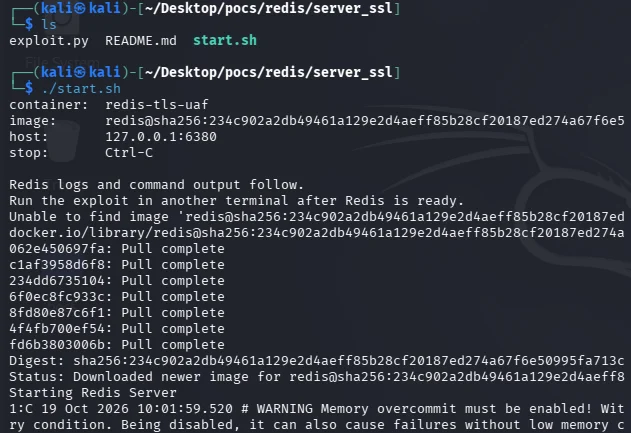
- Run
./start.shto finish setting up the server.

Finding it
The session material frames the bug around tlsProcessPendingData(), the function that processes data still pending on a TLS connection. The problem is a lifetime error: memory is released while a reference to it remains, and the code later follows that stale reference.
That is what makes it a Use-After-Free rather than a simple crash. The freed region can be reused for different data, and the stale pointer then reads or writes whatever now occupies that memory. The material describes the consequence as memory corruption that may, under the right conditions, be turned into code execution.
Exploitation
The material presents the path from UAF to RCE as a high-level sequence rather than a line-by-line walkthrough:
- Memory allocation: Redis allocates memory to handle incoming TLS data.
- Memory release: Due to a programming error, memory is released while a reference to it remains.
- Memory reuse: The released memory may be reused for different data.
- Invalid access: Redis may access the old reference and interpret unexpected data.
- Potential code execution: If an attacker can reliably influence this process, the memory corruption may lead to Remote Code Execution.
Step 1: Prepare the PoC environment
Clone the repository into the pocs directory and move into the TLS server directory:
This places you in the server_ssl directory of the PoC repository.
Step 2: Install the Python dependencies
Install pwntools with python3:
Then install z3:
The material only says to install pwntools and z3; it does not describe their role. The material does not describe how z3 is applied to the exploit.
Step 3: Start the server
Finish setting up the server by running the start script:
./start.sh
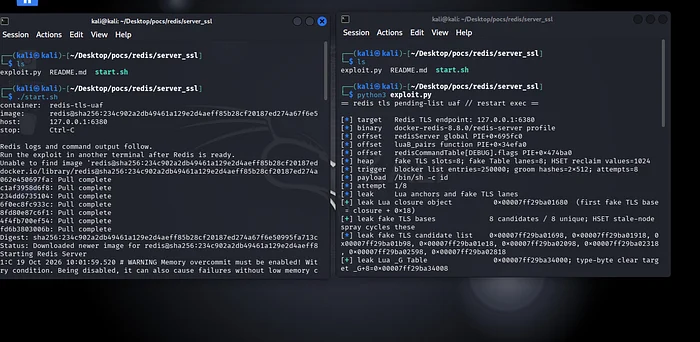
Step 4: Run the payload
With the server running, the payload is executed against the server that was previously started.
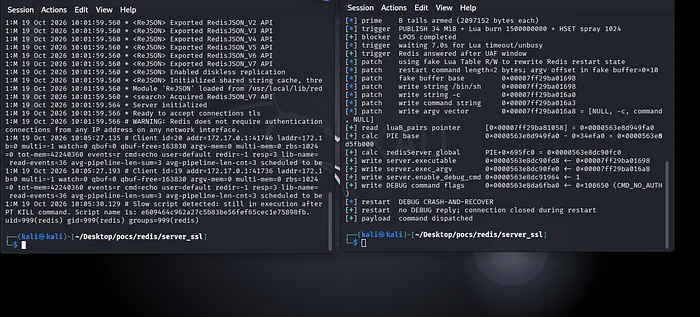
The material states that the payload was added, allowing the required actions on the server. The material does not include the payload itself, the requests sent to the TLS service, or the responses returned, so the exact wire format of the exploit is not shown here.
Root cause
The mistake is in the lifetime management of memory used for pending TLS data inside tlsProcessPendingData(). Memory is freed while a reference to it is still held, and that reference is used afterwards. Because the freed region can be reused for other data, the code can end up interpreting unexpected data through the old reference.
The material does not explain which defence, if any, should have caught this, so whether existing mitigations failed or the bug simply sat outside their coverage is not stated. What it does make clear is the exposure condition: the service must be reachable over the network and TLS must be enabled, which the material gives as the preconditions for the described attack.
Impact
A successful exploitation could put the confidentiality, integrity and availability of a Redis deployment at risk:
- Data exposure: information stored in Redis could be at risk.
- System compromise: code execution may allow unauthorised actions within the privileges available to the Redis process.
- Service disruption: memory corruption or malicious activity could affect application availability.
- Further attacks: a compromised service could potentially become a starting point for additional attacks against connected systems.
The real-world impact depends on the deployment configuration, network exposure and the privileges of the service. The material describes the attacker as remote and unauthenticated, and the CVSS score as 9.8, but it also hedges the code-execution outcome with "under certain conditions" and "potentially", so reliability of exploitation is not guaranteed by the description alone.
Fix
Upgrade to a patched release. The material identifies versions below 8.2.0 as vulnerable and recommends 8.2.0 or later, while advising that you check the official Redis security advisory for the affected versions and the exact fixed release before deciding what to deploy.
Alongside the patch, the material recommends:
- Review TLS configuration. TLS-enabled deployments are the prerequisite for the described attack, but do not disable TLS blindly, because encryption may be necessary to protect data in transit. Prefer applying the security patch and reviewing the TLS configuration against the official advisory.
- Restrict network access. Redis should not be unnecessarily exposed to public networks. Use firewall rules, network segmentation and access controls so that only trusted systems that require the service can connect.
- Apply least privilege. Run Redis with only the permissions necessary for its function, to reduce the potential damage if the service is compromised.
- Monitor and review configurations. Regularly review Redis versions, TLS settings, network exposure, logs and security alerts, and include Redis in routine vulnerability assessments and patch-management processes.
Variants to test
- Other TLS entry points. Any code path that queues or processes pending TLS data is worth reviewing for the same free-then-use pattern. A positive result is a code path where a buffer is released while a reference is still reachable from a later callback or event.
- TLS-enabled deployments below 8.2.0. Confirm the running version and whether TLS is enabled. A positive result is a reachable service on a vulnerable version with TLS configured, which matches the stated preconditions.
- Memory reuse shaping. Because the bug depends on what reoccupies the freed region, test whether repeated connections or crafted TLS records change the contents at the stale reference. A positive result is a crash or observable change in behaviour that tracks the attacker-controlled data rather than random noise.
- Exposure review. Check whether Redis is reachable from untrusted networks at all. A positive result is a Redis instance accepting connections from outside the trusted segment, which turns a memory bug into a remotely reachable one.
What happened, in plain words
Redis is a piece of software that many websites and apps use behind the scenes. Think of it as a very fast notebook kept in the computer's memory rather than on a disk. Because it is so quick, it is used for things like remembering who is logged in, storing temporary data, and passing messages between parts of an application. It is open source, which means anyone can read its code, and it supports several ways of organising data: strings (simple text), lists (ordered items), sets (unordered collections) and hashes (key and value pairs).
Because Redis sits in front of so many busy parts of an application, a mistake in how it handles memory is not a small local problem. It is a problem in shared infrastructure, a bit like a faulty lock on the main door of an office building rather than on one cupboard inside it.
This article is about a specific security flaw called CVE-2026-81934. A CVE is a public identifier given to a known vulnerability, so that people around the world can talk about the same issue without confusion. One vulnerability discussed in the September 2026 God Access weekly session is CVE-2026-81934, described in the material as a Use-After-Free (UAF) vulnerability that could potentially lead to Remote Code Execution (RCE). We will unpack both of those terms shortly.
The affected piece of code is a function called tlsProcessPendingData(), which handles data that is still waiting to be processed on a TLS connection. TLS is the technology that encrypts traffic between a browser and a server, the same thing that puts the padlock in your address bar.
What Is Redis?
Redis is an open-source, in-memory data store. "In-memory" means it keeps data primarily in RAM, the fast working memory of a computer, rather than on a slower hard disk. That is why it is so quick.
It supports different data structures, including strings, lists, sets and hashes. You can think of these as different kinds of containers: a string is a single label, a list is a queue of items, a set is a bag of unique items, and a hash is a small table of labelled values.
Because of its performance, Redis is commonly used for caching (keeping a copy of something so you do not have to fetch it again), session storage (remembering that you are logged in), message processing (passing tasks between programs) and real-time applications (things that must update instantly).
However, when a service is exposed to an untrusted network, a vulnerability in its memory management can become a serious security risk. An untrusted network is simply any network you do not control, such as the public internet.
Understanding CVE-2026-81934
According to the provided session material, CVE-2026-81934 involves a Use-After-Free vulnerability in Redis's tlsProcessPendingData() function, which handles pending TLS data. "Pending" here means data that has arrived but has not yet been fully dealt with.
The issue is described as potentially allowing a remote, unauthenticated attacker to execute arbitrary code under certain conditions. Let us break that sentence down:
- Remote means the attacker does not need to be sitting at the machine; they can reach it over a network.
- Unauthenticated means they do not need a username or password.
- Execute arbitrary code means they could make the server run instructions of their choosing, rather than the instructions it was meant to run.
- Under certain conditions means it does not always work; the circumstances have to line up.
The material lists a CVSS score of 9.8. CVSS is a standard scoring system for the severity of a vulnerability, where 10 is the worst possible. A score of 9.8 is therefore very high. The material also highlights the potential impact on vulnerable Redis deployments. It notes that exploitation requires network access to the service and that TLS must be enabled.
What Is a Use-After-Free Vulnerability?
A Use-After-Free vulnerability occurs when software continues to access a memory location after that memory has been released.
Consider a simple example: an application creates an object in memory and later releases it because it is no longer needed. However, the application still retains a pointer to that memory. A pointer is like a note that says "the thing you want is at this address". If the thing has been removed but the note is still lying around, anyone following the note ends up somewhere unexpected.
If the memory is reused for another purpose, the application may mistakenly access unexpected data through the old pointer. A useful everyday comparison is a hotel room. You check out, the room is cleaned and given to a new guest, but the old key card still works. If you walk back in, you are now in someone else's room, seeing and possibly moving their belongings.
This programming error can cause crashes, memory corruption, or, under certain conditions, security consequences such as code execution. Memory corruption simply means the contents of memory no longer match what the program expects.
From UAF to Remote Code Execution
The vulnerability described in the session material can be understood through the following high-level sequence:
- Memory allocation: Redis allocates memory to handle incoming TLS data. Allocation means reserving a space in memory for a purpose.
- Memory release: Due to a programming error, memory is released while a reference to it remains. Release means handing the space back so it can be reused.
- Memory reuse: The released memory may be reused for different data.
- Invalid access: Redis may access the old reference and interpret unexpected data.
- Potential code execution: If an attacker can reliably influence this process, the memory corruption may lead to Remote Code Execution.
RCE is particularly serious because it can allow an attacker to execute commands on a vulnerable server. The actual impact depends on the vulnerability, runtime conditions and the privileges of the affected service. Privileges are the permissions a program has, much like the difference between a visitor and a building manager.
Potential Security Impact
A successful exploitation could put the confidentiality, integrity and availability of a Redis deployment at risk. Those three words are the classic trio of security concerns: confidentiality means keeping data secret, integrity means keeping data correct and unaltered, and availability means keeping the service working.
- Data exposure: Information stored in Redis could be at risk.
- System compromise: Code execution may allow unauthorised actions within the privileges available to the Redis process.
- Service disruption: Memory corruption or malicious activity could affect application availability.
- Further attacks: A compromised service could potentially become a starting point for additional attacks against connected systems.
The real-world impact depends on the deployment configuration, network exposure and service privileges. In other words, how much damage is possible depends on how the service was set up and what it is allowed to do.
Mitigate the Risk:
Understanding a vulnerability is important, but applying appropriate security controls is equally important. A security control is any measure that reduces risk, from a software update to a firewall rule.
1. Upgrade to a verified patched version
Check the official Redis security advisory for the affected versions and the exact fixed release. An advisory is an official notice from the software's maintainers. The provided session material identifies versions below 8.2.0 as vulnerable and recommends upgrading to version 8.2.0 or later. Verify the official advisory before deciding which release to deploy.
2. Review TLS configuration
The session material identifies TLS-enabled Redis deployments as a prerequisite for the described attack. Do not disable TLS blindly, because encryption may be necessary to protect data in transit. Prefer applying the security patch and reviewing the TLS configuration against the official advisory.
3. Restrict network access
Redis should not be unnecessarily exposed to public networks. Use firewall rules, network segmentation and access controls to allow connections only from trusted systems that require the service. A firewall is a filter that decides which network traffic is allowed in or out.
4. Apply least privilege
Run Redis with only the permissions necessary for its function. Limiting privileges can reduce the potential damage if a service is compromised. This is the same idea as giving a cleaner a key to the rooms they clean, not to the safe.
5. Monitor and review configurations
Regularly review Redis versions, TLS settings, network exposure, logs and security alerts. Include Redis in routine vulnerability assessments and patch-management processes. Logs are the records a system keeps of what happened, and patch management is the routine of keeping software up to date.
How to Prevent:
The practical part of the session uses a proof-of-concept repository. A proof of concept, or PoC, is a small demonstration that shows a vulnerability is real, usually in a safe test environment. The setup steps are:
- Clone the repository into the
pocsdirectory, then navigate topocs/redis/server_sslwith thecdcommand. - Install
pwntoolsusingpython3. - Install z3.
- Run
./start.shto finish setting up the server.
Clone the repository into the 'pocs' directory, then navigate to 'pocs/redis/server_ssl' using the 'cd' command.
To fulfill our requirement, we need to install pwntools using python3.
then install z3.
Finally, to finish setting up the server, run the ./start.sh command.
Here, we are trying to run the payload on the server that we previously started.
The material states that the payload was added, allowing the required actions on the server.
Final Thoughts
CVE-2026-81934, as described in the provided session material, highlights how a seemingly small memory-management error can become a significant security concern.
Use-After-Free vulnerabilities demonstrate why secure memory handling, timely patching, restricted network access and least-privilege configurations are essential.
For security professionals and aspiring penetration testers, understanding the relationship between memory corruption and Remote Code Execution is valuable. The goal is not just to understand how vulnerabilities work, but also to recognise exposure, verify risks responsibly and help organizations strengthen their defences.
Security is not only about discovering vulnerabilities. It is also about reducing the opportunities attackers have to exploit them.
Conclusion:
CVE-2026-81934 demonstrates how a memory-management error can become a significant security concern in widely used infrastructure software.
The best defence combines timely patching, restricted network access, least privilege and continuous monitoring.
For cybersecurity learners, this vulnerability is a reminder that understanding the root cause, assessing exposure and applying appropriate defensive controls are just as important as identifying a CVE.
Glossary
- CVE: A public identifier given to a known security vulnerability so people can refer to it unambiguously.
- CVSS: A standard scoring system for the severity of a vulnerability, from 0 to 10.
- Use-After-Free (UAF): A bug where a program keeps using memory after it has been released.
- Remote Code Execution (RCE): A situation where an attacker can make a system run instructions of their choosing.
- TLS: The encryption technology that protects traffic between a client and a server, shown as a padlock in a browser.
- Redis: An open-source, in-memory data store used for caching, sessions and fast data handling.
- In-memory: Keeping data in RAM rather than on disk, which makes access very fast.
- RAM: A computer's fast working memory, cleared when the machine is switched off.
- Data structure: A way of organising data, such as a string, list, set or hash.
- String: A piece of text or a sequence of characters.
- List: An ordered collection of items.
- Set: An unordered collection of unique items.
- Hash: A collection of labelled values, like a small table.
- Caching: Keeping a copy of data so it can be fetched quickly later.
- Session storage: Remembering that a user is logged in between requests.
- Pointer: A reference that says where a piece of data lives in memory.
- Memory allocation: Reserving a space in memory for a purpose.
- Memory release: Handing a space in memory back so it can be reused.
- Memory corruption: A state where the contents of memory no longer match what the program expects.
- Unauthenticated: Acting without a username or password.
- Remote: Reaching a system over a network rather than sitting at it.
- Privileges: The permissions a program or user has.
- Least privilege: Giving a program or user only the permissions it needs to do its job.
- Confidentiality: Keeping data secret from those who should not see it.
- Integrity: Keeping data correct and unaltered.
- Availability: Keeping a service working and reachable.
- Firewall: A filter that decides which network traffic is allowed.
- Network segmentation: Splitting a network into separate parts so problems in one part do not spread.
- Advisory: An official notice from software maintainers about a vulnerability and its fix.
- Patch: A software update that fixes a problem.
- Patch management: The routine of keeping software up to date.
- Logs: Records a system keeps of what happened.
- Proof of concept (PoC): A small demonstration that shows a vulnerability is real, usually in a safe test environment.
- Repository: A collection of code and files, often stored and shared online.
pwntools: A Python library used for building and running exploit demonstrations.- z3: A tool used in the PoC tooling; the material does not describe how it is applied.
- Payload: The data or instructions an attacker sends to trigger a vulnerability.
- Function: A named block of code that performs a task.
tlsProcessPendingData(): The Redis function that handles pending TLS data, where the vulnerability lives.

