Testing PHP2Shell Across Apache and PHP-FPM
A memory-lifetime flaw in PHP's multipart and session handling lets a stale pointer survive across requests on the same worker, enabling heap and module address disclosure and, with build-specific offsets, command execution over HTTP. The author reproduced this on Apache mod_php with WordPress and Symfony, and on nginx with PHP-FPM via a file-write-then-execute path.
 Published on cobalt.io
After PHP2Shell was announced, I wanted to see whether CVE-2026-109619 could lead to command execution over HTTP in a complete web stack. I also wanted to know whether one exploit could work across different vulnerable PHP builds without build-specific calibration.
The full write-up lives on its author's site
It belongs to its author, so we link to it rather than copy it. The other two tabs are our own rewrites, checked against it.
Context
PHP2Shell is the nickname used for this pair of PHP memory-safety issues. This write-up looks at whether one of them, CVE-2026-109619, can be turned into command execution over HTTP in a complete web stack, and whether a single exploit can work across different vulnerable PHP builds without build-specific calibration.
The feature at the centre of the Apache chain is session upload progress. PHP parses multipart/form-data during request startup, before the application's front controller runs, and session upload progress can create session state at that stage. That means the dangerous state can exist before /index.php, WordPress or Symfony has executed a single line. No upload form, no call to move_uploaded_file() and no vulnerable controller is required.
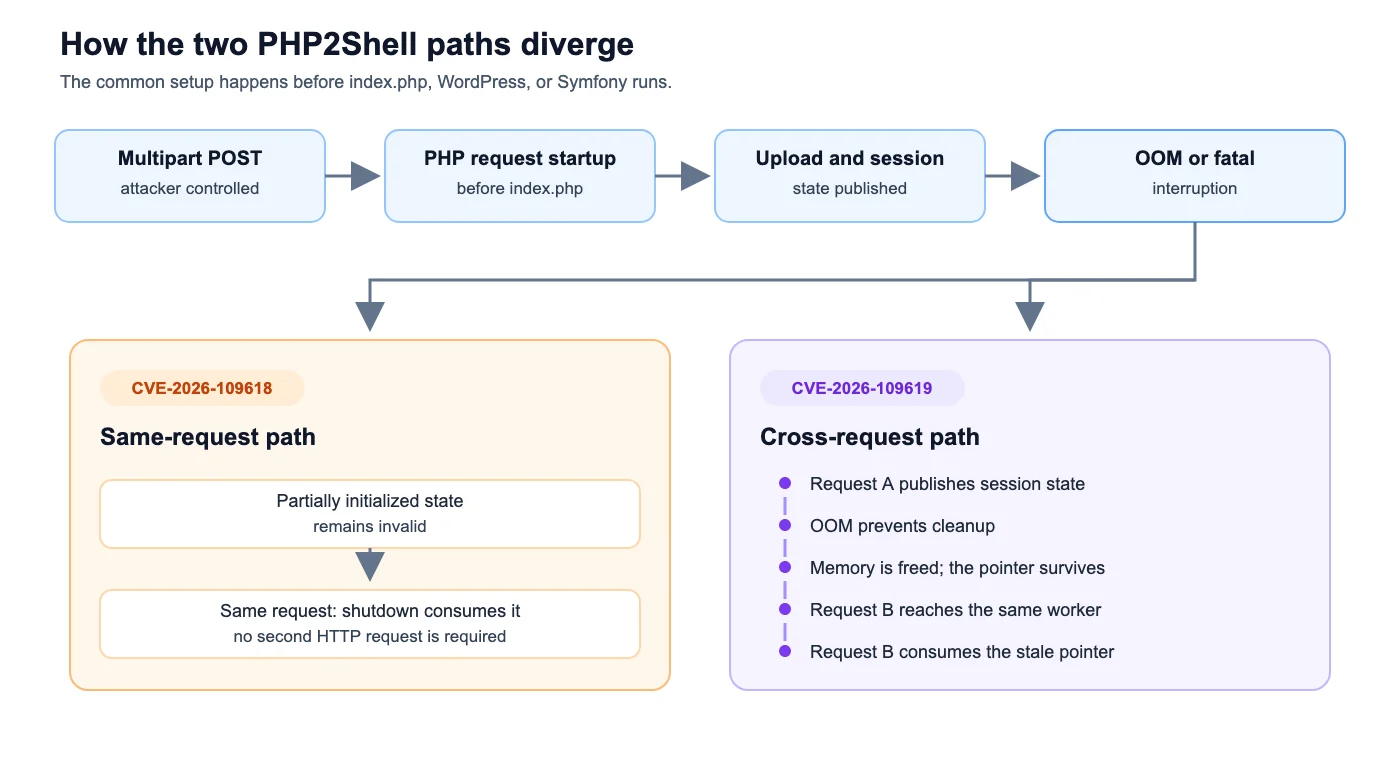
The two CVEs are related but do not have to be chained:
- CVE-2026-109619 crosses a request boundary. Request A stores a pointer to request-owned data in worker-global state. An OOM or fatal error interrupts cleanup, and request B uses the stale pointer before PHP resets it.
- CVE-2026-109618 involves incomplete state consumed during request shutdown, within the same request. It is covered here to distinguish it from the exploitation path demonstrated in the labs, which is CVE-2026-109619.
As Cobalt's PHP2Shell technical brief puts it, a working proof of concept is not automatically portable to every production build.
Setup
Three lab deployments were tested:
- WordPress with Apache mod_php;
- Symfony with Apache mod_php;
- Symfony with nginx and PHP-FPM.
| Lab | Stack | Result | Main lesson |
|---|---|---|---|
| WordPress | WordPress 7.1.3, PHP 8.4.26, Apache mod_php, one and four workers | Command execution through HTTP | The sequence did not need an upload form or a plugin vulnerability. |
| Symfony | Symfony 7.4.21, PHP 8.4.26, Apache mod_php | Command execution through HTTP | The framework change did not change the PHP memory problem. |
| Symfony build profile | Symfony 7.4.19, PHP 8.3.21, Apache mod_php, one and four workers | Command execution through HTTP after build-specific calibration | The PHP 8.4.26 offsets did not work without changes on PHP 8.3.21. |
| nginx and PHP-FPM | Symfony 7.4.19, PHP 8.3.21, nginx and PHP-FPM, one, four, and six workers | Build-specific disclosure and command execution under lab conditions | FPM needed different calibration, an output path, and a worker strategy. |
The labs ran in Docker containers on a Linux x86_64 host, with ASLR enabled on the host.
Configuration differed per SAPI:
- The Apache labs used
memory_limit=8Mandpost_max_size=32M. - The PHP-FPM lab used file-backed sessions,
memory_limit=128Mandpost_max_size=8M. The FPM execution path also required a test-only Symfony entry point and a writable directory that nginx served as PHP.
The production-style profiles used display_errors=Off. That hid errors from the HTTP response but did not correct the invalid memory state.
Finding it
The starting observation is about ordering. PHP parses multipart bodies during request startup, before the application's front controller runs. Session upload progress can create session state at this stage. PHP frees the request heap at the end of the request, but the worker may remain alive and process subsequent requests.
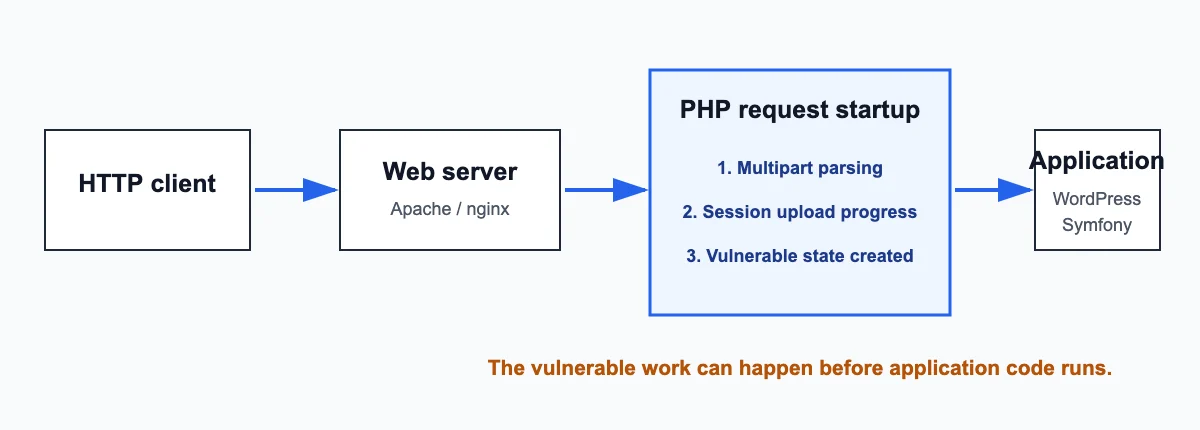
In the Apache startup chain, request A published session state before hitting a fatal interruption. Cleanup did not clear the worker's pointer to that state. Request B then had to reach the same worker and consume the stale pointer after request A's heap had been freed. The FPM chain used a different post-startup producer, described below.
The two flaws
CVE-2026-109619 is a memory-lifetime issue. During request A, PHP stores temporary data in the request heap and keeps a pointer to it in a worker-owned variable. When the request ends, PHP frees the request heap, but the worker remains alive. If the pointer is not cleared, it continues to reference invalid memory: a dangling pointer.
The producer stores the pointer during request A. If cleanup is interrupted, the pointer remains in worker-global state. The consumer runs during request B on the same worker and reads, frees, or otherwise uses the stale pointer before PHP resets it. In the multipart sequence, session upload progress can act as both producer and consumer. The CVE is not limited to this feature: PHP also maintains worker-level state for errors, exceptions, objects and extensions, which may retain stale pointers if cleanup is interrupted.
An OOM can trigger the interruption, but so can a parse failure, an uncaught error, a failed require, or an execution timeout.
CVE-2026-109618 is an initialization-order flaw in Zend HashTable, the internal structure PHP uses for arrays such as $_POST and $_FILES. Each entry is stored in a bucket containing a key and a value. In the affected sequence, PHP exposes a new bucket before fully initializing its fields. If a fatal error occurs at that point, request shutdown may process the incomplete bucket as a valid entry. The simplified code below shows the critical order:
index = table->used++;

table->elements++;

bucket = table->data + index;

bucket->key = allocate_key(); /* may trigger a fatal error */

bucket->hash = hash;

bucket->value = value;
If allocate_key() triggers a fatal error, PHP never executes the remaining assignments. Because the used count has already been incremented, request shutdown processes the incomplete bucket as a live entry. The flaw is caused by the ordering between initialization and teardown. The relevant code is in PHP's zend_hash.c.
Exploitation
Step 1: cause a controlled out-of-memory
post_max_size limits the POST body accepted by PHP, while memory_limit caps the memory available to process it. An accepted multipart body can expand into much larger in-memory structures. A request without a usable declared length may pass the initial size check, while multipart parts containing many headers can further increase PHP's memory usage.
Empty file fields do not count toward max_file_uploads, but PHP still creates the corresponding $_FILES metadata. Nested field names multiply this work across six parallel metadata structures.
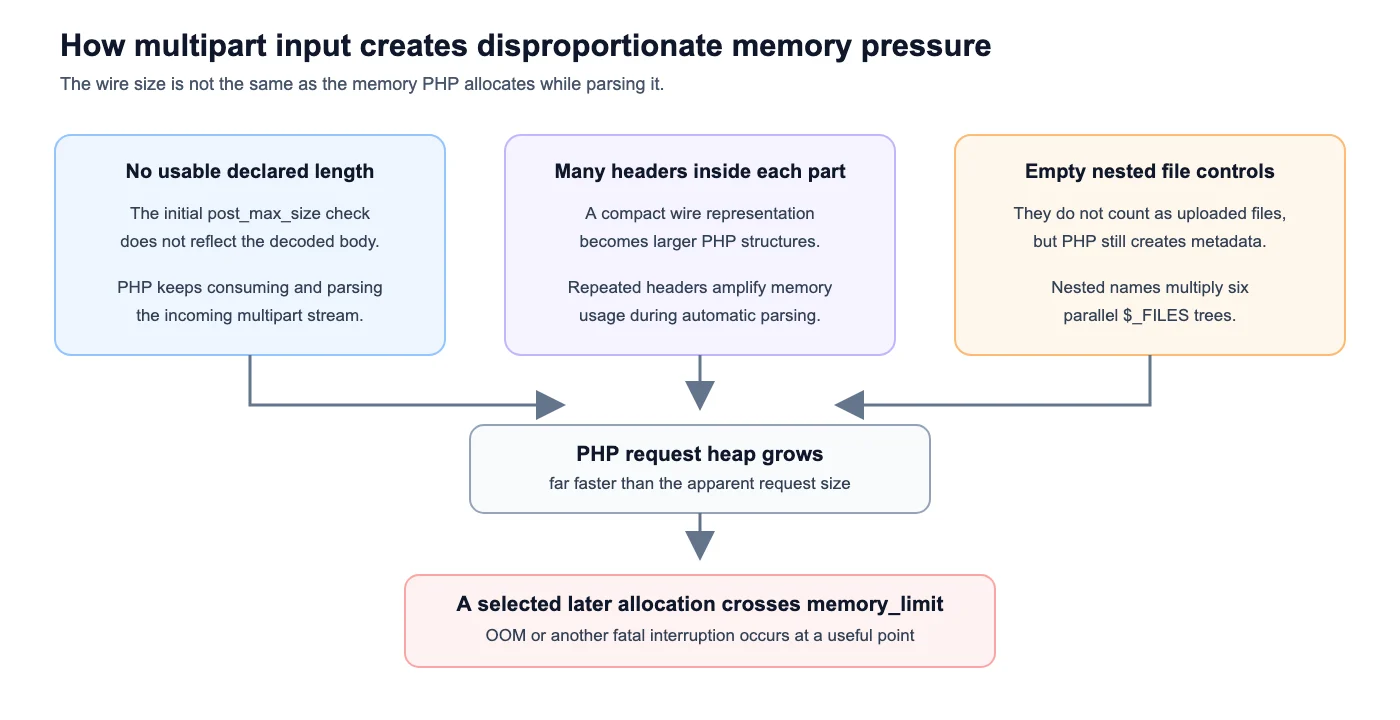
By arranging the multipart fields, a later allocation can be made to hit memory_limit after the vulnerable state has been created. The failing allocation does not need to be the one that created that state.
Step 2: request A leaves a stale pointer
Request A publishes session state and then hits the fatal interruption. Cleanup does not clear the worker's pointer to that state. The worker survives.
Step 3: request B consumes the pointer
Request B must reach the same worker and consume the stale pointer after request A's heap has been freed. With one Apache worker, requests A and B are guaranteed to reach the same process. With four workers, request B may reach another child that does not contain the stale pointer.
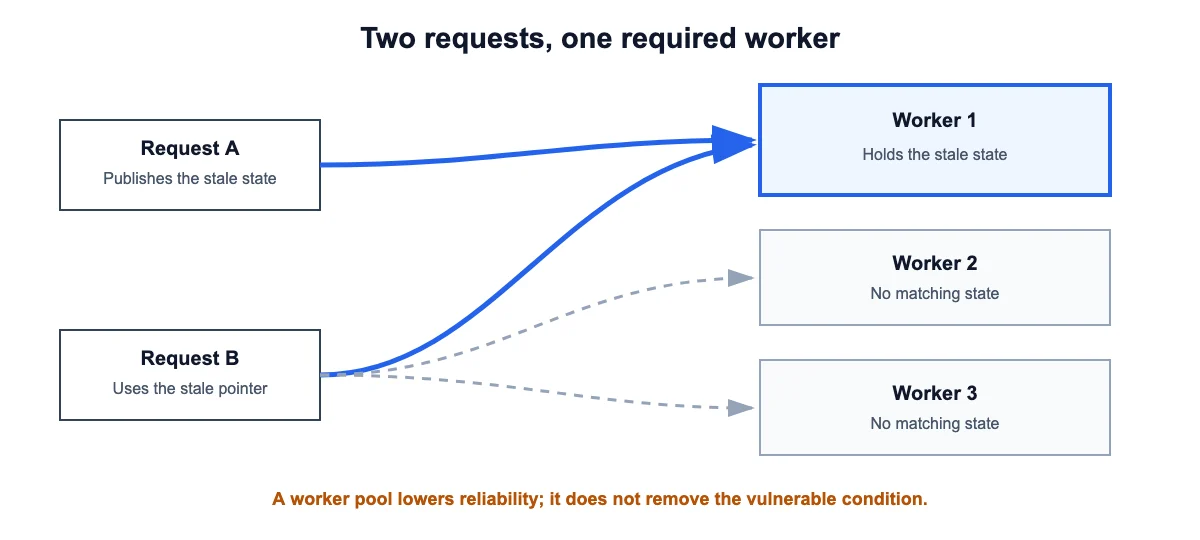
In the lab, three verified keep-alive connections were kept busy and the sequence was run through the remaining Apache child. This produced repeatable results, and all four workers were restored after the test. The test confirms that the condition can persist in a worker pool. It is not safe for production use because occupying workers can reduce capacity or cause an outage.
Step 4: turn the stale pointer into address disclosures
ASLR was enabled in every reference test. It changed runtime addresses between runs but did not correct the underlying PHP memory flaw.
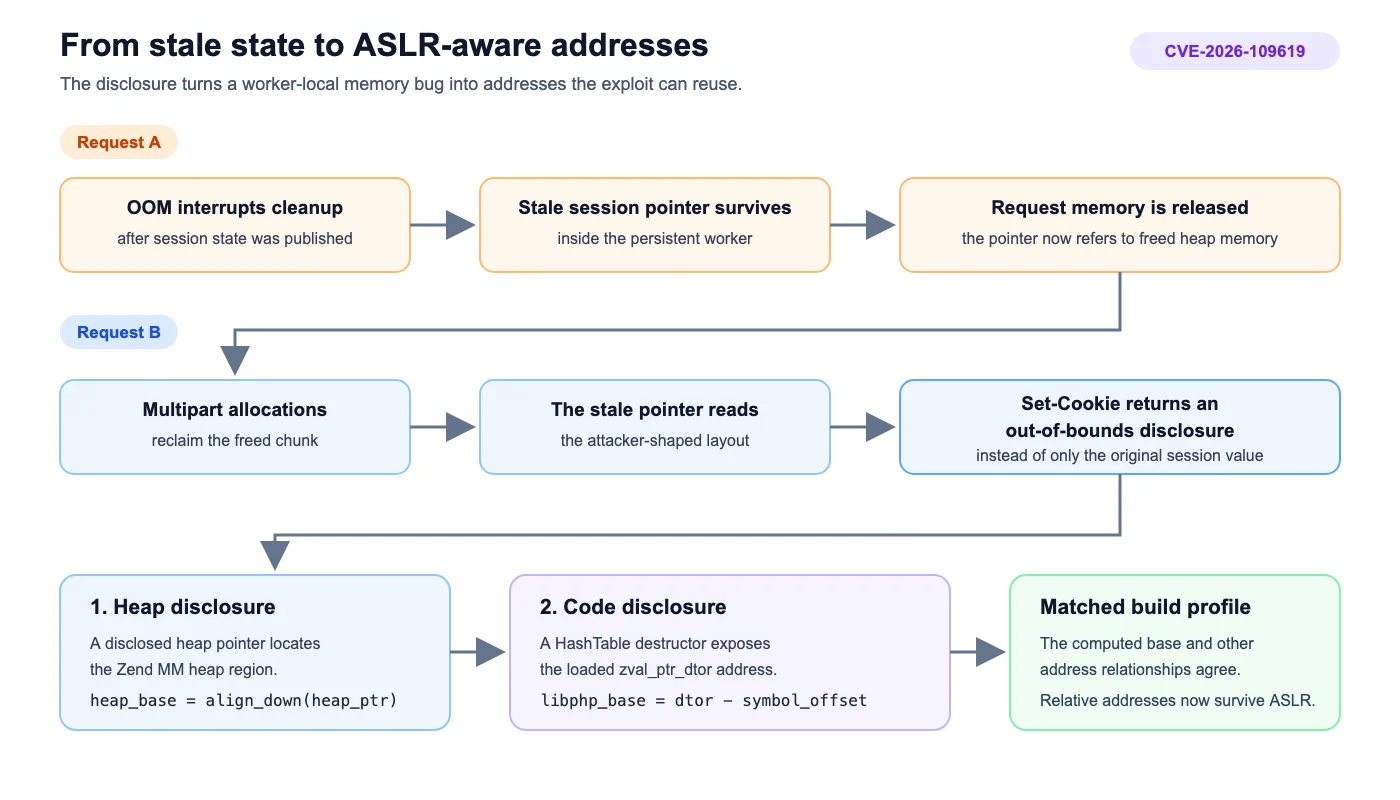
At this stage there was an old pointer but no ASLR bypass. Most incorrect heap layouts crashed the worker, so request B had to reuse memory that request A released. Request A left session state with a pointer to freed request memory. Request B used normal multipart allocations to reuse the same memory blocks, with controlled string metadata placed in the reused area. PHP followed the old pointer and read the new contents as a longer string.
PHP put this incorrect string in the session cookie. The Set-Cookie header then contained an out-of-bounds read, and the response contained real process pointers and controlled bytes.
The first useful disclosure gave a pointer into the Zend Memory Manager (Zend MM), PHP's internal allocator. Aligning the pointer to the expected heap boundary gave the heap base and the location of the request data.
A second disclosure gave the address of zval_ptr_dtor, the function PHP uses to destroy a zval value. The function is in the loaded libphp module, so its address gave the runtime location of that module.
Step 5: calibrate offsets for the tested build
The exact libphp binary in each lab was known. The relative offset of zval_ptr_dtor was found in that binary and subtracted from the HTTP disclosure. The result was a candidate libphp base, checked for alignment and user-space range:
candidate_base = leaked_zval_ptr_dtor - profile.zval_ptr_dtor_offset

candidate_is_plausible = (

candidate_base % profile.expected_alignment == 0

and profile.user_address_min <= candidate_base < profile.user_address_max

)
This native x86_64 result shows the calculation:
leaked_zval_ptr_dtor = 0x71d9bb411b60

zval_ptr_dtor_offset = 0x64eb60

libphp_base = leaked_zval_ptr_dtor - zval_ptr_dtor_offset

assert libphp_base == 0x71d9badc3000
The calculated base matched the worker mapping. The mapping was checked after the HTTP calculation; the exploit client did not use the mapping as an input. The libphp build ID and SHA-256 were recorded for each exploit profile, because offsets can change between builds with the same PHP version.
Step 6: execute a command over HTTP
The final Apache test used display_errors=Off. The two HTTP disclosures gave both runtime bases, and the HTTP response contained the command output:
HTTP/1.1 200 OK

Content-Length: 54

uid=33(www-data) gid=33(www-data) groups=33(www-data)
The container identity did not change. The Apache error-log hash was the same before and after the command response, which showed that the expected worker returned the response and stayed available.
The first command-execution prototype did not meet this condition. It executed the command, then PHP tried to destroy the forged structure and crashed the worker. The final version used two callbacks: the first called zif_passthru() to execute the command and return its output, the second called _zend_bailout() before PHP freed the forged structure.
Step 7: deal with startup reliability
A successful result does not mean that each new process has a usable heap layout. Four separate Apache startups failed the first disclosure checks; the fifth startup completed the sequence. In another test, the first process failed and the next process succeeded. The test program stopped when disclosed addresses did not match the expected profile boundaries, which prevented execution attempts with unverified pointers.
Step 8: the PHP-FPM sequence
In the PHP 8.3.21 and Symfony 7.4.19 replica, the Apache startup sequence did not work. PHP-FPM terminated the affected child. A separate decoder sequence ran after startup, kept the child alive, and enabled a file write and command execution under the conditions below. These results apply to the local replica; no intrusive requests were sent to the observed system.
A normal request passes through these steps:
- nginx receives the HTTP request and applies checks such as
client_max_body_size. - nginx converts the request into FastCGI records and sends them to an available PHP-FPM child.
- The child starts the PHP request, parses the multipart body, and initializes extensions. Then it runs the Symfony front controller.
- During request shutdown, PHP frees request memory. A healthy child returns to the pool and can process another request.
The vulnerability crosses steps 3 and 4. The vulnerable code is one condition; the same child must also survive until a later request uses the invalid state.
With Apache mod_php, PHP runs inside each Apache worker. After a request startup error, Apache runs the normal request-shutdown path and can reuse the worker, so an old pointer can still exist when request B reaches that worker. With PHP-FPM, PHP runs in a separate worker pool and nginx sends requests to the pool through FastCGI. In the tested startup-error path, the affected FPM child exited and did not return to the pool; the FPM master started a clean child with new process state. The old pointer from request A disappeared with the terminated child, and request B could not use that child's heap or global state. The Apache cross-request sequence stopped.
This result does not cover all PHP-FPM error paths. A fatal error after request startup can leave the child alive, and another cross-request sequence can then occur.
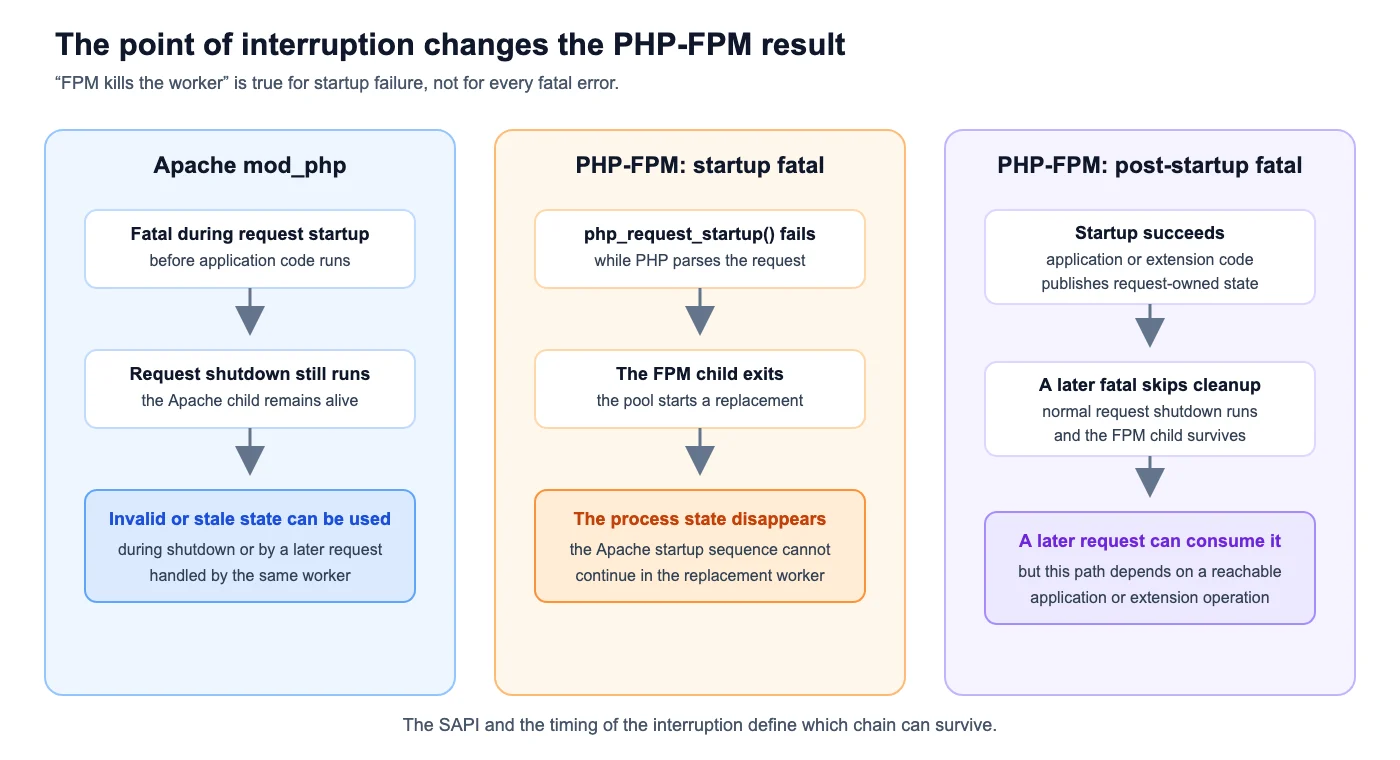
In the tested post-startup path, the FPM child survived a fatal error and processed a later request. This result does not apply to every error after startup. The alternate sequence had four stages:
- Routines such as
session_start(),session_decode()andunserialize()put temporary structures in the request heap. They also store pointers in persistent worker-global state. - A fatal error stopped execution before PHP cleared the worker-level pointer.
- Request shutdown freed the request heap. The child stayed alive, leaving the pointer referring to freed memory.
- A later session upload-progress request reached the same child and used the old decoder pointer before PHP reset it.
This producer ran after request startup. In the Symfony replica, a lab-only entry point called session_start(), decoded a prepared file-backed session and caused a controlled OOM. The FPM child survived and processed the later request.
Step 9: file write, then execution
The lab used nginx, PHP 8.3.21 NTS, Symfony 7.4.19 and file-backed sessions, with display_errors disabled and a fixed FPM pool. The sequence was calibrated with one worker, then four-worker and six-worker pools were used to examine worker affinity.
The FPM sequence did not directly execute a command from memory corruption. It first used the memory problem to write a file, and a separate HTTP request then executed that PHP file:
- Upload-progress requests prepared file-backed session data containing controlled decoder records and the PHP text for the final file.
- The lab-only
/fpm-index.phpentry point calledsession_start(). Session decoding caused an OOM after startup, and decoder state stayed in the surviving child. - Later upload-progress requests reached the same child, reused freed decoder memory and used the old pointer.
- The corruption changed the destination of
ps_files, PHP's file-session writer, from the normal session path to/var/www/html/public/proof/shell.php. - PHP saved the controlled session data, and the redirected writer created
shell.phpon the shared filesystem. - The client sent
GET /proof/shell.php?0=id. nginx sent the request to PHP-FPM, which executed the file and returneduid=33(www-data).
The prepared session contained <?php system($_GET[0]); ?>. The redirected writer saved that text in shell.php. The final request put id in query parameter 0; PHP-FPM executed the file, read the command from $_GET[0] and returned the system() output in the HTTP response.
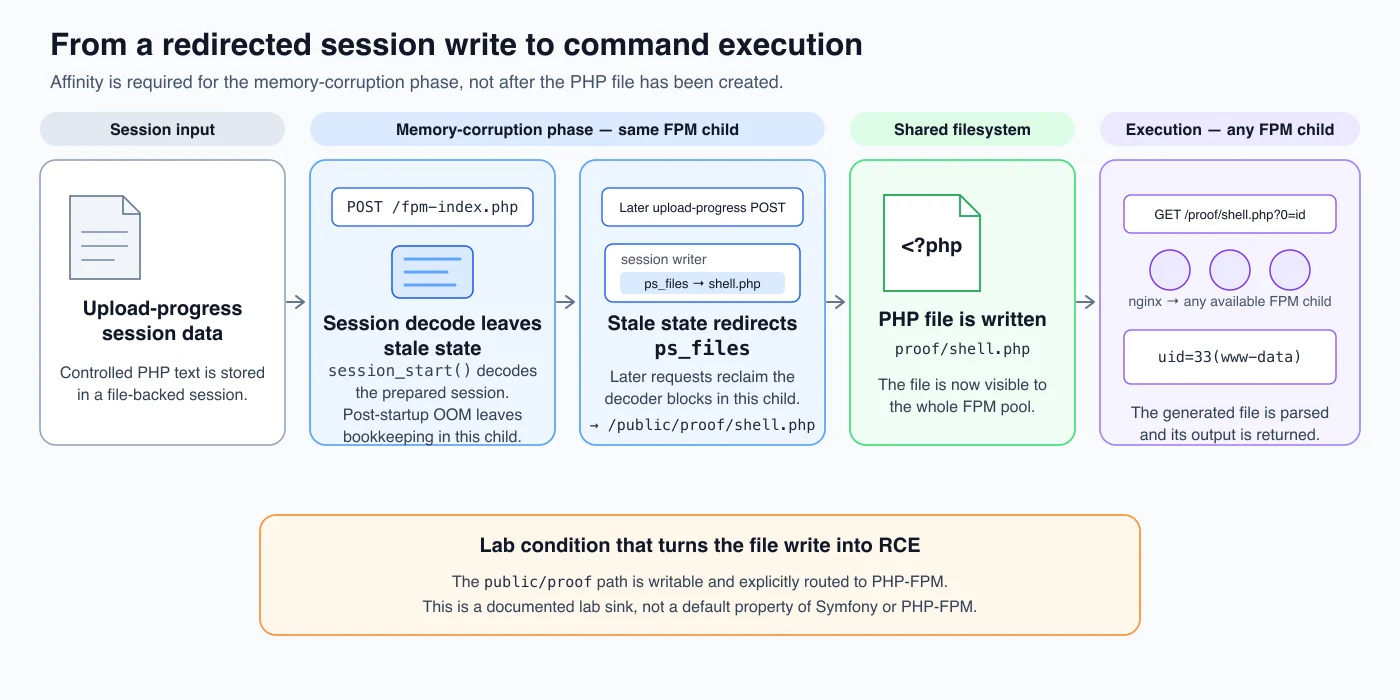
The lab had a writable public/proof directory that nginx served as PHP. This directory was a required test condition: it gave the file write a path to command execution. Symfony and PHP-FPM do not create this condition by default.
Worker affinity applied to the requests that created and used the old decoder pointer. After shell.php existed on shared storage, any FPM child with access to the file could process the final GET.
The lab showed a file-write-to-execution sequence under these conditions. It did not show a general direct command-execution method inside PHP-FPM. Other FPM paths can possibly execute a command without a file; such a path was not tested.
Step 10: multiworker validation
The producer and consumer had to reach the same FPM child. HTTP keep-alive kept the connection between the client and nginx; it did not keep the connection between nginx and one FPM child. In the lab, a dedicated endpoint kept all but one child busy, and the sequence then reached the available child.
| Pool configuration | Observed result |
|---|---|
| Four children | Four children identified and three kept busy. The writer used the lab-only PHP path. A request for the new file returned command output. |
| Six children, first run | Six children identified and five kept busy. A different heap layout stopped the file-write sequence. |
| Six children, new run | Five children kept busy. The file-write-to-execution sequence completed. The new PHP file returned uid=33(www-data). |
These tests show that the sequence can work in a pool when worker affinity is controlled. They do not establish a general remote method or a success rate. Keeping production workers busy can interrupt service.
Step 11: how nginx changes the HTTP response
nginx sits between the client and PHP-FPM. PHP-FPM sends a result to nginx through FastCGI, and nginx makes the HTTP response. A value inside an FPM child does not necessarily reach the client; nginx can reject, change or discard it. Three output methods were tested in the native x86_64 replica:
| Output method | What PHP-FPM produced | Measured client result |
|---|---|---|
| Raw binary bytes in a FastCGI header | FPM placed mapped-memory bytes in a response header. | nginx rejected the invalid upstream header and returned a 502 error. No bytes reached the client. |
| Disclosed memory through a lab-only response-body endpoint | FPM streamed mapped memory in the response body. | HTTP 200 with 1,343,207 client-body bytes. The same FPM child served the next request. |
| Pointer displayed by Symfony WebProfiler | The value reached $_FILES as an integer. |
HTTP 200 with 77,289 bytes. The decimal value 132471168115328 represented 0x787b58eb2280, giving the heap base 0x787b58e00000. |
The WebProfiler method gave the clearest result: nginx received printable text in the response body. It still needed the profiler route, the correct build profile, session upload progress and worker affinity.
An HTTP 413 response gives limited evidence. nginx usually makes this response before PHP receives the body. It shows that nginx rejected that request; it does not show that PHP has a patch, and it does not show how nginx handles other multipart bodies.
Root cause
The mistake is a lifetime and ordering problem in PHP itself, not in the applications. In CVE-2026-109619, a pointer to request-owned data is stored in worker-global state, and an interrupted cleanup leaves it dangling across the request boundary. In CVE-2026-109618, a HashTable bucket is published before its fields are initialised, so a fatal error at the wrong moment leaves shutdown processing an incomplete entry.
Application-level defences do not help, because the vulnerable code runs before the application starts. The WordPress lab showed normal GET requests loading WordPress and accessing its database, while exploit POST requests stopped in PHP's parser before WordPress bootstrapped. The sequence did not require a WordPress upload feature, plugin flaw or theme flaw, and did not depend on a Symfony controller. display_errors=Off hid errors from the response but did not correct the invalid memory state. ASLR changed runtime addresses between runs but did not correct the flaw.
Impact
In the Apache labs, the chain leaked the Zend heap and libphp base addresses and then used build-specific offsets to execute a command over HTTP, returning uid=33(www-data). The WordPress site still processed a normal request with database access after the test, and the Apache error-log hash was unchanged, showing the worker stayed available.
In the PHP-FPM lab, the demonstrated outcome is a file-write-to-execution sequence: a controlled session file is written to a writable directory that nginx serves as PHP, and a later GET executes it. This required a test-only Symfony entry point and a writable directory served as PHP, conditions that Symfony and PHP-FPM do not create by default. The lab did not show a general direct command-execution method inside PHP-FPM.
Reliability is conditional. Multiple workers reduce the chance that request B reaches the worker holding the stale pointer, and some startups fail the disclosure checks entirely. Occupying workers to force affinity can reduce capacity or cause an outage, so the technique is not safe for production use.
An assessment must keep three claims separate:
- A component contains vulnerable code.
- A deployment makes a useful exploitation method available.
- An attacker can reliably execute code through HTTP.
PHP2Shell can reach all three stages. A version scanner usually gives only a version-based indication. A worker crash shows a process failure. Backend evidence must connect that failure to the vulnerable path, and a technical assessment must state which stage the test showed and the conditions of that result.
Fix
Application changes, display_errors=Off and ASLR do not address either flaw.
Variants to test
- Other producers of worker-global state. The report notes that PHP maintains worker-level state for errors, exceptions, objects and extensions. Try interrupting cleanup through a parse failure, an uncaught error, a failed
requireor an execution timeout rather than an OOM, and look for a later request on the same worker that reads or frees the stale pointer. - Other SAPIs and error paths. The FPM startup-error path killed the child, but a fatal error after startup left it alive. Test other post-startup fatal paths in FPM and other SAPIs to see which ones keep the child in the pool with stale state.
- Other output channels through nginx. The report tested a FastCGI header (rejected with 502), a lab-only response-body endpoint, and Symfony WebProfiler.
- Other builds. The PHP 8.4.26 offsets did not work on PHP 8.3.21 without changes to symbol offsets, allocator geometry, state placement and heap-reuse behaviour.
Hunting notes
This class of bug hides below the application, in request startup and shutdown, so the signals are in the stack rather than in the routes. The report's own observations point to what to look for: multipart parsing that happens before the front controller, session upload progress enabled, a memory_limit that a crafted multipart body can reach, and a SAPI whose worker survives a fatal error. Worker count matters, because affinity between the producing and consuming request is a precondition.
On the output side, the report shows that the transport can swallow the result: nginx rejected a FastCGI header carrying mapped-memory bytes with a 502, while a response-body channel returned the bytes. A 413 from nginx is not evidence of a patch, since nginx usually produces it before PHP sees the body.
For impact, the report is explicit that a crash is not proof. The evidence that carried the result was the command output in the HTTP response, an unchanged container identity, an unchanged Apache error-log hash, and a check that disclosed addresses matched the expected profile boundaries before any execution attempt. In the FPM case, the impact rested on a writable directory served as PHP and a lab-only entry point, and the report states those conditions plainly rather than presenting the result as a general remote method.
What happened, in plain words
The researcher wanted to answer two questions. First: can a pair of bugs in PHP, the software that runs most of the world's websites, be turned into a real attack that runs commands on a web server over the internet? Second: does one working attack keep working when the server runs a slightly different version of PHP, or does it have to be rebuilt for each version?
The two bugs are related but different. This article is about the first of them, CVE-2026-109619, and about whether it can lead to command execution over HTTP in a complete web stack. The second bug, CVE-2026-109618, is mentioned only to keep the two apart, because they are related but different.
To test this, the researcher built three small practice environments, called labs, each mimicking a real website setup. One ran WordPress on Apache. One ran Symfony on Apache. One ran Symfony behind nginx with PHP-FPM. In the Apache labs, the attack returned the output of a command run on the server, though some startups failed the disclosure checks. In the nginx and PHP-FPM lab, the attack needed a different route: it wrote a file to disk first, and a later request ran that file.
The important lesson is that the applications (WordPress, Symfony) were not the problem. The problem was in PHP itself, and in how the surrounding server software handles PHP's memory. A working proof of concept is not automatically portable to every production build, as Cobalt's PHP2Shell technical brief puts it.
The two bugs, explained from zero
Before the details, a few ideas that come up constantly.
PHP is a programming language used to build websites. When you load a page, the web server hands the request to PHP, PHP runs the site's code, and the result goes back to your browser as a web page.
Memory is the working space a program uses while it runs. PHP borrows memory for each request, uses it, and gives it back when the request ends. A pointer is a small note that says "the data you want is at this spot in memory". If the data is moved or freed but the note is not updated, the note points at nothing useful. That is called a dangling pointer, and it is the heart of CVE-2026-109619.
A worker is one running copy of PHP that handles requests one after another. A server usually has several workers so it can handle several visitors at once. Each worker has its own memory. If a worker stays alive between requests, anything it remembers from the previous request can leak into the next one.
A request is one thing your browser asks the server to do: load a page, submit a form, fetch an image. The attack here uses two requests, called request A and request B, aimed at the same worker.
A cookie is a small piece of text a website asks your browser to store and send back on every later request, so the site can remember who you are. A session is the server-side memory that goes with that cookie. Session upload progress is a PHP feature that lets a website show a progress bar while a file uploads; it stores information about the upload in the session.
multipart/form-data is the format a browser uses to send a form that includes files. It splits the body into parts, each with its own headers and content.
Out-of-memory (OOM) means a program asked for more memory than it is allowed to use, so it stops. memory_limit is the setting that says how much memory PHP may use per request. post_max_size is the setting that says how large a submitted form body may be.
ASLR (Address Space Layout Randomisation) is an operating-system feature that shuffles where things sit in memory each time a program starts, so an attacker cannot guess addresses. An offset is the fixed distance between two things inside a program file, which stays the same even when ASLR moves the whole program around.
Apache and nginx are web servers: the programs that receive your browser's requests. mod_php means PHP runs inside the Apache process itself. PHP-FPM means PHP runs in a separate pool of worker processes, and nginx talks to that pool using a protocol called FastCGI.
A CVE is a public catalogue number for a known security flaw, so people can talk about the same bug unambiguously.
The two flaws
CVE-2026-109619 is a memory-lifetime issue. During request A, PHP stores temporary data in the request heap (the memory set aside for that one request) and keeps a pointer to it in a worker-owned variable (memory that survives between requests). When the request ends, PHP frees the request heap, but the worker remains alive. If the pointer is not cleared, it continues to reference invalid memory: a dangling pointer.
The producer stores the pointer during request A. If cleanup is interrupted, the pointer remains in worker-global state. The consumer runs during request B on the same worker and reads, frees, or otherwise uses the stale pointer before PHP resets it. In the multipart sequence, session upload progress can act as both producer and consumer. The CVE is not limited to this feature: PHP also maintains worker-level state for errors, exceptions, objects and extensions, which may retain stale pointers if cleanup is interrupted.
An OOM can trigger the interruption, but so can a parse failure, an uncaught error, a failed require, or an execution timeout.
CVE-2026-109618 is an initialization-order flaw in Zend HashTable, the internal structure PHP uses for arrays such as $_POST and $_FILES. Each entry is stored in a bucket containing a key and a value. In the affected sequence, PHP exposes a new bucket before fully initializing its fields. If a fatal error occurs at that point, request shutdown may process the incomplete bucket as a valid entry. The simplified code below shows the critical order:
index = table->used++;

table->elements++;

bucket = table->data + index;

bucket->key = allocate_key(); /* may trigger a fatal error */

bucket->hash = hash;

bucket->value = value;
Line by line:
index = table->used++;picks the next free slot in the table and marks it as used straight away. The counter goes up before anything is actually stored.table->elements++;updates a second counter that tracks how many entries the table holds.bucket = table->data + index;works out where in memory that slot lives.bucket->key = allocate_key();tries to create the key (the name of the array entry). The comment notes this step may fail with a fatal error, for example if memory runs out.bucket->hash = hash;andbucket->value = value;would fill in the rest of the entry, but only if the previous line succeeded.
If allocate_key() triggers a fatal error, PHP never executes the remaining assignments. Because the used count has already been incremented, request shutdown processes the incomplete bucket as a live entry. The flaw is caused by the ordering between initialization and teardown. The relevant code is in PHP's zend_hash.c.
A useful comparison: imagine a hotel clerk who marks a room as occupied in the booking system before checking whether the guest actually has a key. If the key machine jams, the room is marked occupied but nobody is in it, and the cleaning staff later walk into a room that is half-prepared.
The setup: three labs
Three lab deployments were tested:
- WordPress with Apache mod_php;
- Symfony with Apache mod_php;
- Symfony with nginx and PHP-FPM.
WordPress and Symfony are two popular frameworks for building websites. The point of testing both was to show that the bug is not tied to one application.
| Lab | Stack | Result | Main lesson |
|---|---|---|---|
| WordPress | WordPress 7.1.3, PHP 8.4.26, Apache mod_php, one and four workers | Command execution through HTTP | The sequence did not need an upload form or a plugin vulnerability. |
| Symfony | Symfony 7.4.21, PHP 8.4.26, Apache mod_php | Command execution through HTTP | The framework change did not change the PHP memory problem. |
| Symfony build profile | Symfony 7.4.19, PHP 8.3.21, Apache mod_php, one and four workers | Command execution through HTTP after build-specific calibration | The PHP 8.4.26 offsets did not work without changes on PHP 8.3.21. |
| nginx and PHP-FPM | Symfony 7.4.19, PHP 8.3.21, nginx and PHP-FPM, one, four, and six workers | Build-specific disclosure and command execution under lab conditions | FPM needed different calibration, an output path, and a worker strategy. |
The labs ran in Docker containers on a Linux x86_64 host, with ASLR enabled on the host. Docker is a tool that packages a program and its settings into a self-contained box, so the test can be repeated exactly. x86_64 is the common processor type in laptops and servers.
Configuration differed per SAPI. SAPI means Server API: the way PHP is plugged into a web server.
- The Apache labs used
memory_limit=8Mandpost_max_size=32M. - The PHP-FPM lab used file-backed sessions,
memory_limit=128Mandpost_max_size=8M. The FPM execution path also required a test-only Symfony entry point and a writable directory that nginx served as PHP.
File-backed sessions mean the session data is stored in files on disk rather than in memory. A test-only entry point is a small extra script added just for the lab, not something a real site would have.
The production-style profiles used display_errors=Off. That hid errors from the HTTP response but did not correct the invalid memory state. In other words, turning off error messages makes the site look calm; it does not fix the underlying problem.
Finding it
The starting observation is about ordering. PHP parses multipart bodies during request startup, before the application's front controller runs. The front controller is the first script of a website, the one that decides what to do with the request. Session upload progress can create session state at this stage. PHP frees the request heap at the end of the request, but the worker may remain alive and process subsequent requests.
Figure 1 shows this ordering: multipart and session processing happens before the application runs. That is why no upload form, no call to move_uploaded_file() and no vulnerable controller is required. The dangerous state can exist before /index.php, WordPress or Symfony has executed a single line.
In the Apache startup chain, request A published session state before hitting a fatal interruption. Cleanup did not clear the worker's pointer to that state. Request B then had to reach the same worker and consume the stale pointer after request A's heap had been freed. The FPM chain used a different post-startup producer, described below.
Figure 2 shows the common setup happening before the application, then the two vulnerabilities following different lifecycles.
Exploitation, step by step
Step 1: cause a controlled out-of-memory
post_max_size limits the POST body accepted by PHP, while memory_limit caps the memory available to process it. An accepted multipart body can expand into much larger in-memory structures. A request without a usable declared length may pass the initial size check, while multipart parts containing many headers can further increase PHP's memory usage.
Empty file fields do not count toward max_file_uploads, but PHP still creates the corresponding $_FILES metadata. Nested field names multiply this work across six parallel metadata structures.
Figure 3 shows how several small-looking multipart structures can create disproportionate memory pressure inside PHP. The comparison is a suitcase: a few flat items fit easily, but if each item is itself a box of boxes, the same suitcase fills up far faster than you expect.
By arranging the multipart fields, a later allocation can be made to hit memory_limit after the vulnerable state has been created. The failing allocation does not need to be the one that created that state.
Step 2: request A leaves a stale pointer
Request A publishes session state and then hits the fatal interruption. Cleanup does not clear the worker's pointer to that state. The worker survives. Think of a note left on a desk saying "the file is in cabinet 3", while the file has already been shredded: the note is still there, but it points at nothing.
Step 3: request B consumes the pointer
Request B must reach the same worker and consume the stale pointer after request A's heap has been freed. With one Apache worker, requests A and B are guaranteed to reach the same process. With four workers, request B may reach another child that does not contain the stale pointer.
Figure 4 shows that both requests must reach the worker that holds the relevant state.
In the lab, three verified keep-alive connections were kept busy and the sequence was run through the remaining Apache child. Keep-alive means the browser keeps one connection open and reuses it, but that does not guarantee the same worker handles every request. By occupying three of four workers, the sequence was run through the remaining Apache child. This produced repeatable results, and all four workers were restored after the test. The test confirms that the condition can persist in a worker pool. It is not safe for production use because occupying workers can reduce capacity or cause an outage.
Step 4: turn the stale pointer into address disclosures
ASLR was enabled in every reference test. It changed runtime addresses between runs but did not correct the underlying PHP memory flaw.
At this stage there was an old pointer but no ASLR bypass. Most incorrect heap layouts crashed the worker, so request B had to reuse memory that request A released. Request A left session state with a pointer to freed request memory. Request B used normal multipart allocations to reuse the same memory blocks, with controlled string metadata placed in the reused area. PHP followed the old pointer and read the new contents as a longer string.
PHP put this incorrect string in the session cookie. The Set-Cookie header then contained an out-of-bounds read, and the response contained real process pointers and controlled bytes. An out-of-bounds read means PHP read past the end of the intended data, picking up whatever happened to be next to it in memory.
The first useful disclosure gave a pointer into the Zend Memory Manager (Zend MM), PHP's internal allocator. Aligning the pointer to the expected heap boundary gave the heap base and the location of the request data.
A second disclosure gave the address of zval_ptr_dtor, the function PHP uses to destroy a zval value. A zval is PHP's internal container for a single value, such as a number or a string. The function is in the loaded libphp module, so its address gave the runtime location of that module. libphp is the file that contains PHP's code when it is loaded into Apache.
Figure 5 shows that in the CVE-2026-109619 path, controlled heap reuse turns the stale session pointer into two disclosures: the Zend heap base, then the loaded libphp base.
Step 5: calibrate offsets for the tested build
The exact libphp binary in each lab was known. The relative offset of zval_ptr_dtor was found in that binary and subtracted from the HTTP disclosure. The result was a candidate libphp base, checked for alignment and user-space range:
candidate_base = leaked_zval_ptr_dtor - profile.zval_ptr_dtor_offset

candidate_is_plausible = (

candidate_base % profile.expected_alignment == 0

and profile.user_address_min <= candidate_base < profile.user_address_max

)
Line by line:
candidate_base = leaked_zval_ptr_dtor - profile.zval_ptr_dtor_offsettakes the address leaked over HTTP and subtracts the known distance of the function from the start of the module. The result should be where the module starts in memory.candidate_is_plausible = (opens a check that the answer makes sense.candidate_base % profile.expected_alignment == 0checks that the address is a multiple of the expected alignment. Memory is laid out in regular blocks, so a real base address should divide evenly.and profile.user_address_min <= candidate_base < profile.user_address_maxchecks that the address falls in the range where ordinary programs are allowed to live, not in a reserved area.)closes the check.
This native x86_64 result shows the calculation:
leaked_zval_ptr_dtor = 0x71d9bb411b60

zval_ptr_dtor_offset = 0x64eb60

libphp_base = leaked_zval_ptr_dtor - zval_ptr_dtor_offset

assert libphp_base == 0x71d9badc3000
Line by line:
leaked_zval_ptr_dtor = 0x71d9bb411b60is the address of the function, as leaked over HTTP. The0xprefix means the number is written in hexadecimal, a base-16 notation programmers use for memory addresses.zval_ptr_dtor_offset = 0x64eb60is the fixed distance of that function from the start of the module, read from the known binary.libphp_base = leaked_zval_ptr_dtor - zval_ptr_dtor_offsetsubtracts one from the other to get the module's start address.assert libphp_base == 0x71d9badc3000checks the answer equals the expected value. If it did not, the program would stop.
The calculated base matched the worker mapping. The mapping was checked after the HTTP calculation; the exploit client did not use the mapping as an input. The libphp build ID and SHA-256 were recorded for each exploit profile, because offsets can change between builds with the same PHP version. A build ID and a SHA-256 are fingerprints of a specific file, so the researcher could be sure which binary was being tested.
Step 6: execute a command over HTTP
The final Apache test used display_errors=Off. The two HTTP disclosures gave both runtime bases, and the HTTP response contained the command output:
HTTP/1.1 200 OK

Content-Length: 54

uid=33(www-data) gid=33(www-data) groups=33(www-data)
Line by line:
HTTP/1.1 200 OKis the status line. 200 means the request succeeded.Content-Length: 54says the body is 54 bytes long.uid=33(www-data) gid=33(www-data) groups=33(www-data)is the output of theidcommand, showing the user the web server runs as.www-datais the standard low-privilege user for web servers on Linux.
The container identity did not change. The Apache error-log hash was the same before and after the command response, which showed that the expected worker returned the response and stayed available. A hash is a short fingerprint of a file's contents; if the log had changed, the hash would have changed too.
The first command-execution prototype did not meet this condition. It executed the command, then PHP tried to destroy the forged structure and crashed the worker. The final version used two callbacks: the first called zif_passthru() to execute the command and return its output, the second called _zend_bailout() before PHP freed the forged structure. A callback is a function that another part of the program calls at a chosen moment. _zend_bailout() is PHP's way of jumping out of the current execution before cleanup runs, which avoided the crash.
Step 7: deal with startup reliability
A successful result does not mean that each new process has a usable heap layout. Four separate Apache startups failed the first disclosure checks; the fifth startup completed the sequence. In another test, the first process failed and the next process succeeded. The test program stopped when disclosed addresses did not match the expected profile boundaries, which prevented execution attempts with unverified pointers. This is a safety measure: if the leaked address does not look right, do not try to use it.
Step 8: the PHP-FPM sequence
In the PHP 8.3.21 and Symfony 7.4.19 replica, the Apache startup sequence did not work. PHP-FPM terminated the affected child. A separate decoder sequence ran after startup, kept the child alive, and enabled a file write and command execution under the conditions below. These results apply to the local replica; no intrusive requests were sent to the observed system.
A normal request passes through these steps:
- nginx receives the HTTP request and applies checks such as
client_max_body_size. - nginx converts the request into FastCGI records and sends them to an available PHP-FPM child.
- The child starts the PHP request, parses the multipart body, and initializes extensions. Then it runs the Symfony front controller.
- During request shutdown, PHP frees request memory. A healthy child returns to the pool and can process another request.
The vulnerability crosses steps 3 and 4. The vulnerable code is one condition; the same child must also survive until a later request uses the invalid state.
With Apache mod_php, PHP runs inside each Apache worker. After a request startup error, Apache runs the normal request-shutdown path and can reuse the worker, so an old pointer can still exist when request B reaches that worker. With PHP-FPM, PHP runs in a separate worker pool and nginx sends requests to the pool through FastCGI. In the tested startup-error path, the affected FPM child exited and did not return to the pool; the FPM master started a clean child with new process state. The old pointer from request A disappeared with the terminated child, and request B could not use that child's heap or global state. The Apache cross-request sequence stopped.
This result does not cover all PHP-FPM error paths. A fatal error after request startup can leave the child alive, and another cross-request sequence can then occur.
Figure 6 shows PHP-FPM discarding state after a startup failure, but a fatal error after successful startup following a different lifecycle.
In the tested post-startup path, the FPM child survived a fatal error and processed a later request. This result does not apply to every error after startup. The alternate sequence had four stages:
- Routines such as
session_start(),session_decode()andunserialize()put temporary structures in the request heap. They also store pointers in persistent worker-global state. - A fatal error stopped execution before PHP cleared the worker-level pointer.
- Request shutdown freed the request heap. The child stayed alive, leaving the pointer referring to freed memory.
- A later session upload-progress request reached the same child and used the old decoder pointer before PHP reset it.
session_start() begins a session. session_decode() turns a stored session string back into variables. unserialize() turns a stored string back into a PHP data structure. All three are ordinary PHP functions that a website might call.
This producer ran after request startup. In the Symfony replica, a lab-only entry point called session_start(), decoded a prepared file-backed session and caused a controlled OOM. The FPM child survived and processed the later request.
Step 9: file write, then execution
The lab used nginx, PHP 8.3.21 NTS, Symfony 7.4.19 and file-backed sessions, with display_errors disabled and a fixed FPM pool. NTS means Non-Thread-Safe, a PHP build variant. The sequence was calibrated with one worker, then four-worker and six-worker pools were used to examine worker affinity. Affinity means which worker handles which request.
The FPM sequence did not directly execute a command from memory corruption. It first used the memory problem to write a file, and a separate HTTP request then executed that PHP file:
- Upload-progress requests prepared file-backed session data containing controlled decoder records and the PHP text for the final file.
- The lab-only
/fpm-index.phpentry point calledsession_start(). Session decoding caused an OOM after startup, and decoder state stayed in the surviving child. - Later upload-progress requests reached the same child, reused freed decoder memory and used the old pointer.
- The corruption changed the destination of
ps_files, PHP's file-session writer, from the normal session path to/var/www/html/public/proof/shell.php. - PHP saved the controlled session data, and the redirected writer created
shell.phpon the shared filesystem. - The client sent
GET /proof/shell.php?0=id. nginx sent the request to PHP-FPM, which executed the file and returneduid=33(www-data).
The prepared session contained <?php system($_GET[0]); ?>. The redirected writer saved that text in shell.php. The final request put id in query parameter 0; PHP-FPM executed the file, read the command from $_GET[0] and returned the system() output in the HTTP response.
A short explanation of that payload: <?php ... ?> marks the start and end of PHP code inside a file. system() runs a shell command and prints its output. $_GET[0] reads the value of the query parameter named 0 from the URL. So ?0=id makes the file run the id command.
Figure 7 shows that worker affinity is required while corrupting the session-writer state. Once the PHP file exists on shared storage, the final GET can be handled by any available FPM child.
The lab had a writable public/proof directory that nginx served as PHP. This directory was a required test condition: it gave the file write a path to command execution. Symfony and PHP-FPM do not create this condition by default. In everyday terms, the attacker could write a note into a drawer, but the drawer also had to be one the server would open and read aloud.
Worker affinity applied to the requests that created and used the old decoder pointer. After shell.php existed on shared storage, any FPM child with access to the file could process the final GET.
The lab showed a file-write-to-execution sequence under these conditions. It did not show a general direct command-execution method inside PHP-FPM. Other FPM paths can possibly execute a command without a file; such a path was not tested.
Step 10: multiworker validation
The producer and consumer had to reach the same FPM child. HTTP keep-alive kept the connection between the client and nginx; it did not keep the connection between nginx and one FPM child. In the lab, a dedicated endpoint kept all but one child busy, and the sequence then reached the available child.
| Pool configuration | Observed result |
|---|---|
| Four children | Four children identified and three kept busy. The writer used the lab-only PHP path. A request for the new file returned command output. |
| Six children, first run | Six children identified and five kept busy. A different heap layout stopped the file-write sequence. |
| Six children, new run | Five children kept busy. The file-write-to-execution sequence completed. The new PHP file returned uid=33(www-data). |
These tests show that the sequence can work in a pool when worker affinity is controlled. They do not establish a general remote method or a success rate. Keeping production workers busy can interrupt service.
Step 11: how nginx changes the HTTP response
nginx sits between the client and PHP-FPM. PHP-FPM sends a result to nginx through FastCGI, and nginx makes the HTTP response. A value inside an FPM child does not necessarily reach the client; nginx can reject, change or discard it. Three output methods were tested in the native x86_64 replica:
| Output method | What PHP-FPM produced | Measured client result |
|---|---|---|
| Raw binary bytes in a FastCGI header | FPM placed mapped-memory bytes in a response header. | nginx rejected the invalid upstream header and returned a 502 error. No bytes reached the client. |
| Disclosed memory through a lab-only response-body endpoint | FPM streamed mapped memory in the response body. | HTTP 200 with 1,343,207 client-body bytes. The same FPM child served the next request. |
| Pointer displayed by Symfony WebProfiler | The value reached $_FILES as an integer. |
HTTP 200 with 77,289 bytes. The decimal value 132471168115328 represented 0x787b58eb2280, giving the heap base 0x787b58e00000. |
A 502 error means nginx could not get a valid answer from the program behind it. Symfony WebProfiler is a debugging tool that shows internal values on a web page.
The WebProfiler method gave the clearest result: nginx received printable text in the response body. It still needed the profiler route, the correct build profile, session upload progress and worker affinity.
An HTTP 413 response gives limited evidence. 413 means "payload too large". nginx usually makes this response before PHP receives the body. It shows that nginx rejected that request; it does not show that PHP has a patch, and it does not show how nginx handles other multipart bodies.
Root cause
The mistake is a lifetime and ordering problem in PHP itself, not in the applications. In CVE-2026-109619, a pointer to request-owned data is stored in worker-global state, and an interrupted cleanup leaves it dangling across the request boundary. In CVE-2026-109618, a HashTable bucket is published before its fields are initialised, so a fatal error at the wrong moment leaves shutdown processing an incomplete entry.
Application-level defences do not help, because the vulnerable code runs before the application starts. The WordPress and Symfony labs confirmed this: normal GET requests booted the application and accessed the database, while exploit POST requests stopped in PHP's parser before the framework bootstrapped. The sequence did not require a WordPress upload feature, plugin flaw or theme flaw, and did not depend on a Symfony controller. display_errors=Off hid errors from the response but did not correct the invalid memory state. ASLR changed runtime addresses between runs but did not correct the flaw.
Impact
In the Apache labs, the chain leaked the Zend heap and libphp base addresses and then used build-specific offsets to execute a command over HTTP, returning uid=33(www-data). The WordPress site still processed a normal request with database access after the test, and the Apache error-log hash was unchanged, showing the worker stayed available.
In the PHP-FPM lab, the demonstrated outcome is a file-write-to-execution sequence: a controlled session file is written to a writable directory that nginx serves as PHP, and a later GET executes it. This required a test-only Symfony entry point and a writable directory served as PHP, conditions that Symfony and PHP-FPM do not create by default. The lab did not show a general direct command-execution method inside PHP-FPM.
Reliability is conditional. Multiple workers reduce the chance that request B reaches the worker holding the stale pointer, and some startups fail the disclosure checks entirely. Occupying workers to force affinity can reduce capacity or cause an outage, so the technique is not safe for production use.
An assessment must keep three claims separate:
- A component contains vulnerable code.
- A deployment makes a useful exploitation method available.
- An attacker can reliably execute code through HTTP.
PHP2Shell can reach all three stages. A version scanner usually gives only a version-based indication. A worker crash shows a process failure. Backend evidence must connect that failure to the vulnerable path, and a technical assessment must state which stage the test showed and the conditions of that result.
Fix
Application changes, display_errors=Off and ASLR do not address either flaw.
Variants to test
- Other producers of worker-global state. The report notes that PHP maintains worker-level state for errors, exceptions, objects and extensions. Try interrupting cleanup through a parse failure, an uncaught error, a failed
requireor an execution timeout rather than an OOM, and look for a later request on the same worker that reads or frees the stale pointer. - Other SAPIs and error paths. The FPM startup-error path killed the child, but a fatal error after startup left it alive. Test other post-startup fatal paths in FPM and other SAPIs to see which ones keep the child in the pool with stale state.
- Other output channels through nginx. The report tested a FastCGI header (rejected with 502), a lab-only response-body endpoint, and Symfony WebProfiler.
- Other builds. The PHP 8.4.26 offsets did not work on PHP 8.3.21 without changes to symbol offsets, allocator geometry, state placement and heap-reuse behaviour.
Hunting notes
This class of bug hides below the application, in request startup and shutdown, so the signals are in the stack rather than in the routes. The report's own observations point to what to look for: multipart parsing that happens before the front controller, session upload progress enabled, a memory_limit that a crafted multipart body can reach, and a SAPI whose worker survives a fatal error. Worker count matters, because affinity between the producing and consuming request is a precondition.
On the output side, the report shows that the transport can swallow the result: nginx rejected a FastCGI header carrying mapped-memory bytes with a 502, while a response-body channel returned the bytes. A 413 from nginx is not evidence of a patch, since nginx usually produces it before PHP sees the body.
For impact, the report is explicit that a crash is not proof. The evidence that carried the result was the command output in the HTTP response, an unchanged container identity, an unchanged Apache error-log hash, and a check that disclosed addresses matched the expected profile boundaries before any execution attempt. In the FPM case, the impact rested on a writable directory served as PHP and a lab-only entry point, and the report states those conditions plainly rather than presenting the result as a general remote method.
Glossary
- ASLR (Address Space Layout Randomisation): an operating-system feature that shuffles where programs sit in memory each time they start, so addresses cannot be guessed.
- Apache: a popular web server program that receives browser requests.
- mod_php: a way of running PHP inside the Apache process itself.
- nginx: a popular web server program, often used in front of PHP-FPM.
- PHP-FPM: a way of running PHP in a separate pool of worker processes, which nginx talks to.
- FastCGI: the protocol nginx uses to pass requests to PHP-FPM and get results back.
- SAPI (Server API): the way PHP is plugged into a web server.
- Worker: one running copy of PHP that handles requests one after another.
- Worker pool: a group of workers that share incoming requests.
- Worker affinity: which worker handles which request; the attack needs the same worker for both requests.
- Request: one thing a browser asks a server to do.
- Request heap: the memory PHP sets aside for one request and frees when it ends.
- Worker-global state: memory that survives between requests inside one worker.
- Pointer: a note saying where data lives in memory.
- Dangling pointer: a pointer that still refers to memory that has been freed.
- Stale pointer: another name for a dangling pointer, or one left over from an earlier request.
- Producer: the step that stores the pointer in worker-global state.
- Consumer: the later step that reads or uses the stale pointer.
- CVE: a public catalogue number for a known security flaw.
- CVE-2026-109619: the cross-request memory-lifetime flaw this article focuses on.
- CVE-2026-109618: the same-request HashTable initialisation flaw, mentioned to keep it separate.
- PHP2Shell: the nickname for the pair of PHP bugs disclosed together.
- multipart/form-data: the format browsers use to send forms that include files.
- Session: server-side memory tied to a visitor, usually identified by a cookie.
- Cookie: a small piece of text a site asks the browser to store and send back.
- Session upload progress: a PHP feature that stores upload information in the session so a site can show a progress bar.
- Out-of-memory (OOM): a program asking for more memory than it is allowed to use, so it stops.
- memory_limit: the PHP setting for how much memory one request may use.
- post_max_size: the PHP setting for how large a submitted form body may be.
- max_file_uploads: the PHP setting for how many files a form may upload.
- $_FILES: PHP's array holding information about uploaded files.
- $_POST: PHP's array holding submitted form values.
- $_GET: PHP's array holding values from the URL query string.
- Zend HashTable: PHP's internal structure for arrays.
- Bucket: one slot in a HashTable, holding a key and a value.
- Zend Memory Manager (Zend MM): PHP's internal allocator, which hands out and reclaims memory.
- Heap base: the starting address of a block of memory.
- zval: PHP's internal container for a single value.
- zval_ptr_dtor: the PHP function that destroys a zval.
- libphp: the file containing PHP's code when loaded into Apache.
- Offset: the fixed distance between two things inside a program file.
- Build ID / SHA-256: fingerprints that identify a specific binary file.
- Hexadecimal: base-16 number notation, written with a
0xprefix, used for memory addresses. - Out-of-bounds read: reading past the end of the intended data, picking up whatever is next in memory.
- Set-Cookie: the HTTP response header that tells the browser to store a cookie.
- Callback: a function that another part of the program calls at a chosen moment.
- zif_passthru(): the internal function behind PHP's
passthru(), which runs a command and returns its output. - _zend_bailout(): PHP's way of jumping out of the current execution before cleanup runs.
- session_start(): the PHP function that begins a session.
- session_decode(): the PHP function that turns a stored session string back into variables.
- unserialize(): the PHP function that turns a stored string back into a PHP data structure.
- ps_files: PHP's file-session writer, which saves session data to disk.
- File-backed session: a session stored in a file on disk rather than in memory.
- display_errors: the PHP setting that controls whether errors are shown in the response.
- client_max_body_size: the nginx setting that limits how large a request body may be.
- HTTP 200: the status code meaning the request succeeded.
- HTTP 413: the status code meaning the request body was too large.
- HTTP 502: the status code meaning nginx could not get a valid answer from the program behind it.
- Keep-alive: keeping one connection open and reusing it for several requests.
- Docker: a tool that packages a program and its settings into a self-contained box.
- x86_64: the common processor type in laptops and servers.
- NTS (Non-Thread-Safe): a PHP build variant.
- Symfony WebProfiler: a debugging tool that shows internal values on a web page.
- Front controller: the first script of a website, which decides what to do with a request.
- WordPress: a popular website platform.
- Symfony: a popular PHP framework for building websites.
- Proof of concept (PoC): a working demonstration that a flaw can be exploited.
- File-write-to-execution: an attack that first writes a file to disk, then gets the server to run it.

